

A Short History of Nearly Everything
Bill Bryson
 English
Shows how parasites and microbes steer animals and people, from rats drawn toward cats to gut bacteria that lift mood, and how fear of infection has shaped disgust, moral judgment and culture.
58 sec
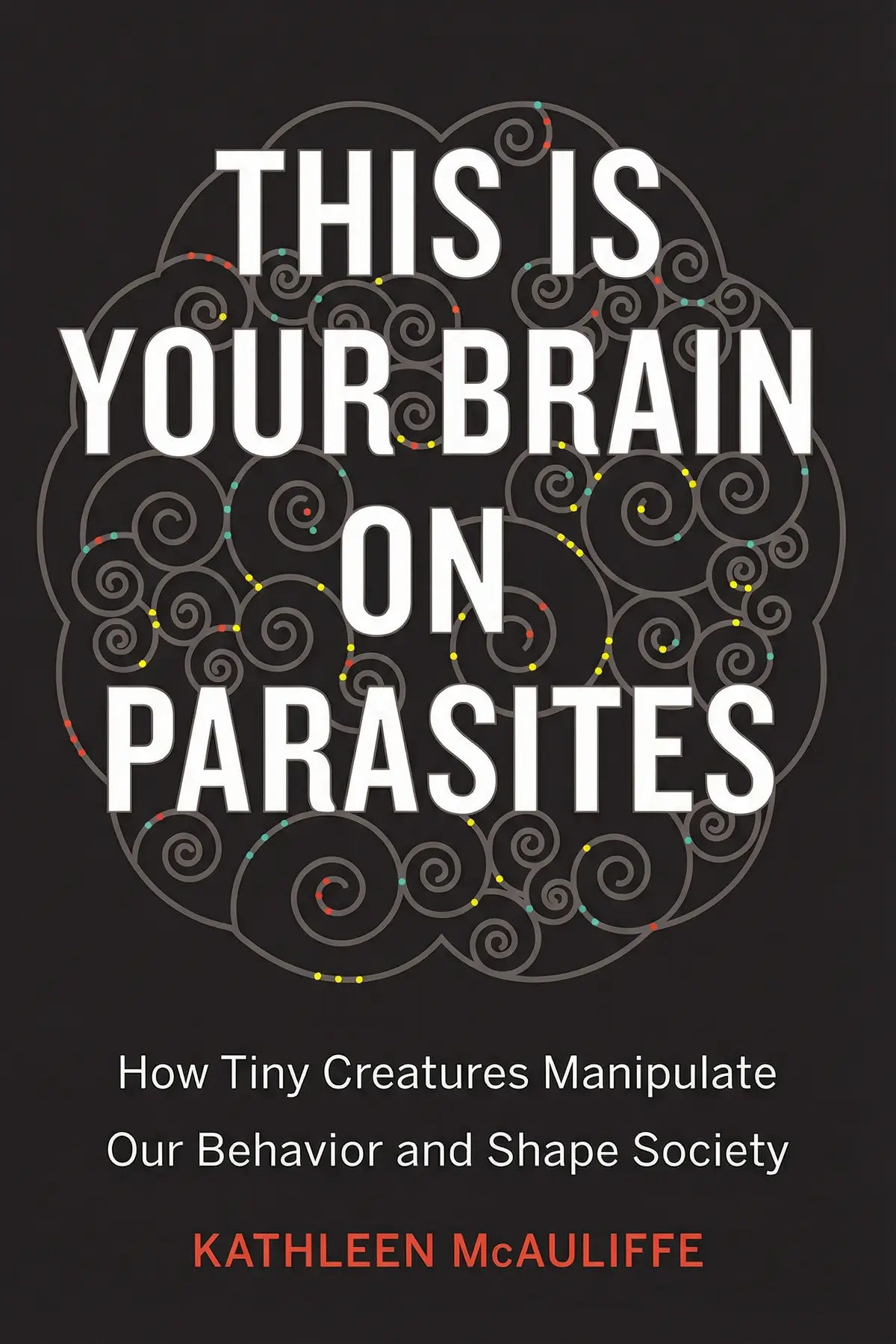
Most of us assume our moods, fears and moral reactions belong to us. In This Is Your Brain on Parasites, science journalist Kathleen McAuliffe shows how shaky that assumption is: a single-celled parasite can make a rat walk toward a cat, and the same organism lives in the brains of millions of people.
Worms, viruses, bacteria and other microbes have fought humans for as long as there have been humans, and many have learned to bend their hosts’ behavior to complete their own life cycles. McAuliffe’s case is that these tiny organisms steer behavior, ours included, and that the long fight against them has shaped human bodies, minds and cultures. Follow it and a predator’s hunt, a low mood or a political scare about disease all look different. You also pick up a few simple kitchen and garden habits that keep the most common brain parasite away.
1 min 54 sec
Humans have built walls of skin, slime and acid against invaders too small to see, yet those invaders keep winning battles. Their record across the centuries is bloodier than any army’s, and it is not finished.
1 min 55 sec
An ant climbs a blade of grass every night and walks home every morning, as if following orders. In a sense it is, and the same strange logic runs through much of what looks like hunting.
2 min 07 sec
A microbe that makes rats lose their fear of cats also lives in a large share of human brains. Researchers disagree on how much it changes us, but the precautions cost almost nothing.
1 min 58 sec
A burning blister, a worm in a child’s brain and a burst of party-going after a flu shot all point the same way. Human behavior may be easier for a parasite to push than we like to think.
2 min 03 sec
A daily cup of yogurt changed how women’s brains reacted to frightened and angry faces. The reason lies in a crowded inner world that starts forming before birth and talks to the brain all day.
1 min 50 sec
A sign about hand wipes made people judge strangers’ private lives more harshly. Disgust feels like a matter of taste, but McAuliffe traces it to an older and far more practical job.
2 min 16 sec
Calling outsiders vermin or disease carriers is an old political move, and it keeps working. McAuliffe connects it to climate, spicy food and the reach of germs, and points to an unexpected remedy.
1 min 14 sec
Through McAuliffe’s eyes, the border between you and the life inside and around you grows faint. The same contest that sends an ant up a blade of grass every night has given us fierce stomach acid and watering eyes, a gut that helps write our moods, and a reflex of disgust that protects us yet can harden into contempt for strangers. Edward O. Wilson praised the book for showing what natural selection can achieve with enough time and enough species, which is nearly anything. And most of this hidden kingdom is not out to kill us; much of it keeps us working.
The book supports a few concrete habits. Keep sandboxes covered so cats cannot use them, and put rare meat in the freezer before you cook it. Treat a troubled gut and a troubled mood as possibly linked, and raise both with a doctor. When a judgment about a person or a group arrives with a jolt of revulsion, pause long enough to ask whether it concerns them or the germs your ancestors feared.
A rat that strolls toward a cat feels brave. Remembering that a feeling can be borrowed is the start of choosing your own.
We like to think our fears, moods and moral reactions are our own. Science journalist Kathleen McAuliffe argues that many of them carry the fingerprints of organisms too small to see. Parasites have fought humans for as long as there have been humans, killing on a vast scale through plague, smallpox, flu and malaria, and many of them have learned to change what their hosts do in order to complete their life cycles. McAuliffe follows that idea from ants that climb grass so sheep will eat them to Toxoplasma gondii, a cat parasite that makes rats bold and lives in the brains of a large share of people. She then turns inward, to the gut microbes that help set our emotions, and outward, to disgust, which she treats as an evolved defense against infection that also colors moral judgments, prejudice and politics. Readers get a new way to look at food chains, low moods, flashes of revulsion and political scare campaigns about disease, along with simple precautions against the most common brain parasite and a clearer sense of when an ancient alarm, not reason, is doing the judging.
Curious readers who want to know how parasites and microbes shape behavior, from ants to people.
Cat owners, parents and cooks wondering what Toxoplasma is and how to avoid it.
Anyone puzzled by how fear of disease feeds prejudice and political scare campaigns.
Kathleen McAuliffe is a science journalist whose work has appeared in The Atlantic, The New York Times, Smithsonian, Discover and the Los Angeles Times. Her Atlantic article How Your Cat is Making You Crazy drew wide attention. She was senior science editor at US News and World Report and Omni Magazine, holds an M.A. in natural science with first-class honors from Trinity College Dublin, and is an adjunct professor at the University of Miami, where she has taught a course on the human microbiome.
Listeners find the work both very accessible and educational, offering intriguing perspectives on how parasites can impact behavior. The quality of the prose earns praise, with one listener specifically describing it as having a fast-paced style. Listeners value the author's awareness of cultural matters, as one review points out how society is formed through these interactions. Reactions to the book's relevance and unsettling nature are varied; while some find the material disturbing, others appreciate the health-related advantages it highlights.
I’ll never look at my cat the same way again after reading McAuliffe’s deep dive into Toxoplasma gondii. This book is a fast-paced journey through the hidden world of microbial manipulation that will leave you feeling a bit itchy but thoroughly enlightened. The writing is incredibly accessible, making complex biological concepts feel like a dinner party conversation. I particularly loved the sections on how pathogens might influence our social structures and even our political leanings. While some of the later chapters feel a bit speculative, the core premise—that we aren't as in control of our brains as we think—is haunting. It’s a perfect blend of 'gross-out' science and high-level sociological theory. If you enjoy Mary Roach or Carl Zimmer, you'll find this right up your alley. Just be prepared to wash your hands a lot more often once you finish the final page.
Show moreMcAuliffe takes a deep dive into how microscopic organisms might actually be the architects of our cultures and personal beliefs. The idea that a simple infection could alter your risk-taking behavior or your preference for certain social structures is mind-bending. I was particularly fascinated by the research into how flu viruses might make us more social just as we become most contagious. It’s a brilliant strategy for the virus, but a terrifying thought for us humans! The book is written with a journalistic flair that keeps the pacing tight and the 'yuck factor' balanced with genuine scientific wonder. It’s rare to find a science book that is this readable while still challenging your fundamental understanding of free will. If you’re looking for something that will make you rethink your every move, this is it.
Show morePicked this up on a whim and was blown away by the connections between infection and human behavior. The way McAuliffe describes the 'logistics chain' of parasites moving between hosts is nothing short of masterful. It’s a complex dance of evolution that shows just how sophisticated these 'lowly' organisms really are. I also enjoyed the discussion on probiotics and how our gut health can influence our moods and personality traits. The book covers a lot of ground—maybe too much for some—but I found the variety to be its greatest strength. It’s a holistic look at how we are shaped by the invisible world around us. This is science writing at its best: provocative, well-researched, and deeply relevant to our daily lives.
Show moreFinally got around to reading this, and it’s easily one of the most thought-provoking books on my shelf. The concept that our 'human' traits—like our preference for certain spices or our fear of outsiders—could be driven by a need to avoid pathogens is genius. McAuliffe handles the 'gross' parts of parasitology with a sense of humor and wonder that keeps it from being too depressing. I loved the story about the French biologist looking for crickets in New Zealand only to find them in his backyard; it’s a perfect metaphor for the book’s theme. We look for these big, grand explanations for why we act the way we do, but often the answer is right under our noses. A must-read for anyone who loves pop science that actually makes you think.
Show moreEver wonder why we’re biologically hardwired to feel repulsed by certain things? McAuliffe explores the 'behavioral immune system' in a way that is both disturbing and deeply logical. The chapter on 'disgustology' was a standout, explaining how our visceral reactions to things like slime or clusters of holes might have saved our ancestors' lives. I found the connection between disease avoidance and the development of human culture to be the most thought-provoking part of the entire book. While it's true that the narrative wanders away from actual parasites toward the end, the insights into the human psyche are worth the detour. It’s a bit creepy at times, especially the parts about wasps 'walking' cockroaches like dogs. Definitely a solid choice for anyone interested in the intersection of biology and psychology.
Show moreNot what I expected, but I mean that in a mostly positive way. I came for the 'zombie ant' stories and stayed for the fascinating look at how our ancestors used 'disgust' to survive. The author does a great job of explaining how things like the Mosaic Law actually contained very practical hygiene advice masquerading as religious dogma. My only real gripe is that the book feels a bit disjointed, jumping from crickets in swimming pools to the psychology of bigotry without much of a bridge. However, the anecdotes are so strong that you almost don't mind the lack of a cohesive narrative thread. The section on T. gondii and its potential link to schizophrenia was particularly well-handled and sensitive. It’s a great conversation starter for your next social gathering.
Show moreGotta say, I didn’t expect a book about parasites to be this much of a page-turner. McAuliffe has a knack for finding the most bizarre stories in the natural world, like the wasp that turns a roach into a compliant pet. The writing is punchy and visual, which helps when you're reading about things that are, frankly, quite nauseating. I appreciated how she didn't just stay in the animal kingdom but pushed the boundaries to look at human behavior through a biological lens. Some of the sociology felt a bit oversimplified, especially the parts regarding liberal versus conservative leanings. Still, the overall premise is strong enough to carry the book through its more speculative moments. It’s a fast, informative read that manages to be educational without feeling like a textbook.
Show moreThe first half of this book is a five-star read, but the second half unfortunately loses its way in a sea of speculation. McAuliffe starts strong with terrifying examples of insects being turned into zombies, which is exactly what I signed up for. However, once she starts trying to link parasite loads to the rise of religions and political conservatism, the science starts feeling a bit thin. It's an interesting hypothesis, but it felt more like a collection of 'what-ifs' than a grounded scientific analysis. I also found the inclusion of the gut biome to be a bit of a stretch given the title's focus. To be fair, her writing style is engaging and the pages fly by, but I wish she had stuck to the biology of the parasites themselves. It’s a decent introductory text, just don’t expect it to stay on topic.
Show moreFrankly, I'm conflicted about this one because the quality of information seems to vary wildly from chapter to chapter. The early stuff on animal host manipulation is gold, but the later chapters on human 'collectivism' felt like they were reaching for conclusions. I also caught a few of the technical errors mentioned by other reviewers, which made me a bit skeptical of the newer studies she cited. The tone is very 'magazine journalism,' which is great for accessibility but sometimes lacks the nuance you want in a science book. It’s worth a read for the anecdotes alone, but I’d take some of the broader sociological claims with a grain of salt. It’s an interesting version of books like Guns, Germs, and Steel, but focused on the creepy-crawly side of history.
Show moreThis book is a prime example of why journalists should be extremely careful when wading into specialized biological fields. I was initially excited for a rigorous look at host manipulation, but the author lost my trust early on by misidentifying basic species. Calling a Guinea worm a tapeworm is a massive red flag for anyone with a passing interest in parasitology. It makes you wonder what else she’s getting wrong when she pivots into the more abstract sociological theories in the latter half. The transition from actual parasites to the 'psychology of disgust' felt like a bait-and-switch to fill pages. Truth is, there are much better books like Parasite Rex that cover this ground without the factual errors or the weirdly political detours. It’s an easy read, sure, but I’d rather have accuracy than a breezy tone.
Show moreKathleen McAuliffe argues that parasites and microbes steer the behavior of their hosts, including humans, and that our long fight against them has shaped our bodies, moods and cultures. She covers parasites that make ants climb grass for sheep to eat, the cat parasite Toxoplasma, gut bacteria that influence emotion, and disgust as an evolved defense that colors moral judgments and politics.
Toxoplasma reproduces in cats, so it pushes infected rats toward them by raising dopamine in the brain cells it invades and boosting sex hormones. McAuliffe says about 20 percent of Americans carry it in their brains. Jaroslav Flegr linked it to slower reaction times, and it may play a role in some schizophrenia cases, though McAuliffe stresses that a single carrier’s risk is not greatly raised.
McAuliffe gives two simple precautions. Cover sandboxes, because cats use them as litter boxes and the parasite is shed in cat feces. Freeze rare meat before cooking it, since freezing kills Toxoplasma. She notes that about half of French people carry the parasite, which she connects to their fondness for very rare meat.
Gut microbes help release dopamine, GABA and serotonin and signal the brain through the vagus nerve. In a 2013 UCLA experiment, women who ate yogurt with live bacteria twice daily for a month reacted less strongly to images of angry, sad and fearful faces. The book also reports that probiotics can ease anxiety and depression in people with digestive disorders.
McAuliffe treats disgust as a behavioral defense against infection that spills into judgment. A sign about hand wipes made people judge taboo sex more harshly, and pregnant women became more xenophobic in the first trimester, when immunity is lowered. She traces propaganda calling minorities vermin or leeches, though New Scientist calls parts of this argument speculative.
Bill Bryson


Jeff Hawkins



Steven C. Hayes


Deborah Gruenfeld


AUDIO SUMMARY AVAILABLE
Get the key ideas from This Is Your Brain on Parasites by Kathleen McAuliffe, plus 5,000+ more nonfiction titles.









