

13 min 30 sec
Available in: English
This is Service Design Thinking: Basics, Tools, Cases
Shows how to design services people return to: put customers at the center, involve every stakeholder, break the experience into moments, and use stakeholder and customer journey maps to find what needs fixing.
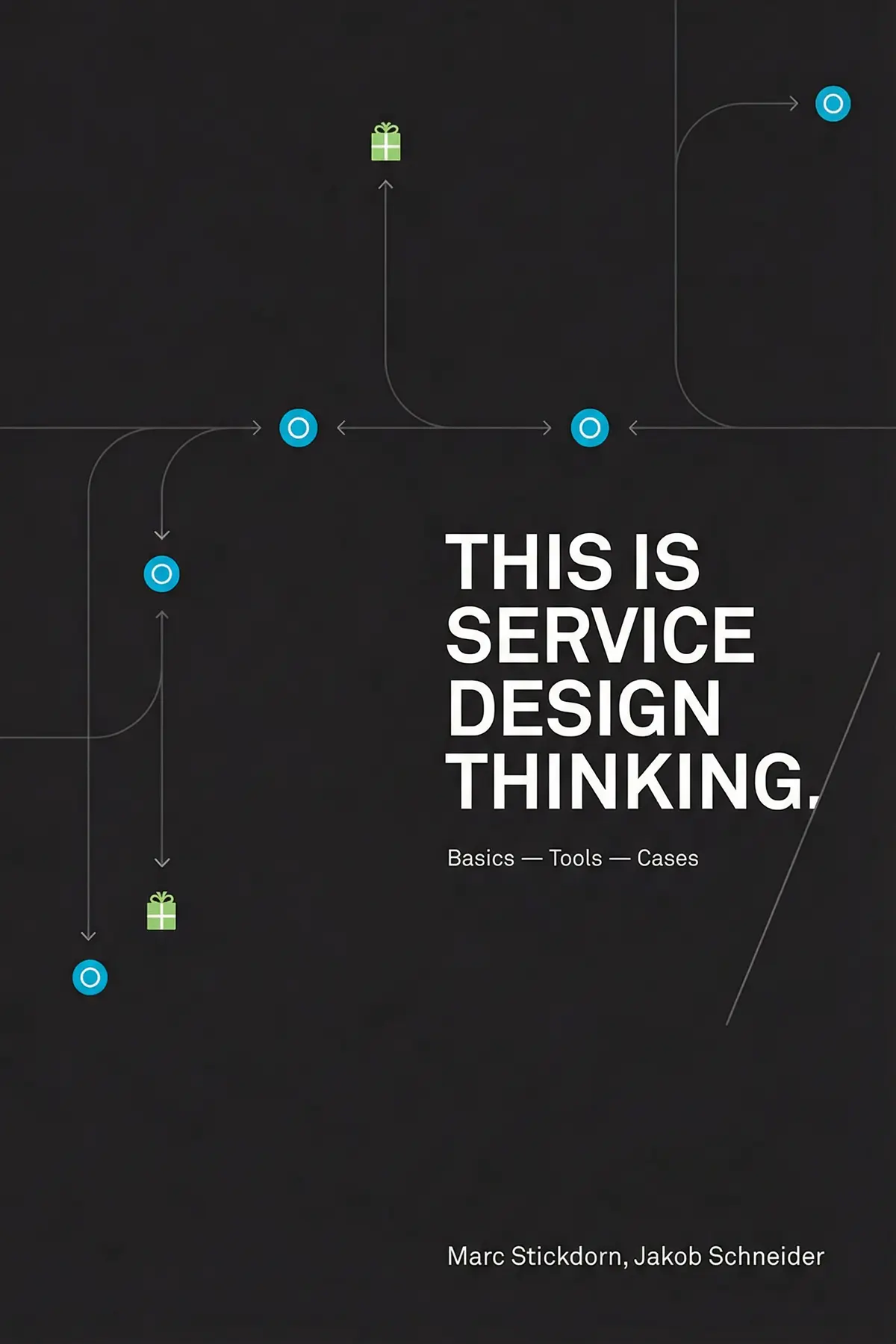
Table of Content
1. Introduction
1 min 04 sec
If you sell haircuts, bus rides or anything else people cannot hold, no logo goes home with the customer, so the experience itself has to bring them back. In This is Service Design Thinking, Marc Stickdorn and Jakob Schneider argue that a service is a process the customer takes part in, and that it can be designed as carefully as a car.
Their case rests on five principles most practitioners share: center the user, create together with stakeholders, sequence the experience, give it physical evidence and keep the whole picture in view. Two visual tools, a stakeholder map and a customer journey map, turn those principles into work you can do on paper.
The idea running through all of it is simple. A good service is the sum of many small interactions, and you design it well only by seeing every detail and the full picture at once. By the end, you can take apart a barbershop, a bus line or your own team’s service moment by moment and see where it needs work.
2. See the customer behind the statistics
1 min 55 sec
Two married, wealthy British men, both around 70, look identical in any spreadsheet. One of them is Prince Charles and the other is Ozzy Osbourne, and that gap shows why numbers alone are not enough to build a valuable service.
3. Bring every stakeholder into the design room
1 min 51 sec
Regulators, engineers and marketers rarely sit at the table when a new service is sketched. The authors argue that each of them plays a part in the service’s success, and that including them is not a burden but a source of useful expertise and ideas.
4. Play your service frame by frame
1 min 48 sec
A film looks like smooth motion, yet it is built from thousands of still pictures. Looking at a barbershop the same way turns up chores and comforts that nobody planning the haircut would think of.
5. Make the experience linger with souvenirs and senses
1 min 49 sec
Tourists fill their shelves with snow globes and postcards for a reason. The same instinct, joined to a pot of fresh coffee, shows how a service can be remembered long after it ends.
6. Untangle a struggling organization with a stakeholder map
2 min 03 sec
A Dutch government agency was stuck in conflict and nobody could say exactly why. One diagram, drawn as rings around a bull’s-eye, showed where the confusion was coming from and what to do about it.
7. Fix one touchpoint without breaking the rest
1 min 49 sec
Customers at a barbershop complain about waiting, and any fix has to account for how it affects the other touchpoints. A timeline drawn with the customers themselves reveals where the delay really starts and what any change will disturb.
8. Conclusion
1 min 11 sec
A car owner sees a logo on the steering wheel every day. A barbershop client or a bus rider gets no such reminder, so for a service the experience itself carries the brand. Stickdorn and Schneider treat that experience as something to design, with the customer and every other stakeholder involved, and with two ways of looking held at the same time: close enough to notice the swept floor, far enough back to notice the smell of coffee at the door.
There is much more to a service than the moment money changes hands. It starts before the customer arrives and continues after they leave.
The book supports a few concrete moves. Send customers a short questionnaire about what they prefer and why, the way a bus service might ask whether riders want music, reading or conversation. Draw a stakeholder map before a project stalls, and look for anyone taking orders from two directions. Then lay out the customer journey with real customers, fix the frame that frustrates them most, and watch what that change does to the frames beside it.
A film is only as good as its frames, and a service is only as good as its smallest moment.
About this book
What is this book about?
Selling a car or a phone puts your brand in the customer's hands every day. Selling a haircut or a bus ride does not. Once the service ends, nothing physical is left to remind the customer of you, so the experience itself has to bring them back. Marc Stickdorn and Jakob Schneider argue that this experience can be designed as carefully as any product. Their approach rests on five principles that most practitioners accept: center the design on the user, create it together with every stakeholder, lay it out as a sequence of touchpoints, give it physical evidence, and keep the whole picture in view. Their examples include two men whom statistics cannot tell apart, a barbershop that improves by brewing coffee, and a Dutch government agency that a stakeholder map helped refocus. Readers get two practical tools, the stakeholder map and the customer journey map, plus a clear habit of mind: look closely enough to catch the swept floor and widely enough to notice what a change does to everything around it.
Book Information
Who it's for
Service business owners
Founders and small business owners selling haircuts, rides, stays or other services people cannot hold.
Leaders redesigning frustrating services
Managers and team leads redesigning a service that customers complain about.
Designers and public servants
Designers and public sector staff who need a shared map of everyone a service touches.
About the Author
Marc Stickdorn
Marc Stickdorn has a background in strategic management and service design. He co-founded More than Metrics, which makes service design software including Smaply and ExperienceFellow, and he helps organizations build service design into their structures and culture. He teaches the subject at several universities. Jakob Schneider is a visual designer and consultant, partner and creative director at the agency KD1, and lead designer at Smaply and ExperienceFellow. Since 2006 he has worked for brands including VW, Siemens and Deutsche Telekom.
Ratings & Reviews
Ratings at a glance
What people think
Listeners find the writing accessible and value the practical examples and tools included, making it a definitive service design textbook for students. They also consider the content thought-provoking, with one listener noting that it offers a great introduction to service thinking. On the other hand, the way concepts are described draws mixed reviews—some listeners feel it goes straight to the point, while others find it extremely abstract. Additionally, the organization receives criticism, as one listener highlights specific issues with the layout.
Top reviews
Air
As a design student, I found this to be the quintessential textbook for understanding the holistic nature of service design. The authors do a fantastic job of explaining that it is not just a standalone discipline but an interdisciplinary approach that borrows from ethnography and psychology. I really appreciated the visual layout, even though some might find the lines and icons a bit distracting at first. It genuinely feels like the authors treated the book itself as a service to the reader. The section on stakeholder maps and service safaris provided a solid foundation for my semester project. While some of the theory feels a bit high-level, the case studies at the end—especially the medical one—bring the concepts down to earth. This is a must-have for anyone's professional library.
Show moreChai
This book is essentially the foundation for anyone looking to transition into a user-centric role. It perfectly captures how service design combines different tools from various disciplines to create a seamless customer journey. I love the interdisciplinary focus because it acknowledges that great services aren't built in a vacuum. The tools like shadowing and stakeholder maps are explained clearly enough for a beginner to start experimenting. Truth is, the field is evolving fast, but the core principles laid out here remain incredibly relevant. Some might call the aesthetic 'busy,' but I found it thought-provoking and energetic. It’s a book that invites you to think differently about organizational change rather than just following a rigid checklist. Highly recommended for students and pros alike.
Show moreConnor
If you're looking for a definitive guide to the world of service design, this is the place to start. It doesn't just give you a list of tasks; it teaches you a new way of thinking about how people interact with systems. I found the interdisciplinary nature of the book to be its strongest suit, pulling in ideas from all over the place. The five case studies at the end provide a realistic look at how these strategies are implemented in various organizations. It’s a thought-provoking read that encourages you to focus on the entire customer journey rather than just a single touchpoint. Some parts are definitely a bit more academic, but the overall presentation is engaging and keeps you turning pages. Definitely a cornerstone for any design library.
Show moreMind
After hearing about 'Service Design Thinking' for years, I finally sat down with this book and I'm glad I did. It’s an excellent start point for anyone who wants to move past simple product design and into the realm of experiences. The book does a great job of explaining that the process of designing is often more important than the final outcome. I particularly enjoyed the section on stakeholder maps—it’s a tool I’ve used daily since reading this. Not gonna lie, the aesthetic of the book is a bit polarizing, but I found it quite refreshing compared to dry business manuals. It’s an essential text that helped me structure my thoughts on how to innovate within a complex organization. A truly quintessential resource.
Show moreYindee
Finally got around to picking up this classic, and I must say it lives up to the hype as an introductory text. It defines service design thinking across various perspectives, which helps clear up the jargon often found in the industry. The tools section is particularly useful, even if the descriptions are a bit brief for my liking. I would have loved to see more deep dives into the 'how-to' rather than just 'what it is.' To be fair, the book focuses more on the 'thinking' aspect than the nitty-gritty execution. The layout is experimental and fun, though it can make quick referencing a bit of a challenge. It's a great starting point, but you'll definitely need more practical guides like Gamestorming if you want to facilitate workshops.
Show moreValentina
The chapter on case studies was the highlight of this book for me, providing a much-needed bridge between theory and practice. It’s one thing to read about the 'holistic' approach, but seeing how it applies to a real-world medical setting makes it click. The authors provide a broad overview of the methodology, though I'll admit the middle section feels a bit like a collection of blog posts. Some tools are more developed than others, so you might find yourself googling for more detail on specific workshop techniques. In my experience, the book serves best as an inspirational guide rather than a step-by-step manual. The physical design of the book is beautiful, although the Kindle version apparently has some formatting issues according to colleagues. Stick to the print version if you can.
Show moreBo
Ever wonder how companies manage to create those seamless experiences that just feel 'right'? This book breaks down that magic into a structured design process. It avoids being too academic while still providing a solid theoretical framework for how service design functions within a business. My only gripe is that it stays a bit too high-level at times, almost feeling like a marketing pitch for the discipline itself. You get a great sense of the 'service design thinking' mindset, but you might feel a bit lost when it comes to the actual measurable benefits in a corporate environment. Still, the tools are fantastic for kickstarting a project. It’s a bit of a classic now, and despite some of the flashy layout choices, the core message still resonates in today’s market.
Show moreTawee
Look, the tools inside this book are definitely useful, but they aren't exactly groundbreaking. Most of the methodologies come from much older practices like ethnography or psychology. While I appreciate the effort to create a 'textbook' for designers, it often feels more like a coffee table book due to the heavy focus on visuals. The structure is a bit funky, which makes it hard to use as a quick reference during a meeting. I also felt the first section was a bit too abstract and filled with 'fancy words' that didn't add much value. It's a decent introduction if you are completely new to the topic, but seasoned professionals might find it a bit superficial. It’s good for a broad overview, just don't expect a deep dive into implementation.
Show moreLuckana
While the content is undoubtedly foundational, I struggled with the way the book was actually designed. They tried to 'service design' the reading experience with all these icons and non-linear paths, but it just made it complex to read. Sometimes a book should just be a book. The information itself is a bit of a mixed bag; the sections on tools like service safaris are great, but the intro drags on with a lot of abstract definitions. I also felt it ignored some of the more technical aspects like ITIL or Lean, which are pretty important in actual service delivery. It’s an interesting artifact of the design world, but I think I would have preferred a more straightforward layout and a bit more practical substance.
Show moreThitiwan
Not what I expected from a book that claims to be the bible of the industry. The first hundred pages are incredibly self-indulgent, with the authors spending way too much time justifying why service design is important rather than showing us the work. I found the abstract language and constant use of the word 'holistic' to be quite tiring after a while. Most of the 'innovative' methods mentioned here are just recycled concepts from Lean or marketing that have been rebranded for a design audience. Frankly, the structure is a mess; the icons and lines going everywhere feel like a gimmick that actually hinders readability. Even the case studies felt lackluster, with one example celebrating a project that never even launched. It lacks the practical depth I need for my daily work.
Show moreQuestions about this book
What is the main idea of This is Service Design Thinking?
Marc Stickdorn and Jakob Schneider argue that a service is a process the customer takes part in, made of many small touchpoints, and that it can be designed deliberately. They describe five shared principles: put the user at the center, create together with all stakeholders, lay the service out as a sequence, give it physical evidence, and keep the whole experience in view while working on details.
What are the five principles of service design thinking?
The authors name five. User-centered means the customer is central to the process. Co-creative means managers, engineers, officials, marketers and customers all shape the design. Sequencing means breaking the service into touchpoints, like frames of a film. Evidencing means giving the service a souvenir that outlasts it. The fifth is keeping the whole picture in view, including sound, smell and taste.
What is a customer journey map and how do I make one?
It is a timeline that lists and connects every touchpoint a customer has with your service. For a barbershop, that runs from finding the shop online and booking by phone to waiting, the haircut and paying. The authors insist you ask customers about each step, since they are the experts. The map then shows where problems sit and what a fix would affect elsewhere.
What is a stakeholder map used for?
A stakeholder map pictures everyone involved in a service and how they relate, often as rings around a bull’s-eye with the most influential nearest the center. The firm DesignThinkers used one with the Dutch NL Agency and found that staff were confused by orders from both the agency and powerful outside forces. Seeing that let the agency refocus on the people it served.
Why isn't statistical data enough to design a good service?
Statistics reveal trends, such as when demand for buses peaks, but they miss the people behind them. The authors note that Prince Charles and Ozzy Osbourne look identical on paper: married, wealthy, British, around 70. Customers differ in culture, habits and motivations, so the book recommends adding qualitative information, for example a questionnaire about riders’ preferences and motivations.
Readers also enjoyed





AUDIO SUMMARY AVAILABLE
Listen to This is Service Design Thinking in 15 minutes
Get the key ideas from This is Service Design Thinking by Marc Stickdorn, plus 5,000+ more nonfiction titles.
- 5,000+ titles
- Listen as much as you want
- 7-day free trial
- Cancel anytime









