

13 min 13 sec
Available in: English
The Work-Life Balance Myth: Rethinking Your Optimal Balance for Success
Shows busy professionals why chasing an even split between job and home keeps failing, and how a few honest minutes a day in seven areas of life, from body to beliefs, can ease chronic stress.
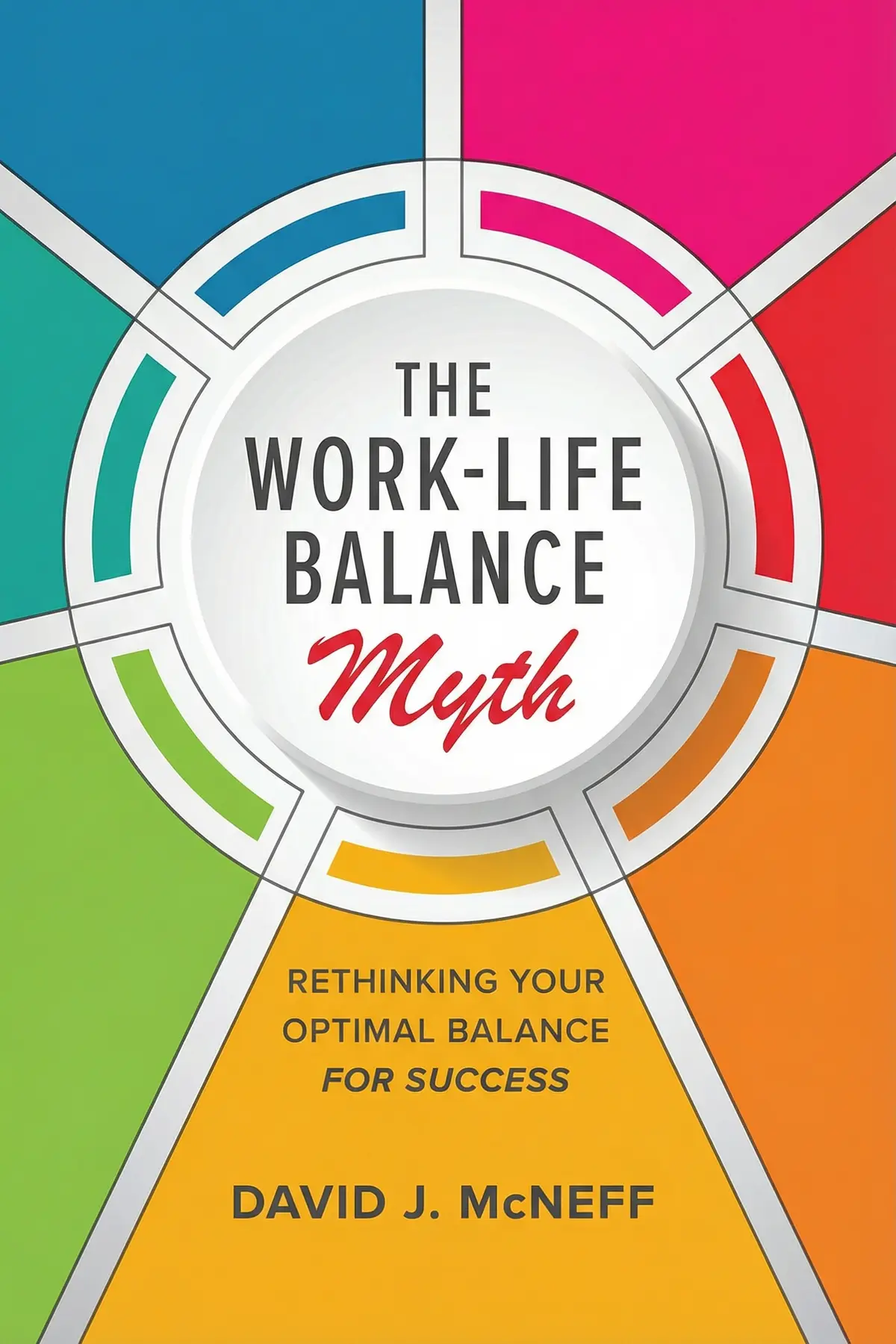
Table of Content
1. Introduction
1 min 07 sec
If your days mean pressure at work and short tempers at home, moving a few hours from one side of the scale to the other will not fix it. In The Work-Life Balance Myth, executive coach David J. McNeff argues that stress builds because most professionals live in only two parts of their lives, work and family, and leave five others untouched. He lists every one: alongside the Family and Professional slices come Personal, Physical, Intellectual, Emotional, and Spiritual ones. Together they make seven.
McNeff calls the hunt for an even split between job and home futile. His aim is harmony instead: some genuine attention to every slice, every day, even on a crowded schedule. His method runs in three phases, assessment, reflection and action, and his coaching clients show how each one works in practice. By the end, a jammed calendar looks less like a trap and more like something you can rearrange, starting this week with ten minutes.
2. Stop chasing balance and aim for harmony
1 min 46 sec
Roughly three in four American workers, about 76 percent, say they feel burned out on the job, and the usual prescription is to strike a better balance. McNeff thinks that cure is aimed at the wrong target entirely.
3. Know the seven parts your life runs on
1 min 46 sec
Ask a stressed person and a calm person the same everyday question and you hear two very different answers. The gap between them points to five parts of life most busy people forget they have.
4. Measure where your week really goes
1 min 49 sec
Most people suspect they are neglecting something, but very few have ever put a number on it. When McNeff’s clients did, the figure that came back surprised almost all of them.
5. Revive a neglected slice in five minutes
1 min 53 sec
When an old pleasure comes up, the overwhelmed answer is always that there is no time anymore. One client’s Wednesday coffee and one couple’s evening calendar show how little time it actually takes.
6. Build a plan that fits your motivation
1 min 55 sec
A businessman whose colleagues sometimes found him tone deaf and a curious client who chose to focus on a single slice took different routes. Each chose a route suited to what motivates him, and Dan’s approach, at least, clearly paid off.
7. Conduct your week like an orchestra
1 min 45 sec
A conductor never lets every instrument play at full volume all evening, yet the music still needs all of them. That picture changes how you judge whether a busy week was a good one.
8. Conclusion
1 min 12 sec
McNeff’s book swaps an impossible scale for a wider map. Most people pour their waking hours into work and family, and he takes that pattern as his starting point. What he changes is the diagnosis. The crisis builds from neglect of the other five parts of life. A businessman learning to read the people around him, a client reading spiritual books over Wednesday coffee, a couple walking at 5:30 after a day of video calls: each of them widened where their attention went, and the pressure eased.
The practice starts with a plain sheet of seven rows and an honest estimate that adds up to 100. Choose the slice that scores closest to zero and give it the smallest step you will actually take, shaped around whatever has motivated you before. Guard a weekly half hour to look at the sheet again. And after an evening of television, check whether you feel refreshed or more drained, because the answer tells you whether those hours fed your Personal slice or simply filled time.
Balance asks you to split yourself in two. Harmony asks you to show up, briefly and honestly, in all seven places you live.
About this book
What is this book about?
Many professionals spend the day performing under pressure, then come home tired and short-tempered, and the standard advice is to find a better work-life balance. Executive coach David J. McNeff thinks that goal is futile. In his view, stress builds toward a crisis because people pour every waking hour into two parts of life, their job and their family, while five other parts get nothing. McNeff labels these the Seven Slices, which are Family, Professional, Personal, Physical, Intellectual, Emotional, and finally Spiritual. His Seven-Slice Method moves through three phases. First comes assessment, an honest inventory of how your week is really divided. Then reflection on why some slices dominate. Then action, which starts with the smallest possible step and is built around your own motivation style. The book draws on his coaching clients: a woman who read spiritual books over Wednesday coffee, a couple who rescued their evenings with a daily walk, a businessman who gave no time to his emotional life, and a curious client who built a whole plan around one weekly appointment. Readers get a simple tool for seeing what they have been neglecting and a realistic way to bring harmony back, even on a packed schedule.
Book Information
Who it's for
Professionals taking stress home
Professionals who carry work stress home and snap at the people they love.
Working parents and partners
Parents and partners stretched between demanding jobs and family duties with no time left for themselves.
Wanting old habits back
Anyone who has dropped hobbies, exercise or reflection and wants a small, realistic way back.
About the Author
David J. McNeff
David J. McNeff coaches executives and works with companies and leaders across the globe. He is CEO of the Peak Consulting Group, where his work combines leadership development with stress management, the two fields at the heart of this book. The client stories he tells come from his own coaching practice. He is also the author of Lessons from the Abyss.
Ratings & Reviews
Ratings at a glance
What people think
Listeners find that this work provides a functional system for finding harmony using the "Seven-Slice Method," which addresses various aspects of existence from career to spirituality. Although views are mixed regarding the narrative speed and some think the material could be tightened, listeners value the concrete guidance for pinpointing interruptions and handling pressure. Furthermore, they appreciate the mental shift from chasing an unattainable equilibrium toward practicing intentionality, with one listener highlighting that the guide offers a useful "here do this" fix instead of merely analyzing the issue. They also note the audio version features high-quality narration and delivers numerous thought-provoking concepts to consider.
Top reviews
Violet
This book completely shifted my perspective on what it means to lead a "full" life. For years, I’ve been chasing an impossible equilibrium between my job and my home life, always feeling like I was failing at both. McNeff's argument that we should seek harmony through his Seven-Slice Method changed the game for me. I’ve started paying much more attention to my Intellectual and Spiritual slices, which I hadn't realized I was neglecting for nearly a decade. The writing is encouraging and the "Actionable Advice" sections at the end of chapters are actually realistic to implement. Frankly, seeing my life as something to manage rather than something to survive has lowered my stress levels significantly. This belongs on everyone’s bookshelf.
Show moreBam
As someone who struggles with chronic burnout, finding this book felt like finding a lifeline. The Seven-Slice Method isn't just about time management; it's about life harmony. McNeff’s breakdown of the Physical, Personal, and Intellectual slices helped me realize I was only living about 60% of my life. The quote "He who lives in harmony with himself, lives in harmony with the universe" really stuck with me throughout the reading. I love the "here do this" style of writing because I don't need more theories; I need steps. I’ve already started being more intentional about my transitions between work and home. If you feel overwhelmed by your professional demands, please give this a read. It is truly transformative.
Show moreWanphen
Truth is, I was skeptical about the seven-category approach at first, fearing it would just add more stress to my plate. However, McNeff’s Seven-Slice Method actually simplified how I view my daily routine. By acknowledging the Intellectual and Physical slices alongside my professional duties, I’ve stopped feeling so guilty about taking time for myself. The advice to "decide when to begin to begin" was exactly the kick in the pants I needed. My only minor gripe is that the book feels longer than it needs to be to convey what is essentially a simple (though effective) framework. That said, the shift from seeking balance to seeking harmony is a perspective I won’t soon forget. Highly recommend for the chronically busy.
Show moreTuck
Finally got around to reading "The Work-Life Balance Myth," and I must say the Seven-Slice Method is a refreshing departure from the usual productivity hacks. McNeff argues that mathematical balance is impossible, which felt like a massive weight off my shoulders. Instead, he focuses on harmony across seven key areas like the Physical, Intellectual, and Spiritual slices. I particularly enjoyed the actionable advice regarding the "Personal Slice"—checking in to see if an activity like watching TV actually refreshes you or just drains you further. While some sections felt a bit repetitive, the core message is incredibly grounding. It’s less about doing more and more about being intentional with the time you actually have. Great for anyone feeling victimized by their own schedule.
Show moreJan
After hearing David J. McNeff discuss his philosophy, I decided to pick up the audiobook. The narrator is an excited American male who is very easy to listen to, especially at 1.75x speed. The content itself is quite thoughtful. I particularly resonated with the section on the Family Slice and how our early habits dictate how we handle stress as adults. The idea that we aren't "victimized" by our schedules but rather responsible for managing them is a tough but necessary pill to swallow. I’ve started using his spreadsheet method to track my time, and it’s been eye-opening to see how much I’ve ignored my Physical and Intellectual health. It's a very practical guide for the modern professional.
Show moreSoontorn
Is the Seven-Slice Method truly revolutionary, or just a new way to package common sense? Personally, I found the framework quite useful for visualizing where my energy goes, but the book itself is significantly bloated. David McNeff has a great core idea here—categorizing life into things like the Emotional and Family slices—but it could have been presented in half the pages. I liked the "here do this" approach, especially the suggestion to map out percentages in a spreadsheet. However, trying to track all seven slices every single day felt a bit too complex for my lifestyle. It’s a solid 3-star read: good concepts, but you might find yourself skimming through the fluff to get to the actual meat of the advice.
Show moreMilk
Let's be real: work-life balance is a pipe dream that most of us will never achieve. McNeff acknowledges this right out of the gate, which I appreciated. His Seven-Slice Method offers a nifty framework for thinking about life as a whole, including areas like the Emotional and Spiritual slices that most business books ignore. That said, the book felt a little bit like a "blink" that got stretched out to fill a certain word count. The advice on identifying distractions was helpful, but I found the emphasis on the "Family Slice" as the root of all stress management a bit of a stretch. It’s a decent read if you have the patience for some repetition, but it might not be for everyone.
Show moreDen
The concept of "slices" is definitely a nifty framework for anyone feeling a bit scattered. McNeff breaks life down into seven distinct areas, and the exercise of creating a pie chart to see where your time goes is quite revealing. To be fair, though, the writing style is a bit dry and the pacing is slow in the middle sections. I did find the "Actionable Advice" regarding the Personal Slice quite useful—specifically the bit about checking if your hobbies actually leave you feeling refreshed. It’s a good book for a weekend read, but you could probably get the gist of the method by reading a summary. Still, the focus on harmony over balance is a vital takeaway for today's world.
Show morePensuda
Not what I expected from a leadership book. While the Seven-Slice Method has some merit, the book leans very heavily into self-help territory, especially with the Emotional and Spiritual slices. I was looking for more professional strategies, but McNeff focuses a lot on how our upbringing in the Family Slice affects our current stress levels. Some might find that insightful, but for me, it felt a bit too "touchy-feely" and less about practical productivity. Look, the core idea is fine, but the execution is bloated and the tone didn't quite resonate with my specific needs as a manager. If you want a deep psychological dive into your habits, you might like it, but it was just okay for me.
Show moreChokdee
I really wanted to love this because the premise of "The Work-Life Balance Myth" is so relatable. Unfortunately, the execution didn't quite land for me. While I appreciate that McNeff provides a concrete solution—the Seven-Slice Method—the framework felt overly complicated to maintain in the long run. Between the Family, Professional, Personal, Physical, Intellectual, Emotional, and Spiritual slices, it feels like just another list of chores to track. Also, the author spends a lot of time on anecdotes that didn't always feel relevant to the core message. Not gonna lie, I think this could have been an excellent long-form article or a 20-page PDF rather than a full-length book. If you're looking for a quick fix, this isn't it.
Show moreQuestions about this book
What is the main idea of The Work-Life Balance Myth?
David J. McNeff argues that chasing an even split between work and life is futile. Stress reaches a crisis, he says, because people spend all their time in the Professional and Family slices of life and neglect five others: Personal, Physical, Intellectual, Emotional and Spiritual. The goal he proposes is harmony, meaning some real attention to each of the seven slices every day, even when the schedule is full.
What are the seven slices in the Seven-Slice Method?
The Professional slice is making a living and the Family slice covers your roles as child, parent or partner. The Personal slice holds hobbies and time alone. The Physical slice is caring for your body through fitness and food. The Intellectual slice is curiosity, such as reading for pleasure. The Emotional slice covers your thoughts and feelings toward yourself, while the Spiritual slice is the place where your faith, values and beliefs are nurtured.
How do you start using the Seven-Slice Method?
Begin with an inventory. List the seven slices in a spreadsheet or pie chart and estimate what percentage of your week each one gets, making sure the total is 100. Be honest and avoid judging yourself. Most of McNeff’s clients found at least 30 percent of their lives was getting no attention. Then pick the smallest possible step for a neglected slice, such as five or ten minutes of meditation.
Can the method work if my schedule is completely full?
McNeff says yes, because it depends on small steps and on quality more than quantity. His client Rosa started with a few minutes of spiritual reading over Wednesday coffee, about 20 minutes a week, and felt the benefit within a month. A couple working from home scheduled a daily one-hour walk at 5:30 that served three slices at once. Committing to a fixed weekly review slot keeps it going.
Who should read The Work-Life Balance Myth?
It suits professionals under steady pressure who bring that stress home, and people juggling demanding jobs with family responsibilities while their hobbies, health and inner life fade. It also helps anyone who wants a plan shaped around their own motivation style, whether that means a structured course, as with McNeff’s client Dan, or a single weekly anchor, as with his client Jack.
Readers also enjoyed




A Guide to the Good Life: The Ancient Art of Stoic Joy
William B. Irvine


A High-Performing Mind: Strengthen Your Mind and Live Your Best Life
Andrew D. Thompson


Abundance: The Inner Path to Wealth
Deepak Chopra
AUDIO SUMMARY AVAILABLE
Listen to The Work-Life Balance Myth in 15 minutes
Get the key ideas from The Work-Life Balance Myth by David J. McNeff, plus 5,000+ more nonfiction titles.
- 5,000+ titles
- Listen as much as you want
- 7-day free trial
- Cancel anytime









