

14 min 39 sec
Available in: English
The Unaccountability Machine: Why Big Systems Make Terrible Decisions & And How the World Lost Its Mind
By Dan Davies
Shows why broadcasters, platforms, banks and governments make decisions nobody inside them wants, and how feedback loops, emergency channels and less reckless debt can put human judgment back in charge of big systems.
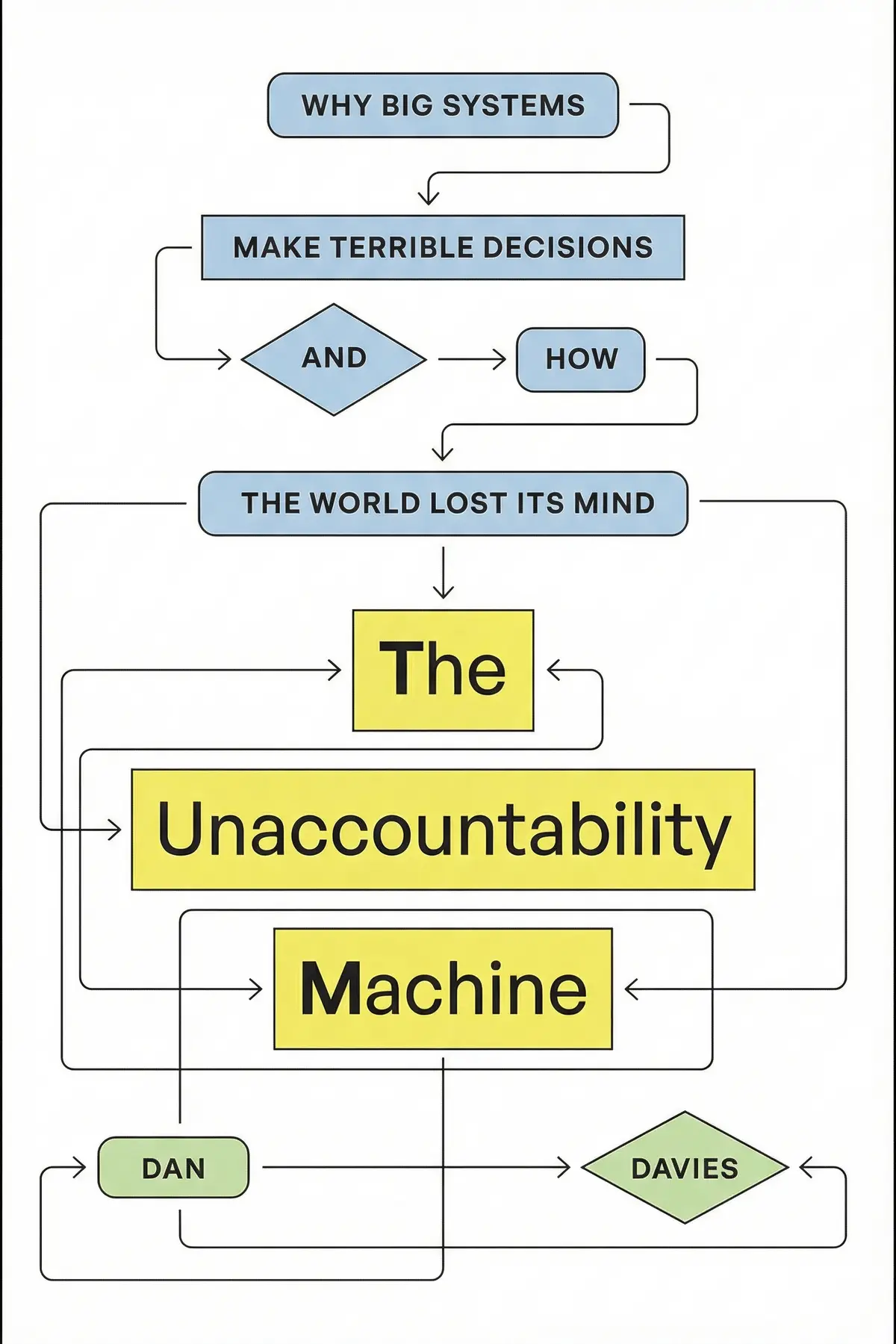
Table of Content
1. Introduction
1 min 04 sec
If you have ever been passed from department to department with nobody able to say yes or no, you have met what Dan Davies calls an accountability sink. In The Unaccountability Machine, the British writer argues that large organizations now route decisions through rules and procedures so completely that no person is left who can overrule them. That is how a broadcaster airs claims its own executives think are false, and how an airport ends up shredding live animals over a paperwork problem.
Davies’s case is that these failures come from design, not from villains, and that design can be repaired. His tools come from cybernetics, a science of feedback born in 1948, which treats an organization as something that must sense its world and respond to it. Follow his argument and the next baffling decision from a bank, a platform or your own employer becomes readable, along with the questions that expose it: who set the goal, which signals get heard, and where the emergency brake is.
2. Spot the rules that let nobody take the blame
2 min 00 sec
A television network kept airing a story its own executives privately mocked, and an airport destroyed hundreds of animals while insisting it had acted correctly. Neither case needed a villain, which is exactly what makes them so unsettling.
3. See how big organizations end up acting like mindless machines
2 min 08 sec
No one at a giant video platform decided to frighten children, yet children were frightened. A famous puzzle about a sealed room explains how a company can produce sensible-looking answers with no understanding anywhere inside it.
4. Steer a complex system without opening every box
2 min 09 sec
A gun sight tracking a moving airplane gave a mathematician an idea about how companies think. It led to a surprising claim: you can manage something enormous without ever understanding how its insides work.
5. Read the books before trusting the profits
1 min 59 sec
A skincare company looks at its figures and decides its luxury lotions are the stars. The reasoning seems flawless, the decision seems obvious, and the savings it promises somehow never arrive.
6. Learn how chasing quarterly numbers leaves firms fragile
2 min 08 sec
An industrial giant closed factories and cut jobs simply to keep one quarter’s figures tidy. The move looked disciplined at the time, and it previewed a habit that later left companies and governments defenseless in a crisis.
7. Balance many goals instead of maximizing one
2 min 06 sec
A celebrated musician and a management theorist discovered they were working on the same problem. Their shared idea suggests a different way to fund companies, and a different meaning for the word accountability.
8. Conclusion
1 min 05 sec
Davies leaves an uncomfortable picture. Everyone is told to trust the system, and nobody is given the power to correct it. The squirrels in Amsterdam, the cartoons served to children and the factories closed to keep a quarter tidy all came from one source: procedures doing exactly what they were built to do, with no one positioned to step in.
His hope rests on design. Organizations that sense their world through clear feedback, that keep enough variety to absorb surprises and that carry less reckless debt can let informed people use their judgment again. The change will be gradual, he admits, but each step toward real oversight means fewer crises.
You can begin from wherever you sit. When a process produces something absurd, ask what single target it serves and who is allowed to override it. When you write a rule, give it an exit for the case nobody foresaw. And before trusting a profitable number, find out which costs were left out of it.
The machine has no villain at the controls. What it lacks is someone allowed to pull the handle.
About this book
What is this book about?
Anyone who has been passed from desk to desk without finding a person able to decide has met the problem Dan Davies sets out to explain. Large institutions increasingly hand their choices to rules, procedures and targets. That protects staff from blame, but it also means that when something goes badly wrong, nobody is placed to stop it. Davies moves from a record defamation settlement and 440 squirrels destroyed over paperwork to children's video recommendations, misleading cost accounting and the shareholder value era that hollowed out companies and states before the late-2000s mortgage collapse. His argument is that these failures come from the design of systems more than from bad people. His remedy draws on cybernetics, the science of feedback developed by Norbert Wiener, Ross Ashby and Stafford Beer. Readers learn to judge an organization by what it consistently does, to look for the single number a process serves, to ask where its emergency brake is, and to see why limiting debt-funded buyouts might let managers balance many goals instead of one.
Book Information
Who it's for
Managers and team leads
Managers and team leads frustrated by rules nobody can override and decisions nobody owns.
Founders and operators
Founders and operators who want to avoid steering their company by one misleading metric.
Professionals puzzled by institutions
Professionals curious why banks, platforms and governments keep producing outcomes no one wanted.
About the Author
Dan Davies
Dan Davies is a British writer, and The Unaccountability Machine is among his books. In it he looks at how broadcasters, airports, tech platforms, companies and governments end up making decisions that no individual will own, and he turns to the management science of cybernetics for ways to make large systems answerable to the people who depend on them.
Ratings & Reviews
Ratings at a glance

What people think
Listeners find the book intellectually stimulating, with one listener highlighting the way it navigates sensitive subjects with deliberate self-reflection. Furthermore, the work is commended for being very easy to read. On the other hand, the material presented by the author has drawn a range of conflicting opinions.
Top reviews
Manop
Ever wonder why nobody is ever responsible when things go sideways? Davies explores the 'industrialization of decision-making' with a sharp, often funny perspective that makes complex cybernetics feel accessible. The concept of 'accountability sinks'—where systems are designed to absorb blame without changing anything—is a total lightbulb moment for anyone stuck in corporate purgatory. While the middle sections on economic theory get a bit dense, the writing remains engaging and surprisingly self-reflective. It really makes you question if we've traded human judgment for efficient but heartless algorithms. Ultimately, it’s a brilliant diagnosis of why modern life feels like talking to a brick wall. A must-read for systems thinkers.
Show moreAraya
The chapter on 'accountability sinks' should be mandatory reading for every corporate executive and politician. Dan Davies has written a masterful bridge between the history of cybernetics and the failures of modern finance. It is intellectually invigorating to see Stafford Beer’s 'Brain of the Firm' concepts applied to the 2008 financial crisis. The author shows how we’ve built structures that are literally incapable of processing the risks they create. This isn't just a book about business; it's a look at why our democracy feels so unresponsive to the people. Every page offers a new way to look at the world. Truly a brilliant, multi-layered piece of work.
Show moreSangduan
As someone who works in operations, this book provided the language I’ve been looking for to describe my daily frustrations. It’s an amazing and intellectually stimulating deep dive into why systems fail even when 'good' people are in charge. Davies’ analysis of the 2008 crash through the lens of information theory was a highlight for me. It’s rare to find a book that balances historical context with such relevant modern critiques of the corporate world. The writing is punchy, the examples are vivid, and the self-reflection on his own discipline of economics is refreshing. If you want to understand the invisible structures governing your life, read this book immediately.
Show morePenelope
After hearing Rory Sutherland rave about this in a Masterclass, I had to see if the hype was real. Davies does an excellent job reviving the forgotten world of Stafford Beer and management cybernetics to explain our current global malaise. He argues that we've optimized ourselves into a corner where no one actually makes decisions anymore; the system just 'happens.' The explanation of POSIWID—the purpose of a system is what it does—is a powerful mental model that I’ve already started applying to my own workplace. My only gripe is that the critique of neoliberalism feels a bit well-trodden toward the end. Still, the unique lens of information theory makes this a very worthwhile read for the intellectually curious.
Show moreJin
Picked this up to better understand why large organizations feel so inhuman lately. Davies provides a fascinating look at how we’ve outsourced our morality to systems and processes. The book isn’t just a dry academic text; it’s a thoughtful self-reflection on how we’ve let economic modeling flatten the complexity of the real world. I particularly enjoyed the sections on 'information-reducing filters' in corporations. It’s a dense subject, but the prose is lively enough to keep you turning the pages. You might not agree with every conclusion regarding neoliberalism, but the framework he provides for viewing organizations as information-processing entities is invaluable.
Show moreGrace
Finally got around to Davies’ latest, and it’s a remarkably readable take on a normally dry subject. He handles controversial economic issues with a level of nuance that you don't often see in popular science books. The central idea—that we are living in an era of 'industrialized decision-making'—really resonated with my experiences in the public sector. He explains complex ideas like 'sufficient variety' and the 'Viable System Model' without making your head spin. There are some minor pacing issues in the later chapters when the focus shifts heavily toward leveraged buyouts. However, the overall message about the loss of human agency in our systems is chilling and necessary.
Show moreChokdee
To be fair, the first half of this book is absolute lightning. The way Davies connects mid-century cybernetics to modern bureaucratic failures is genuinely thought-provoking and filled with black humor. But somewhere around the deep dive into Milton Friedman, it loses its momentum and veers into abstract tangents. I found myself wishing he spent more time on practical evidence rather than pretty diagrams and theoretical models of 'variety.' It’s a readable book, but the ending feels a bit like a shrug. It identifies the problem of the 'unaccountability machine' perfectly but leaves the machine running without telling us how to unplug it.
Show moreAurora
Look, I appreciate the deep dive into Stafford Beer, but the connection to modern AI felt a bit strained. The book starts with a strong premise about how systems avoid blame, but it gets bogged down in the history of operations research. It’s a bit of a 'black box' itself; you put in the effort to read it, but the output is a bit fuzzy. While the writing style is conversational and often witty, the middle sections on the Friedman Doctrine felt like they belonged in a different book. I think I’ll stick to 'Thinking in Systems' for a clearer introduction to these concepts. Interesting, but ultimately a bit disjointed.
Show moreArthit
Frankly, I found the core thesis about information flow fascinating, but the lack of concrete solutions left me hanging. I loved the early anecdotes and the introduction to the heroes of cybernetics like Norbert Wiener. But as the book progressed, it felt more like a history lesson on why everything is broken rather than a guide for the future. The author is clearly brilliant, and his critique of how economists ignore information theory is spot on. I just wish there was more 'how-to' and less 'here’s why.' It’s a great book for identifying the symptoms of our unaccountable world, even if the cure remains elusive.
Show moreGor
Not what I expected based on the catchy title. The book starts with a bang, using the 'squirrel shredding' at Schiphol Airport as a vivid example of how processes replace personal responsibility. However, the narrative quickly peters out into a long-winded grievance about accounting standards and private equity. I was hoping for a roadmap on how to fix these 'accountability sinks,' but the author eventually admits that cybernetics might not offer clear solutions. It felt like a bait-and-switch where a cool systems-thinking premise was used to smuggle in a standard critique of shareholder value. Disappointing, especially given how much I enjoyed the initial chapters.
Show moreQuestions about this book
What is the main idea of The Unaccountability Machine?
Dan Davies argues that large organizations make bad decisions because rules, delegation and single metrics have absorbed personal responsibility. He calls such structures accountability sinks. Cases like Fox News paying Dominion $787.5 million and an Amsterdam airport shredding 440 squirrels over paperwork show outcomes nobody inside wanted. His remedy comes from cybernetics: build feedback loops, match the variety of the outside world, and add emergency channels that reach people who can act.
What is an accountability sink?
It is a setup of rules and delegated duties that strips a decision of any personal owner while everything carries on as normal. These structures protect staff from blame and keep routine work consistent. The danger appears when a policy meets a situation it was never designed for. Then nobody feels able to override it, as when airport staff destroyed a shipment of ground squirrels because their import documents were wrong.
What does cybernetics have to do with management?
Cybernetics began with Norbert Wiener in 1948, studying feedback in automated gun sights. Ross Ashby added the idea of variety, the range of states a system can take, and Stafford Beer applied these ideas to businesses. The core lesson is that you can manage an organization as a set of black boxes judged by inputs and outputs, filtering noise, amplifying important signals and keeping a red handle for emergencies.
How can I apply The Unaccountability Machine at work?
When a process produces something absurd, ask what single number it is built to maximize and who is allowed to override it. When you write a rule, define the case that would justify breaking it. Before trusting a profitable figure, check how costs were allocated, as the skincare example shows. And treat spare capacity and experienced middle managers as the sensors that warn of trouble.
Who should read The Unaccountability Machine?
It suits managers, founders and team leads who deal with rigid procedures, metric-driven targets or outsourcing, and anyone puzzled by why big institutions act against common sense. Readers interested in the shareholder value era, the late-2000s mortgage collapse or the rise of populism will find Davies links them to the same loss of feedback inside companies and governments.
Readers also enjoyed



A Year with Peter Drucker: 52 Weeks of Coaching for Leadership Effectiveness
Joseph A. Maciariello


1929: Inside the Greatest Crash in Wall Street History--and How It
Andrew Ross Sorkin



Acting with Power: Why We Are More Powerful Than We Believe
Deborah Gruenfeld
23 Things They Don’t Tell You About Capitalism
Ha-Joon Chang
AUDIO SUMMARY AVAILABLE
Listen to The Unaccountability Machine in 15 minutes
Get the key ideas from The Unaccountability Machine by Dan Davies, plus 5,000+ more nonfiction titles.
- 5,000+ titles
- Listen as much as you want
- 7-day free trial
- Cancel anytime









