

14 min 45 sec
Available in: English
 ไทย
EnglishไทยThe Toyota Way: 14 Management Principles from the World's Greatest Manufacturer
Shows why Toyota's famous lean tools work only inside a patient philosophy of long-term thinking, visible problems, respect for people and small experiments, and how to start building that culture where you work.
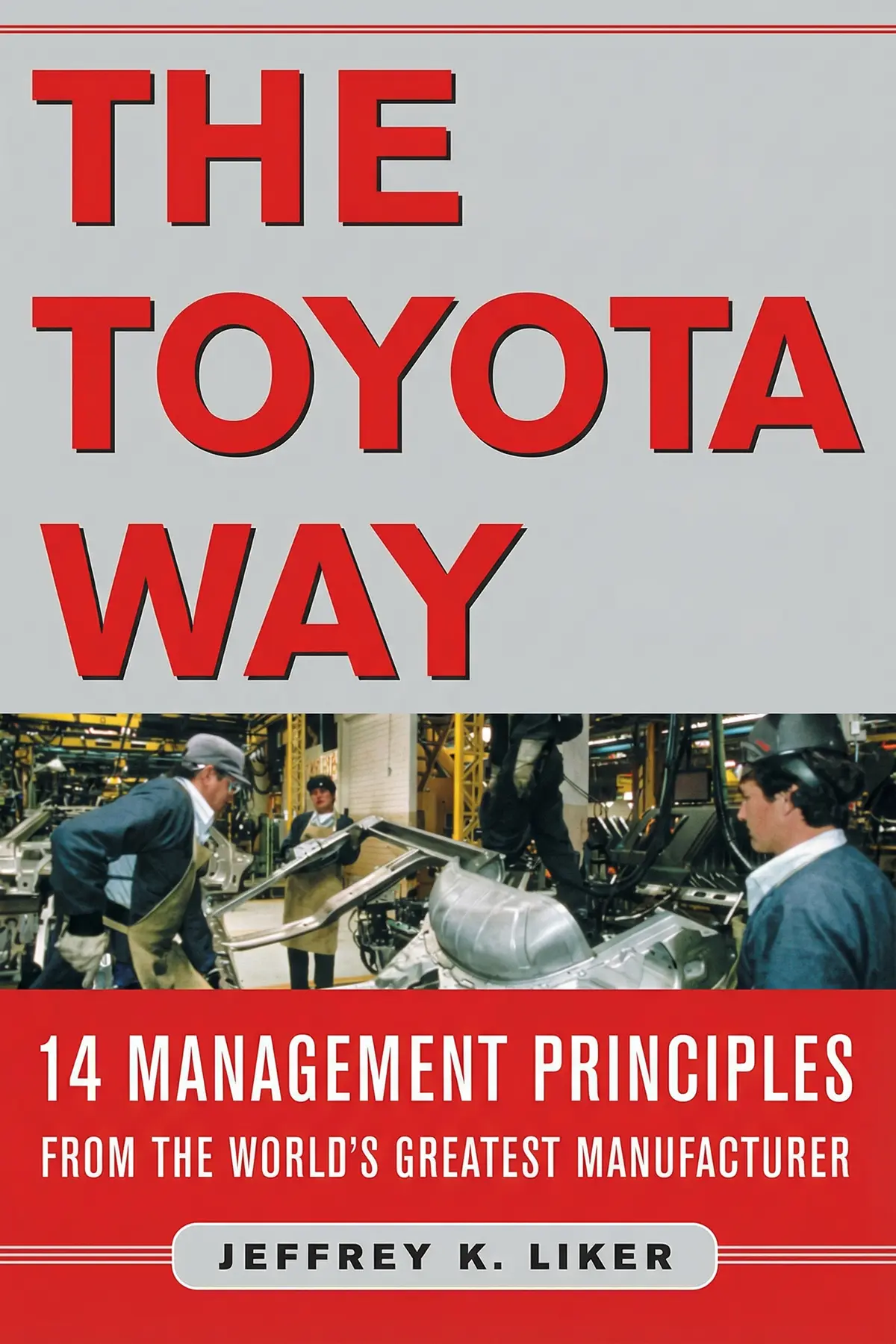
Table of Content
1. Introduction
1 min 08 sec
If you run a team or a business, you may know the pattern: a new method arrives, results jump for a quarter, then everything slides back. In The Toyota Way, Jeffrey K. Liker, an emeritus scholar of industrial and operations engineering at the University of Michigan, traces Toyota’s lasting edge to a seed planted in 1920, when Sakichi Toyoda was building a loom that stopped itself the moment a thread snapped. That idea, catch a problem where it starts before it spoils the cloth, still runs through the company his son Kiichiro founded, which now sells in more than 170 countries.
Liker’s case is that the famous tools are only the visible part. What makes them last is a patient philosophy: think long term, expose waste and problems at once, develop people and partners, and learn through small experiments. Copy the tools without it and the gains fade. By the end, you will be able to spot waste in your own work, run a better problem-solving conversation, and tell which improvements will actually hold.
2. Trade quick quarterly wins for lasting strength
2 min 06 sec
One carmaker spent its own resources helping a struggling rival, while another deal between two giants lost half a billion dollars in three months. The difference says a lot about how good decisions are timed.
3. Cut waste by making work flow
2 min 02 sec
Piles of half-finished work look like progress, and a team that is always rushing looks productive. Toyota treats both as warning signs, and it names three enemies that hide inside almost any busy operation.
4. Stop the line the moment something breaks
1 min 58 sec
Most organizations find defects at the end, when fixing them is expensive and blame is easy. A loom built more than a century ago suggests a different place to look, and a different person to trust.
5. Grow your people and your suppliers together
2 min 04 sec
Toyota saw the future of hybrid cars early but lacked a key piece of the technology. How it filled that gap, without simply buying it, shows what treating partners as partners really means.
6. Coach people to think like scientists
2 min 11 sec
Asking why five times sounds like rigor, yet Toyota warns against doing it by rote. Its alternative is slower at first, and it explains how a doubted hybrid car ended up as a profit engine.
7. Build your own lean culture, starting small
2 min 05 sec
Plenty of organizations have tried lean and watched it quietly fade within a few years. Liker names the missing ingredient, and it cannot be bought, borrowed or installed by a consultant.
8. Conclusion
1 min 11 sec
Liker’s book tells a single, slow story. A loom that stopped itself when a thread broke grew into a carmaker selling in more than 170 countries, and the logic never changed: find problems where they start, fix them while they are small, and let the people closest to the work make it better. The lean tools so many companies copy are the visible surface of that habit. Underneath sit patience, respect and a willingness to learn by trying.
That is why NUMMI could lift a rival while Daimler and Chrysler fell apart, and why a careful hybrid program became a profit engine while a bolder competitor struggled to deliver. Values held steady produced the results; the methods alone would not have.
For your own work, the starting points are modest. Go and see a problem before you explain it. Make waiting work and overloaded people visible. Pick one model area and run small experiments there, with the people who do the job, and keep your commitments to them when a quarter goes badly.
Sakichi’s loom did not prevent every broken thread. It made sure one break never ruined the cloth.
About this book
What is this book about?
Many companies try lean methods, enjoy a burst of better numbers and then watch the gains slip away. Jeffrey K. Liker sets out to explain why Toyota is different, tracing its approach back to a 1920 workshop where Sakichi Toyoda built a loom that stopped itself the moment a thread broke. Liker argues that Toyota's tools, from one-piece flow and pull production to andon lights and standardized work, rest on a deeper management philosophy. The company judges decisions by their long-term effect, treats workers and suppliers as partners to develop, and trains its leaders to coach scientific thinking instead of handing down answers. Stories such as the NUMMI plant shared with General Motors, the Panasonic battery venture behind the Prius and the contrast with Tesla's production troubles show the philosophy at work. Readers get a clear picture of how a lean organization actually runs and a realistic plan for starting their own: begin in one model area, learn by doing, and expect the change to take years.
Book Information
Who it's for
Founders and ops managers
Operations managers and founders whose improvement programs keep fading after a promising start.
Team leads
Team leads who want their people to solve problems instead of waiting for answers.
Curious about Toyota's success
Professionals curious how Toyota built quality, loyalty and supplier trust over decades.
About the Author
Jeffrey K. Liker
Jeffrey K. Liker holds emeritus status at the University of Michigan in industrial and operations engineering and is president of Liker Lean Advisors. The Toyota Way, published in 2004, has sold more than a million copies in 26 languages. He has coauthored further books on Toyota, studied Toyota Kata with Mike Rother, won Shingo Prizes for his research and was inducted into the Association of Manufacturing Excellence Hall of Fame and the Shingo Academy.
Ratings & Reviews
Ratings at a glance

What people think
Listeners consider this title essential reading for those curious about Lean manufacturing, as it offers thorough breakdowns of Toyota's techniques and top-tier explanations of Lean principles. Furthermore, the work earns praise for being easy to follow, well-structured, and worth the investment, with one listener mentioning it is especially helpful for industrial engineering courses. Listeners also value the narratives shared throughout the text, with one review emphasizing the inclusion of direct perspectives on Toyota's quality management framework.
Top reviews
Pia
Finally got around to reading this staple of industrial engineering, and it lives up to the reputation. Liker does a phenomenal job breaking down the 14 management principles that transformed Toyota from a small loom manufacturer into a global powerhouse. While some parts feel like a love letter to the brand, the first-hand accounts of their quality systems are incredibly valuable for any manager. I found the section on Genchi Genbutsu particularly striking—the idea that you must see the problem with your own eyes is lost in our modern remote-work era. It’s organized logically, making it a great reference even after you finish the initial read. If you want to understand why 'Lean' isn't just a buzzword, start here.
Show moreNina
Ever wonder why Toyota cars seem to last forever while other brands crumble? This book uncovers the 'secret sauce' by explaining their 14 principles in exhaustive detail. I was fascinated by the story of the engineer who drove across North America to understand the need for oversized cup holders before designing for that market. It shows a level of dedication to the customer that most companies only pretend to have. Personally, I think the focus on becoming a 'learning organization' is the most vital takeaway here. It’s not just about fixing errors; it’s about creating a system where errors are welcomed as opportunities for growth. It’s definitely a must-read for any aspiring leader.
Show moreKamol
The chapter on 'Heijunka' (production leveling) completely changed how I think about project management in my own office. Liker does an excellent job of showing that the Toyota Way isn’t just for people in hard hats; it’s a mindset for anyone who wants to deliver value. I love how he stresses that the process is just as important as the final result. There's something almost spiritual about their dedication to Kaizen and the constant pursuit of perfection. The book is well-organized and serves as an excellent presentation of Lean principles that are often misunderstood by other authors. It’s easily one of the most influential business books I’ve picked up this year. Highly recommended.
Show moreYongyut
Wow, what an eye-opener regarding the 'autistic-genius' nature of Toyota's operations. They truly do everything differently, from their refusal to overproduce to their obsession with finding the root cause of every single defect. This book captures the essence of a company that is never satisfied with the status quo. I found the 14 principles to be a fantastic roadmap for anyone looking to build a sustainable, quality-focused culture. Not gonna lie, it’s a long read and you have to be in the right headspace to tackle it. But if you are serious about operational excellence and want to learn from the best, you cannot afford to skip this. It’s a foundational text for a reason.
Show moreChon
As someone who works in manufacturing, I expected a technical manual, but what I got was a deep dive into corporate philosophy. The truth is, the 'Toyota Way' is more about culture than it is about assembly lines or robotics. Liker highlights how they prioritize long-term thinking over short-term financial gains, which feels revolutionary compared to typical Western quarterly-profit obsessions. My only gripe is that it can get a bit repetitive when discussing the elimination of waste. You might find yourself seeing 'muda' everywhere in your house after reading this, from how you load the dishwasher to how you organize your mail. It's a solid, practical guide that every MBA student should probably have on their shelf.
Show moreWipada
This book provides a comprehensive look at how a company's internal values dictate its external success. I particularly enjoyed the history of Kiichiro Toyoda and how he adapted Henry Ford’s ideas to fit a resource-poor post-war Japan. The concept of 'pull' systems versus 'push' systems is explained clearly enough for a novice to grasp. Frankly, some of the analogies feel a bit dated, and the tone is a little too uncritical of Toyota's flaws. Despite that, the practical advice on empowering employees to stop the production line when they see a defect is inspiring. It’s a dense read, but the organization into 14 distinct principles makes it much easier to digest in small chunks.
Show moreAurora
After hearing about Lean management for years, I finally decided to go to the source. Liker’s breakdown of the Toyota Production System is both informative and intimidating in its scope. It’s fascinating to see how they view inventory as a 'waste' that hides underlying problems, much like lowering the water level in a river to see the rocks at the bottom. The writing style is a bit academic, but the real-world examples from Toyota's plants in Kentucky and Japan keep it grounded. I didn't expect to learn so much about the transition from power looms to automotive manufacturing. It’s a heavy lift, but it provides a very valuable framework for anyone trying to streamline their own business processes.
Show morePriya
To be fair, it’s easy to see why this is considered a 'bible' in the manufacturing world. The depth of research is staggering, and Liker's access to Toyota insiders provides a level of detail you won't find anywhere else. I was particularly impressed by the sections on the Andon cord and how it empowers the lowest-level employees to take responsibility for quality. It’s a great reminder that people, not just machines, are at the heart of any successful operation. My only hesitation in giving five stars is the occasionally dry tone, which makes it feel a bit like homework. However, the value for money is high considering how much actionable advice is packed into these pages.
Show moreTantipat
Look, the content here is gold, but the prose is as dry as a desert in July. I read this for a professional development course and struggled to stay awake during the middle sections. Liker clearly knows his stuff, and the specific tactics regarding Heijunka and the Andon system are essential for anyone in operations. However, the book often gets bogged down in corporate-speak and anecdotes that feel a bit sanitized for a PR department. It’s a great resource to keep on your desk for occasional reference, but reading it cover-to-cover is a test of endurance. If you can push through the dense passages, you’ll find a blueprint for efficiency that actually works in the real world.
Show moreTippawan
I’ll be blunt: this could have been a 20-page white paper rather than a full-length book. While the core ideas of Lean manufacturing are brilliant, they are buried under mountains of filler and repetitive historical summaries. It honestly felt like reading a textbook where the author was getting paid by the word count. I appreciate the legacy of Taiichi Ohno, but I don't need to hear the same story about waste elimination five different times in three chapters. If you’re an industrial engineer, you might find the minutiae interesting, but for the average reader, it’s a slog. I’m giving it two stars because the principles themselves are life-changing, even if the delivery is incredibly tedious.
Show moreQuestions about this book
What is the main idea of The Toyota Way?
Jeffrey K. Liker argues that Toyota’s success rests on a management philosophy, not on a set of tools. The company thinks long term, builds quality in where work happens, develops its people and suppliers, and trains leaders to coach scientific thinking. Lean methods such as one-piece flow and pull production work because they sit inside that philosophy. Companies that copy the tools alone tend to see short gains that fade.
What are muda, muri and mura in the Toyota Way?
They are Toyota’s three enemies. Muda is overproduction, making parts before the downstream process actually needs them. Muri is overburden, pushing people or machines too hard. Mura is unevenness, swinging between rush and idleness. Toyota fights them with a pull system, where parts are made only when the next step asks, and with heijunka, which levels the production schedule so demand on people, machines and suppliers stays steady.
How can I apply the Toyota Way outside manufacturing?
Liker advises against cloning Toyota. Start with one model area, such as a single team or process, and learn by doing before spreading what works. Go and see problems firsthand before explaining them, look for work waiting between steps, and use a simple routine: set a direction, understand the current condition, define a near-term target and run small experiments toward it. Expect the cultural change to take years.
Why does the Toyota Way compare Toyota with Tesla?
Liker uses Tesla to show two routes to innovation. Tesla relied on a bold vision and an early lead in electric vehicles and disrupted the industry, but faced major quality and production problems that caused many delays. Toyota took a bold step into hybrids with the Prius, then refined it through steady experiments until it became a core profit driver. His point is that innovation needs to be balanced with stable, continuous improvement.
Readers also enjoyed



A Year with Peter Drucker: 52 Weeks of Coaching for Leadership Effectiveness
Joseph A. Maciariello





Acting with Power: Why We Are More Powerful Than We Believe
Deborah Gruenfeld

All In: How Great Leaders Build Unstoppable Teams
Mike Michalowicz
AUDIO SUMMARY AVAILABLE
Listen to The Toyota Way in 15 minutes
Get the key ideas from The Toyota Way by Jeffrey K. Liker, plus 5,000+ more nonfiction titles.
- 5,000+ titles
- Listen as much as you want
- 7-day free trial
- Cancel anytime









