

11 min 23 sec
Available in: English
The Third Perspective: Brave Expression in the Age of Intolerance
Shows why so many people edit themselves into silence, from schoolyard rules to online backlash, and how to speak honestly and wisely by naming fears, admitting fallibility, holding to values and practicing small daily courage.
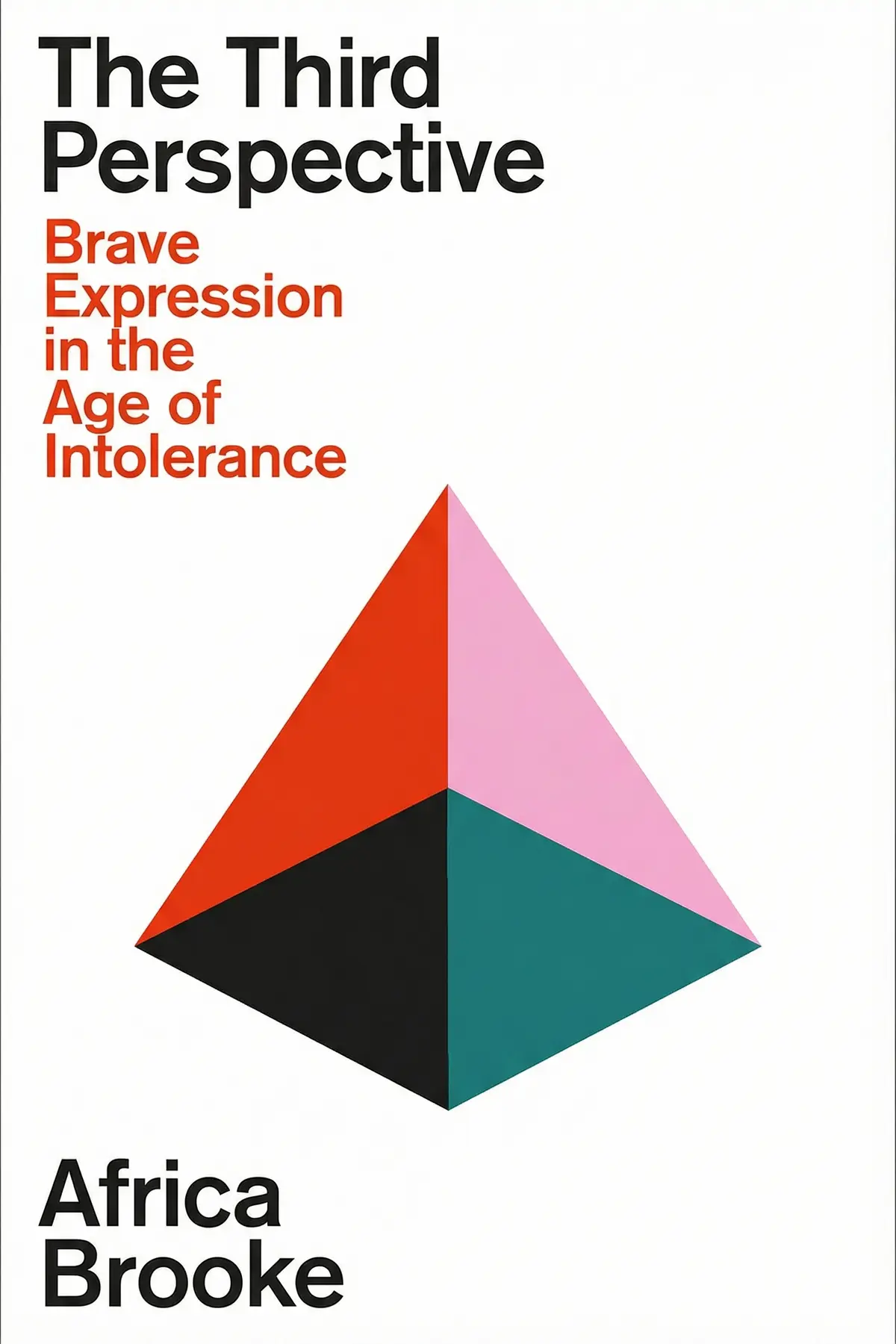
Table of Content
1. Introduction
56 sec
If you rehearse every sentence before you say it, or swallow an opinion to stay safe, you are paying a tax on your own voice. In The Third Perspective, coach and consultant Africa Brooke argues that this habit of self-censorship is learned, often as early as the schoolyard, and that it can be unlearned. Her goal is a voice that is honest and considered at once, one that says what you actually think while still weighing what your words do to others.
Brooke traces the silence to fear of judgment, made sharper by social media and the dread of public backlash. Then she offers a way out: name the fear, admit you might be wrong, anchor yourself in values and practice courage in small daily moments. The reward is a voice you can rely on in meetings, in hard debates and online, because it finally sounds like you.
2. Quiet the inner editor and speak freely
1 min 25 sec
Long before anyone posted online, a set of unwritten rules decided who in the room was allowed to talk. Brooke argues those rules never really expired, and they may still be running your meetings.
3. Name the fear behind your silence
1 min 28 sec
A vague worry is almost impossible to argue with, which is why it wins so often. Brooke’s first move is to make the fear specific, and one of her tests involves a page nobody else will ever read.
4. Speak your mind without ignoring its effect
1 min 35 sec
Once people stop holding back, some swing straight to saying everything. Brooke rejects both extremes and describes a third option that keeps your honesty intact while still caring how the words land.
5. Join heated debates without faking certainty
1 min 33 sec
When a controversy breaks, staying silent can be read as taking a side. Brooke argues the pressure to have an instant position is the real problem, and she offers a way to speak before you are sure.
6. Values that hold when pressure rises
1 min 38 sec
Opinions shift with every news cycle, and it is easy to drift along with them. Brooke uses one extreme case and several ordinary ones to show what it takes to stay put when compromise would be easier.
7. Build courage in small everyday moments
1 min 40 sec
Bravery usually gets pictured as a dramatic rescue or a grand stand. Brooke locates it somewhere far less glamorous, and argues that whether you have it depends mostly on what you practice.
8. Conclusion
1 min 08 sec
Brooke’s book adds up to a different picture of what speaking up means. Bravery, in her sense, is a steady match between what you think, what you value and what you say, delivered with enough care that people can actually hear it. Self-censorship, in her account, often has roots in the playground, where fitting in mattered and unspoken rules decided who got to speak. Those early patterns carry into adult life.
The practice starts small. Name the fear that keeps you quiet, whether it is judgment, exclusion or standing out, and test it somewhere safe, even in a journal no one will read. When a charged topic comes up, give yourself permission to say you are still learning instead of rushing to plant a flag. And now and then, hold your actions up against the values you claim, then close one gap in an ordinary moment: a comment in a meeting, or a mistake you admit out loud.
None of this requires becoming someone else. The voice you have been editing all these years was yours to begin with, and each small, honest sentence lets more of it through.
About this book
What is this book about?
Many people rehearse every sentence before they say it, or keep an opinion to themselves because the reaction feels too risky. Africa Brooke calls this self-censorship and treats it as a habit, not a fixed trait. In her account it grows from early social rules about who gets to speak, and it is sharpened by social media scrutiny and the fear of public backlash. Brooke does not ask readers to say everything they think. She describes a balance: a voice that stays true to what you believe while still weighing the effect of your words on others. Her method moves through four steps. Name the specific fear behind your silence and test it in safe settings. Accept that you will sometimes get things wrong, especially in polarized debates. Anchor yourself in clear core values. And treat courage as a skill built in ordinary moments, like speaking up in a meeting or admitting a mistake. Readers get practical reflections to try, a way to join charged conversations without faking certainty, and a steadier sense that what they say finally matches who they are.
Book Information
Who it's for
Professionals who keep quiet
Professionals who stay silent in meetings or online because they fear judgment or backlash.
Pressured to take sides
People who feel pushed to take instant sides in heated debates and want a calmer way to speak.
Words not matching values
Anyone who notices a gap between the values they hold and what they actually say.
About the Author
Africa Brooke
Africa Brooke was born in Zimbabwe and is based in London. She founded Africa Brooke International, where she serves as CEO and offers consulting and coaching to clients around the world, with a focus on self-sabotage and self-censorship. She hosts two weekly podcasts, Beyond the Self and Unthinkable Thoughts. Her views have appeared in publications such as the Guardian, and she has given keynote talks at venues including Cambridge University.
Ratings & Reviews
Ratings at a glance
What people think
Listeners find the book's message to be impactful and transformative, with one listener noting how it encourages radical responsibility for our personal outlooks. They value the clear writing style, which one listener characterizes as a masterpiece.
Top reviews
Pierre
A masterclass in radical responsibility that feels like a breath of fresh air in our current social climate. This isn't just another book complaining about 'woke' culture; instead, it’s a deep dive into why we silence ourselves and how to regain our integrity. Brooke’s focus on the 'grey areas' helped me realize how much I’ve been flattening my own opinions just to keep the peace. The exercises are actually useful, forcing you to look at your own insecurities rather than just blaming the internet. I’ve already recommended this to three friends who struggle with people-pleasing. It is a masterpiece of modern communication that everyone should read.
Show moreWipawan
Wow. This book hit me exactly when I needed it. As a chronic people-pleaser, the concept of the 'internal censor' felt like someone was finally reading my mind. Africa Brooke doesn't just point out the problems with our current culture; she offers a way to live within it without losing your soul. The focus on radical responsibility for our own views is life-changing. It’s not about winning arguments or being a 'maverick' in the sense of being a loudmouth; it’s about making sure your outward expression aligns with your core values. This is easily one of the most important books I’ve read this year. It’s practical, brave, and deeply necessary.
Show moreElan
Picked this up after seeing Africa Brooke’s viral posts, and it generally delivers on its promise to help you stop self-censoring. The way she breaks down the psychological pressure to fit into a mold is genuinely insightful. I specifically enjoyed the sections about how our digital selves often perform for an audience that doesn't really care about our nuance. My only real gripe is that it occasionally feels a bit repetitive in the middle chapters, almost like the editors were trying to stretch the word count. However, the practical advice on finding a 'third perspective' between total silence and aggressive shouting is something we desperately need right now. It's a readable, compassionate guide for those of us tired of walking on eggshells.
Show moreHiroshi
Ever wonder why you’re so afraid to post a harmless opinion online? This book gets to the heart of that anxiety. Africa Brooke explores the 'internal censor' that we all carry around, explaining how societal pressure and early life experiences combine to shut us down. It’s less about politics and more about the psychology of authentic expression. I appreciated that she doesn't encourage shouting from the rooftops but rather teaches discernment and wisdom. Sometimes, the best 'third perspective' is realizing you don't even need to have an opinion on every trending topic. It’s a solid, thoughtful read with a lot of practical value for anyone feeling overwhelmed by the modern digital landscape.
Show moreEnd
Finally got around to reading this, and I’m glad I did. It’s a very readable exploration of how we’ve lost the art of nuanced conversation. The author emphasizes that we don't have to choose between being a silent observer or a loud-mouthed contrarian. There is a middle path. I found the sections on 'Principles Worth Defending' particularly helpful for sorting out what actually matters to me versus what I'm just reacting to because of social pressure. Some of the anecdotes about people 'winning' against the internet mob felt a bit cherry-picked and idealistic, but the overall message of reclaiming your voice through radical responsibility is incredibly empowering.
Show moreChai
After hearing Africa on a few podcasts, I was curious to see if her ideas translated well to a full-length book. For the most part, they do. The writing is accessible and the tone is encouraging rather than judgmental. She does a great job of explaining how the anticipation of negative feedback keeps us in a state of hyper-awareness. I did feel that some chapters were stronger than others—the stuff on the 'digital self' was fascinating, while the parts on early life experiences felt a bit like filler for those already familiar with therapy. Still, it’s a great resource for anyone wanting to develop a more authentic voice and move away from either-or thinking.
Show moreTom
As someone who has followed Africa for years, I found myself a little underwhelmed by the prose in this debut. Don't get me wrong, the core message about breaking free from 'either-or' thinking is essential, but the writing style felt a bit generic and lacked the fire I’m used to seeing from her online. Chapters 3 through 6 were definitely the highlight, particularly the discussion on the digital landscape and why we owe the internet absolutely nothing. Other parts felt like they were treading very familiar ground in the realm of basic psychological counseling and yoga-adjacent mindfulness. It’s a good starting point for younger readers, but it felt a bit 'Self-Help 101' for me.
Show moreGabriel
Look, I appreciate what Brooke is trying to do here, but the 'Third Perspective' often felt like a fancy way of saying 'think before you speak.' While the book aims to be a guide for the 'maverick,' much of the advice leans heavily on basic mindfulness and breathwork techniques you can find in any standard wellness blog. To be fair, her perspective on self-censorship as a form of personal betrayal is powerful. I just wish the book had more depth and fewer cliches. It’s a decent introductory text for someone who feels paralyzed by social media scrutiny, but it doesn't quite live up to the revolutionary hype for me.
Show moreCarter
Frankly, I found this to be a bit of a confused mess. I went in expecting a sharp critique of cancel culture, but it pivoted quickly into a surface-level self-help book that feels targeted at a very specific Gen-Z demographic. While Africa Brooke is clearly talented, the writing here felt bland and laden with cliches about mindfulness and 'finding your voice.' The advice for people facing actual professional backlash—her maverick strategy—felt dangerously naive, almost like she's telling you to quit your job and follow your passion without a safety net. It ignores the reality that not everyone has a massive platform or a 'grift' to fall back on. Great concept, but the execution was a huge miss for me.
Show moreChon
Not what I expected, and to be fair, I'm quite disappointed. The book spends a lot of time talking about 'mavericks' and uses references like Logan Paul, which felt totally out of touch with the experiences of regular people who can't afford to be 'brave' without losing their livelihoods. It’s marketed as a way to navigate our intolerant age, but it reads more like a generic communication course for people-pleasers. The editors really let her down here; the structure is repetitive and the tone is surprisingly bland given how provocative her online presence usually is. If you're looking for deep sociological analysis or help after being canceled, you won't find it here.
Show moreQuestions about this book
What is The Third Perspective by Africa Brooke about?
The book is about self-censorship: the habit of editing or silencing yourself out of fear of judgment. Brooke traces it to early social rules, such as who got to speak at school, and to modern pressures like social media scrutiny and cancel culture. She then shows how to build a voice that is honest about what you believe while staying careful about how your words affect others.
Why do people censor themselves, according to Africa Brooke?
Brooke points to a mix of social pressure, personal insecurity and the expectation of negative reactions. She argues the pattern often starts in childhood, when fitting in could matter as much as good grades and the playground had unspoken rules about who could talk. Those rules, in her account, carry over into adult work and social life, and online backlash makes the stakes feel even higher.
How can I stop self-censoring?
Brooke suggests first naming the specific fear behind your silence, such as being judged, not belonging or being seen as different. Then step out of your comfort zone gradually: share an unpopular opinion with someone safe, or write in a journal without filtering. Over time, use a careful social filter that keeps your real thought while choosing words that fit the people and the setting.
How does the book suggest handling polarized debates?
Brooke warns against the rush to pick a side and label yourself before you understand an issue. She encourages accepting that you will sometimes be wrong, and giving yourself permission to say you are still learning. Treat discussions as shared spaces to explore. She also suggests recalling a time you kept quiet on a complex topic and imagining sharing your view while staying open to learning.
Who should read The Third Perspective?
It suits people who hold back their opinions at work, among friends or online because they fear the reaction, and people who feel pressured to take instant positions on charged topics. It also fits readers who want their words to match their values, and who are interested in treating courage as a skill built through small acts like speaking up in a meeting.
Readers also enjoyed









AUDIO SUMMARY AVAILABLE
Listen to The Third Perspective in 15 minutes
Get the key ideas from The Third Perspective by Africa Brooke, plus 5,000+ more nonfiction titles.
- 5,000+ titles
- Listen as much as you want
- 7-day free trial
- Cancel anytime









