

14 min 26 sec
Available in: English
The Story Factor: Inspiration, Influence, and Persuasion through the Art of Storytelling
Shows why stories persuade where facts fail and how to use them well: the six stories every speaker needs, how to perform them, how to listen first and how to reach resistant audiences with hope.
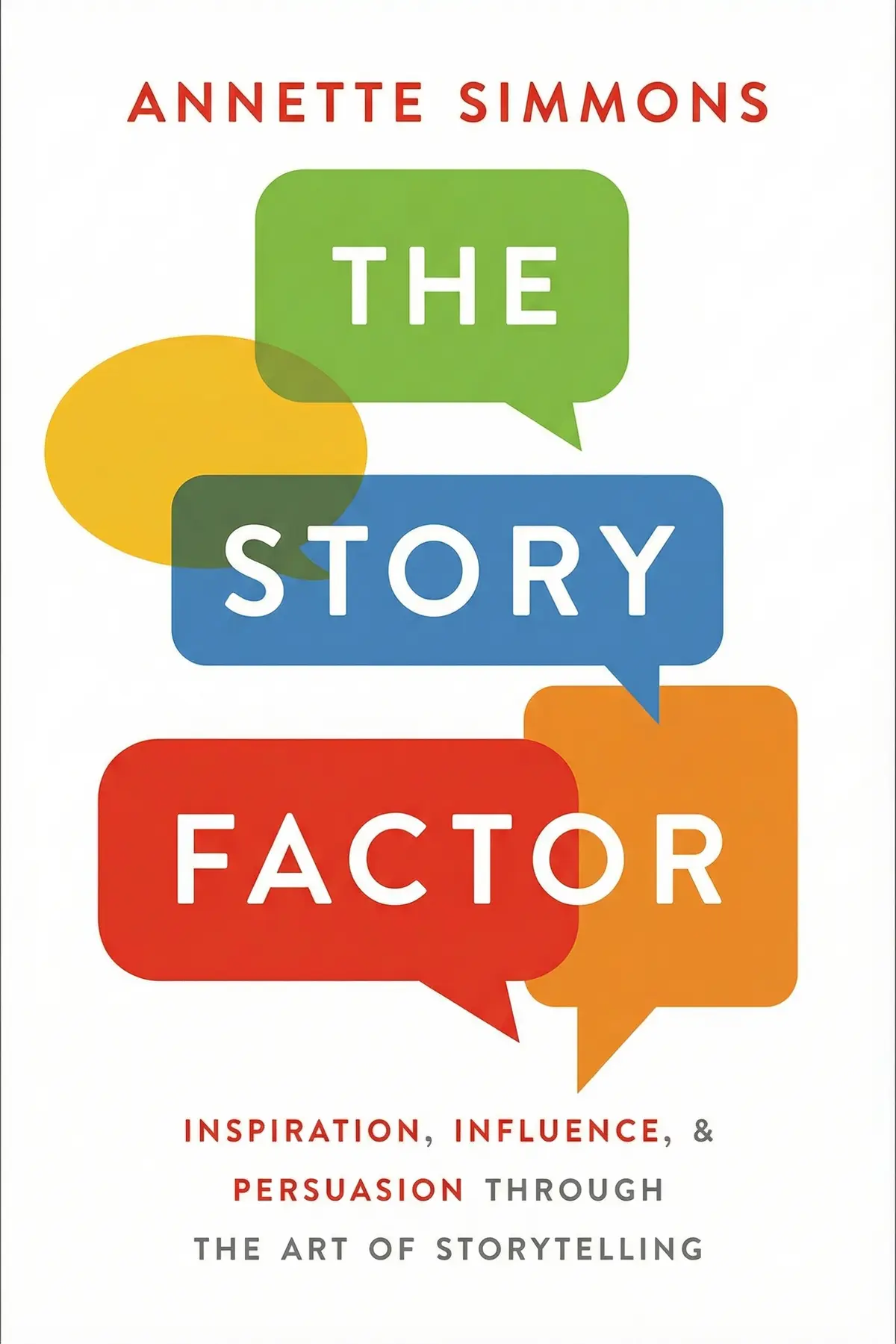
Table of Content
1. Introduction
1 min 01 sec
If your best arguments keep bouncing off people, the facts may not be the problem. In The Story Factor, consultant Annette Simmons argues that a story moves people where data stalls, because it lets them live through the facts as a kind of borrowed experience. Ideas people would not believe or care about suddenly matter, and whoever tells the story shapes how the facts are read.
That is the claim the whole book builds on: lasting influence comes from telling, and hearing, the right stories in a hopeful spirit. Simmons explains why stories slip past suspicion, which six stories a persuasive speaker needs, how to perform them with more than words, and why listening sometimes persuades better than talking. She also warns that every storyteller carries real responsibility. By the end, your next presentation, sales conversation or awkward email can be rebuilt around a few stories chosen on purpose.
2. Teach a lesson that outlives the moment
1 min 39 sec
An instruction fixes one problem and then fades from memory. Simmons shows why the slower route, a well-chosen tale about someone else, keeps working in situations you never thought to mention.
3. Lower your listener's guard with a story
1 min 47 sec
The moment people sense persuasion coming, they brace. Yet one simple announcement makes most audiences relax and stop analyzing, and what they hear next may end up feeling like their own memory.
4. Six stories that make a presentation persuasive
1 min 42 sec
A single good anecdote rarely wins a room. Simmons maps the separate doubts every audience carries, from who you are to the objection nobody has said aloud, and the kind of story each one needs.
5. Turn your voice and face into a stage
1 min 43 sec
Skip the names and numbers and offer one concrete sensory detail instead. Simmons argues that the details people keep are the ones that seem least important, and that your face and hands can do half the telling.
6. Win over a skeptic by listening first
1 min 34 sec
A customer says he hates the very car you want to sell him. The most persuasive response, in Simmons’s account, involves saying almost nothing at first.
7. Move reluctant audiences with hope instead of guilt
1 min 59 sec
Grim statistics feel like the strongest case for change, yet they often leave audiences frozen. Simmons explains what actually moves a resistant room, and what Abraham Lincoln’s answer about his enemies shows about positivity.
8. Choose the stories you and others live by
1 min 51 sec
Stories do not stop working when the speaker sits down. Simmons follows them into families, companies and history, and argues for a kind of thinking schools rarely teach.
9. Conclusion
1 min 10 sec
Simmons makes a simple promise and then raises the stakes. The promise is that a story will carry your point further than facts and figures, into minds that would resist a direct argument. The stakes arrive once you accept that promise: if stories work this well, the teller answers for what they make people feel and do. Lincoln turning enemies into friends and Hitler spreading fear sit at the two ends of the same tool.
The practical version begins with your next presentation. Write down the points you need to make, then find an anecdote that brings each one to life. Simmons shows how with organic food: drop the statistics on phosphates and vitamins, and describe a farmer who can hug his children the moment he comes in from the fields, because no dangerous pesticides cling to his clothes. In conversation, let the skeptic tell his story before you tell yours. And whenever you are tempted to motivate people with fear or guilt, look for the hopeful version of the same story.
Facts tell people what is true. A story lets them feel it, and that feeling is what gets them to act.
About this book
What is this book about?
Most people try to persuade with facts, figures and direct instructions, and they are puzzled when good arguments change nothing. Annette Simmons argues that the missing piece is story. A story lets listeners experience an idea as if it had happened to them. It makes a confusing world feel understandable, gets past people's suspicion of being sold to, and keeps working long after the speaker stops. Simmons turns that claim into a working method. She names six stories a persuasive speaker needs, from who you are to the objection nobody has voiced yet. She shows how voice, face, hands and small sensory details turn a story into something close to a performance. She explains why listening to the other person's story can move them more than telling yours, and how to reach audiences that seem cynical or indifferent without scaring them or making them feel guilty. The book also carries a warning. Stories shape families, companies and whole societies, so the people who tell them answer for what those stories teach others to believe.
Book Information
Who it's for
Managers and team leads
Managers and team leads whose instructions and values statements change little.
Facing skeptical, indifferent audiences
Salespeople, founders and presenters who meet skeptical or indifferent audiences.
Wanting a speech remembered
Anyone preparing a speech or pitch who wants it remembered after the slides are gone.
About the Author
Annette Simmons
Annette Simmons studied business at Louisiana State University, graduating in 1983, and then spent ten years in international business in Australia. She earned a master's degree in education from NC State in 1994 and founded Group Process Consulting in 1996. She has led storytelling seminars for years and has an interest in psychology. The Story Factor has appeared on a list of the 100 best business books of all time, and she is also the author of Territorial Games and A Safe Place for Dangerous Truth.
Ratings & Reviews
Ratings at a glance
What people think
Listeners consider the content educational and skillfully crafted, utilizing engaging anecdotes to highlight key concepts. Furthermore, they value the way it equips individuals to impact others and find the material very accessible. Nevertheless, opinions on the prose are varied, as some find the details precise while others argue they are too broad. Additionally, several listeners point out that the narrative begins to feel tedious around the midpoint.
Top reviews
Hugo
Ever wonder why some leaders command a room without shouting? Simmons argues it’s all about the story you tell, not the data you dump on people. I loved the breakdown of the six types of stories, especially the "Who I Am" and "Values-in-Action" categories. The Nelson Mandela anecdote near the end was a moving touchstone for the whole philosophy. To be fair, she gets a little philosophical at times, but the core message is empowering for anyone in a leadership role. This isn't just a business book; it's a toolkit for human connection. I feel much more confident about using narrative to bridge emotional gaps now.
Show moreManop
As someone who works in a data-heavy field, I found this book's emphasis on faith and belief to be revolutionary. We often assume that facts speak for themselves, but Simmons proves that facts need a story to survive. The "Why I Am Here" story type has already changed how I approach my quarterly presentations. I no longer just list my credentials; I explain the journey that led me to the problem we’re solving. Truth is, people value their own conclusions more than yours, and a good story lets them reach those conclusions naturally. This is essential reading for anyone who wants to move beyond simple information sharing.
Show morePakpoom
After hearing so much buzz about story-driven leadership, I decided to give Annette Simmons a shot. The way she describes an idea as a "resilient parasite" that sticks in the brain is exactly what I needed to hear for my branding projects. It’s empowering to realize that anyone can be a storyteller because it is our natural birthright. I particularly connected with the "Vision" story section, which helps bridge the gap between abstract goals and daily action. While the text is a bit disorganized at times, the emotional intelligence on display is truly impressive. This is a great read for anyone looking to inspire others without relying on dry data.
Show moreJonathan
Finally got around to reading this staple of communication literature. Simmons is a clear expert, and her writing is generally engaging, though it does drag slightly in the middle sections. The distinction between "push" and "pull" strategies really stuck with me as a copywriter. Frankly, we often try to force ideas on people when we should be inviting them in with a story. While I would have liked more granular, step-by-step instructions that I could apply to specific client pitches, the "Teaching" stories provided enough of a general framework to get started. It’s an informative read that shifts your mindset away from cold facts toward meaningful persuasion.
Show moreKung
The chapter on the six specific stories is worth the price of admission alone. I particularly liked the "I Know What You Are Thinking" category, which is perfect for disarming skeptics before they even speak. Simmons writes with a lot of heart, though she can lean into being a bit preachy about the "purity" of storytelling. I found the Pittsburgh butcher example very relatable for someone trying to humanize their professional background. It’s an easy read that focuses more on the spirit of the teller than the mechanics of the tale. If you want a rigid 1-2-3 guide, look elsewhere, but if you want inspiration, this is it.
Show moreEllie
Annette Simmons delivers a powerful argument for the emotional weight of narrative over the dry delivery of facts. The proverb about the man beating his horse was a standout moment that perfectly illustrated her point about consequences and influence. I found the section on "The Vision" story especially helpful for my current project at work. However, the book does get a bit preachy toward the end, and the writing style isn't always as crisp as I’d like. Still, the core idea that we are always "living our story" is a profound shift in perspective. It’s a solid 4-star read for anyone looking to increase their influence through authenticity.
Show moreFinn
Not what I expected when I picked this up for my marketing team last month. I was hoping for a technical manual on how to construct a perfect narrative arc, but Simmons intentionally avoids that. She actually compares dissecting a story to "dissecting a kitten" to see why it's cute—you lose the magic in the process. While I appreciate that sentiment, it makes the book feel a bit too abstract and disorganized for my taste. Look, there are some golden nuggets here about influence, but you have to sift through a lot of "water" to find them. It’s a decent philosophical look at the art, but not a practical guide for beginners.
Show moreSuphan
This book feels like it could have been a very impactful 50-page essay rather than a full-length volume. Don’t get me wrong, the initial concept of using narrative as a "pull" strategy is brilliant and well-explained. However, the writing gets extremely repetitive after the first few chapters, and I found myself skimming through several sections. She keeps telling us stories are powerful without giving us enough "how-to" meat to chew on. In my experience, the advice on being a better listener was a bit generic for a book specifically about storytelling. It’s an okay resource for general self-help, but it lacks the depth I wanted for professional development.
Show moreBella
In my experience, the first few chapters had me hooked, but the momentum died out pretty quickly. The author has a wealth of knowledge, yet the book feels like it’s constantly talking around the subject instead of diving in. I loved the "Who I Am" concept, but I wanted more examples of how to refine that story for different audiences. It’s a bit frustrating when a book about storytelling is this repetitive and, at times, quite dull. While it’s certainly informative about the "why," it leaves the "how" almost entirely up to the reader’s intuition. It’s a fine supplementary read, but it shouldn't be your only resource on the topic.
Show moreFatou
Look, I’m going to be blunt: I found this incredibly boring and far too vague to be useful. I came into this expecting specific techniques to sharpen my narrative skills for sales, but it felt more like a series of disjointed anecdotes. Simmons argues that storytelling is too instinctive to be modeled, which seems like a bit of a cop-out for an instructional book that promised to help me improve my professional influence. I much prefer Paul Smith’s "Lead With a Story" because it actually provides a structure you can follow. The "Story Factor" is just too philosophical and abstract for someone who needs practical results. Unless you enjoy wading through "water" and repetitive phrases about how "stories are cool," skip this one.
Show moreQuestions about this book
What is the main idea of The Story Factor?
Annette Simmons argues that stories influence people far more than facts and figures. A story lets listeners experience an idea as if it had happened to them, makes a confusing world feel understandable and gets past their suspicion of being persuaded. Because stories are this effective, she adds, the people who tell them carry real responsibility for what those stories teach others to believe and do.
What are the six stories in The Story Factor?
Simmons says a persuasive talk needs six stories: who you are, why you are there, your vision of the goal, a teaching story, a values-in-action story and an I know what you are thinking story. The last one raises the audience’s likely objections and answers them inside a story, so listeners feel understood and relax.
How do you persuade someone who disagrees with you, according to Simmons?
Listen to their story first. In her example, a car salesperson facing a customer who hates Toyotas asks why instead of arguing. Talking it through, the customer tests his own complaints and may concede the newer models could be better. He also feels he owes you the same courtesy, so he becomes an attentive listener when you finally tell your story.
Why does Simmons warn against fear and guilt in storytelling?
She argues that negative emotions such as shame, bitterness and anger make people defensive and rarely produce lasting change, while hope moves them to act. Her advice is to avoid depressing statistics when urging people to protect the planet, never act superior, never bore the audience, and look for the hopeful version of any story you tell.
How can I use The Story Factor in my next presentation?
List the key points you need to make and find an anecdote for each. Simmons’s example is promoting organic food: instead of statistics on phosphates and vitamins, describe a farmer who can hug his children straight after leaving the fields because his clothes carry no pesticides. Add a gesture, an honest expression and one concrete sensory detail to make the story stick.
Readers also enjoyed





AUDIO SUMMARY AVAILABLE
Listen to The Story Factor in 15 minutes
Get the key ideas from The Story Factor by Annette Simmons, plus 5,000+ more nonfiction titles.
- 5,000+ titles
- Listen as much as you want
- 7-day free trial
- Cancel anytime









