

A Theory of Justice
John Rawls
 English
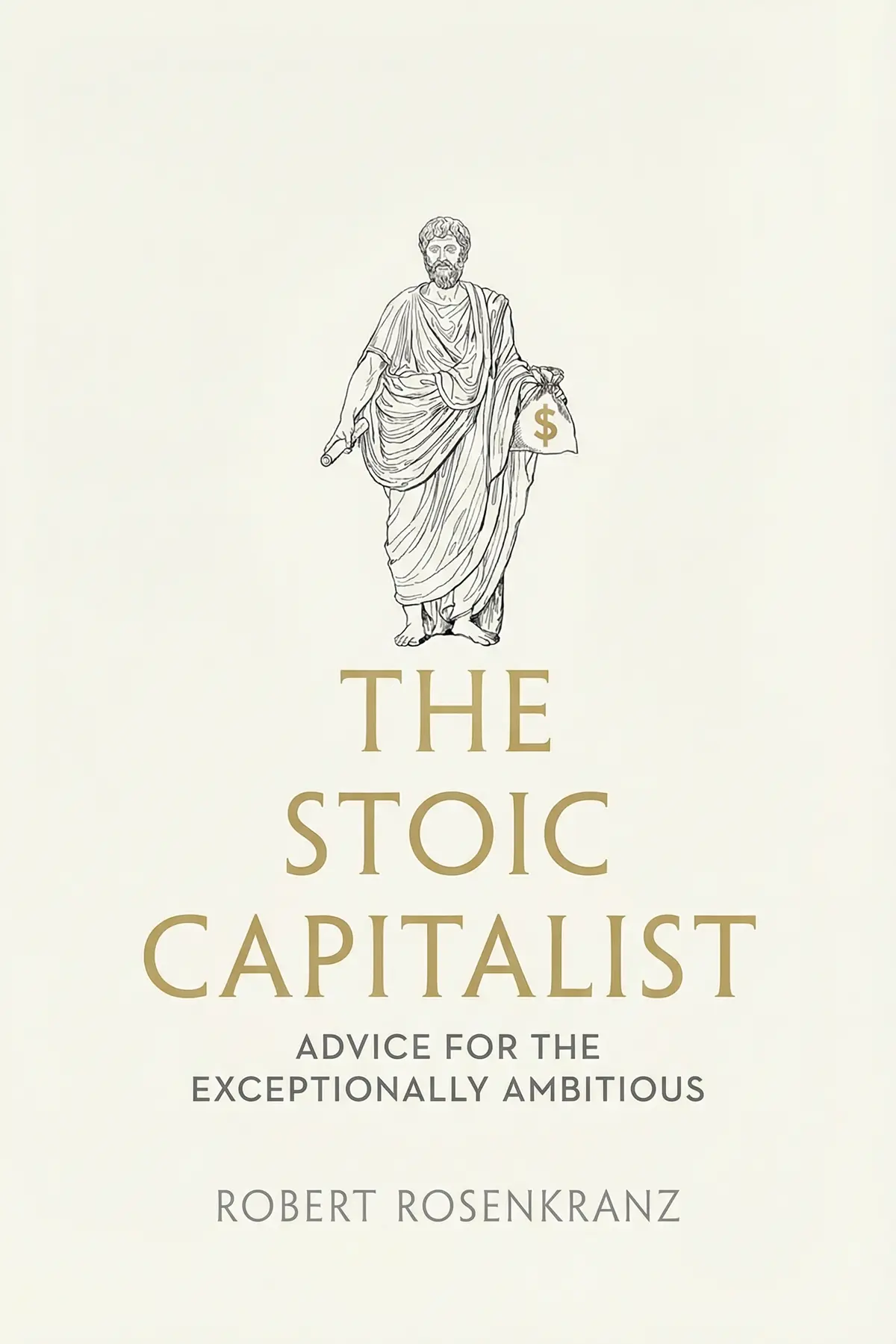
Shows how ancient Stoic habits, such as separating facts from interpretation and adapting to change, can steer big ambition, drawing on a financier's path from teenage stock picker to insurance chief and philanthropist.
59 sec
Ambition often comes with a bill: burnout, tunnel vision, or success that feels strangely hollow. In The Stoic Capitalist, financier Robert Rosenkranz argues that an old philosophy can pay it. His first lesson is that what happens to you matters less than how you read it, an idea he traces from Seneca to modern cognitive behavioral therapy.
His case is that big ambition and a settled mind can grow together when reason, not impulse, does the steering. The proof is his own life: a boy from an unsteady Manhattan home who ran a small stock fund at 14 and later built an investment business that turned $20 million into more than $5 billion. From that story come working habits for reading setbacks, choosing partners, building an honest team, spending money with meaning and protecting the one resource no deal can replace, your time.
1 min 27 sec
A boy in an unstable Manhattan home decided that adults did not always know best. What he did next, with a stack of biographies and a habit of doubt, shaped everything that followed.
1 min 42 sec
Two thousand years before modern therapy, a group of ancient thinkers spotted the same trap that makes setbacks feel worse than they are. Rosenkranz turned their insight into a working set of rules.
1 min 36 sec
At 14, Rosenkranz made money for his family on a scheme he barely understood. The way he responded to that near miss set his course toward Yale, Harvard Law and a Cold War think tank.
1 min 37 sec
Some of Wall Street’s top firms would not hire Jewish people, and the alternatives felt just as confining. Rosenkranz’s answers to that wall, and later to a boss’s warm praise, came from one consistent way of thinking.
1 min 40 sec
Wall Street’s standard deal let firms keep a share of the gains and walk away from the losses. Rosenkranz offered a partner something far riskier, and his first deal promptly collapsed.
1 min 29 sec
When his industry changed in a way that did not suit him, Rosenkranz stopped competing in it. The company he built next grew $20 million into over $5 billion by backing boutique investment firms like a talent agency.
1 min 37 sec
Rosenkranz funds a huge art space in New York and supports elite universities, yet he refuses to call it giving back. His blunter label sounds bad until he explains it with help from My Fair Lady.
1 min 34 sec
A man raised a Democrat who later turned Republican and ended up feeling politically abandoned built a stage where people disagree without contempt. His parting advice concerns a resource that even a large fortune cannot replace.
59 sec
Rosenkranz’s life makes an unusual case: the drive to win big and the wish to stay calm can feed each other. The boy who hated his mother’s storms became an investor who stayed level through a failed record jacket business, a hiring market closed by prejudice and an industry that outgrew him. Each time he looked at the facts, set his first reaction aside and chose the response that served the long game.
The habits travel well beyond finance. When a setback lands, separate what happened from the meaning you added, and keep the calmer reading if the facts allow it. When you ask someone to trust you, carry part of the risk yourself, as he did with Mailman. And when your calendar fills, give away every task another person can do reasonably well, then spend what is left on work and causes you care about.
In his account, wealth was always renewable. The hours never were, and he treats them as the scarcer of the two.
Ambition often brings burnout, tunnel vision or wealth that feels empty. Robert Rosenkranz, a financier who led an insurance company from 1987 until 2018, argues it does not have to. His model is the ancient Stoics, whose stress on reason, emotional control and acceptance of change he finds echoed in modern cognitive behavioral therapy. The book is part memoir and part philosophy. Rosenkranz traces his own path from an unsettled childhood in 1950s Manhattan to running a small fund at 14, studying at Yale and Harvard Law, working at the RAND think tank and building an investment business that grew $20 million into more than $5 billion. Along the way he shows how Stoic thinking shaped his response to antisemitism in hiring, his unusual partnership terms, a company culture built on admitting mistakes, and his philanthropy. Readers get working principles for ambitious people: read setbacks calmly, share risk to earn trust, adapt when an industry shifts, give to causes that carry personal meaning, debate without contempt and treat time as the one resource money cannot replace.
Ambitious professionals and founders who want to keep climbing without burning out.
Young investors curious how a teenage stock picker built a fortune slowly and carefully.
Leaders who want a team culture where people admit mistakes and ask for help.
After studying economics at Yale, Robert Rosenkranz went on to Harvard Law School. He started out as an economist at the RAND Corporation, researching foreign policy and municipal finance. He was chief executive of the insurer Delphi Financial Group from 1987 until 2018 and has chaired the investment firm Delphi Capital Management. Through The Rosenkranz Foundation he backs the arts, education and public policy, and he takes part in the Open to Debate series.
Listeners find that perspectives vary regarding the book’s narrative focus, with some feeling the content acts more like a self-absorbed personal history than a dedicated manual on philosophy. However, many value the author’s authentic perspectives on corporate strategy and his systematic approach to making logical decisions in the finance sector. They also appreciate the practical guidance on skill development and raising capital, with one listener noting the book offers a useful blueprint for the "exceptionally ambitious." Additionally, they highlight the compelling writing quality and the author’s ability to blend modern-day drive with the value of intellectual patience.
Finally got around to reading Rosenkranz’s take on the intersection of wealth and wisdom, and it did not disappoint. While many modern business books feel like recycled blog posts, this provides a genuine blueprint for the exceptionally ambitious. He doesn't just talk about money; he dives deep into the necessity of intellectual patience and the importance of a methodical approach to leveraged buyouts. Frankly, the way he explains rational decision-making as a tool for navigating the high-stakes finance world is masterclass material. The prose is engaging and flows well, making even the technical aspects of capital raising feel accessible. It is a rare treat to see how a high-level career can be built on such a solid foundation of logic and intellect.
Show moreA rare, transparent look into the mind of a master investor who actually understands the value of intellectual patience. I loved how Rosenkranz detailed his strategy of reading biographies to understand wealth creation; it’s a methodical approach that few people have the discipline to follow. The book successfully merges modern ambition with a calm, rational mindset that avoids the confrontational nature of today’s politics. Whether he's discussing photography or leveraged buyouts, his voice remains steady and insightful. For the exceptionally ambitious reader, there is a goldmine of signal here regarding how to structure a life and a career. It’s more than a memoir; it’s a blueprint for a certain kind of excellence.
Show moreAs someone working in the private equity space, I found the early chapters regarding skill development and market efficiency surprisingly tactical. He offers high-signal advice on things like hiring partners and the nuances of raising capital that you just don't get from younger authors. It's a solid merge of modern ambition and traditional discipline. However, I’ve got to say the narrative balance is a bit off. Some chapters feel scattered, jumping from photography to tax law without much of a bridge. Despite the occasional bragging in the latter half, the core lessons on avoiding anger and accepting the world as it is are valuable. It’s a pragmatic look at how to maintain a cool head while chasing massive success.
Show morePicked this up after hearing about Rosenkranz's career through various finance circles, and I found his methodical approach to life quite refreshing. The book focuses heavily on his time in finance, using the investment world as a backdrop for his broader principles of rational decision-making and patience. I appreciated the specific details on LBOs and how he analyzed biographies of millionaires to map his own path. In my experience, most business memoirs are either all fluff or all numbers, but he strikes a decent balance here. My only gripe is that the ending feels less self-aware than the beginning, bordering on a vanity project. Still, the practical advice for the ambitious makes it a worthwhile addition to your shelf.
Show moreRosenkranz offers a fascinating blueprint for those who value logic over emotion in the high-stakes world of finance. The way he applies rational decision-making to everything from his career to his art collecting is truly impressive. I particularly liked his focus on avoiding anger and accepting the world as it is. It's a very methodical way to live. Granted, the book is 80% about his career and can feel a bit self-indulgent at times, especially toward the end. But the signal-to-noise ratio is high if you’re interested in finance and personal development. If you want to learn how a successful person actually thinks, skip the fluff and read this.
Show moreThe title is a bit of a misnomer if you’re looking for a deep dive into Marcus Aurelius or Epictetus. To be fair, Rosenkranz is a good writer, and his stories about the art world and philanthropy are interesting, but the Stoicism feels like a retrospective label. He seems more like a very smart, methodical businessman who happened to find parallels in philosophy later in life. About 80% of the book is a personal memoir of his career in finance. I found the sections on business strategy insightful, yet the second half of the book drifts into a tone that feels slightly self-indulgent and a bit too proud of his own successes. It’s worth a read for the business acumen, but don't expect a manual on ancient philosophy.
Show moreEver wonder how a billionaire retrospectively justifies their path? This book gives you the answer, though it might not be the one you expected. It is nominally about Stoicism, yet the focus is overwhelmingly on his professional biography and his specific triumphs in the 80s and 90s. The writing is polished, but the structure is scattered across various interests like art and politics. Not gonna lie, I felt a bit of a 'bait and switch' regarding the philosophical content. He pushes the idea of using intellect and morality as blueprints, which is great, but the execution feels more like a highlight reel of his life. It’s an interesting look at a successful career, but the Stoic guidance is thin.
Show moreLook, the business advice here is top-tier, even if the philosophical grounding feels a bit thin. I appreciated the time he took to write down lessons on things like market efficiency and tax strategies, which are often ignored in 'mindset' books. But I found his tone to be increasingly irritating as the chapters progressed. It starts with genuine insights but ends with a level of pride that doesn't feel very Stoic at all. The sections on his art collection and philanthropy felt more like bragging than teaching. Personally, I would have preferred more about how he handled failure rather than a list of his greatest hits. It’s a decent memoir, just take the 'Stoic' part with a grain of salt.
Show moreAfter hearing Ryan Holiday mention this, I expected a guidebook, but I got a biography instead. Rosenkranz is clearly a deep thinker with a good business brain, and his prose is actually quite engaging. However, the book feels like he retrospectively fitted Stoic labels to what he was doing anyway. Most of the content is about his specific business dealings, which might be too niche for some. I did value the advice on raising capital and developing critical skills early on. But, to be fair, the second part of the book goes into a lot of self-congratulatory territory. It’s a good memoir of a 'great man,' but as a guide to Stoicism, it falls short.
Show moreThis book exemplifies the problematic trend of 'capitalist stoicism' where ancient virtues are stripped of their communal focus and repurposed for narcissistic selfishness. Rosenkranz clearly has a brilliant business brain, but his writing comes across as incredibly self-indulgent. Every success is framed as a triumph of his unique intellect, while the failures are glossed over with a detached, 'stoic' shrug. Truth is, it feels more like a platform for him to showcase his highlights rather than to teach the reader anything applicable. The chapter on raising children felt particularly out of touch with reality. If you want a memoir of a wealthy financier, this is fine, but it’s definitely not a guide for living a virtuous life.
Show moreRobert Rosenkranz argues that great ambition and personal steadiness can go together when Stoic thinking guides the pursuit of success. Mixing memoir and philosophy, he follows his own path from a turbulent childhood to a career in finance and philanthropy, showing how principles such as separating facts from interpretation, adapting to change and serving the common good shaped his decisions.
He sees a direct line between them. Seneca treated philosophy as a practical toolkit for living, and the Stoics held that our reactions depend on how we interpret events. Cognitive behavioral therapy, one of the most respected approaches in mental health, teaches the same idea: feelings are driven largely by our reading of what happens. Rosenkranz uses this to separate facts from the stories we add.
Several come from his deals. He offered partner Joe Mailman an even split of profits and losses instead of the usual 20 percent share of gains, building trust through shared risk. When private equity changed in the late 1980s, he adapted and built Delphi, with a culture of admitting mistakes and an investment team that backed boutique firms, growing $20 million into more than $5 billion.
He follows the Stoic concern with using time well. His rule is to prioritize ruthlessly and delegate aggressively: if another person can do a job well, or even reasonably well, pass it on, and if no one can, find a better person instead of supervising poorly. His parting message is that money can always be earned again, while time cannot.
It suits ambitious professionals, founders and investors who want success without losing their calm or their sense of purpose. Leaders will find a model for an honest team culture, younger readers will see how one financier built wealth step by step, and anyone tired of angry public debate will find his case for settling arguments with facts.
John Rawls


Richard Wiseman






William B. Irvine

AUDIO SUMMARY AVAILABLE
Get the key ideas from The Stoic Capitalist by Robert Rosenkranz, plus 5,000+ more nonfiction titles.









