

13 min 18 sec
Available in: English
The Soft Edge: Where Great Companies Find Lasting Success
Shows why strategy and efficient execution only make a company good, and how building trust, learning, small diverse teams, taste and a clear story makes it great and hard to copy.
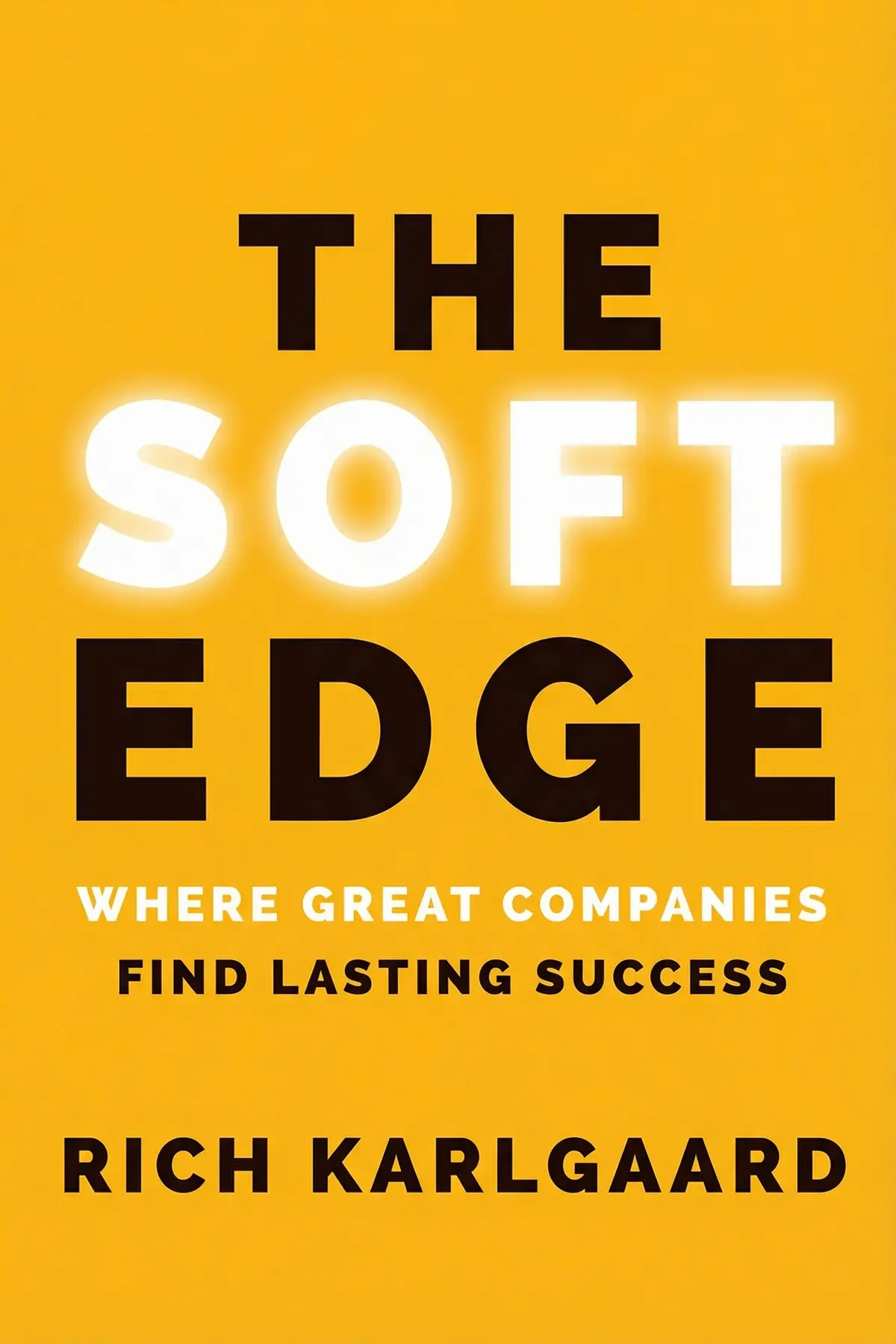
Table of Content
1. Introduction
1 min 04 sec
If your company runs on spreadsheets and still feels interchangeable, the missing piece may be the part no spreadsheet shows. In The Soft Edge, Rich Karlgaard, who became publisher of Forbes in 1998, argues that strategy and sharp execution only make a business good, and that great ones are set apart by something harder to count. He calls it the soft edge: the human meaning a company carries for the people who work there and the people who buy from it.
Karlgaard’s claim is that this soft side rests on five supports you can deliberately build: trust, smarts, teams, taste and story. Each one comes with cases, from an insurer that has guarded its customers’ confidence for 157 years to a software firm that cut its development time roughly in half by shrinking its teams. By the end, you will have a way to check which of the five your own organization is starving, and a few moves, like the two-pizza team, that you can start on Monday.
2. Spot the side of your company no chart shows
1 min 58 sec
Two companies can share the same market, the same data and the same efficient operations, yet only one of them becomes the name people remember. The difference sits in a part of the business most leaders never measure.
3. Earn the trust that outweighs product quality
1 min 52 sec
An international survey found that one thing shapes a company’s reputation more than how good its products are. An insurer and a tech firm in the middle of layoffs show how to earn it from both sides.
4. Turn every mistake into the next improvement
1 min 47 sec
Some companies always seem one step ahead of everyone else. Their advantage has little to do with brilliant hires, and a celebrated chef and a famous hospital show where it really comes from.
5. Keep teams small enough to share two pizzas
1 min 48 sec
Porsche and a German software maker changed one simple thing about how they organized their people, and the results showed up in production, profits and months saved. The change costs nothing to try.
6. Design products customers feel smart owning
1 min 46 sec
Two products can do exactly the same job while only one makes people excited to own it. A thermostat in a bamboo box and a chain of Italian-style cafés reveal what the winner has.
7. Build a company story people can retell
1 min 50 sec
One insurer makes its hiring five times more expensive on purpose, just to protect the story it tells about itself. Karlgaard explains why that trade can be worth it, and the one mistake that ruins a good story.
8. Conclusion
1 min 13 sec
Karlgaard’s argument comes down to a plain observation about competition. Strategy and execution can be copied, and data now gives every company a clear view of its hard edge. What is far harder to copy is the human layer: whether staff believe their leaders, whether a team learns from its errors, whether a product feels right in the hand and whether the company knows its own story. That layer is the easiest to neglect, and many businesses ignore it entirely. Yet Northwestern Mutual and Apple show it can win loyalty and financial gains at the same time.
The work can start small. Look at the size of your next project team, and if two pizzas would not feed it, split it and mix the skills on each half. When news is bad, deliver it in person. After the next mistake, say out loud what it taught you, and borrow one practice from an industry far from yours, as Mayo Clinic did with hospitality. Then check whether your company’s story still fits in a few plain sentences.
The Sauber engineers can hand their driver every number they have. Someone still has to take the corner at 200 miles per hour, and that someone is the soft edge.
About this book
What is this book about?
Most business thinking centers on two things: choosing the right strategy and executing it efficiently. Rich Karlgaard accepts that both matter. He argues, though, that they only make a company good. With data now giving every firm a sharp view of its own operations, the companies that stand out are the ones that also tend the human side of the business, which he calls the soft edge. Karlgaard pictures a company as a triangle. Strategy is the base, the hard edge of execution is one side and the soft edge is the other. He breaks the soft edge into five pillars: trust, smarts, teams, taste and story. Each one is illustrated with real companies, including Northwestern Mutual, NetApp, Momofuku, Mayo Clinic, Porsche, SAP, Nest Labs, Apple and Starbucks. Readers get a practical way to check which of the five pillars their organization is neglecting, along with concrete moves to strengthen each one, from delivering bad news in person to keeping teams small enough for two pizzas to feed.
Book Information
Who it's for
Leaders of efficient companies
Founders and managers whose company runs efficiently but still feels easy to replace.
Team leads
Team leads trying to speed up slow, crowded projects and keep trust through hard times.
Marketers and product teams
Marketers and product people who want their brand and design to carry real meaning.
About the Author
Rich Karlgaard
Rich Karlgaard has worked as an entrepreneur, publisher, columnist, angel investor, board director and speaker, and he became publisher of Forbes magazine in 1998. He has also advised the Forbes School of Business and Technology. He has written three books: Life 2.0, which reached the Wall Street Journal business bestseller list, The Soft Edge, and Late Bloomers, about patience in a world focused on early achievement.
Ratings & Reviews
Ratings at a glance

What people think
Listeners find the book to be skillfully written and easy to follow, specifically enjoying its approachable, conversational tone. They find the content insightful; one listener emphasizes the focus on culture, while another mentions how it serves to complement hard-edge leadership. Furthermore, the work is praised for upholding a "Soft Edge Excellence" approach, and listeners are engaged by the good storytelling.
Top reviews
Yaowares
The chapter on 'Story' completely changed how I look at our internal communications and corporate mission. Rich Karlgaard has a gift for taking these intangible concepts—things like trust and team chemistry—and showing exactly how they impact the bottom line. I loved the idea that demanding great performance is actually a form of high-level respect; it’s a 'soft' skill that has very 'hard' results. The book flows like a well-paced novel, which is rare for business literature coming from a Forbes publisher. It highlights how 'Soft Edge Excellence' isn't just about being nice, but about building a foundation that can withstand the pressures of a tech-driven market. This is a must-read for any leader who feels like they've mastered the numbers but are still struggling to get their team truly engaged. Simply superb work.
Show moreWatcharaporn
Picked this up during a cross-country flight and ended up finishing the whole thing before we touched down. Karlgaard is a master storyteller, and he uses that skill to demonstrate why 'Story' itself is a pillar of great leadership. I was especially moved by the section on teams and the idea that high expectations are the highest compliment you can pay a colleague. It really reframes the way you think about accountability and culture. The book isn't just another dry business manual; it’s an entertaining exploration of what makes companies human. It perfectly balances the need for precise execution with the need for core values. If you're looking for a way to stay competitive in an age where technology is a commodity, this is the blueprint you need. Definitely keeping this one on my shelf for future reference.
Show moreBond
Wow, the author really nails the intersection of culture and profit in a way that feels practical rather than just aspirational. Most CEOs are uncomfortable talking about the language of the soft edge because they can't attach an immediate ROI to it, and Karlgaard addresses that head-on. By breaking it down into Smarts, Teams, Trust, Taste, and Story, he gives us a vocabulary to discuss things that are usually dismissed as 'touchy-feely.' I loved the connection he drew between genuine internal trust and the speed of innovation. It makes so much sense when you see it laid out like that. The book is well-written, fast-paced, and filled with insights that apply to any industry. It’s a brilliant reminder that at the end of the day, business is still about people.
Show moreMia
After hearing so much about the hard edge of data and logistics, this was a refreshing deep dive into the human elements that actually sustain a company. Karlgaard argues that while strategy and execution are the base, the 'Soft Edge'—consisting of trust, smarts, teams, taste, and story—is what differentiates the greats from the merely good. I particularly enjoyed the chapter on 'Story' as a narrative with conflict; it made me realize how a vision statement can actually move people if it isn't just corporate jargon. The writing is incredibly smooth and conversational, making it easy to finish in a few sittings. While some of the case studies felt a bit like common knowledge to a seasoned manager, the way he ties them back to the 'triangle' framework is genuinely helpful. It is a solid read for anyone looking to balance out their technical skills with some much-needed cultural perspective.
Show moreDivya
Ever wonder why some companies thrive while others with better technology and more funding fail miserably? This book argues that the difference lies in the soft edge, and Karlgaard provides a compelling case for why things like trust and storytelling are non-negotiable for long-term success. The conversational style makes the complex topics of organizational health feel accessible and even fun. I found the anecdotes about currently successful companies to be the highlight, providing real-world context for the five pillars. My only minor gripe is that the book leans heavily on qualitative observations rather than hard data, but that’s almost the point of the 'soft edge' anyway. It’s a great companion piece to more traditional, strategy-heavy business books. It reminds us that without a relationship with your employees and customers, execution alone won't save you.
Show moreManop
Not what I expected from the publisher of Forbes, but in the best way possible. Instead of just talking about the 'Hard Edge' of supply chains and ROI, Karlgaard focuses on the soul of the company. The writing style is very engaging—almost like sitting down for a long coffee with a very smart mentor. I found the section on 'Smarts' particularly interesting, especially the distinction between individual IQ and the collective intelligence of a team. While some parts of the 'Taste' chapter felt a bit repetitive, the overall message is powerful. In the real world, strategy alone isn't enough; you need that soft edge to truly endure. It’s a quick, insightful read that I’ve already recommended to several colleagues in my department. Great work on highlighting what really matters for lasting success.
Show moreRungrat
Karlgaard’s writing is undeniably smooth, but I found myself wondering if he was just dressing up old management concepts in shiny new clothes. The book is what I would call high-level infotainment—it’s pleasant to read and features several intriguing anecdotes about companies like Specialized, but it lacks the empirical rigor of something like Jim Collins’ work. To be fair, the author admits to taking a more qualitative, subjective road, which makes for a better narrative but perhaps a less actionable manual. I liked the focus on 'Taste' as a competitive advantage, even if it felt a bit abstract at times. It’s a decent book for a long flight when you want something professional but not overly taxing on the brain. It didn't revolutionize my worldview, but it served as a good reminder that people and culture are the real engines of innovation.
Show moreNatchaya
As someone who usually gravitates toward data-driven strategy and supply chain management, I appreciated the attempt to quantify the unquantifiable here. The framework of the 'triangle'—Strategic Base, Hard Edge, and Soft Edge—makes a lot of sense in theory. However, some sections were a little too 'soft' for me, particularly the parts on 'Taste' and 'Style,' which remained frustratingly intangible throughout the chapter. I did enjoy the focus on how trust acts as a lubricant for innovation, which was an insight I hadn't fully considered before. The truth is, the book is a pleasant, easy read that highlights the importance of keeping people in the forefront of your business plan. It’s hit or miss depending on the chapter, but the overarching theme is important enough to warrant a look if you have the time.
Show morePongpan
Look, the central premise of the book—that culture and values are often neglected because they are hard to measure—is absolutely correct. Karlgaard does a fine job of illustrating this through various anecdotes and his five-pillar system. But I couldn't help but feel that he was occasionally just putting new labels on very common subjects within management. The chapters on 'Trust' and 'Teams' cover ground that has been explored extensively by other authors, sometimes more effectively. To be fair, his passion for the subject is infectious, and the book functions well as a high-level overview of why 'soft' skills matter. It’s a good entry-level book for a young professional or an intern, but it might not offer enough new 'meat' for a seasoned executive. It’s a solid 3-star read for me.
Show moreWatchara
Frankly, this was a bit of a disappointment given the hype and the endorsements from big names like Tom Peters. It felt very basic, and I honestly think you could gloss over the first twenty pages and get the gist of the entire philosophy without missing much. Most of the advice boils down to 'be a good leader and care about your culture,' which isn't exactly groundbreaking in the modern business world. The stories are well-told because Karlgaard is a talented writer, but they felt more like long-form magazine profiles than deep analytical dives. If you are brand new to management, you might find some value here, but for anyone who has been in the trenches for a few years, it feels a bit repetitive. I ended up power-skimming the last third of the book just to get through it.
Show moreQuestions about this book
What is the main idea of The Soft Edge by Rich Karlgaard?
Karlgaard argues that a company is like a triangle. Strategy is the base, the hard edge of execution is one side and the soft edge is the other. Strategy and execution make a company good, but the soft edge, the human meaning it carries for staff and customers, is what makes it great. He divides the soft edge into five pillars: trust, smarts, teams, taste and story.
What are the five pillars of the soft edge?
The five pillars are trust, earned from both customers and employees; smarts, the habit of learning from mistakes and from other industries; teams, kept small and diverse; taste, a mix of function, form and meaning that creates an emotional connection; and story, which gives a brand its purpose. Karlgaard illustrates each with companies such as Northwestern Mutual, Momofuku, Porsche, Nest Labs and Apple.
What is the two-pizza team rule?
The rule comes from Jeff Bezos of Amazon: a development team should be small enough for two pizzas to feed everyone, roughly eight to twelve people. Karlgaard reports that Porsche’s production rose fourfold after it set up mini-teams, with profitability up 19 percent, and that SAP’s average development time dropped to 7.8 months, down from 14.8, once its teams were trimmed to that size.
How can a company build trust with employees, according to The Soft Edge?
Karlgaard says internal trust starts with honesty and openness. His example is NetApp, which had to cut jobs during a difficult period. Its executive team traveled to every affected office to deliver the news in person. Because employees felt respected, the ones who stayed kept working hard even though they knew they could also be laid off.
Who should read The Soft Edge?
It suits founders, executives and team leads who already have a strategy and solid operations but want their company to stand out and last. It also helps product designers and marketers thinking about taste and brand story. Its suggestions are concrete, from delivering bad news in person to keeping teams small and diverse and keeping the company story simple.
Readers also enjoyed


A Bigger Prize: How We Can Do Better Than the Competition
Margaret Heffernan





A Year with Peter Drucker: 52 Weeks of Coaching for Leadership Effectiveness
Joseph A. Maciariello



Acting with Power: Why We Are More Powerful Than We Believe
Deborah Gruenfeld
AUDIO SUMMARY AVAILABLE
Listen to The Soft Edge in 15 minutes
Get the key ideas from The Soft Edge by Rich Karlgaard, plus 5,000+ more nonfiction titles.
- 5,000+ titles
- Listen as much as you want
- 7-day free trial
- Cancel anytime









