
A History of the World in 6 Glasses
Tom Standage
 English
 ไทย
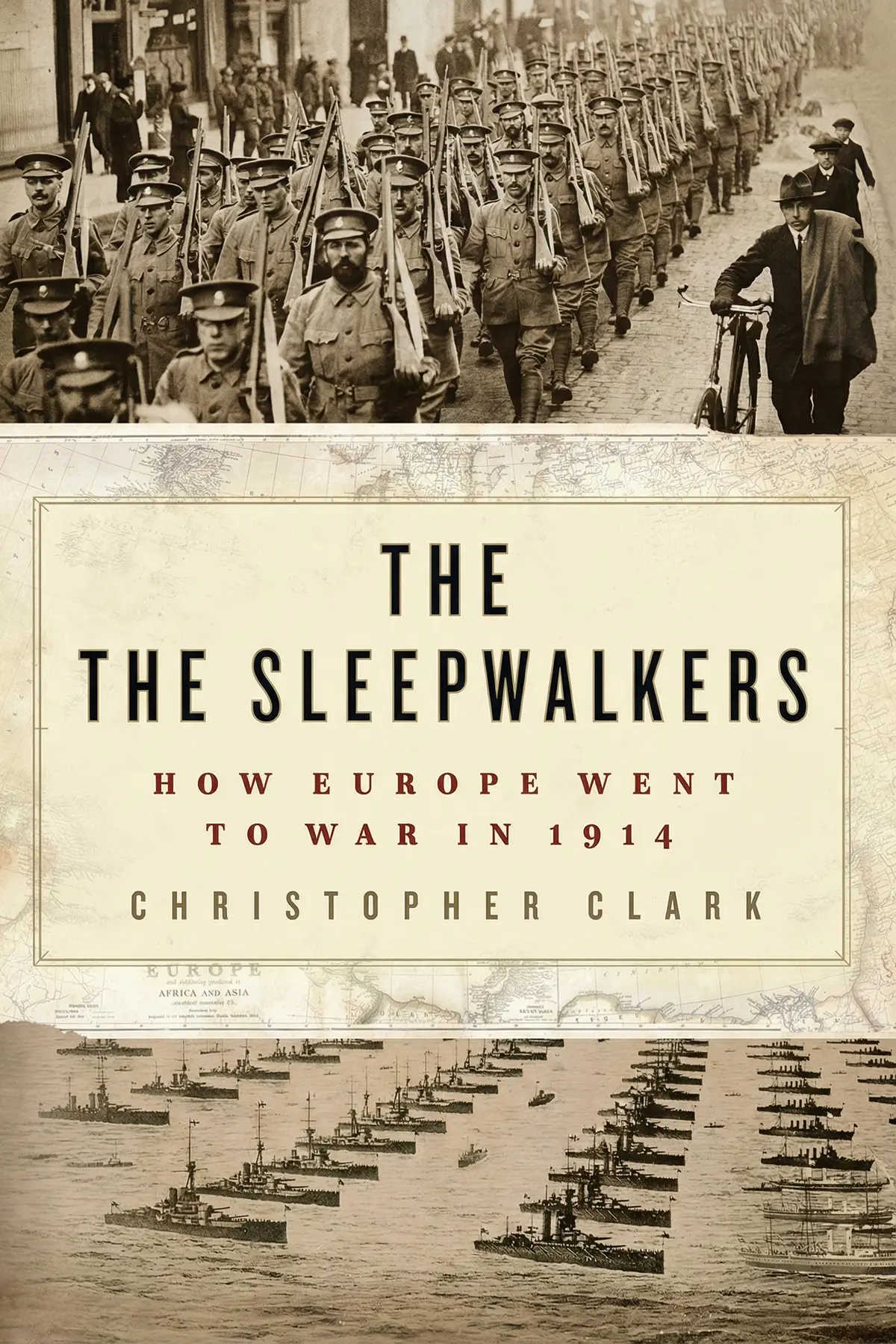
Clark explains how the First World War grew from choices made in Austria-Hungary, Germany, Russia and France, inside rigid alliances and a fatalistic mood, and why it could still have been stopped.
56 sec
When a crisis spirals, the instinct is to find the one person who caused it. In The Sleepwalkers, Cambridge historian Christopher Clark argues that the First World War defeats that instinct: no single government dragged Europe into catastrophe. Austria-Hungary, Germany, Russia and France each share part of the blame, inside an alliance system that let one murder in Sarajevo become a war across the continent.
His case runs like this. Alliances hardened into two rigid camps, leaders convinced themselves that war was coming and had better come soon, and governments sent such mixed signals that no one could read anyone else. Even so, some people fought for peace until the very end. Follow the argument and you can answer anyone who asks who started the Great War, and you gain a sharper eye for the moment when a team, a market or a country starts treating conflict as fate.
1 min 53 sec
Treaties signed to keep Europe calm ended up doing the opposite. The difference between the alliances of 1887 and those of 1914 comes down to one missing ingredient that any system of commitments still needs.
1 min 36 sec
The standard verdict blames Austria, pushed on by Germany. Clark finds that verdict only partly fair, and part of what holds is that one government pledged its backing for an ultimatum it never asked to see beforehand.
1 min 40 sec
Two powers usually cast as defenders carry a share of the blame. Their mistake began long before the ultimatum, with how they saw their rival, and it closed the cheapest exit from the crisis.
2 min 00 sec
Many people in Europe did not want a war, yet many were convinced one was coming and planned for it. Clark shows how a forecast repeated in diaries, budgets and strategy papers became a reason to fight sooner rather than later.
1 min 41 sec
Austria misjudged Russia, and Russia mobilized against a country it had no quarrel with. Behind both mistakes lay an emperor’s private letters and a habit of floating anonymous articles in the newspapers.
1 min 43 sec
In hindsight the two blocs of 1914 seem carved in stone. Serbia’s shifting partners and a hidden rivalry between Britain and Russia suggest the war depended far more on timing than on fate.
1 min 41 sec
After Sarajevo, Britain pleaded for restraint and Germany hesitated. Then a telegram between two royal cousins actually halted an army, until a single argument from the generals undid it.
1 min 28 sec
The idea to keep is that Europe’s nations drifted into conflict almost by accident, with leaders moving toward a war they believed they could not avoid. What makes 1914 frightening is how ordinary the failures were. A blank check signed without reading the terms. A rival dismissed as too weak to deserve a hearing. An emperor whose letters might or might not be policy. A forecast of war repeated until it became the reason for war.
Clark is also frank that the record may never be complete. German researchers alone published fifty-seven volumes holding 15,889 documents, while diary entries for decisive days are missing and some papers were destroyed on purpose. Any version with one guilty party deserves suspicion.
The habits worth taking from the story are practical. When the people around you call a conflict inevitable, hear that word as a warning, because the forecast may be steering the choices. Read the terms before you back an ally, and make it clear who speaks for you. And keep a direct line open to the other side, because in 1914 one telegram between cousins stopped an army, if only briefly. Catastrophes of this size do not need a villain. They need enough people convinced that stopping is pointless.
A hundred years on, the question of who started the First World War still gets a quick answer: Austria, egged on by Germany. Christopher Clark argues that the real story is wider and more unsettling. Four great powers each helped turn the murder of the Austrian Crown Prince in Sarajevo into a war across the continent, and each carries its own share of the blame. Clark traces how a loose web of treaties hardened into two opposing camps with no neutral broker left between them. He shows how leaders came to treat war as unavoidable and decided it had better come early, and how muddled governments and anonymous press statements left every capital guessing about the others. He also shows the other side of the story. The alliances were more fragile than they looked, and in the final days British, German and even Russian leaders tried to stop the slide. Readers get a clear account of 1914 they can retell, and a lasting lesson about how capable people drift into disaster together.
History readers who want a clear, fair answer to who started the First World War.
Managers and founders who make decisions inside alliances, partnerships or rivalries.
Students of politics and international relations looking for a case study in how crises escalate.
Sir Christopher Clark is an Australian historian, born in Sydney in 1960, who has made his home in the United Kingdom and Germany. He holds the Regius chair of history at the University of Cambridge, the twenty-second person to do so. In 2015 he was knighted for services to Anglo-German relations. His books include The Sleepwalkers and Iron Kingdom.
Listeners view this historical work as an exceptional listen, praising its deep research and comprehensive analysis of the facts. The narration is charming, with one listener highlighting the elegant prose style, and the text functions as an indispensable resource for mastering the material. Furthermore, the storytelling offers a sophisticated breakdown of a complicated and tangled history, and listeners value how it stimulates reflection and debate. Conversely, the speed of the narrative gets varied feedback, with some finding it somewhat exhausting.
This book is a masterclass in diplomatic history that completely reshaped my understanding of the Great War’s origins. Clark moves away from the simplistic "who to blame" narrative and instead dissects the "how" of the catastrophe. He illustrates a Europe where leaders weren't necessarily villains, but rather calculated risk-takers who didn't fully grasp the consequences of their brinkmanship. The prose is remarkably elegant for a work of this academic depth. I was particularly fascinated by the detailed look at Serbian nationalism and the 1903 coup, which provided much-needed context often skipped in other histories. It’s a dense read, but the payoff is a nuanced, multi-layered view of how a series of small, local crises snowballed into global carnage. If you want to understand the systemic fragility of early 20th-century alliances, this is the definitive text.
Show moreThe 1903 regicide in Belgrade starts this book with a literal bang, setting a dark and gripping tone for what follows. Christopher Clark manages to take the dry, dusty documents of 1914 and turn them into a living, breathing political thriller. I loved his "sleepwalkers" metaphor—the idea of leaders moving toward danger with eyes open but somehow failing to see the reality of the horror they were inviting. The analysis of the shifting alliances between the Entente and the Central Powers is incredibly thorough. I’ve read a lot of WWI history, but the focus on the Balkan perspective here felt fresh and vital. It’s an essential guide for anyone who finds the standard "mobilization timetables" explanation a bit too mechanical. Truly a wonderful, thought-provoking read.
Show moreFinally got around to this after hearing so much praise, and it absolutely lives up to the hype. The "why" of WWI is always debated, but Clark’s focus on the "how" provides a much clearer picture of the actual steps taken toward the abyss. It’s a haunting reminder that peace is fragile and often maintained by people who are just as confused and biased as the rest of us. The final third of the book, covering the assassination of Franz Ferdinand and the subsequent ultimatum, is as tense as any modern novel. I particularly appreciated the way Clark humanizes the actors without excusing their failures. It’s a thick, heavy book, but the prose is surprisingly delightful once you get into the rhythm. Essential reading for history buffs.
Show moreThe level of research on display here is frankly mind-blowing. Clark seems to have read every diary, telegram, and memo ever written in the decade leading up to 1914. What results is a thorough analysis of how a series of contingent events and individual choices—not just "inevitable forces"—led to war. The way he connects the 1911 invasion of Libya to the instability in the Balkans was a particularly "aha!" moment for me. It’s a very smart book that treats its readers like adults, refusing to simplify the byzantine complexity of the era. Despite the length, I found it to be a page-turner because the stakes are so high. It really is the definitive modern account of the July Crisis.
Show moreAfter hearing this was the "replacement" for Tuchman, I had high expectations, and Clark delivered. He captures the atmosphere of a Europe that was simultaneously sophisticated and utterly incapable of resolving its own disputes. The book is saturated with agency, showing that war wasn't some unavoidable storm but the result of specific, flawed decisions. The description of the assassination in Sarajevo is particularly vivid and moving, bringing the human cost of the political maneuvering into sharp focus. It’s an incredible achievement that manages to be both a massive scholarly work and a compelling story. I’d recommend it to anyone who wants a truly deep understanding of how the 20th century really began.
Show moreEver wonder how a single assassination in a Balkan backwater could set the entire world on fire? Clark provides a staggering amount of detail, though I’ll admit the sheer volume of diplomats—Kokovtsov, Sazonov, Hartwig—made my head spin at times. The book’s central strength lies in its refusal to offer easy answers or point a single finger at Germany or Austria. Instead, it treats every player as an agent with their own logical, if ultimately tragic, motivations. The middle sections on the various Moroccan and Balkan crises can feel a bit like wading through thick mud, but the momentum picks up significantly once you reach the July Crisis. It is a profound piece of research that demands your full attention. To be fair, it’s probably not for the casual reader looking for a quick summary.
Show moreAs someone who grew up on Barbara Tuchman’s The Guns of August, reading Clark was an eye-opening experience. He offers a much more modern, revisionist take that moves the spotlight toward the east and the volatile politics of the Balkans. The way he describes the "lumbering mechanism" of the alliance systems is brilliant; you really feel the weight of those mountaineers being dragged into the crevasse. My only gripe is that the pacing is quite uneven. One chapter flows beautifully, and the next feels like a slog through the finer points of French high finance. Still, the level of insight into the minds of the decision-makers is unparalleled. It’s a deep dive into the sheer amateurishness of international relations during the Belle Époque.
Show morePicked this up for a book club and it sparked the best discussion we’ve had in months. Clark’s nuanced explanation of the Balkan Wars as a precursor to 1914 was a revelation to me. He paints a picture of a world where everyone felt like they were acting in self-defense, which makes the eventual explosion even more tragic. The writing style is generally great, although some of the middle chapters on international crises are definitely a test of endurance. I liked that it didn't just fall back on the "poor old ostrich" jokes but actually dug into the real political pressures of the time. It's a demanding book that asks you to rethink your assumptions about who was really "guilty" for the slaughter.
Show moreWow, this was a lot more academic than I anticipated. While the research is clearly exhaustive and the analysis is sharp, the prose often becomes so stodgy and abstract that I found myself rereading the same paragraph three times. Clark spends hundreds of pages on minor diplomatic shifts that, while likely important to a scholar, felt like they were stalling the narrative for a general reader. The cast of characters is absolutely massive, and without a scorecard, it’s hard to keep track of which Russian or Austrian minister is advocating for what. When he finally gets to Sarajevo and the July Crisis, the writing is electric and genuinely gripping. I just wish the road to get there hadn't been so paved with dense, bureaucratic minutiae. It’s a 5-star piece of research trapped in a 3-star reading experience.
Show moreNot what I expected at all. I was looking for a narrative history of the start of the war, but this felt more like a 700-page dissertation on diplomatic cables and obscure Balkan treaties. The truth is, I couldn't keep the names straight—too many Russian and Serbian ministers that all started to sound the same after a while. It’s clearly a work of profound research, and I respect the scholarship, but it’s just so dry. The prose is often described as "elegant," but I found it needlessly wordy and abstract. I wanted more of the human element and less of the "disembodied state level" analysis. If you aren't already a serious student of the period, you might find this one a bit of a chore to get through.
Show moreClark argues that no single country caused the First World War. Austria-Hungary, Germany, Russia and France all helped turn the Sarajevo assassination into a continental war. Rigid alliances split Europe into two camps, leaders believed war was inevitable and better fought early, and confused signals made it hard to predict anyone else’s moves. Yet some leaders tried to keep the peace until the very end.
Only in part. Clark accepts that Germany encouraged Austria’s harsh ultimatum to Serbia and promised unconditional support without asking to see the text. But he also places blame on Austria, which wanted war with Serbia, and on Russia and France, which dismissed Austria’s grievances, stiffened Serbia’s refusal and escalated through mobilization and promises of support.
Clark suggests it was not. The alliances rested on convenience and kept shifting, so a crisis at another time might not have led to war. In the final days Britain urged restraint, Germany hesitated to mobilize, and the Tsar briefly halted Russia’s mobilization after a telegram from Wilhelm, before his generals persuaded him that war was coming anyway.
The book shows how a shared belief that conflict is unavoidable can push people into it. It suggests keeping a neutral party inside any system of commitments, reading the terms before backing an ally, sending signals that others can clearly read, and keeping direct channels open between decision makers, since a single telegram nearly stopped the war.
Tom Standage

Ishmael Beah




William J. Bernstein

Ben Macintyre


Charles C. Mann
AUDIO SUMMARY AVAILABLE
Get the key ideas from The Sleepwalkers by Christopher Clark, plus 5,000+ more nonfiction titles.









