

14 min 48 sec
Available in: English
The Sleep Solution: Why Your Sleep Is Broken and How to Fix It
A sleep neurologist explains what sleep does for brain and body, how its stages and inner clock work, and how a dark bedroom, a fixed wake-up time and careful use of pills repair broken nights.
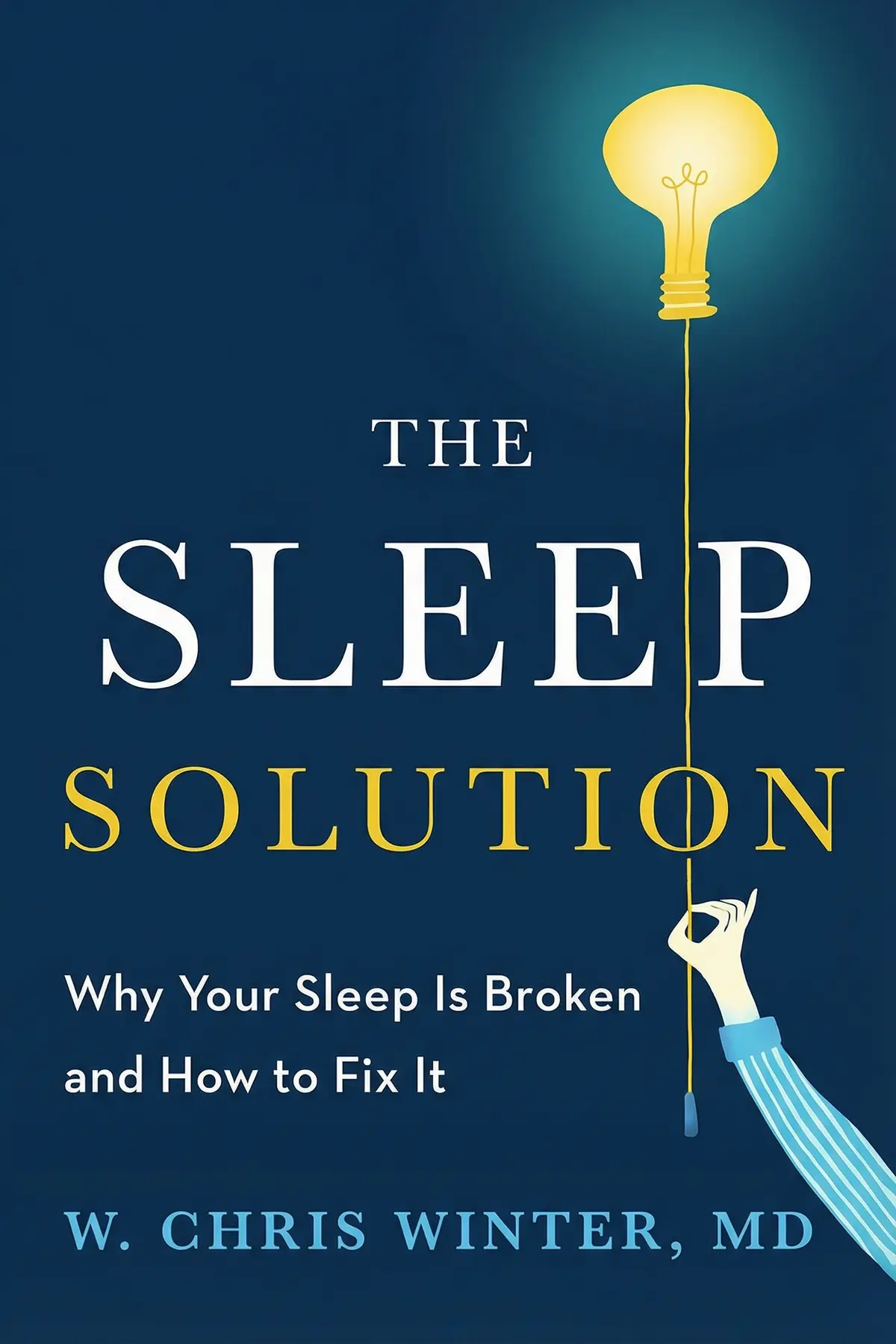
Table of Content
1. Introduction
58 sec
Plenty of adults treat constant tiredness as part of growing up, a low hum they stopped noticing years ago. In The Sleep Solution, neurologist and sleep specialist W. Chris Winter argues that this tiredness can be fixed, and that the fix rarely comes from a pill bottle. One reason to care: while you sleep, your brain clears out waste about 60 percent more effectively, including a protein linked to Alzheimer’s disease.
Winter’s case is that good sleep is not a talent some people are born without. It is a system with parts you can understand and control: what sleep does, how its stages and your inner clock work, what your bedroom does to it, and why a fixed wake-up time beats most medication. Follow his reasoning and you can tell real sleepiness from other exhaustion, judge whether you truly have insomnia, and measure how much sleep your own body needs.
2. Sleep that cleans your brain and guards your body
1 min 45 sec
Cutting an hour of sleep to finish work feels like a fair trade. Two researchers, a cold virus and a group of sleeping rodents suggest the real bill is paid in places you never feel.
3. Tell sleepiness apart from fatigue
1 min 51 sec
Some people insist they barely sleep, and others insist short nights do them no harm. A study at the University of Pennsylvania caught both beliefs out, and it exposed a confusion hiding inside the word tired.
4. Know the three stages a good night needs
1 min 54 sec
A night in bed looks like one long blank stretch from the outside. Underneath, the brain follows a set route with very different jobs at each stop, and one stop decides whether you wake up restored.
5. Set your inner clock with light, meals and movement
1 min 37 sec
In 1938 two scientists moved into a cave in Kentucky for over a month and tried to reprogram their own bodies. Their failure revealed how stubborn the human day is, and what keeps it on time.
6. Turn your bedroom into a place built for sleep
1 min 44 sec
The glow of a phone on the nightstand seems harmless. Winter explains what even a little light does to the chemistry of falling asleep, and why the bedtime routine you had as a child still makes sense.
7. Spot real insomnia and keep pills short-term
2 min 07 sec
Two people sleep equally badly once a month, yet only one of them has insomnia. The difference changes how the problem should be treated, and it explains why a sleeping pill so often disappoints.
8. Find your true sleep need in fifteen-minute steps
1 min 39 sec
Most people let last night decide this morning, and the schedule slides from there. Winter reverses that order with one fixed number and a simple experiment that reveals exactly how much sleep your body wants.
9. Conclusion
1 min 13 sec
The Sleep Solution comes down to a change in who is in charge. Tired people often feel that sleep simply happens to them: a good night is luck, a bad one is fate, and a pill is the only control they have. Winter sees a system with visible parts. Sleep cleans the brain and defends the heart and immune system. It moves through its stages in a set order, and it follows a clock that runs a little over 24 hours and responds to light, meals and movement. Once those parts are clear, most of what helps is plain and within reach.
The wake-up time comes first, because everything else hangs on it. Choose one you can keep every day, then use the 15-minute steps to find the amount of sleep that ends your daytime sleepiness. Make the bedroom dark and give the phone another place to spend the night. And if exhaustion stays despite better nights, ask whether it is sleepiness or fatigue, and take fatigue to a doctor.
Kleitman spent 32 days in a cave and still could not talk his body out of its own clock. The wiser move is to stop fighting that clock and give it a schedule worth keeping.
About this book
What is this book about?
Many adults live with a steady background tiredness and assume it comes with being grown up. W. Chris Winter, a neurologist and sleep specialist, disagrees. He argues that poor sleep can be fixed, and that the fix rarely comes from expensive medication, which can easily backfire. Winter starts with what sleep actually does: clearing waste from the brain, protecting the heart and strengthening the immune system. He then separates sleepiness from fatigue, maps the three stages of a night's sleep and explains the circadian rhythms that time them, from a 1938 experiment in Mammoth Cave to the cues that keep the inner clock on schedule. From there the book turns practical. Readers learn how to set up a bedroom for sleep, what insomnia really is, when sleeping pills help and when they get in the way, and how a fixed wake-up time plus a step-by-step method known as sleep restriction can reveal precisely how many hours of rest their own body needs.
Book Information
Who it's for
Professionals used to exhaustion
Professionals who have accepted constant tiredness as normal and want a practical way out.
Wondering if it's insomnia
Light sleepers and people who lie awake, wondering whether they have insomnia or need pills.
Sleeping at changing hours
Shift-changers and frequent flyers whose sleep schedule changes from night to night.
About the Author
W. Chris Winter
W. Chris Winter, MD, is a neurologist and sleep specialist who has practiced in Charlottesville, Virginia since 2004, and he has worked in sleep medicine and sleep research since 1993. His research centers on sleep and athletic performance, and he has advised sports organizations, businesses and the US military on how sleep affects performance. He studied at the University of Virginia, earned his medical degree at Emory University and has written for the Huffington Post, Runner's World and Details.
Ratings & Reviews
Ratings at a glance

What people think
Listeners find the book beneficial for grasping sleep, particularly for those struggling with insomnia, and they value the educational material that simplifies the topic. Furthermore, the narrative approach is absorbing, with one listener observing it's remarkably readable for this subject matter, and listeners respect the author's professional history, with one citing their clinical expertise. Listeners also consider the text both witty and relatable, as one review notes the author's encouraging bedside manner. However, feedback on effectiveness is varied; some claim it works well while others feel it offers no tangible solutions.
Top reviews
Tern
Picked this up during a particularly brutal bout of insomnia and I’m glad I did. Dr. Winter has a way of explaining the science of the brain that doesn’t require a PhD to follow, which is a relief when you're exhausted. I actually laughed out loud at some of his anecdotes, though I know some readers find his sarcasm a bit much. For me, the humor made the technical parts about neurological pathways much easier to digest. It’s less of a 'do this one trick' guide and more of an education on why your body does what it does. Truth is, understanding paradoxical insomnia changed my entire perspective on my 'sleepless' nights. It won't fix your life overnight, but the bedside manner here is surprisingly supportive and grounded in real clinical experience.
Show moreClara
Wow. This is the first sleep book that didn't actually put me to sleep while reading it! Winter manages to take very dense, technical information about the brain and turn it into something genuinely engaging. I’ve read a lot of these types of health guides, but this one stands out because of the author’s unique voice and clear expertise. He doesn't just tell you to stop drinking coffee; he explains the mechanics of how it impacts your system over time. Personally, I appreciated the section on how we often perceive ourselves as awake when we are actually getting light sleep. It’s a dense book but written with such a light touch that you fly through it. Highly recommended for anyone who wants to understand the 'why' behind their tired eyes.
Show moreChee
Ever wonder why your brain won't shut off even when you're physically exhausted? This book provides those answers in a way that is both scientifically rigorous and surprisingly funny. I loved the deep dive into the neurological side of things, specifically how our systems work to keep us healthy during the night. The author’s conversational style makes it feel like you’re sitting in his office getting a private consultation rather than reading a dry textbook. Gotta say, the tips on creating a schedule were the wake-up call I needed to stop treating my sleep like an afterthought. It’s an easy-to-read guide that manages to be both educational and entertaining, which is a rare feat for a health book. Definitely worth your time.
Show moreNarongrit
Direct and incredibly informative, this manual is a must-read for anyone struggling to get through the day. I’ve dealt with sleep issues for a decade and learned more in these chapters than I have in years of searching the internet. Dr. Winter’s approach is refreshing because he doesn't coddle the reader; he tells you exactly what you need to change. The information on paradoxical insomnia was a total game-changer for my anxiety levels at night. While the humor is a bit dry, it serves to make the more technical discussions about the brain's health much more accessible. Frankly, it’s the most readable book on the subject I’ve found yet. It provides a real sense of hope that sleep isn't some mysterious thing out of our control.
Show morePong
As someone who has struggled with shift work for years, I found the chapters on circadian rhythms incredibly insightful. Dr. Winter’s clinical background shines through every page, offering a level of depth you just don’t get from a standard health blog or news segment. He tackles serious conditions like narcolepsy with a mix of authority and empathy that I found quite refreshing. Not gonna lie, some of the 'humorous experiments' felt a bit like filler and I ended up skimming them to get back to the meat of the book. Still, the advice on environmental changes and sticking to a schedule is solid, even if it's the kind of stuff we usually ignore. It’s a readable manual that helps demystify why we struggle to shut down at night.
Show moreMichael
After hearing so many people talk about this book, I finally decided to see if it lived up to the reputation. It’s a very thorough look at the mechanics of sleep, covering everything from the importance of darkness to the specifics of REM cycles. I found the segments on restless leg syndrome and how the brain stays healthy through sleep to be the most valuable parts. The writing is witty, though I can see why some might find the doctor’s sense of humor a little polarizing. To be fair, he provides a lot of 'common sense' advice that is hard to hear but necessary, like getting the electronics out of the bedroom. It’s a great educational resource, though I wish there had been more focus on women’s specific hormonal sleep issues.
Show moreSun
This book does a pretty fantastic job of breaking down the wall between medical jargon and the average person. I appreciated how Dr. Winter uses his clinical experience to debunk common myths about insomnia that keep people stressed out. Most of us are probably doing everything wrong, and he’s not afraid to point that out with a bit of a 'Gomer Pyle' charm. The chapter on the environment was especially helpful for me, leading to some immediate changes in my bedroom setup. My only real gripe is that it can feel a bit repetitive in the middle sections when he's making a point about linguistics. Aside from that, it’s a solid 4-star read that offers a lot of clarity in a very confusing health niche.
Show moreTak
The title feels a bit like a misnomer if you are looking for a quick fix or a step-by-step program. While the author is clearly an expert, he spends an inordinate amount of time nitpicking the language patients use to describe their exhaustion. Look, I get that accuracy matters in a clinic, but as a reader, I felt like I was being lectured on linguistics rather than being helped with my sleep. There is some great info on sleep apnea and restless leg syndrome that was genuinely eye-opening. However, the 'solution' often boils down to seeing a specialist or changing your mindset, which might frustrate those seeking a DIY approach. It’s an okay read if you want the science, but don't expect a miracle cure in these pages.
Show morePia
Finally got around to finishing this, and I have mixed feelings about the overall experience. On one hand, the author is clearly brilliant and the educational components regarding serious sleep disorders are top-notch. On the other hand, the constant sarcasm and the 'fun experiments' really didn't land for me at all. I felt like I was wading through a lot of fluff to get to the actual advice, which was sometimes buried under anecdotes about difficult patients. It’s a decent book for understanding the science, but as a 'solution,' it feels a bit thin on the ground. If you’re a fan of a very specific, jokey medical tone, you might love it more than I did. It’s okay, just not the life-changer I was hoping for.
Show moreWatcharaporn
Not what I expected at all, and frankly, quite disappointing given the hype around it. The author’s tone comes across as incredibly jaded and, at times, borderline condescending toward the very patients he’s supposed to be helping. I was looking for actionable strategies, but instead, I got pages of whining about how people describe their symptoms incorrectly. He seems obsessed with the idea that we’re all actually sleeping more than we think, which feels like a slap in the face when you’ve been staring at the ceiling for six hours. If you want a book that spends more time on the author’s personal grievances than on actual solutions, this is for you. Otherwise, I’d suggest looking elsewhere for empathetic, practical advice that doesn't involve sarcastic exercises.
Show moreQuestions about this book
What is the main idea of The Sleep Solution?
W. Chris Winter argues that broken sleep can be fixed without expensive medication. Sleep clears waste from the brain, protects the heart and supports the immune system, and it follows stages and an inner clock you can work with. By keeping the bedroom dark, building a bedtime routine and holding a fixed wake-up time, most people can improve their sleep and their daily lives.
What is the difference between sleepiness and fatigue?
In Winter’s account, sleepiness is the desire to sleep, while fatigue is a lack of energy. Sleepiness comes from medication, sleep deprivation or sleep dysfunction. Fatigue can come from poor sleep, but also from a vitamin B12 deficiency, diabetes or depression. If you improve your sleep and still feel drained, Winter advises seeing a doctor.
How does sleep restriction work in The Sleep Solution?
Set a fixed wake-up time, such as 6:30 a.m., and count back five and a half hours to set your bedtime, here 1:00 a.m., with no daytime naps. Then move bedtime 15 minutes earlier at a time while keeping the wake-up time fixed, until daytime sleepiness disappears. That amount is your sleep need, which usually sits in the range of six and a half to eight hours.
Does W. Chris Winter recommend sleeping pills?
Only in a limited way. Winter notes that most research finds pills shorten the time to fall asleep only slightly, add little total sleep and reduce deep sleep. They were designed for short-term, occasional use, such as during intense stress after a death in the family. He advises agreeing a plan with your doctor first: when to take them, for how long and when to stop.
What counts as insomnia according to The Sleep Solution?
Winter defines insomnia as being bothered by unsatisfying sleep, whether that means trouble falling asleep or trouble staying asleep. The annoyance matters as much as the bad nights: someone upset by one poor night a month may have insomnia, while someone unbothered by two does not. He calls the common rule of twice a week for three months arbitrary.
Readers also enjoyed




AUDIO SUMMARY AVAILABLE
Listen to The Sleep Solution in 15 minutes
Get the key ideas from The Sleep Solution by W. Chris Winter, plus 5,000+ more nonfiction titles.
- 5,000+ titles
- Listen as much as you want
- 7-day free trial
- Cancel anytime









