

11 min 04 sec
Available in: English
The Secret of Culture Change: How to Build Authentic Stories That Transform Your Organization
Shows leaders how to change a company's culture by acting out stories people retell. It draws on cases from Telesp, Procter and Gamble Brazil and Mandela's South Africa, balancing business sense with emotional engagement.
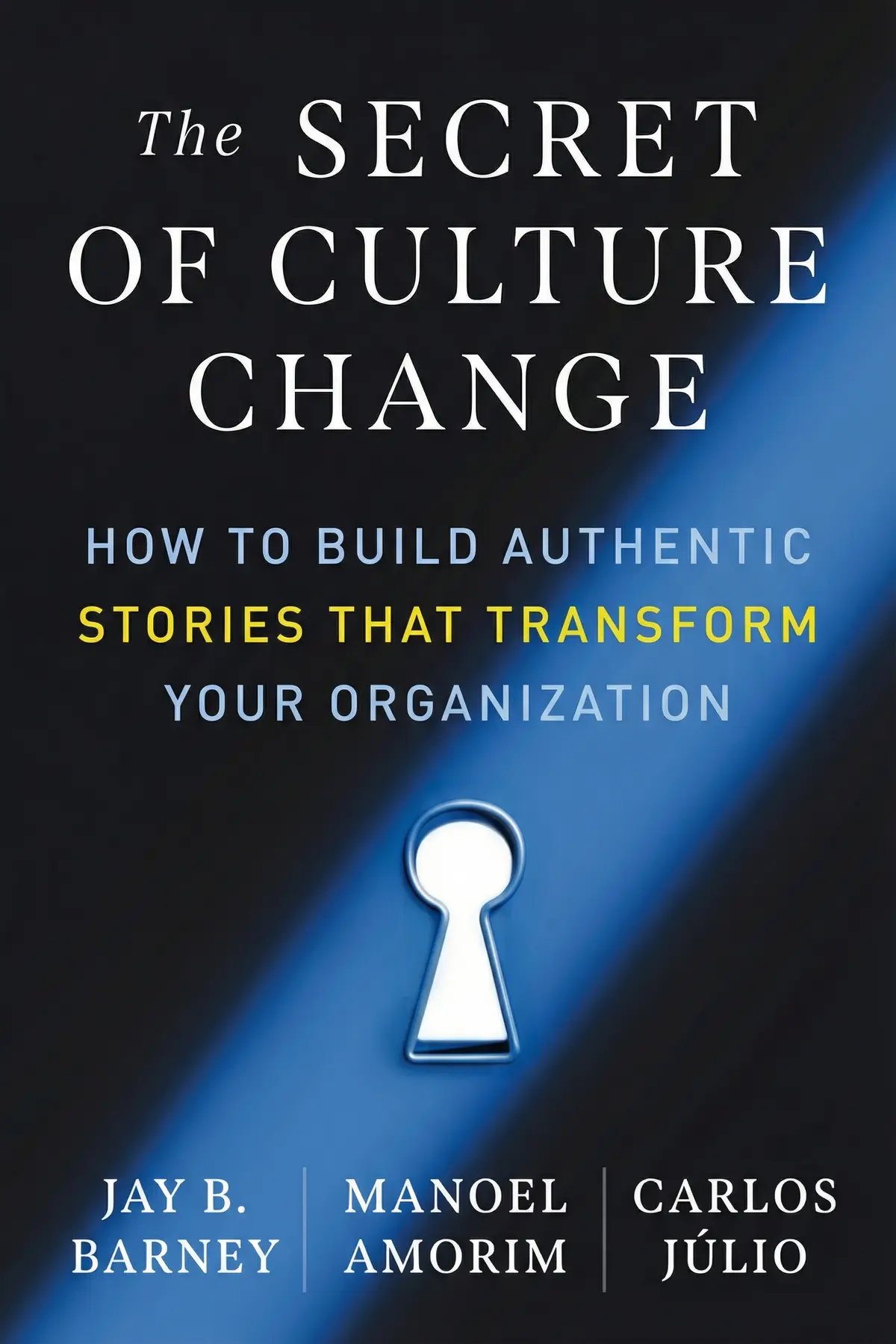
Table of Content
1. Introduction
1 min 06 sec
Most leaders try to change a culture by announcing new values, and most then watch the old habits carry on as before. In The Secret of Culture Change, former telecom chief executive Manoel Amorim, business leader Carlos Júlio and strategy professor Jay B. Barney argue that culture shifts when people see a leader act out a new story they can repeat. A memo describes values. A story people tell each other shows them.
The authors build their case on one claim. Authentic stories change a culture when the leader lives them first and when they make sense to both reason and emotion. Their evidence comes from vivid cases: a CEO who phoned his own customer helpline, a plant manager on a company jet, a founder with a cut eyebrow on live television, a soap maker losing money fast, and Nelson Mandela in a rugby jersey. Each one leaves a manager with something to try on a team the very next week.
2. Change culture with one story people retell
1 min 46 sec
A new chief executive found a hidden perk for senior managers just as problems with a new internet service were coming to light. What he did next changed a company’s habits faster than any policy could.
3. Earn the trust that makes people follow you
1 min 34 sec
On a corporate flight over the forest, a plant manager with 18 months to save his factory asked himself a question most leaders avoid, and the answer reshaped how he led.
4. Turn a bad moment into proof of your values
1 min 55 sec
Hours before a live TV slot selling beauty products, a founder cut her face badly. Her choice on air showed whether her company’s values were real or decoration.
5. Win the spreadsheet and the room at once
1 min 52 sec
A soap maker was losing more than half of every dollar it earned, and its staff seemed perfectly happy. Fixing the numbers was only half of what the turnaround needed.
6. Change your culture while honoring its past
1 min 39 sec
Revenge would have cost a nation its skills, and silence would have insulted its victims. Mandela’s third path offers any leader a way to move a proud, wounded culture forward.
7. Conclusion
1 min 12 sec
None of these leaders gave a speech about culture. Amorim made a phone call. A plant manager asked himself an uncomfortable question above the forest. O’Banion told the truth about a cut on her face. Aguirre moved headquarters into a factory. Mandela put on a jersey. Each act was small enough to retell and costly enough to believe, and the retelling did the work that policy alone could not.
That gives a leader a different job description. A culture is the set of stories people tell about what happens here, and the person at the top is the main character whether they choose the role or not.
The book points to a few concrete moves. Find one privilege or habit at the top that contradicts the culture you want, and remove it where people can see. Measure yourself against competence, character and care before a crisis does it for you. Give every change both a business case and a way for people to take part. When the old culture carries pride or pain, honor it before you ask anyone to leave it behind.
People forget the values statement. They remember the day the boss called the helpline.
About this book
What is this book about?
Many organizations know their strategy needs a different culture. Yet new rules and value statements rarely change how people think and act. Manoel Amorim, Jay B. Barney and Carlos Júlio argue that the missing piece is story: a new culture spreads when people see leaders act out its values in moments worth retelling. The authors build the case through concrete examples. A chief executive at the Brazilian telecom firm Telesp shuts down a private helpline for senior managers and calls the customer line himself. A plant manager facing closure rebuilds trust around competence, character and care. A skincare founder turns an injury before live television into proof of her company's values. A Procter and Gamble executive pulls a loss-making acquisition into profit with hard cuts and open town halls. Nelson Mandela uses a truth commission and a rugby jersey to honor a painful past while building a shared future. Readers learn why leaders cannot hand culture change to someone else, and why every change needs both an economic reason and an emotional one. They also learn how to create the small, visible actions that teams turn into the stories that define them.
Book Information
Who it's for
Managers and team leads
Managers and team leads asked to change how their people work, who suspect a new values poster will not do it.
Leaders driving major change
Founders and executives leading a turnaround, merger or new strategy that needs different everyday behavior.
HR and learning teams
HR and learning professionals looking for real cases that show culture change in action.
About the Author
Manoel Amorim
Manoel Amorim has led companies in Brazil, Latin America, Europe and the US, including Telefonica Brazil, where his work on cultural change was taught as a Harvard Business School case. Jay B. Barney is a Presidential Professor at the Eccles School of Business at the University of Utah. He specializes in strategic management, once edited the Academy of Management Review and had drawn more than 200,000 citations by 2021. Carlos Júlio has been CEO of Tecnisa, HSM do Brasil and Polaroid in Brazil, and has written nine best-selling books.
Ratings & Reviews
Ratings at a glance
What people think
Listeners consider this work a discerning and hands-on manual for navigating corporate shifts through the use of sincere storytelling. They also value the transparent, logical framework that bypasses mere theory to deliver "common-sense advice" reinforced by various actual scenarios. Furthermore, listeners appreciate the spotlight on high-level management's impact, with one listener describing the book as an "essential" read for organizations looking to maintain their edge. They also highlight how the concept of "storybuilding" allows leaders to relate more deeply to the human components of the transition process.
Top reviews
Kiattisak
Finally got around to reading this, and it’s a game changer for anyone in HR or leadership roles. The core concept of 'storybuilding' versus 'storytelling' is brilliant because it forces you to act before you speak. I’ve seen so many culture initiatives fail because they start with a memo, but Barney and the team argue for intentional actions that naturally turn into legends. The 38 case studies provide a roadmap that feels both grounded and aspirational. If you want to move beyond corporate fluff and actually change how people feel at work, this is your blueprint. It’s well-organized and doesn’t waste your time with unnecessary jargon. The authors understand that people need a reason to care.
Show moreRosa
Wow, this was exactly what I needed for my professional development list! The 'secret' isn't some complex algorithm; it’s about connecting with the head and the heart through authentic narratives. I loved how the book emphasizes that stories aren't just historical tales—they are living actions that you participate in right now. The structure is fantastic, with six clear principles that build on each other without feeling repetitive. It’s a delight to read because it feels like you're getting advice from seasoned mentors rather than a textbook. This is essential for anyone trying to bridge the gap between strategy and actual day-to-day behavior. Truly insightful and actually enjoyable.
Show moreLuke
The chapter on senior leadership being the 'stars' of the culture story changed my entire perspective on my role as a director. Barney, Amorim, and Julio explain that leaders can't just delegate culture to the HR department. You have to be willing to be the face of the change, even if it feels a bit dramatic at times. I appreciated the broad-based examples from around the world, proving these principles work across different industries and geographies. The organization of the book is top-notch, making it easy to jump back into specific chapters when you need a refresher. Truly a must-read for anyone serious about organizational development. It is both profound and practical.
Show morePat
After hearing Jay Barney speak on a podcast, I knew I had to pick this up, and it did not disappoint. The way they map out culture change as a series of intentional, story-worthy moments is brilliant. It’s not just about the 'soft stuff'; it’s about how culture drives competitiveness and actual results. The book is succinct, avoiding the fluff that plagues most business literature today. I’ve already started applying the 'storybuilding' concept with my team by taking more visible, symbolic actions. This isn't just a book you read once; it’s a manual you keep on your desk to reference during every major transition. Highly recommended for any leader.
Show moreSophia
As a professional consultant who has managed teams through multiple mergers, the focus on the human element here really hit home. The authors suggest that senior leaders need to be the stars of the story, which might be uncomfortable for some, but the research shows it’s non-negotiable. I found the advice on 'theatricality' particularly interesting, though I do wonder if it works in every industry. Some of the examples felt a bit extreme, yet the underlying principles are solid. It’s a very detailed take on change management that avoids being too dry. I would have liked more on maintaining culture in fully remote environments, but the core message remains strong and applicable across the board.
Show moreNoi
This book cuts through the usual business school noise to offer what I can only describe as common-sense wisdom. It’s refreshing to read a leadership guide that doesn't shy away from the hard stuff, like restructuring or policy shifts, while keeping the human element front and center. Gotta say, the writing style is punchy and direct, making it a quick read for busy professionals. My only gripe is that some of the case studies felt a little dated, but the principles themselves are timeless. If you’re struggling to make a new strategy stick, look at how you’re building your internal stories. It's a solid resource for any modern manager.
Show moreWin
Ever wonder why your company’s values posters never actually change how people work? This book answers that question by focusing on 'storybuilding'—the act of doing things that are worth talking about. The authors argue that people don't care about what you say; they care about what you do, especially when those actions feel like a clean break from the past. Personally, I think the emphasis on profit as a driver for culture was a bold but necessary inclusion. It’s a very practical guide that balances the need for results with the need for a healthy environment. A few chapters felt repetitive, but the core message is incredibly valuable.
Show moreGor
Frankly, I have mixed feelings about the 'theatrical' approach suggested in several chapters. While I appreciate the 38 real-world examples, some of the tactics feel a bit performative for a modern workplace where employees crave radical transparency. To be fair, the authors back their claims with significant experience, and the 'storybuilding' concept is a useful shift in perspective. The writing is clear and the framework is easy to follow, but I’m not entirely convinced that culture change must always start exclusively at the top. It’s a decent read for executives, but I found myself disagreeing with the emphasis on senior leaders as the sole protagonists. It feels a bit too top-down for my taste.
Show moreLeila
Honestly, I appreciated the focus on 'head and heart' communication, but a lot of this felt like common sense dressed up as a secret. If you've been in management for a while, you already know that actions speak louder than words. That said, the specific framework for turning actions into 'stories' is a helpful tool for more intentional leadership. I did find the focus on theatricality a bit much, as it could easily backfire if not done with absolute sincerity. It’s an interesting read and the stories are well-told, but I’m not sure it’s the revolutionary breakthrough the title promises. Good for beginners, but maybe a bit basic for veterans.
Show moreFord
Not what I expected given the hype surrounding this title in the business world. While the 38 stories are certainly diverse, I found that several examples felt a bit too 'neat,' glossing over the messy reality of failed transitions. In my experience, culture is more of a bottom-up evolution than the strictly top-down approach championed here by Barney and his colleagues. The focus on 'theatricality' and senior leaders acting as the 'stars' felt a little dated for my taste. That said, the writing is remarkably clear and the 'storybuilding' concept is a solid takeaway. It’s a decent guide for traditional corporate environments, but it didn't really resonate with my experience in agile startups.
Show moreQuestions about this book
What is the main idea of The Secret of Culture Change?
Amorim, Barney and Júlio argue that culture changes through stories, not rules. When a leader acts out a new value in a visible moment, people retell it, and the story shapes how everyone behaves. Those stories must be authentic, lived first by the leader, and they must make sense both economically and emotionally. The authors support this with cases from Telesp, a South American car plant, Beauty Biosciences, Procter and Gamble Brazil and Mandela’s South Africa.
How did Manoel Amorim change the culture at Telesp?
After Telefonica acquired Telesp, Amorim found a culture focused on efficiency and distant from customers. When the new Speedy internet service had problems, he closed a private helpline for senior managers. He then called the regular customer line himself, revealed who he was and invited the representative to brief the executive team. Speedy sales were halted until the service was fixed, and the episode became a legend inside the company.
What do competence, character and care mean in the book?
They come from a West Point speech remembered by a young plant manager who had 18 months to save a loss-making car plant. The idea is that a team follows a leader in a crisis when the leader shows skill, integrity and genuine concern for them. He made those three qualities deliberate, became more open about the plant’s problems and involved his team in the turnaround, which succeeded.
How can a manager apply the ideas in this book?
Start by finding one visible habit or perk that contradicts the culture you want and changing it publicly, as Amorim did with the managers’ helpline. Treat setbacks as chances to show your values, as Jamie O’Banion did on live television. Pair hard business decisions with real involvement, the way Fernando Aguirre combined cost cuts with factory town halls. Above all, lead the change yourself and do not hand it to someone else.
Readers also enjoyed



A Year with Peter Drucker: 52 Weeks of Coaching for Leadership Effectiveness
Joseph A. Maciariello





Acting with Power: Why We Are More Powerful Than We Believe
Deborah Gruenfeld

All In: How Great Leaders Build Unstoppable Teams
Mike Michalowicz
AUDIO SUMMARY AVAILABLE
Listen to The Secret of Culture Change in 15 minutes
Get the key ideas from The Secret of Culture Change by Manoel Amorim, plus 5,000+ more nonfiction titles.
- 5,000+ titles
- Listen as much as you want
- 7-day free trial
- Cancel anytime









