

12 min 25 sec
Available in: English
The Revenue Growth Habit: The Simple Art of Growing Your Business by 15% in 15 Minutes a Day
Shows how a small or midsize business can grow sales with little time or money by reaching existing clients and warm prospects through email, testimonials, calls, handwritten notes, newsletters, webinars and steady follow-up.
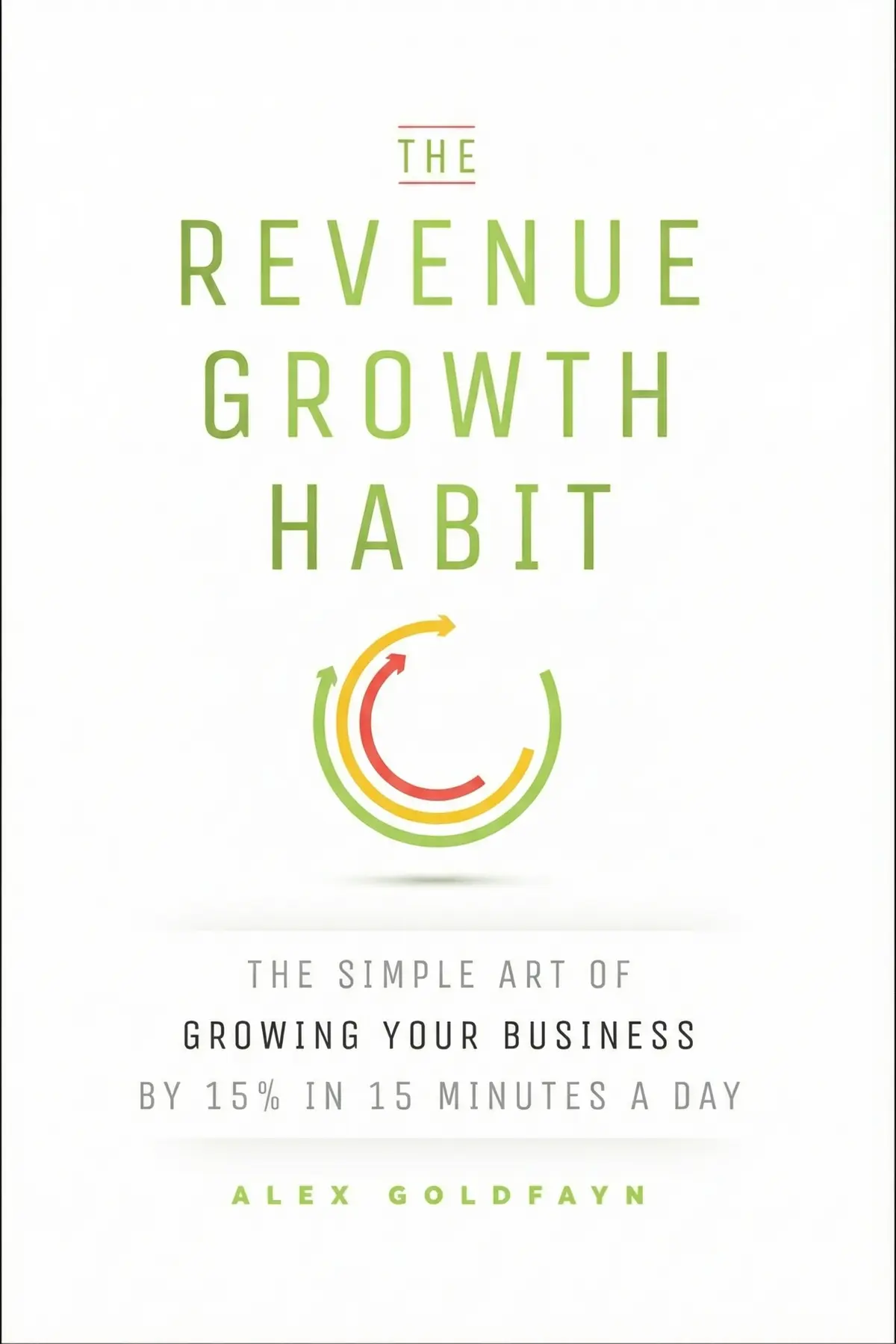
Table of Content
1. Introduction
56 sec
Most business owners assume serious growth needs a serious budget, the kind that buys billboards in Times Square. In The Revenue Growth Habit, marketing consultant and business coach Alex Goldfayn argues that the cheapest new revenue is already sitting with your customers, since most satisfied clients know about only a quarter of what a company sells. His case is that a few minutes a day of plain, personal contact with people who already know you will outsell a flashy campaign.
That idea runs through every technique he offers: emails that state a benefit clearly, testimonials gathered with two kinds of questions, phone calls and handwritten notes, a newsletter with a fixed recipe, webinars and client events. It ends with a rule for acting before your plans feel finished. Each method is cheap, most take minutes, and the first one can go out this afternoon.
2. Sell more without a big advertising budget
1 min 48 sec
Expensive commercials often leave viewers unsure what was even advertised. Goldfayn argues the money is better spent elsewhere, and he names a popular channel that, in his view, almost never turns attention into revenue.
3. Your current customers hold most of your growth
1 min 37 sec
Your happiest clients may be missing most of what you sell simply because nobody told them. Goldfayn’s fix is an ordinary format built from three parts, and the size of the opportunity is startling.
4. Let happy clients write your best pitch
1 min 43 sec
Buyers trust a friend’s word far more than a company’s claims. Goldfayn shows how to get clients to praise you in specific, quotable terms, and it depends entirely on how you phrase two kinds of questions.
5. Win loyalty with a five-minute call and a pen
1 min 49 sec
Email is easy, which is exactly why it can feel cold. Two old-fashioned gestures, costing minutes and a little money, can make a client feel singled out for the whole year.
6. Show the value instead of describing it
1 min 43 sec
A $20,000 private plane sounds like a reckless marketing expense. Goldfayn argues it can pay for itself, and that a phone camera and a room full of happy clients follow the same logic.
7. Act at 85 percent and keep following up
1 min 42 sec
Six months of polishing a newsletter can cost more than sending a flawed one. Goldfayn explains why nobody but you will see the gap, and what to do about the prospects who go silent.
8. Conclusion
1 min 07 sec
The Revenue Growth Habit turns growth into a small task you can finish before lunch. Goldfayn’s claim is that revenue rarely hides in new audiences or expensive media. It sits in plain sight: in clients who know a quarter of your range, in prospects who contacted you once and never heard back, in happy customers whose praise nobody thought to ask for. The work is mostly about making your offer visible and personal to people already close to you, and doing it steadily.
He suggests trying the techniques one at a time and keeping the ones that work for your business. A sensible place to begin is the follow-up, since it costs almost nothing: two emails and a call for every inquiry that goes quiet. Then ask one satisfied client a how question and a why question, and put the answer into a short newsletter that ends with a single offer. Send it before it feels finished.
Nobody will notice the missing 15 percent. They will notice the call, the note and the newsletter that actually arrived.
About this book
What is this book about?
Many small and midsize companies put off marketing because they believe it takes a big budget, an agency and months of planning. Alex Goldfayn disagrees. In his view, revenue grows fastest when a business makes its offer clear and visible to the people already close to it: existing clients, past buyers and prospects who once showed interest. Goldfayn sets out a group of low-cost growth techniques. He favors direct email over chasing social media likes. He collects client testimonials with targeted how and why questions, and he uses five-minute phone calls and handwritten notes to make customers feel valued. A regular newsletter with an article, a testimonial and a promotion tells clients about products they never knew you offered. Webinars and client events then show value instead of describing it. The book closes with a push to act. Readers get a daily question to ask themselves, permission to launch at 85 percent of their ideal, and a simple follow-up routine for the many prospects who otherwise disappear.
Book Information
Who it's for
Owners without marketing budgets
Owners of small and midsize businesses who think marketing needs a budget they don't have.
Sales and service leads
Sales and customer service leads looking for daily routines that bring in repeat and referral business.
Founders tired of likes
Founders tired of chasing social media likes that never turn into revenue.
About the Author
Alex Goldfayn
Alex Goldfayn works as a marketing consultant and business coach, and he also works as a public speaker. Large companies have tested his methods in practice: Fortune 500 firms such as Logitech and Virgin Mobile have applied his strategies to their own businesses.
Ratings & Reviews
Ratings at a glance

What people think
Listeners find this business guide an accessible read filled with high-quality insights, praising its straightforward and achievable strategies for increasing income. They view it as essential reading for entrepreneurs and a top-tier tool for securing new clients, with one listener highlighting how it offers a structured method for boosting sales. Listeners appreciate its function as a hands-on manual and believe the advice is both successful and easy to implement.
Top reviews
Evelyn
Finally got around to reading Goldfayn’s book and it’s a game-changer for anyone who thinks they don't have time for marketing. The whole "15-minute" concept is brilliant because it removes the excuses we all make when things get busy. I started implementing the phone call techniques and the referral asks immediately, and the results are already visible in my pipeline. It's a very systematic way to look at revenue generation without needing a massive budget or a huge team. If you are running a small B2B operation, you need this on your desk as a daily reference. Some might find the tone a bit aggressive, but I think it’s the kick in the pants most business owners actually need. This is highly recommended for the pragmatists out there.
Show moreEthan
Ever wonder why some companies grow effortlessly while others struggle despite having a great product? This book answers that by focusing on the communication gap between what we do and what the customer knows. It’s all about the mindset of selling as a service to the prospect. I found the techniques for generating recurring business particularly helpful because it’s so much cheaper to keep a client than to find a new one. The book is an easy read with a lot of value packed into very short, digestible chapters. I’ve already started the daily 15-minute marketing actions with my team, and the energy in the office has shifted for the better. This is a must-read for business owners who want simple, actionable growth.
Show moreSaranya
As someone who works in tech evangelism, I found the customer-centered approach here incredibly refreshing and relevant to my daily work. The author emphasizes that our duty is to communicate value, which is a mindset shift many of us desperately need to make. I loved the sections on how to properly leverage testimonials and case studies to build trust. It’s not just about flashy ads; it’s about the recurring business that comes from genuine relationships. In truth, some of the early chapters felt like a long sales pitch for the book itself, which was a bit annoying. However, once you get into the actual 22 practical methods, the value is undeniable. It's an easy read that focuses on what truly moves the needle.
Show morePor
Look, this isn't a complex academic textbook, and that is exactly why it works so well for busy people. Goldfayn provides a very simple, doable framework for increasing sales through consistent habits rather than one-off "magic" campaigns. I appreciated the focus on short, daily actions like sending personal notes or following up on old leads. Truth is, most of us know we should be doing these things, but we lack the system to make them happen regularly. The writing style is punchy and direct, making it possible to finish the whole book in a single afternoon. My only gripe is that it can feel a bit repetitive at times, but maybe that’s the point of building a habit. Solid resource for any business owner.
Show moreMatteo
The chapter on testimonials alone is worth the price of admission for this book. Goldfayn breaks down exactly how to ask for them and, more importantly, how to use them to drive new business in a way that feels organic. I’ve read a lot of business books that stay too high-level, but this one stays in the trenches with 15-minute tactics. It really shines when describing how to turn a single successful project into a series of case studies and referrals. Not gonna lie, I was skeptical about the "habit" part, but the structure makes it easy to track your progress. It’s a very practical resource for anyone in a B2B role who needs a systematic approach to growth. Definitely worth a read for the tactics.
Show moreIvan
Picked this up on a whim after a colleague mentioned it, and I’m glad I did. The book focuses heavily on how to get more value from your existing customer base, which is often overlooked in the hunt for new leads. I especially liked the sections on webinars and white papers as tools for education rather than just hard selling. It’s a fast-paced read that emphasizes doing the work rather than just thinking about it. While the author’s confidence can verge on arrogance at points, the actual tactics are simple and realistic for any size of company. From what I've seen, the hardest part of sales is the consistency, and this book provides the structure needed to stay on track. It is an excellent resource for winning new business.
Show moreOn
To be fair, the first thirty pages or so are incredibly repetitive as the author tries to convince you how great his system is. I almost put it down because it felt like one of those self-prophesied manuals that lacks real substance. Thankfully, the second half of the book picks up significantly with actionable tactics that actually make sense for a B2B environment. The 15-minute tasks are doable, but I think some of the revenue growth claims are a bit hyperbolic for certain industries. It’s a decent summary of relationship marketing basics, but if you’ve been in sales for a long time, you might find most of this to be common sense. It's a quick read, so it's probably worth your time even for just a few new ideas.
Show moreCameron
Frankly, the content here is a bit of a mixed bag for me. On one hand, the 22 practical methods are great for creating a checklist of things to do when sales are slow. On the other hand, the writing can be a bit redundant, and the author repeats the same core ideas over and over. It’s a fast read, which I appreciate, but I was hoping for a bit more depth on the digital marketing side of things. It leans very heavily on traditional B2B interactions like phone calls and newsletters. If you’re looking for a systematic approach to the basics, this is perfect. If you’re looking for cutting-edge innovation marketing, you might find it a little dated compared to newer tech strategies.
Show moreTeng
I've read dozens of sales books, and "The Revenue Growth Habit" is a solid, middle-of-the-road entry. It doesn't offer anything particularly groundbreaking, but it does a fantastic job of organizing standard best practices into a doable schedule. The focus on 15-minute increments makes marketing feel less like a chore and more like a series of quick wins. I did feel that the first few chapters were fluff, but the practical part in the middle is where the real value lives. It’s a good reminder to focus on the value the customer receives rather than just our own internal metrics. Not a life-changing masterpiece, but a very useful tool for anyone needing a nudge to be more proactive. It's worth a read if you need structure.
Show morePensuda
Not what I expected given all the five-star hype I’ve seen on LinkedIn recently. The author spends way too much time shouting about how his methods work without actually explaining the "how" until you're halfway through the book. Personally, I found the tone a bit too "sales-bro" for my taste, and many of the "habits" are things that any competent salesperson should already be doing. While the focus on testimonials and referrals is valid, there isn't much here that you couldn't find in a good blog post about basic marketing. It’s not a terrible book, but it certainly isn't the revolution it claims to be in the introduction. I’d say borrow it from a library before you decide to buy a permanent copy.
Show moreQuestions about this book
What is the main idea of The Revenue Growth Habit?
Alex Goldfayn argues that a business does not need expensive campaigns to grow. Revenue comes from making a clear, personal case to people who already know you: existing clients and interested prospects. He offers cheap, quick techniques, including direct email, client testimonials, phone calls, handwritten notes, newsletters, webinars and events, and urges owners to spend a little time on them every day instead of waiting for a perfect plan.
How does Alex Goldfayn suggest collecting customer testimonials?
After a sale, contact the client, say their satisfaction and feedback matter to you, and ask two kinds of questions. Confirming questions start with how, such as how much their business has grown since using your service, and tend to produce specific numbers. Probing questions start with why and focus on something central to your offer, such as why delivery times matter to them.
What should a business newsletter include according to The Revenue Growth Habit?
Goldfayn recommends three parts. An article on world events or trends that could affect the client’s business gives free, useful knowledge. A client testimonial links that value to an independent endorsement. A promotion for one product or service closes the newsletter while the reader is paying attention. Sent regularly, it tells clients about the many offerings they never knew you had.
How should I follow up with potential customers?
Goldfayn says that on average 80 percent of potential buyers are never heard from again, so persistence pays. When someone contacts you, send two emails and then make a phone call, one a week over three weeks or until they reply. He argues that even a 2 percent rise in revenue would be a good return on such a small amount of effort.
Who should read The Revenue Growth Habit?
It suits owners and managers of small and midsize businesses who believe marketing requires big budgets or expert teams, and sales leaders who want simple daily routines. Its methods cost little, from a five-minute call to a recent client or a handwritten note on good paper to a webinar recorded on a phone, and they focus on customers you already have.
Featured in
Readers also enjoyed


AUDIO SUMMARY AVAILABLE
Listen to The Revenue Growth Habit in 15 minutes
Get the key ideas from The Revenue Growth Habit by Alex Goldfayn, plus 5,000+ more nonfiction titles.
- 5,000+ titles
- Listen as much as you want
- 7-day free trial
- Cancel anytime









