
14 min 34 sec
Available in: English
The Practice of Adaptive Leadership: Tools and Tactics for Changing Your Organization and the World
Shows how to tell problems that experts can fix from challenges that require people themselves to change, and how to lead that change by diagnosing the system, managing pressure and surviving the pushback.
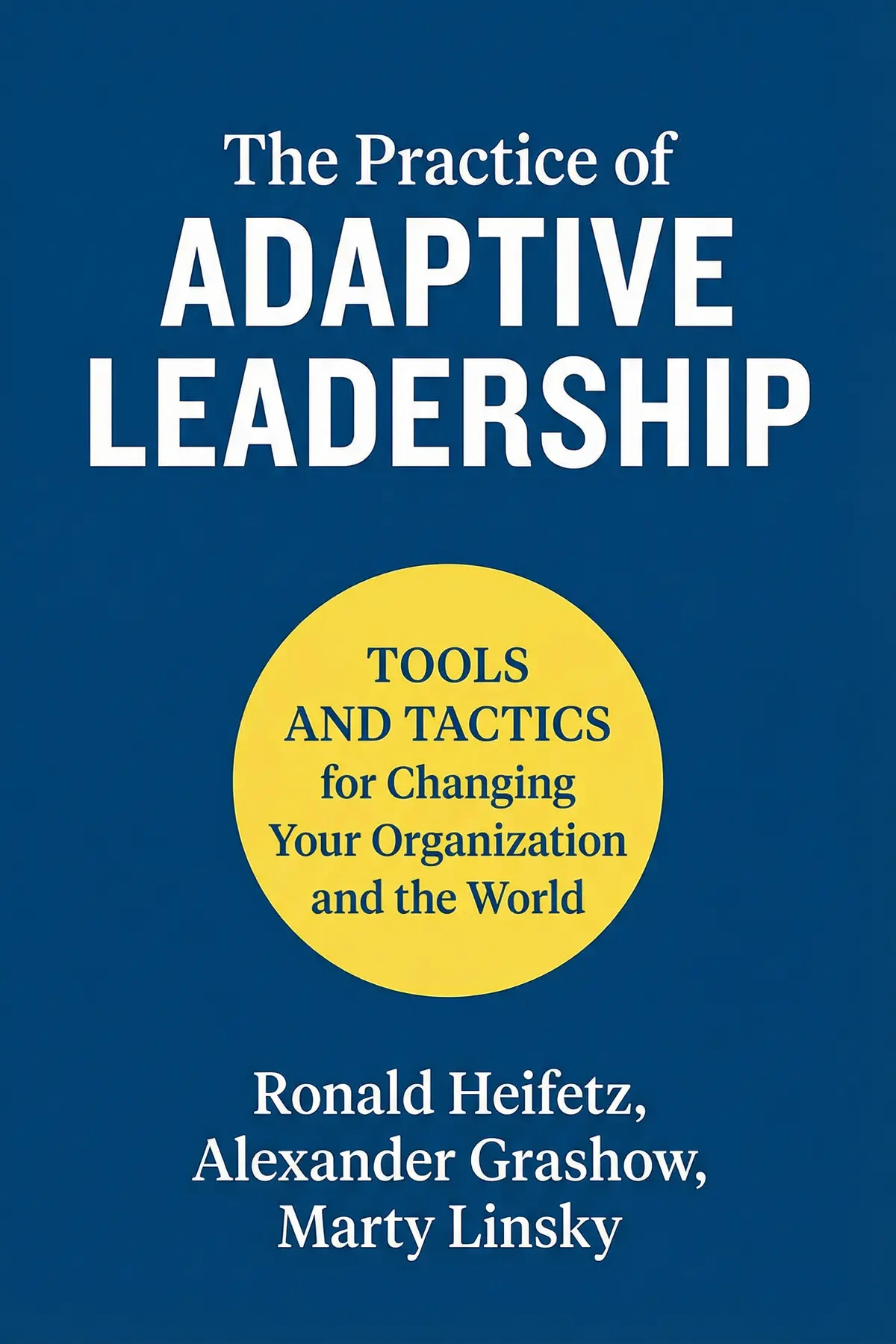
Table of Content
1. Introduction
1 min 03 sec
Most leaders facing a stubborn problem reach for an expert or an order from the top, then wonder why nothing changes. In The Practice of Adaptive Leadership, Ronald Heifetz, Alexander Grashow and Marty Linsky explain why: the problems that matter most cannot be fixed by anyone’s expertise, because they require the people involved to change their own values, habits or loyalties. The authors call these adaptive challenges, and they define leadership as the work of mobilizing people to take them on and thrive.
A leader’s real job, in their account, is to read the system clearly, protect what is worth keeping, hold people under enough pressure to learn, and stay standing while the organization pushes back. The book was built as a field guide of tools, cases and worksheets. From it you get a test for spotting which kind of problem is in front of you, and a set of moves for leading people through change that many of them will feel as loss.
2. Tell a hard problem from an adaptive one
1 min 47 sec
Some problems keep coming back no matter how good the expert you hire. The authors explain why skill and authority fail against them, and offer one plain question that tells you which kind you are facing.
3. Change that keeps the best of your past
1 min 50 sec
People resist change partly because they hear it as a verdict on everything they built. A fact about chimpanzees suggests a far more reassuring way to frame even a deep transformation.
4. Step onto the balcony before you act
1 min 37 sec
The authors say they try to keep clients from leaping into action before they have studied the situation. Their reason involves a dance floor, and a view of your own behavior that most leaders never get.
5. Map who stands to lose before you push
1 min 45 sec
Good ideas die in organizations every day, and logic is rarely the cause. The authors show where the real resistance hides, and offer a startling definition of what leaders actually do to people.
6. Keep the pressure high enough, never too high
1 min 46 sec
Leaders facing resistance tend to make one of two opposite mistakes, and both end badly. The authors describe a narrow zone between them where people actually change, and what it takes to stay there.
7. Small experiments beat one grand plan
1 min 51 sec
Nature produces its best adaptations through a process with a startling failure rate. The authors argue organizations should copy that tolerance for loss, and show who already does.
8. Survive the system when it pushes back
1 min 45 sec
Organizations have reliable ways of neutralizing the people who name their hardest problems, and some of them feel like rewards. Learn to recognize them, and why an attack can mean you got something right.
9. Conclusion
1 min 10 sec
What the authors offer, in the end, is a new job description. Leadership here is an activity anyone can practice, whatever their title, and its central task is helping a group change itself while keeping what makes it worth belonging to. That explains why so much of the book is about seeing before acting. A leader who mistakes an adaptive challenge for a technical one will pull the wrong lever with great energy and then be surprised by the resistance.
The practice begins with modest moves. Ask who really has the problem before calling in an expert. Say what will be preserved before saying what must go. Watch the temperature in the room and adjust it, letting people feel enough discomfort to learn and no more. Run small tests and expect some to fail. And keep at least one honest confidant, because the system may try to turn you into a good soldier or a scapegoat.
Then remember the chimpanzee. A change of less than 2 percent produced everything that makes us human. Most adaptive leadership looks like that: a small share of change, chosen well, resting on a large inheritance worth keeping.
About this book
What is this book about?
Every organization meets problems that resist the usual fixes. A new expert is hired, a clear order goes out, and months later the same trouble returns. Ronald Heifetz, Alexander Grashow and Marty Linsky argue that these are adaptive challenges, problems that only go away when the people involved change their own values, habits or loyalties. Leaders often go wrong by treating them like technical problems, which existing know-how can solve. The book is a hands-on field guide built from stories, tools, cases and worksheets, and it follows Leadership Without Easy Answers and Leadership on the Line. It borrows from evolutionary biology to show that good change keeps most of the past. Then it teaches leaders to diagnose first: step back, read the structures, culture and politics of the system, and see who stands to lose. From there it turns to action and to the leader's own survival. Readers learn to keep pressure in a productive range and to run small experiments rather than bet on one plan. They also learn to spot the ways organizations sideline people who name hard truths, and the habits that let a leader last the distance.
Book Information
Who it's for
Bosses with stubborn problems
Managers whose fixes keep failing because the real problem is how people work.
Leaders driving contested change
Founders and change leads facing resistance to a restructuring, merger or new strategy.
Advocates without formal authority
People without formal authority who see what must change and keep getting sidelined for saying so.
About the Author
Ronald Heifetz
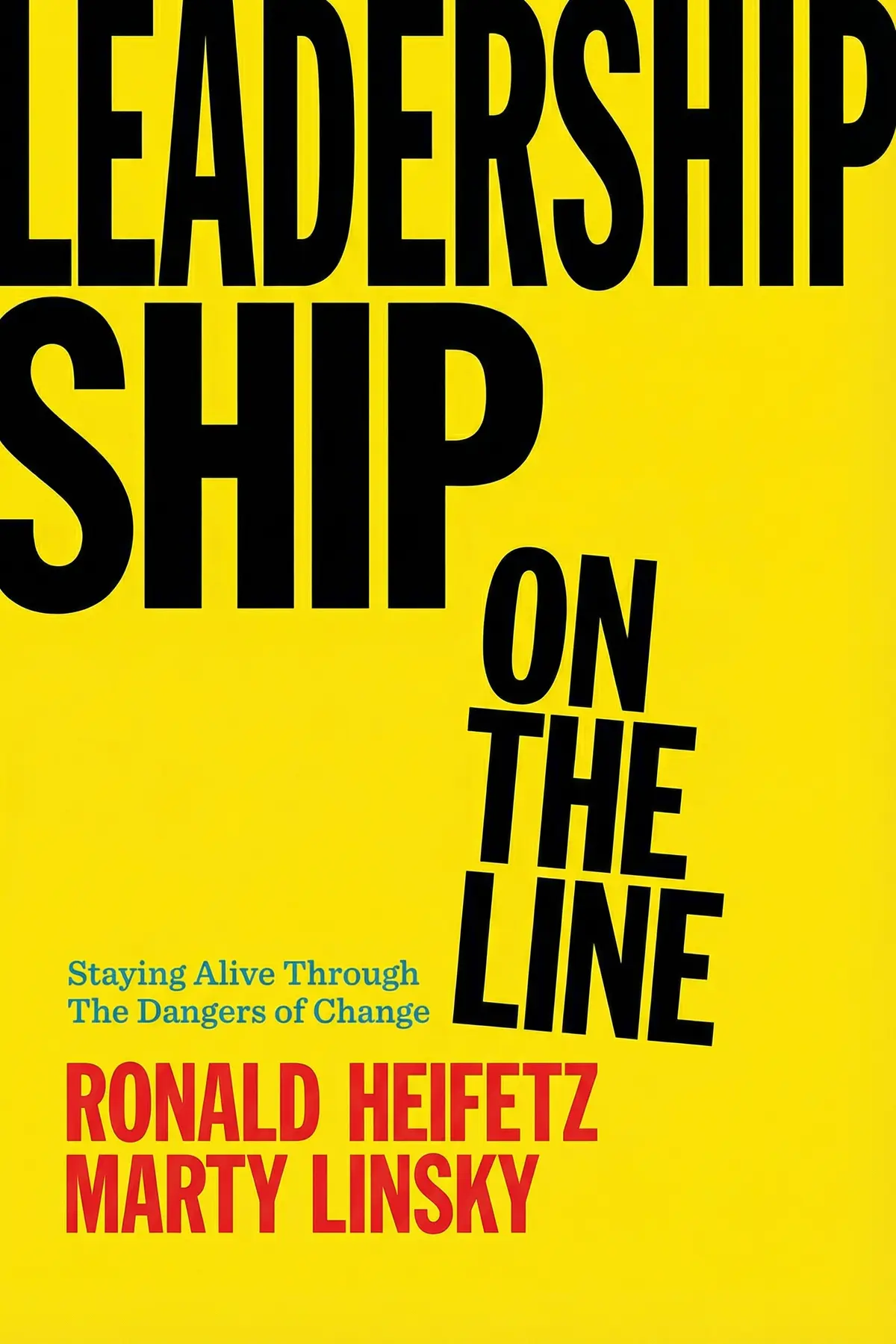
Ronald Heifetz founded the Center for Public Leadership at Harvard Kennedy School, where he holds the Hussein bin Talal Senior Lecturer in Public Leadership post. He was once a clinical instructor in psychiatry at Harvard Medical School. Marty Linsky teaches at the Kennedy School and served Massachusetts Governor William Weld as chief secretary and counselor from 1992 to 1995. The two co-founded Cambridge Leadership Associates and co-wrote Leadership on the Line. Alexander Grashow joined them to write this 2009 practical guide.
Ratings & Reviews
Ratings at a glance

What people think
Listeners find this leadership guide to be a definitive resource that offers excellent instruments for adaptive leadership. The work is approachable, confronts leadership obstacles, and allows people to perceive their organizations differently. They value the real-world utility and find the subject matter compelling, with one listener highlighting that it is filled with helpful frameworks and tools. Listeners prize the book’s clarity and feel it is a worthwhile purchase.
Top reviews
Roongsak
Finally got around to finishing this, and the distinction between technical problems and adaptive challenges is a total game-changer for my team. Most of us are trained to fix things immediately using expertise, but this book forces you to step back and observe the whole system from the 'balcony.' It’s not just a dry manual; the frameworks for mobilizing people through uncomfortable change felt incredibly relevant to our current organizational culture. While some sections are a bit dense, the core message—that people resist loss rather than change itself—is a profound insight that I’ll be carrying into every meeting from now on. Highly recommended for anyone who feels like they are hitting a wall with traditional management styles. It is a quintessential guide for the modern era.
Show moreKanokwan
This book was a required read for my graduate seminar, but it turned out to be the most useful thing on the syllabus. As someone who works in the non-profit sector, the chapter on not going it alone really hit home because I’ve definitely tried to be the 'lone hero' before and failed miserably. The authors do a fantastic job explaining that leadership is a risky, political activity that requires building coalitions and managing the expectations of various stakeholders. I especially appreciated the sections on distinguishing your professional role from your personal self to avoid burnout. It’s a dense read, but the insights into how systems resist change are absolutely essential for long-term success. It really helps you see your organization anew.
Show morePruet
Wow, this is easily one of the most profound books on organizational dynamics I have ever encountered. The authors challenge the conventional wisdom that people naturally resist change, arguing instead that they resist the loss of competence or status that comes with it. This single realization has changed how I communicate new initiatives to my department. Every chapter is filled with 'aha!' moments that make you look at your organization's habitual practices in a totally different light. If you are tired of the usual 'rah-rah' leadership fluff, this is the serious, systemic deep-dive you’ve been looking for. It is easy to read despite the complexity of the subject matter.
Show moreZanya
Ever wonder why your most well-intentioned changes constantly get derailed by office politics? This book provides the map and the compass to navigate those exact waters. I’ve been using the 'balcony' technique to observe our staff meetings, and the patterns of avoidance and distraction are suddenly so much clearer. It’s not an easy 'how-to' guide that promises success in five steps, but rather a serious framework for thriving in a rapidly changing world. The emphasis on self-care and finding purpose outside of work was also a refreshing and necessary touch. This is a must-have for anyone serious about making a real impact in their organization. It truly addresses leadership challenges head-on.
Show moreSupachai
The Practice of Adaptive Leadership provides a robust toolkit for anyone navigating messy organizational shifts. I found the practical exercises to be the most valuable part of the text, as they move beyond theory into actual application. To be fair, the writing can feel quite repetitive at times, and the book is definitely longer than it needs to be to get its primary points across. However, the concept of 'productive disequilibrium' is brilliant—it explains exactly why some of my previous initiatives failed because I either pushed too hard or not enough. It’s a solid resource that helps you diagnose problems before jumping into 'fix-it' mode. Just be prepared to wade through some redundant chapters to get to the gold.
Show moreSiriphen
After hearing colleagues rave about Heifetz for years, I finally dove into this guide. It offers a fascinating look at why traditional authority often fails when faced with complex, systemic issues that don't have a clear 'technical' solution. The focus on 'orchestrating conflict' is a bit intimidating, but the book provides enough structure to make the idea of pushing people into discomfort feel manageable and necessary. My only real gripe is that the chapter on inspiration felt a bit 'woo-woo' and manufactured compared to the rigorous systemic analysis found in the rest of the book. Still, the diagnostic tools alone are worth the price of admission for any leader looking to handle deep-rooted cultural barriers.
Show moreSuthee
Picking this up during a major transition at work was the best decision I could have made. It completely reframed how I view resistance; I stopped seeing my coworkers as 'difficult' and started seeing the 'losses' they were trying to protect. This shift in perspective allowed me to approach our meetings with more empathy and better questions. The book is packed with useful frameworks, though it requires a significant time investment to really digest the material. I did feel that the distinction between 'leadership' and 'authority' was a bit over-explained, but the practical value of the balcony metaphor more than made up for it. It’s a great tool for those trying to get ahead in complex organizations.
Show moreRin
As a consultant who deals with complex systems, I found the systemic approach to organizational challenges to be spot on. The authors correctly identify that the biggest failure in modern leadership is applying technical solutions to adaptive challenges that actually require learning and risk-taking. While I agree with other reviewers that the book is a bit disorganized, the sheer volume of practical exercises makes it a valuable workbook for any leadership team. It forces you to look at your own loyalties and hidden commitments that might be hindering progress. It’s a challenging read, but the growth it facilitates is genuine and lasting. Definitely worth the price for the diagnostic frameworks alone.
Show moreAraya
Look, there is a very good 100-page book hidden inside this 300-page volume. The central thesis—that we often try to solve human, adaptive problems with technical fixes—is brilliant and deserves to be studied. However, the authors repeat themselves constantly, and the disorganized structure makes it hard to use as a quick reference guide later on. I also found some of the personal advice, like seeking delight from your spouse to avoid office drama, to be a bit strange and dated. It’s worth a read for the core concepts, but you might find yourself skimming a lot of the redundant filler. It is a fascinating topic, but the execution is a bit hit-or-miss for me.
Show moreBank
Not sure what the hype is about, but I found the first hundred pages to be a slog of corporate jargon and recycled ideas. If you have ever read a basic leadership book, you probably already know that you need to be flexible and build strong relationships. The authors spend a lot of time talking about 'getting on the balcony,' but the actual hands-on advice felt surprisingly thin on the ground. Frankly, the organization of the chapters is a mess, making it difficult to follow the logical progression of their framework. It might be helpful for someone brand new to an office environment, but for seasoned managers, it feels like a lot of fluff that could have been a long blog post.
Show moreQuestions about this book
What is adaptive leadership according to Heifetz, Grashow and Linsky?
The authors define adaptive leadership as the work of mobilizing people to take on hard challenges and thrive. They treat leadership as an activity rather than a personal trait. Its core is diagnosing what kind of problem a group faces, keeping people under productive pressure, encouraging experiments and helping them separate what to keep from their past and what to let go.
What is the difference between a technical problem and an adaptive challenge?
A technical problem can be solved with knowledge that already exists, even if it is very hard, like complex surgery. An adaptive challenge requires the people involved to change their values, beliefs, habits or loyalties. A useful test the book offers is to ask who has the problem: if the people who must change lack authority, or change cannot be ordered from above, it is adaptive.
What does getting on the balcony mean in adaptive leadership?
It means stepping back from the action to see patterns: how groups react, where coalitions and resistance form, and your own part in frustrating dynamics. The authors pair it with acting on the dance floor. Leaders move between the two views, carrying what they observe back into their actions. They say half of leadership is diagnosis, so this step comes before acting.
How do I apply The Practice of Adaptive Leadership at work?
Start by asking who has the problem before hiring an expert. Map each stakeholder’s interests and possible losses, and state clearly what will be preserved. Keep pressure high enough to motivate but low enough to avoid blame, and run small experiments, accepting that some will fail. Watch for marginalization, diversion, seduction and attack, and keep a confidant who tells you the truth.
Who should read The Practice of Adaptive Leadership?
It suits managers, executives, public servants and nonprofit leaders driving change that people resist. The publisher presents it as the next step after Leadership Without Easy Answers and Leadership on the Line, a practical guide with tools, cases and worksheets. One reviewer notes that its examples come mainly from political and civic life, so corporate readers may need to translate some lessons to their own setting.
Readers also enjoyed





A Year with Peter Drucker: 52 Weeks of Coaching for Leadership Effectiveness
Joseph A. Maciariello



Acting with Power: Why We Are More Powerful Than We Believe
Deborah Gruenfeld

All In: How Great Leaders Build Unstoppable Teams
Mike Michalowicz

AUDIO SUMMARY AVAILABLE
Listen to The Practice of Adaptive Leadership in 15 minutes
Get the key ideas from The Practice of Adaptive Leadership by Ronald Heifetz, plus 5,000+ more nonfiction titles.
- 5,000+ titles
- Listen as much as you want
- 7-day free trial
- Cancel anytime









