

13 min 30 sec
Available in: English
The Power of the Downstate: Recharge Your Life Using Your Body's Own Restorative Systems
Shows why constant tiredness often comes from too little time in the body's recovery mode, and how slow breathing, inversion poses, nature walks and an earlier, better-timed bedtime switch that recovery back on.
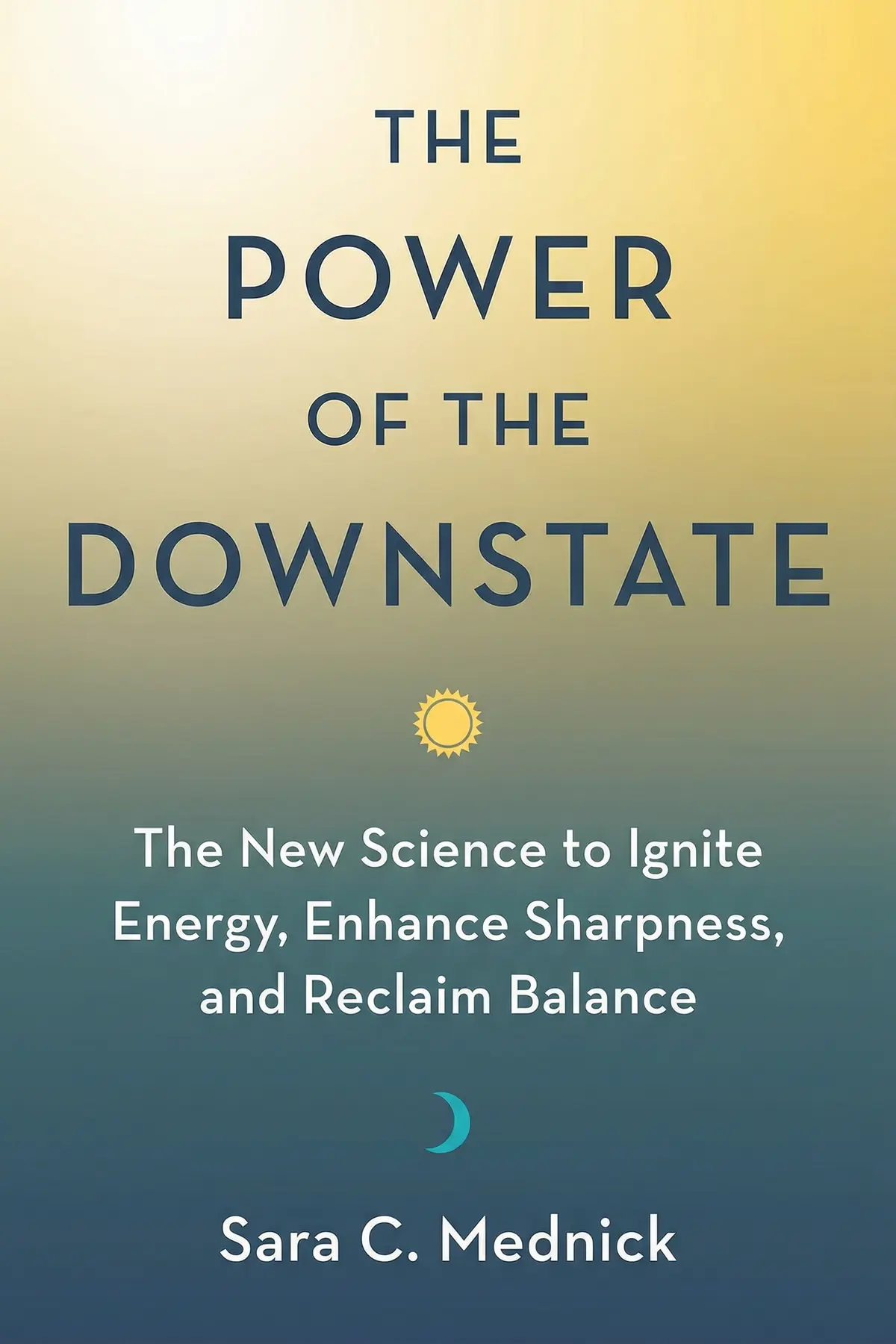
Table of Content
1. Introduction
59 sec
If you wake up tired, get through the day on coffee and still feel empty by evening, the problem may lie in how rarely you let your body refill, not in how hard you work. Every night, in deep sleep, the billions of cells in your brain fall silent together for half a second at a time, and that stillness is a large part of why good sleep restores you. In The Power of the Downstate, psychologist and sleep researcher Sara C. Mednick builds a whole program around that rhythm.
Her argument is that nearly every system in the body works the same way: it spends energy, then needs time to rebuild it, and modern life keeps us stuck in the spending phase. The rebuilding systems can be switched on on purpose. Mednick shows how a ten-second breath, a few head-down yoga poses, a walk among trees and a better-timed day tilt the balance back, and why going to bed around ten may matter more than sleeping longer.
2. Understand the half-second pause that recharges your body
1 min 57 sec
For a brief instant, again and again each night, your brain does something that sounds alarming. Mednick argues that this strange pause holds the pattern behind your energy, and that most of your body follows it too.
3. Recharge when you are running at ten percent battery
2 min 09 sec
The same wiring that gets you ready for a big presentation is supposed to switch off afterward. For many people it rarely does, and Mednick connects that stuck switch to a long list of health problems.
4. Read your stress in the gaps between heartbeats
2 min 07 sec
A healthy heart, it turns out, does not keep perfect time. Mednick explains why an uneven beat is a good sign, and how a few minutes in your calendar can train your heart toward it.
5. Lower your head and walk among trees to recover
1 min 40 sec
Two activities that look like gentle hobbies turn out to change how your heart behaves. One study even found that where you take a walk shows up in your body by bedtime.
6. Deeper repair sleep from a bedtime around ten
1 min 37 sec
Eight hours in bed can still leave you short of the sleep that matters most. Mednick explains why the clock time of your sleep decides how much deep repair you actually get.
7. Shift your bedtime earlier with light, food and movement
1 min 57 sec
In one study, people who relied only on natural sunlight started going to bed hours earlier within days. Mednick shows which everyday signals made that happen and how to send them to your own body clock.
8. Conclusion
1 min 04 sec
Mednick’s message is reassuring in a practical way. In her account, feeling drained usually means the refill half of a natural cycle keeps getting cut short. The same pulse that silences billions of neurons for half a second in deep sleep runs through the heart, the nervous system and the daily clock, and each of them can be given more room to recover.
Nothing she recommends needs a spa or a weekend away, though she has nothing against those. The tools are already in the body. A five-minute calendar slot named breathe, slow counts of five in and five out through the nose, trains the heart toward a healthier rhythm. A walk somewhere green once or twice a week leaves you better prepared for sleep than the same walk on city streets.
And a day arranged around the sun, with bright mornings, a light dinner around seven, workouts before noon and dim evenings, can pull bedtime toward ten, when the deepest repair happens.
The orchestra in your head already knows when to stop playing. Your part is to stop interrupting it.
About this book
What is this book about?
Many people sleep, drink coffee and push on, yet still feel drained by evening. Sara C. Mednick, a psychologist who runs a sleep lab, traces that exhaustion to a simple pattern. Neurons, the heart, metabolism and the daily body clock all spend energy and then need downtime to rebuild it. Borrowing two terms from neuroscience, she calls these phases the upstate and the downstate. Her diagnosis is that most of us live revved up, with the stress branch of the nervous system running far longer than the recovery branch. The result is autonomic imbalance and chronic stress, which she links to poor memory, weaker immunity and disease. Her gauge for the balance is heart rate variability, the small shifts in timing between heartbeats. The practical half of the book gives readers ways to raise that number and deepen sleep: ten-second breaths through the nose, head-down yoga poses, weekly time among trees or water, and a day arranged around sunlight, early meals and morning exercise so that bedtime moves toward 10 p.m., when the deepest restorative sleep happens.
Book Information
Who it's for
Professionals tired all day
Professionals who feel tired all day despite sleeping seven or eight hours.
Hoping to sleep earlier
Night owls who want to move their bedtime earlier without forcing it.
Under chronic stress
Anyone under chronic stress looking for simple, body-based ways to calm down.
About the Author
Sara C. Mednick
Sara C. Mednick is a professor of psychology at the University of California, Irvine, where she directs the Sleep and Cognition Lab. She earned her PhD in psychology at Harvard University. Her research examines how napping relates to performance, and it has been funded by the National Institutes of Health and the National Science Foundation. She is also the author of Take a Nap! Change Your Life.
Ratings & Reviews
Ratings at a glance

What people think
Listeners value the way this title converts intricate brain science into a reachable, research-backed manual for making recuperation and downtime a priority. They feel that the emphasis on the autonomic nervous system and circadian rhythms offers useful ways to enhance everyday wellness. Furthermore, the writer’s "unpretentious" and captivating tone allows listeners to seamlessly integrate scientific ideas into their own lives. People also highlight the concrete outcomes of these methods; specifically, one listener observed that adhering to the advice notably improved their blood pressure and heart rate variability in just two weeks.
Top reviews
Valentina
Two weeks in and I’m already seeing a measurable difference in my vitals, particularly my heart rate variability. I’m a data-driven person, so seeing my HRV climb 15 points just by prioritizing my 'downstate' windows was a massive wake-up call. Dr. Mednick has a real gift for taking complex neuroscience and making it feel like a conversation over coffee. Look, we all know we should rest more, but understanding the why behind the parasympathetic nervous system makes it much easier to actually follow through. I especially loved the section on how light exposure affects our internal clocks; it’s prompted me to change my entire evening routine. It isn't just a sleep book; it’s a total blueprint for metabolic health and cognitive longevity. This is one of those rare health books that actually provides an actionable plan rather than just theoretical fluff. I've already bought copies for my parents and my sister because the advice is so practical.
Show moreCharlotte
Wow, finally a science book that doesn't feel like a dry textbook or a condescending lecture. Dr. Mednick manages to weave together hard data with a sense of ethnic and cultural inclusiveness that is so often missing from the wellness world. I loved the holistic approach—she doesn't just look at sleep in a vacuum but considers how our values and our environment shape our biological rhythms. The 'aha' moments were frequent, especially regarding how the downstate impacts our cognitive longevity as we age. Even though some of the advice is familiar, the way it’s framed within the upstate/downstate cycle made it finally stick for me. I found myself laughing out loud at her humor, which is rare for a book about neuroscience. It’s a refreshing, impactful read that has already helped me find more balance in my chaotic schedule. Highly recommend to anyone feeling overwhelmed by modern life.
Show moreClara
As someone who constantly lives in a state of high stress, Mednick’s breakdown of the 'downstate' felt like a permission slip to rest. Personally, I’ve always felt guilty for napping or taking slow afternoons, but this book explains how those moments are literally repairing our cells. The distinction between the upstate (sympathetic) and downstate (parasympathetic) is explained so clearly that it finally clicked for me. I’ve started implementing the 'micro-breaks' she suggests, and the brain fog I usually hit by 3 PM has significantly lifted. My only real gripe is that some of the sections on aging felt a bit rushed compared to the earlier chapters on circadian rhythms. Still, the tone is incredibly encouraging and unpretentious, making the science accessible without dumbing it down. If you feel like you’re constantly redlining your engine, this provides a necessary roadmap to cooling down without losing your productivity.
Show moreSue
The chapter on aging alone made this worth the purchase for me, offering a perspective I hadn't considered before. In my experience, most books focus on 'anti-aging' as a series of hacks, but Mednick focuses on the biological imperative of restoration. The way she explains how our systems lose their resilience if we don't prioritize the downstate was eye-opening. While the writing style is a bit too casual at times—I could have done without some of the slang—the evidence-based nature of the book is undeniable. I appreciated that she didn't just tell us what to do, but explained the 'why' using her years of research. There’s a bit of overlap with other health books when it comes to the diet sections, but the overarching theme of autonomic balance is unique enough to keep it interesting. It’s a great resource for anyone looking to age gracefully.
Show moreManee
Finally got around to reading this after hearing several podcasts feature Dr. Mednick, and I’m glad I did. It’s a very practical, unpretentious guide to getting your health back on track by working with your body’s natural rhythms. The trick, as she points out, is actually applying the science, and her action plan makes that feel doable rather than daunting. I particularly liked the focus on the macrocosmic dance of life—how our internal cycles mirror the rhythms of nature. Some might find the middle chapters a bit generic, but I found them to be a helpful reminder that everything is interconnected. The book is well-paced, and her personal stories add a nice human touch to the data. It’s a solid 4-star read that offers a clear path to wellness for anyone willing to put in the everyday effort. It’s definitely helped me prioritize my recovery time.
Show moreChamnong
Ever wonder why you feel totally burnt out even when you think you're 'relaxing' on the couch? This book explains why 'vegging out' isn't the same as a true biological downstate, and that distinction has changed my life. Gotta say, I was skeptical of yet another wellness book, but Mednick’s focus on the autonomic nervous system feels much more grounded than the usual 'self-care' fluff. The writing is engaging and funny, though it does get a bit repetitive toward the end of the longer chapters. I really appreciated the scientific backing for things like light exposure and consistent sleep-wake times, as it makes the habits easier to stick to. It’s not perfect—some sections feel a bit like a general health summary—but the core concept of the upstate/downstate cycle is incredibly powerful. I’ve already noticed I’m sleeping better and feeling more focused during my 'up' times.
Show moreWoravit
While I appreciate the core message about the autonomic nervous system, the execution felt a bit scattered to me. Dr. Mednick is clearly brilliant, and her research on the power of rest is vital in our burnout-obsessed culture. However, the middle chapters felt like they belonged in a different book entirely. Truth is, I signed up for a deep dive into recovery science, but I ended up reading about general nutrition and exercise tips I’ve seen in every other wellness manual. The writing style is very casual—she uses words like 'doozering'—which might charm some readers but felt a bit unprofessional to me. On the plus side, the final chapter on living in alignment with your values was surprisingly profound and tied the 'downstate' concept to a higher purpose. It’s a good book with some great 'aha' moments, but it definitely needed a tighter edit to keep the focus on its unique premise.
Show moreWorawit
Not what I expected given the hype, though the science is definitely solid and well-researched. The central idea—that we need to balance our 'up' energy with 'down' recovery—is a great framework for health. But frankly, the book feels stretched thin to reach its page count. I found myself skimming through the parts about basic healthy eating and exercise because they didn't offer anything new to the conversation. Mednick is a wonderful narrator with a very down-to-earth sense of humor, which makes the biology easier to digest. However, I wish she had spent more time on the specific neuroscience of the downstate rather than branching out into every facet of wellness. It’s a helpful guide if you’re looking to overhaul your entire lifestyle, but if you’re looking for hyper-specific new discoveries in sleep science, you might be disappointed. It's a solid 3-star read that's useful but could have been much more concise.
Show moreEmily
I really wanted to love this book, especially since I'm a bit of a sleep-science junkie. To be fair, Mednick writes with a lot of heart, but if you’ve already read the classics like Matthew Walker, you won’t find much groundbreaking material here. Most of the suggestions—consistent wake times, limiting blue light, and morning exercise—are things I’ve been doing for years. The first half focuses heavily on the autonomic nervous system, which is interesting, but then it veers into general diet and exercise advice that feels like filler. I found the 'downstatey' terminology a little grating after a while, and the book is quite repetitive in its phrasing. It’s a decent primer for a total beginner who has never thought about their circadian rhythm, but for anyone else, it’s a lot of pages for very few new insights. I finished it feeling like I could have just read a summary and saved myself several hours.
Show moreWichai
Honestly, this could have been a long-form article rather than a 300-page book with a lot of repetitive anecdotes. I was really hoping for deep insights into the 'downstate,' but instead, I got the same old advice about limiting caffeine and getting morning sun. If you’ve read any health book in the last five years, you already know 90% of what is in here. The author tries to make it trendy with made-up words, but it just felt like it was trying too hard to be 'accessible' at the expense of depth. Not gonna lie, I was annoyed. The actual 'action plan' is tucked away in the back after pages and pages of fluff. I appreciate the focus on the parasympathetic system, but the signal-to-noise ratio is just too low for me to recommend this to anyone who is already health-conscious. It might be good for a total novice, but it was a waste of time for me.
Show moreQuestions about this book
What is the downstate in The Power of the Downstate?
Sara C. Mednick borrows the term from neuroscience. In slow-wave sleep, brain cells fire together for half a second, the upstate, then fall silent for half a second, the downstate. She uses the two words for a pattern she sees across the body: systems spend energy, then need downtime to restore it. The downstate covers all the body’s restorative systems and processes.
What are the REV and RESTORE systems?
They are Mednick’s nicknames for two branches of the autonomic nervous system. REV, the sympathetic branch, prepares you for action with stress hormones, a faster heart and more sweat. RESTORE, the parasympathetic branch, relaxes muscles, slows the heart and replenishes fluids. She argues most people spend too long in REV, which leads to autonomic imbalance and chronic stress.
How can I increase my heart rate variability according to Mednick?
She suggests slow breathing at about one breath every ten seconds, ideally through the nose, practiced in a daily five-minute calendar slot. She also suggests inversion yoga poses like Downward Dog and Legs Up the Wall, beginning with seven minutes three times weekly, plus a once or twice weekly dose of time outdoors in nature, forest bathing included.
Why does Mednick recommend going to bed at 10 p.m.?
Whatever time you go to bed, the brain gets the bulk of its slow-wave sleep early in the night, a couple of hours after the sun sets. Sleeping late can mean a full eight hours with little of this stage. Slow-wave sleep is when the body clears toxins from the brain, repairs cells, refills muscle fuel, consolidates memories and resets brain networks.
How can a night owl start sleeping earlier?
Mednick points to three levers. Get morning sunlight, or 15 to 30 minutes by a light therapy lamp, and avoid artificial light after 6 p.m. Eat breakfast and lunch as main meals with a light dinner around 7 p.m. Do aerobic exercise in the morning. In one study, removing artificial light moved bedtimes two and a half hours earlier in under a week.
Readers also enjoyed




AUDIO SUMMARY AVAILABLE
Listen to The Power of the Downstate in 15 minutes
Get the key ideas from The Power of the Downstate by Sara C. Mednick, plus 5,000+ more nonfiction titles.
- 5,000+ titles
- Listen as much as you want
- 7-day free trial
- Cancel anytime









