

12 min 03 sec
Available in: English
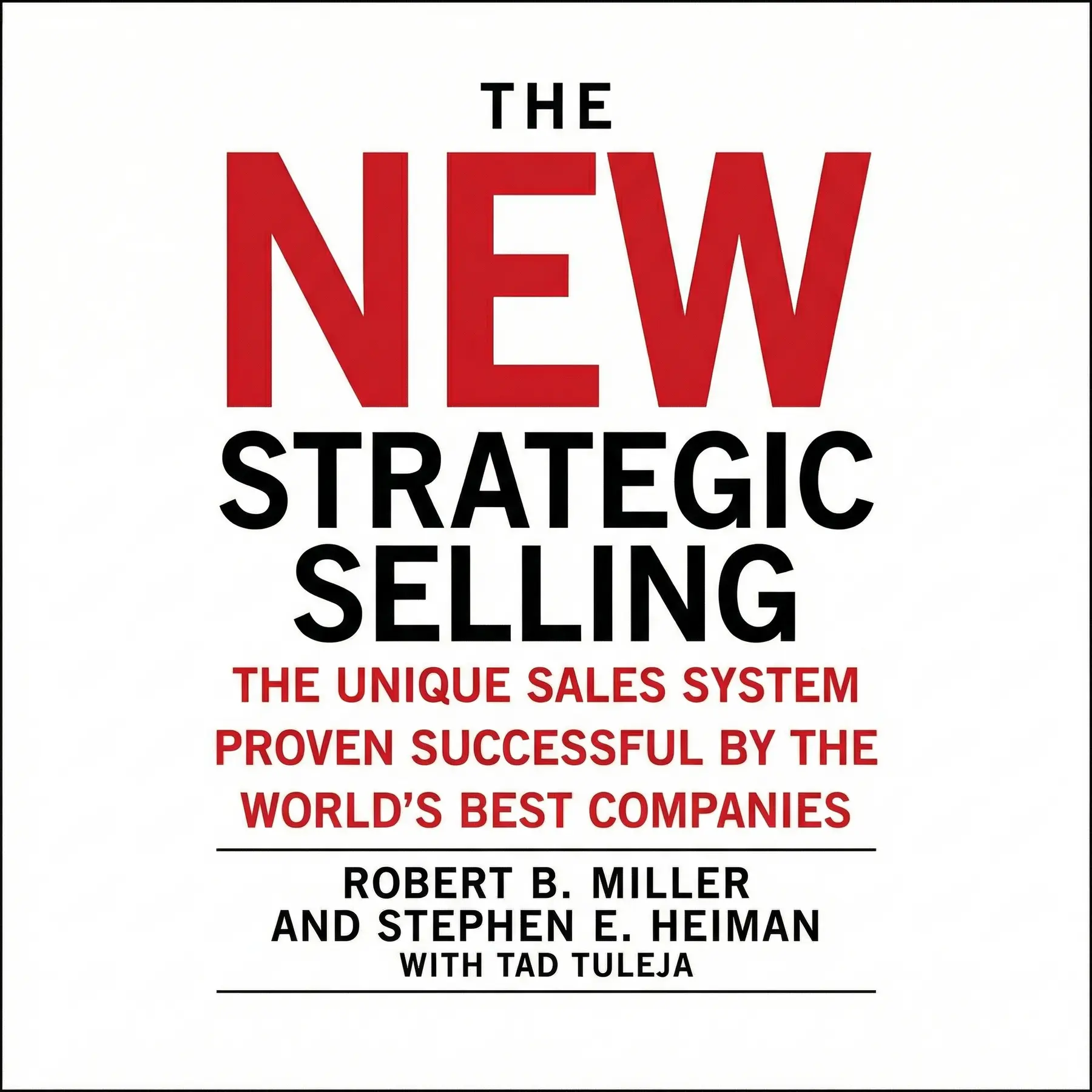
The New Strategic Selling: The Unique Sales System Proven Successful By the World’s Best Companies
Shows sellers how to plan complex deals: assess their position, set one precise sales objective, identify the four people who decide, catch red flags early and shape offers where buyer and seller both win.
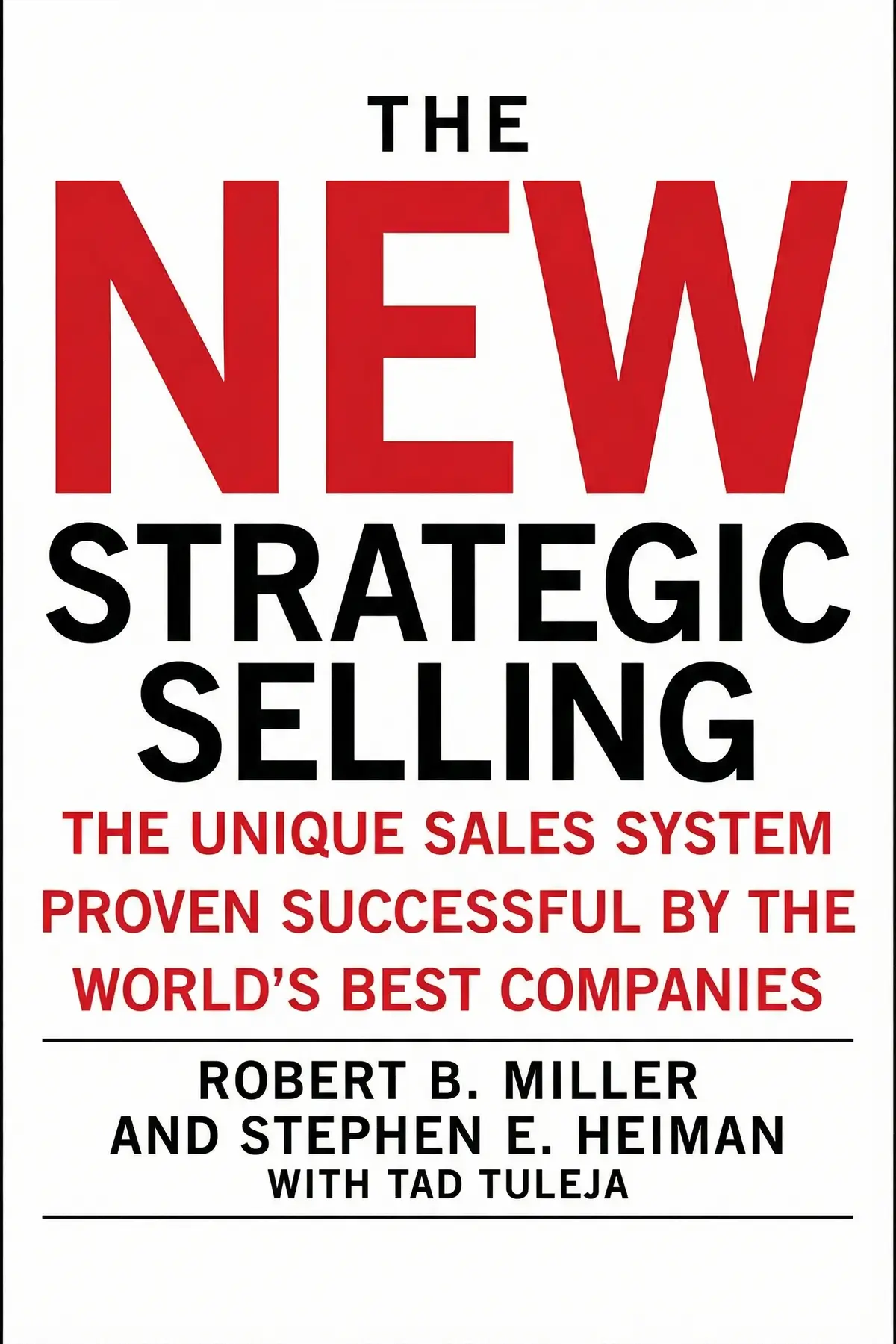
Table of Content
1. Introduction
56 sec
Most salespeople lose deals they never saw slipping away, because they put all their effort into the meeting and none into the plan. In The New Strategic Selling, Robert B. Miller, Stephen E. Heiman and Tad Tuleja argue that a sale is won before anyone sits down at the table. Their first point is blunt: clever tactics can close one order, but without a strategy behind them the customer rarely buys a second time.
The whole method follows from one idea. Lasting sales come from planning around the buyer’s side of the deal: your position, the people who can approve or block it, the warning signs, and what each person hopes to gain. The authors build this step by step, from sizing up your market to reading a buyer’s mood. By the end, you will be able to map any complex deal, name the four roles that decide it, and shape an offer that leaves each of those people better off.
2. Plan the account before you pitch the deal
1 min 36 sec
Many sellers are excellent in the room and still watch their accounts fade. The authors trace the problem to a missing step that most people skip because the meeting feels more urgent.
3. Set one sales target you can actually measure
1 min 44 sec
A goal like selling more to a big retailer sounds ambitious and gets you nowhere. The authors show the difference between a wish and an objective, and why the gap decides whether you can plan at all.
4. Find the four people who really decide
1 min 35 sec
A deal can look certain right up to the moment it stalls, blocked by someone the seller never met. The authors describe the people hiding behind every complex purchase and how to find each one.
5. Turn red flags into allies before they cost you
1 min 35 sec
Just before a negotiation, a client brought in an outside consultant nobody expected. One insurance salesman’s response shows why the most dangerous moment in a deal is often the one where you feel safest.
6. Pitch to a buyer's growth or their trouble
1 min 48 sec
Two buyers can both want change urgently and still need completely different pitches. The authors explain how to tell them apart, starting with the words a buyer keeps repeating.
7. Close deals that leave both sides winning
1 min 40 sec
A sale that favors only the seller can feel like a victory for weeks. The authors argue it is usually a slow loss, and they show how a glance around a buyer’s office can point to a better deal.
8. Conclusion
1 min 09 sec
Seen from a distance, the book is a lesson in where to look. Deals slip away when sellers fix their eyes on the wrong things: their own product, the next meeting, or the rival down the street. The authors warn that watching competitors too closely can leave a poor impression and pull you away from your own goals. Their steady advice is to look at the customer instead, at the several people who share a decision, and at what each of them needs before they can call the deal a success.
That change of focus turns into specific work. Before your next important pitch, write the sale you want as one sentence with a quantity and a date. Put a name next to the economic buyer, the user, the technical buyer and your coach, and treat any blank space or any new arrival as a flag to deal with now. Then find out, by watching and by asking for opinions, what a personal win would look like for each of them.
A seller who works this way stops trying to beat the buyer. The two sides are on the same team, and the deal they both win is the one that brings the next.
About this book
What is this book about?
Most sellers put their energy into the meeting itself: the pitch, the objections, the close. Robert B. Miller, Stephen E. Heiman and Tad Tuleja argue that this is why so many deals stall or never repeat. A modern sale usually needs several people on the client side to agree, and nobody can steer that many people well without a plan made in advance. The authors separate strategy, the long-term plan for an account, from tactics, the moves inside a single conversation, and they show how the two work together. They walk through sizing up your market position, writing a single sales objective with a quantity and a date, and finding the four roles that shape every complex deal: the economic buyer, the user, the technical buyer and the coach. They also show how to spot red flags, read whether a buyer is chasing growth or escaping trouble, and look for what each person would count as a personal win. The result is a way of selling that puts the customer at the center and treats a one-sided deal as a loss for everyone. Readers come away with a method they can apply to the very next account.
Book Information
Who it's for
Sellers facing stalled deals
Account managers and sales reps whose deals stall when people they never met get involved.
Founders entering corporate sales
Founders selling to larger companies for the first time, where several people must say yes.
Heads of sales teams
Sales leaders who want a shared planning method for their team's biggest accounts.
About the Author
Robert B. Miller
Robert B. Miller has worked in sales, consulting and executive management for more than forty years and created the Strategic Selling program in the mid-1970s. Stephen E. Heiman was a top-performing national account salesman at IBM and executive vice president at North American Van Lines before joining Miller in 1978; their partnership grew into the sales performance company Miller Heiman. Tad Tuleja is a writer, editor and researcher who studied at Yale, Cornell and the University of Sussex.
Ratings & Reviews
Ratings at a glance
What people think
Listeners find this work to be a premier sales resource, highlighting its practical guidance and tactical methodology. The material earns high marks, as one listener points out its effectiveness in clarifying the goals of various buying roles. Listeners also appreciate how uncomplicated and user-friendly the text is. Yet, there is varied commentary on its longevity; while some find it timeless, others consider it to be outmoded. In addition, several listeners mention encountering frequent spelling errors throughout the book.
Top reviews
Pawinee
This book remains the gold standard for anyone navigating the treacherous waters of enterprise-level sales. While some might argue that the examples feel a bit dated, the core methodology regarding "Buying Influences" is absolutely timeless. In my experience, understanding who actually holds the veto power in a deal is the difference between a closed win and a wasted quarter. The authors break down the complex psychology of corporate procurement into manageable segments that even a novice can grasp. It's not just about pushing a product; it’s about aligning your solution with the strategic goals of the client's internal stakeholders. Truth be told, I keep a dog-eared copy on my desk for reference before every major pitch. If you are tired of "winging it" and want a repeatable system, look no further.
Show moreTakeshi
The chapter on "Economic Buying Influences" completely changed how I approach my quarterly prospecting. It’s easy to get caught up talking to the person who likes your product, but this book forces you to find the person who actually signs the checks. Look, the methodology is dense, but that’s because high-stakes corporate selling is a dense subject. I appreciated the straightforward breakdown of how to allocate time to the right activities rather than just busy work. It’s a masterclass in staying focused on the end goal without losing sight of the customer's needs. Although the book mentions their pricey seminars a bit too often for my liking, the actual content provided here is a bargain for the price.
Show moreZanya
Following the steps laid out in this book along with "The New Conceptual Selling" is basically a cheat code for building long-term customer referrals. If you are focused on repeat business rather than just a one-time transaction, this strategy is essential. The authors teach you how to move away from being a "vendor" and toward being a "strategic partner." It requires a lot of discipline to follow their system, but the results speak for themselves in terms of customer satisfaction and retention. Frankly, it’s one of the few sales books that actually respects the intelligence of both the seller and the buyer. This is mandatory reading for my entire sales team from now on.
Show moreBae
Ever wonder why your "sure-fire" deals keep falling through at the eleventh hour? Miller and Heiman provide the answer by focusing on the "Win-Win" philosophy, which ensures that both the buyer and the seller walk away feeling like they've gained something substantial. To be fair, the book is a bit of a slog in the middle, and the constant sports analogies can get a little grating if you aren't into that world. However, the introduction of the Sales Funnel concept is worth the price of admission alone. It helps you visualize your pipeline in a way that is both logical and actionable. Despite the occasional typo that breaks the flow, the strategic value here is undeniable for anyone in B2B.
Show moreArjun
As someone who has spent a decade in the tech sector, I can confirm that the principles in this guide are still relevant, even if the "Strategic" label feels a bit overused these days. The focus on identifying the "Coach" within a prospect's organization is a brilliant tactic that many younger sales reps completely overlook. The authors emphasize that selling is a process, not just an event, which is a crucial mindset shift. My only real gripe is that the tone can feel somewhat "old school" and masculine, relying heavily on war metaphors that don't always land well in a modern office environment. Still, if you can look past the 1980s veneer, there is a wealth of tactical advice that produces results.
Show moreYanin
Finally got around to finishing this "sales bible," and I can see why it has stayed on the shelves for so long. It offers a robust framework for managing complex accounts that involve multiple decision-makers. The truth is, most sales books are just fluff, but this one provides actual tools and processes that you can implement immediately. I found the section on "Win-Results" particularly insightful because it differentiates between a corporate win and a personal win for the buyer. It’s a bit of a slow burn, and you have to be patient with the authors' self-promotion, but the payoff is a much clearer understanding of your own sales pipeline. It’s a foundational text that every serious professional should have.
Show moreChatchai
Not what I expected from a book published decades ago, but the logic behind their strategic approach is surprisingly sound. I particularly enjoyed the way they categorize different buyer roles—User, Technical, and Economic—which helps in mapping out a complex deal. In my experience, most sales failures happen because you missed one of these key influencers. The book is definitely on the longer side, and the pace can be glacial at times, but the information is presented in a very easy-to-use format once you get the hang of it. It’s a reliable map for anyone lost in a long sales cycle. I just wish they would hire a better proofreader for the next edition to catch those nagging typos.
Show moreMethinee
Picked this up after seeing it on every "Must Read" sales list, but I found the experience to be a bit of a mixed bag. Frankly, the writing style is incredibly repetitive, and the authors could have easily communicated their main points in half the page count. There were several instances where I felt like I was reading the same paragraph over and over again. Not gonna lie, the typos throughout the text are distracting and make the book feel less professional than its reputation suggests. It provides a decent framework for identifying key players in a sale, but it lacks the punch of more modern, concise sales literature. It’s a solid starting point for a beginner, but seasoned pros might find it a bit elementary.
Show moreKwame
After hearing so much hype, I expected something a bit more revolutionary, but what I got was a very long, very traditional guide to selling. It's not that the advice is bad; it’s just that it’s buried under mountains of text and redundant explanations. Gotta say, the authors seem very proud of their own success, and the constant plugs for their consulting business started to wear thin by chapter four. The book relies on a lot of "old boy" analogies that feel out of place in 2024. If you have the patience to dig through the fluff, you'll find some gems about account management, but you'll need a lot of coffee to get there.
Show moreNew
Wow, I really wanted to like this classic, but it felt like stepping into a time capsule that hasn't aged particularly well. The authors frequently use sports and military analogies that feel incredibly exclusionary and outdated for today's diverse workforce. To make matters worse, there is a misattributed quote about "hell hath no fury" that comes across as unnecessarily sexist. It’s hard to take strategic advice seriously when the delivery is so tone-deaf to the current cultural climate. While the "Win-Win" concept is nice in theory, the book is so drawn out and dry that I struggled to stay awake for more than ten pages at a time. There are much better, more inclusive sales books available now that don't require sifting through this much filler.
Show moreQuestions about this book
What is The New Strategic Selling about?
Miller, Heiman and Tuleja argue that sellers win lasting business by planning, not only by performing well in meetings. They separate strategy, the long-term plan for an account, from tactics, the moves inside one conversation. Their method covers assessing your market position, setting one precise sales objective, identifying the people who influence the purchase, catching red flags and shaping deals where both buyer and seller come out ahead.
What are the four buying influences in Strategic Selling?
The authors describe four roles. The economic buyer has the final say because they approve the payment. User buyers work with or administer the product and care about its effect on their daily work. Technical buyers, such as lawyers or accountants, screen options and suppliers. The coach guides you through the sale; they can work for the client or for you, but must trust you and be seen as credible by the others.
What is a single sales objective?
It is the one specific sale you want to make with a particular customer, stated precisely: what you will sell, how much and by when. The authors contrast a vague aim, getting a retail chain to buy televisions, with a concrete one, a trial order of 100 4G TVs by August 1st. A precise objective tells you what success looks like and gives your plan a fixed target.
What is a win-result in sales?
A win-result happens when the buyer gets good business results from the purchase and also feels personally that they did well. The authors give the example of a manager whose department is over budget: a product that keeps the department within budget helps the company and lets the manager feel he solved the problem. Clues in the office, such as awards or family photos, hint at what that personal win might be.
How can I apply Strategic Selling to my next deal?
Write your objective as one sentence with a product, a quantity and a date. List the four buying roles and put a name under each; blanks and new people are red flags to address now. Notice whether the buyer talks about growth or about escaping trouble, and adjust your pitch. Then ask opinion questions, such as what they think of their current system, to learn what a win means to them.
Featured in
Readers also enjoyed




AUDIO SUMMARY AVAILABLE
Listen to The New Strategic Selling in 15 minutes
Get the key ideas from The New Strategic Selling by Robert B. Miller, plus 5,000+ more nonfiction titles.
- 5,000+ titles
- Listen as much as you want
- 7-day free trial
- Cancel anytime









