

13 min 44 sec
Available in: English
The Motivation Myth: How High Achievers Really Set Themselves Up to Win
By Jeff Haden
Shows why waiting to feel motivated keeps people stuck. Explains how to turn a big goal into a precise daily process and a number you can hit, so that small wins create the drive you need.
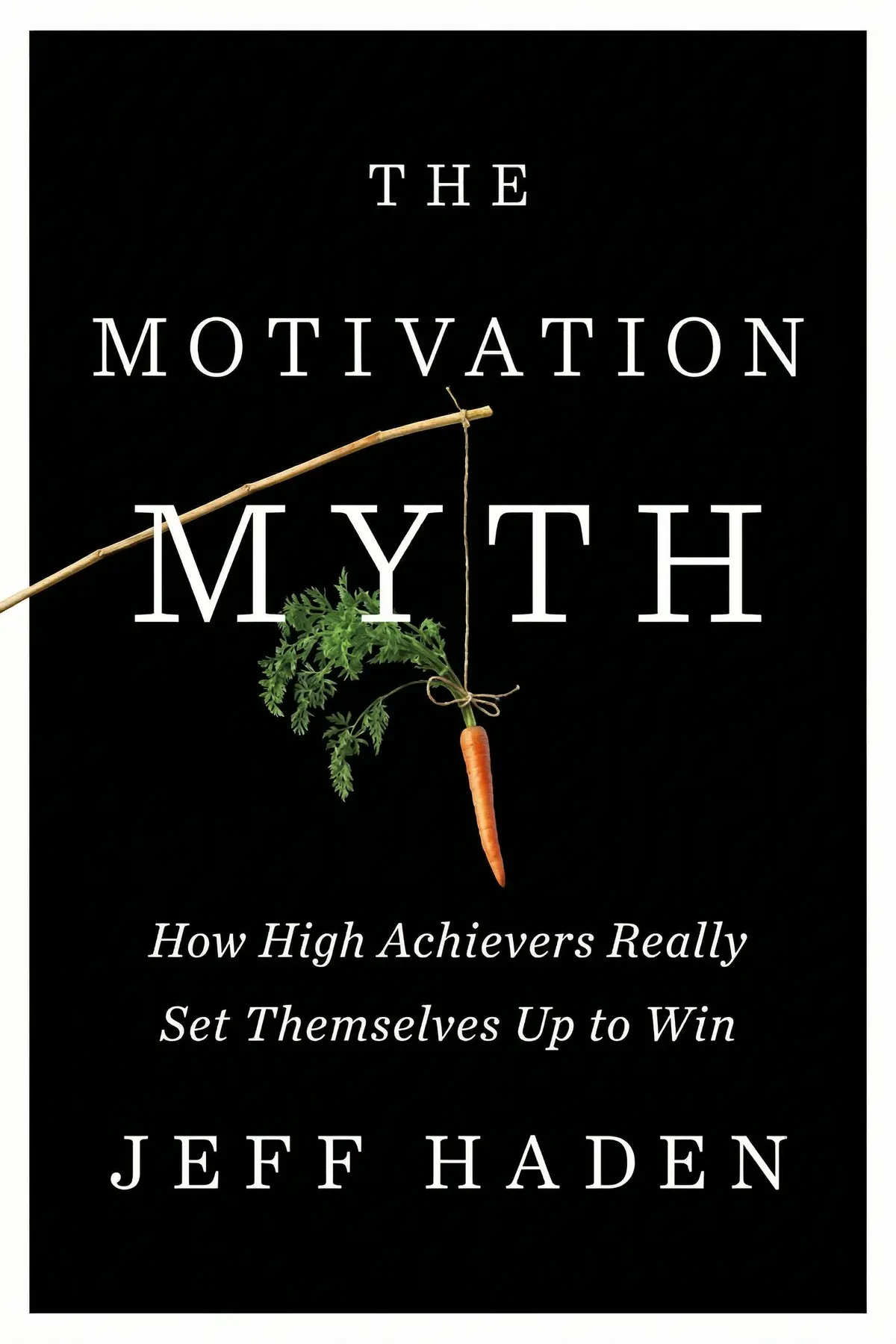
Table of Content
1. Introduction
59 sec
If you have been waiting to feel motivated before you start, Jeff Haden says you have the order backward. In The Motivation Myth, the Inc. contributing editor argues that motivation does not arrive first and push you into hard work. Hard work produces it, one small win at a time. People who seem endlessly driven have simply arranged their days so that success shows up often.
Every idea that follows supports one claim: build a specific daily process that produces regular wins, and motivation will follow. Haden tests it on his own cycling races, on a writing routine that took him from 35,000 monthly page views to 2.1 million, and on a year of 100,000 push-ups. He adds the habits of Venus Williams and race car driver Jimmie Johnson. The payoff is practical: a way to turn a distant goal into a number you can hit today, and a plan for finishing one big task in a single day.
2. Let small wins do the motivating for you
1 min 39 sec
After his hardest race ever, Haden noticed something odd about where his drive came from. It changes how you should treat the mornings when you would rather do nothing at all.
3. Trade the big goal for a daily routine
1 min 47 sec
Sharing your ambitions with friends feels like a smart way to stay on track. Research Haden cites suggests it can do the reverse, and his own early writing career shows what to do instead.
4. Build a plan precise enough to show up for
1 min 47 sec
A racehorse’s second-place finish gave Haden’s grandfather a few proud hours, then left him empty. The lesson explains why hacks fail and what a plan you will actually follow looks like.
5. Pick a daily number and pad it
1 min 42 sec
Two frustrated cofounders saw only a sales problem. Haden saw a simple count, the same kind that later carried him through a year of push-ups and helped a young driver become a champion.
6. Learn from a pro who won't coddle you
1 min 42 sec
Paying for encouragement feels like progress, yet Haden thinks it often keeps people comfortable. A world-class mountain biker and a ride with 4,400-foot climbs show the kind of help that changes results.
7. Finish one major task in a single day
1 min 29 sec
When you cannot see where to begin, Haden prescribes one unusually long day with odd hours and strict rules. The way he tells you to take breaks may be its most useful trick.
8. Grow by pursuing more than one ambition
1 min 33 sec
Conventional wisdom says to pick one thing and master it. A tennis champion who grew up hearing tapes about property deals suggests that spreading your efforts can strengthen each of them.
9. Conclusion
1 min 06 sec
Haden’s case removes an old excuse. Waiting to feel driven means waiting for something that only shows up after you act. In his telling, the people who seem tireless, from a NASCAR champion to a tennis star with a design firm, built routines that let them win something small almost every day, and each win carried them into the next morning.
That changes where your effort goes. Settle the goal once and keep it mostly to yourself. Then turn it into a daily process with a time, a place and a number, padded for bad days the way Haden padded his push-ups. Judge every new commitment by whether it serves that process. When starting feels impossible, ask one person who has done it how they did it. Or block out a long day with one task and an odd starting hour, and do not stop until it is finished.
Motivation, as Haden describes it, is a receipt for work already done. Collect enough of them and you will stop wondering where your drive went.
About this book
What is this book about?
Many people assume that successful people simply have more willpower or grit, and that they themselves would act if only they felt motivated. Jeff Haden argues that this gets the order backward. Motivation, in his account, does not come first and push you into hard work. It is produced by hard work, one small success at a time. Drawing on his own cycling races, his early years writing for Inc.com and a year of 100,000 push-ups, along with the habits of Venus Williams and Jimmie Johnson, Haden shows how to build a routine that wins every day. He explains why announcing your goals can backfire and why shortcuts don't last. He also shows how to break a goal into a daily number with a buffer for bad days, and why a working professional can help you more than a motivational coach. Readers get concrete tools: a way to make a training or work plan specific enough to follow, a filter for saying no to distractions, and the extreme productivity day, a long single-task push for clearing one major job.
Book Information
Who it's for
Professionals waiting for motivation
Professionals who keep waiting to feel motivated before tackling a big goal.
Wanting a daily number
Runners, cyclists, writers and salespeople who want a daily number to work toward.
Early-career professionals feeling stuck
Early-career climbers looking for a side skill, a mentor or one focused day to break a stall.
About the Author
Jeff Haden
Jeff Haden is a speaker, a LinkedIn Influencer and a contributing editor at Inc. Magazine, and he has ghostwritten dozens of books. His work has also appeared in Time, Fast Company, Business Insider, the Huffington Post and on MSNBC. He enjoys talking with highly successful people to learn what makes them succeed, and those conversations shape The Motivation Myth.
Ratings & Reviews
Ratings at a glance
What people think
Listeners describe this motivational title as useful and accessible, featuring uncomplicated, direct methods for achieving objectives. Furthermore, the content is compelling and well-crafted, resonating profoundly with the audience; one listener highlighted how it transforms minor wins into drive for greater achievements. Listeners also value the book's candid perspective and feel it surpasses other titles in the motivation genre.
Top reviews
Bo
Jeff Haden hits the nail on the head regarding how we actually achieve things. Instead of waiting for a lightning bolt of inspiration, he argues that we need to build a system of small, repetitive successes. It’s an incredibly pragmatic take on a genre that is usually filled with empty promises. Look, the writing is straightforward and feels like a long conversation with a mentor who actually wants you to win. I loved the emphasis on process over big, distant dreams because it makes the daily grind feel meaningful rather than exhausting. While some might find the tone a bit too 'pedal to the metal,' I found it genuinely motivating. This isn't just another self-help manual; it’s a blueprint for anyone tired of feeling stuck in a cycle of procrastination.
Show moreFon
Finally got around to reading this and I'm genuinely surprised by how much I enjoyed the no-nonsense tone. Many books in this niche try to be overly philosophical, but this one stays grounded in reality. The idea that success is just a series of mundane, daily tasks performed consistently is a bit of a reality check. I found myself highlighting so many passages about how small successes feed into a larger sense of accomplishment. It hits you on a deep level because it’s so relatable. Haden doesn't sugarcoat the effort required. If you want a book that will hold your hand and tell you everything is easy, look elsewhere. This is for the workers who want a clear, straightforward process.
Show moreIsabella
Wow, this book actually changed the way I look at my morning workout routine. I used to wait until I 'felt' like exercising, but now I understand that the feeling comes after I start moving. Haden’s focus on turning small successes into motivation for even better things is a total game-changer. It’s so simple yet so hard to implement without the right mindset shift. The book is well-written and engaging enough to keep you turning pages late into the night. I appreciated the honesty regarding how boring the process can actually be. Success isn't flashy; it’s just showing up. Highly recommend this to anyone who feels like they are constantly waiting for the 'right time' to start.
Show moreKanokwan
Picked this up because I was tired of the usual 'visualize your way to success' fluff that dominates the market. Haden’s central premise is simple: motivation is the result of action, not the cause of it. This shift in perspective was exactly what I needed to hear. The chapters are structured well, though you can definitely tell he’s a columnist because some sections feel like individual articles stitched together. Frankly, the advice on building a routine is gold, even if it gets a little repetitive toward the middle of the book. It’s a very 'American' style of self-improvement—focused on results and hard work—but it’s honest. I’ll definitely be keeping some of these tactics in mind for my next project.
Show moreElan
As someone who struggles with staying consistent, the focus on daily routines over lofty goals was incredibly refreshing. We often get so swept away by 'Big Dreams' that we forget the actual work involved in the day-to-day. This book forces you to analyze your process and stop relying on emotional whims. While the author can be a bit intense with his 'no excuses' attitude, the logic behind his methods is sound. The writing is punchy and keeps you engaged throughout. I did notice some contradictions where he tells you to work harder but then mentions not ruining your health. Still, the practical value here far outweighs the minor structural issues found in the later chapters.
Show moreFilm
Listening to Ray Porter narrate this made the pragmatic advice go down much easier than it might have on the page. Haden has a very direct, honest approach that cuts through the typical horse-shit found in this genre. I particularly liked the chapter on how to build a routine that actually sticks. It’s not about being a superhero; it’s about being a person who shows up every single day. The author mentions he’ll explain things in 'coming chapters' a bit too much, which can be annoying for the flow. Despite that, the core message is powerful and easy to understand. It’s a solid addition to my shelf, providing clear steps that turn small successes into real momentum.
Show moreLillian
To be fair, the first few chapters are absolute gold, but then the momentum starts to flag significantly. Haden starts strong by debunking the idea that we need a 'spark' to start working, which is a really useful concept. However, after that point, the book veers into general entrepreneurship territory that feels a bit generic and loses the focus of the title. There were moments where the advice felt slightly ableist and ignored the realities of people dealing with actual health limitations or chronic fatigue. If you can push through those parts, there are still some good takeaways regarding the power of the process. It's not a bad read, but for those interested in the science of motivation, 'Drive' by Pink might be a more comprehensive choice.
Show moreAroha
After hearing so much hype, I found the 'no excuses' mantra a bit difficult to swallow in the later sections. The first half of the book is fantastic and offers a truly different perspective on how to get started on your goals. But then it turns into the same old self-help tropes we’ve seen a thousand times before. I also listened to the Ray Porter narration, which was excellent and probably kept me listening longer than I would have read. My main gripe is the lack of nuance for those who aren't in peak physical or mental health. It’s very hustle-culture oriented. It’s a decent enough book for a quick boost, but don't expect a deep philosophical dive into the human psyche.
Show moreKomsan
Ever wonder why you can't stay on track despite having big goals? I read this as an e-book and it really helped me understand where I was going wrong by looking for motivation in the wrong places. The writing style is very casual, with the occasional cuss word thrown in to make it feel edgy. Sometimes it works, and sometimes it feels a bit forced. I think the book is a bit too long for the amount of original content it provides, as a lot of it becomes repetitive by the end. However, the central idea that motivation is a myth is worth the price of admission alone. It’s a good, quick read for a weekend if you need a kick in the pants.
Show moreArm
Not what I expected based on the title, as it quickly devolves into generic entrepreneurship advice. The first chapter promised a unique look at the psychology of motivation, but that promise was soon broken by endless fluff and anecdotal evidence. I found several logic errors where the author contradicts his own stance on hard work versus maintaining personal well-being. It feels very much like a collection of blog posts that weren't edited for a cohesive book structure. Truth is, if you’ve read any other modern productivity book, you’ve already heard most of this. There was even a weirdly sexist aside that felt totally out of place. Skip this and read something with more substance and better research.
Show moreQuestions about this book
What is the main idea of The Motivation Myth?
Jeff Haden argues that motivation is not a spark that comes before hard work. It is a result of it. Small successes feel good and make you want more, so the trick is to build a specific daily process that lets you win something regularly. Successful people, in his view, are not born with more willpower. They set up their days so success arrives often.
Why does Jeff Haden say you should not share your goals?
Haden cites research suggesting that people who talk about their aspirations follow through less. If you tell friends you will hike the Appalachian Trail, their admiration already feels like a reward, which weakens your drive to do it. He makes one exception: on an extreme productivity day, telling people the single task you plan to finish makes you accountable for it.
What does working your number mean?
It means turning a goal into a daily count you can hit. Two cofounders who needed ten contacts per client could land five clients a month by calling 50 prospects. Haden did 100,000 push-ups in 2016 by aiming for 274 a day plus 30 to 40 extra as a buffer for sick days. When no exact figure exists, the number is as many as you can manage.
What is an extreme productivity day?
It is an eleven- or twelve-hour day reserved for one major task. Haden suggests telling others you will be offline, starting at an unusual hour such as 4 a.m. or 6 p.m., and avoiding social media and television. Take breaks in the middle of a task so restarting is easy, and keep working until the task is done, even past the planned hours.
Who should read The Motivation Myth?
It suits people who feel they lack the drive to reach their goals, especially those who assume high achievers simply have more grit. Athletes, writers, salespeople and ambitious employees get concrete tools: a specific daily process, a number with a buffer, help from a working professional instead of a motivational coach, and a single long day to clear one big task.
Readers also enjoyed




A Guide to the Good Life: The Ancient Art of Stoic Joy
William B. Irvine


A High-Performing Mind: Strengthen Your Mind and Live Your Best Life
Andrew D. Thompson


Abundance: The Inner Path to Wealth
Deepak Chopra

AUDIO SUMMARY AVAILABLE
Listen to The Motivation Myth in 15 minutes
Get the key ideas from The Motivation Myth by Jeff Haden, plus 5,000+ more nonfiction titles.
- 5,000+ titles
- Listen as much as you want
- 7-day free trial
- Cancel anytime









