
15 min 26 sec
Available in: English
The Miracle Equation: The Two Decisions that Move Your Biggest Goals from Possible, to Probable, to Inevitable
By Hal Elrod
Hal Elrod shows how to turn one big goal into a likely result. You choose to believe you can reach it, then repeat small, scheduled steps every day without waiting for luck.
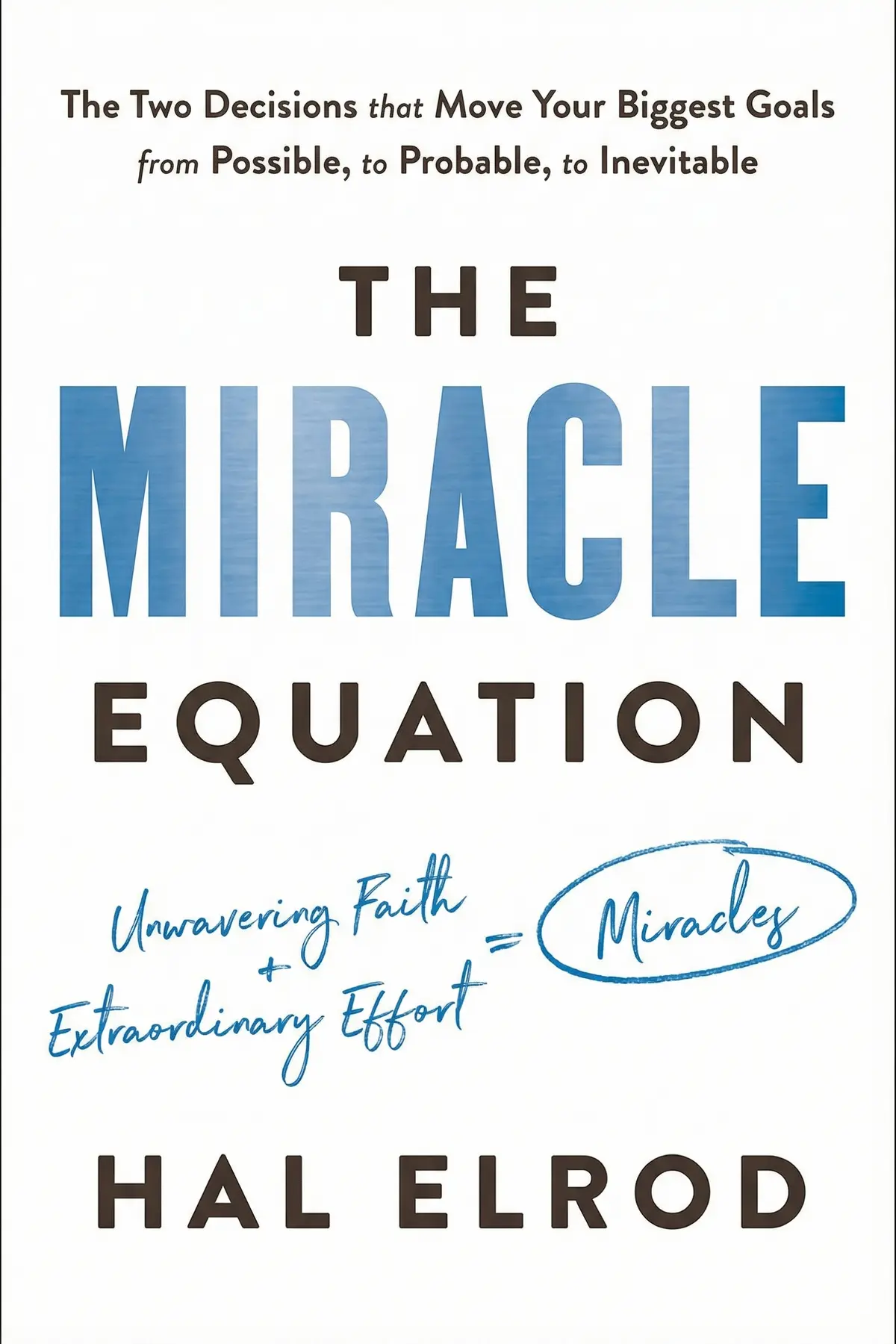
Table of Content
1. Introduction
1 min 02 sec
Many people meditate, read and train every day, yet their money, work and relationships stay stuck. In The Miracle Equation, coach and speaker Hal Elrod argues that self-improvement pays off only when it serves one larger mission. Reaching that mission, he says, rests on two decisions: hold unwavering faith that you can get there, and give extraordinary effort until you do. Faith plus effort, in his formula, equals a miracle. He means a result you build yourself, and the effort he has in mind is small steps repeated every day.
Elrod tested the formula in a ten-day sales contest. He leaned on it again after a crash that left doctors doubting he would ever walk. His method comes in usable parts: a way to choose belief, a five-minute limit on bad feelings, one mission in place of a crowded list and a daily routine that makes the outcome close to certain.
2. Stop waiting for luck and start making it
1 min 29 sec
A gold wedding band once stopped a bullet, and most of us would call that a miracle. Elrod agrees, then argues that this is the least useful kind, and that a second kind is far more common.
3. Two decisions that carry a long shot home
1 min 45 sec
A young salesman needed a pace he had never managed, and the night before the contest he nearly quit. What changed his mind became a formula, and the final day tested it to the last appointment.
4. Choose belief before the evidence arrives
1 min 48 sec
Dr. Seuss heard no from publisher after publisher, and Elvis was told to keep driving trucks. Elrod explains where the stubborn belief that carries people through comes from, and how to get some when yours runs low.
5. Loosen the old alarms behind your limits
1 min 42 sec
Children aim for the stage and the stadium. Adults settle for much less, and Elrod blames two forces, one inside the skull and one all around us. A famous race shows how fragile both can be.
6. Give a setback five minutes, then move on
1 min 43 sec
Doctors expected a young crash survivor to sink into depression. When he joked instead, they suspected denial and called his parents. His explanation was a simple rule anyone can try on a bad email tomorrow.
7. Pick one mission that lifts every goal
1 min 31 sec
A long list of goals feels ambitious, yet Elrod calls it the most common reason people stall. His fix borrows from Olympic athletes and starts with a pen, a sheet of paper and one pointed question.
8. Shrink the year to a month, clear the path
1 min 35 sec
A full year sounds like plenty of time to change, and that is precisely the problem. Elrod offers two supports that make daily progress more likely, and one of them begins with your pantry.
9. Turn big effort into small scheduled steps
1 min 43 sec
Extraordinary effort sounds exhausting, but the top sellers Elrod called for advice described something almost boring. Their answer, and the way he wrote this very book, show what the second decision really asks of you.
10. Conclusion
1 min 08 sec
Elrod’s book rests on one division. Some miracles, like a bullet turned aside by a wedding ring, happen to you and cannot be planned. The others are built, and his formula for building them is unwavering faith plus extraordinary effort. Every tool he offers protects one of those two decisions. Seeing old alarms and inherited labels clearly keeps faith alive. A five-minute limit on bad feelings stops setbacks from draining it. A single mission, monthly targets, a cleared environment and a fixed daily routine turn effort into something you can repeat.
The method is usable because each step is so modest. Write out your goals for the next six months and choose the one that would grow you most. Ask someone who has already reached it what they did every day, then book that action in your calendar. When something goes wrong along the way, give yourself five minutes to feel it, and then accept what you cannot change.
On the last day of that knife contest, Elrod’s miracle was a visitor from Sweden. She only met him because he kept driving.
About this book
What is this book about?
Plenty of people stack up good habits, from morning meditation to daily workouts, and still find their finances, careers or relationships unchanged. Hal Elrod argues that self-improvement needs a larger purpose before it pays off. Turning a big goal into a likely outcome, he says, depends on two decisions made and then kept. The first is unwavering faith: a deliberate choice to believe you can reach the goal, even when reason and evidence show no clear path. The second is extraordinary effort, which Elrod defines as small, consistent steps repeated until the goal is met. He found the formula during a ten-day sales contest at Cutco. He relied on it again after a car crash that left doctors predicting he would never walk. Readers get practical tools for each half of the equation. Elrod shows how to borrow belief from mentors and how to see through the brain's ancient alarms and the limits society teaches. He adds a five-minute rule for setbacks, a way to choose one mission, monthly targets, an engineered environment and a daily process fixed in the calendar.
Book Information
Who it's for
Ambitious young professionals
Young professionals with a big goal and a nagging doubt that they can reach it.
Juggling many goals
People juggling many goals at once who keep making little progress on any of them.
Stuck after setbacks
Anyone who stays stuck after setbacks and wants a fast, practical way to move on.
About the Author
Hal Elrod
Hal Elrod is a coach, speaker and author of personal growth books. His book The Miracle Morning became an international bestseller translated into 37 languages, and he founded the Miracle Morning book series and hosts the Achieve Your Goals podcast. At 20 he was hit head-on by a drunk driver. His heart stopped for six minutes, he spent six days in a coma and doctors doubted he would walk again. He later ran a 52-mile ultra-marathon. In 2016 he was diagnosed with a rare, aggressive cancer and recovered, and he draws on both experiences in his work.
Ratings & Reviews
Ratings at a glance

What people think
Listeners find this book remarkably easy to read and direct, featuring an organized strategy for transforming ambitions into actual results. It delivers transformative wisdom, with one listener calling it a guidebook for creating your own miracles. They value its practical success, with one listener pointing out how it helps readers take steps towards making their goals happen, while another mentions that it simplifies complex concepts.
Top reviews
Skylar
Finally got around to reading Hal's follow-up to The Miracle Morning, and it’s arguably more practical. While his first book was about the "how" of your morning, this one is about the "how" of your entire life's mission. The Miracle Mantra—combining unwavering faith with extraordinary effort—sounds like common sense, but the way Elrod breaks it down makes it feel achievable. Truth is, most of us quit right before the breakthrough happens, and this book provides the mental framework to keep going. It’s highly readable and the layout is very clean, making it easy to reference specific sections when you're feeling stuck. If you're tired of manifestation books that ignore the "work" part of the equation, this is the reality check you need. It turns vague goals into a concrete, step-by-step roadmap. Highly recommended for anyone ready to actually do the work.
Show moreJong
This book acts like a GPS for your biggest ambitions. I’ve read plenty of business and self-help titles, but few provide such a clear, binary path to success as The Miracle Equation. Hal simplifies complex psychological barriers into a simple choice between fear and faith. Not gonna lie, I was skeptical about the "Miracle Mantra" at first, thinking it was just another cheesy affirmation. But after applying it to my sales targets this month, I realized the power is in the commitment to the process, not just the words. The structure is fantastic and the "Level 10 Me" concept really resonated with my current career goals. It’s rare to find a book that actually changes your behavior rather than just your thoughts. If you are looking for a guidebook to create your own miracles, start here.
Show moreWanida
Wow, just wow. This is the rare book that actually shifts your mindset from "I wish" to "I will." Hal Elrod has an amazing ability to take high-level concepts and turn them into a straightforward plan that anyone can follow. I specifically loved the section on "Active Language" and how we use affirmations to convince our subconscious of our potential. It’s not about magic; it’s about the psychology of persistence. The book is highly readable and the layout makes it easy to find the "Miracle Mantra" whenever you need a reminder. Since finishing it, I’ve felt a lot more "emotionally invincible" when things go wrong at work. Acceptance truly is freedom. If you want a guidebook for turning your biggest goals into your everyday reality, you need to buy this book immediately. It’s life-changing in the best way possible.
Show moreNikolai
Look, I’ve read a lot of self-help, and most of it is just fluff and "woo-woo" nonsense. This is different. The Miracle Equation provides a well-laid out plan that focuses on the two things you can actually control: your effort and your mindset. Hal’s story is incredibly moving, but he doesn’t just use it for sympathy; he uses it as proof that his system works. The way he explains "Extraordinary Effort" as being about consistency rather than just working until you burn out was a huge "aha" moment for me. In my experience, this is the perfect follow-up for anyone who loved Miracle Morning but wants to take their results to the next level. It’s straightforward, no-nonsense, and highly motivating. It’s basically a roadmap for anyone who is tired of being average.
Show moreJun
As someone who has followed Hal Elrod for years, I found this book to be a solid addition to his philosophy, even if it feels a bit repetitive at times. The core message is simple: maintain faith and put in the work. Frankly, it’s not groundbreaking stuff, but the way he frames "Emotional Invincibility" is worth the price of admission alone. I loved the "5-minute rule" for processing negative emotions because it’s so actionable. However, I did feel like some chapters were stretched thin to meet a page count, and the writing can feel a bit like a sales lecture occasionally. Despite that, the plan is well-laid out and genuinely helpful for turning abstract dreams into tangible realities. It’s a great companion piece for those already doing the Miracle Morning. If you want a straightforward guide to grit and persistence, this is it.
Show moreNannapat
Ever wonder why some people seem to breeze through life’s biggest challenges while others get stuck in the mud? Hal Elrod suggests it’s all down to your internal equation. I really appreciated the focus on "Enlightened Entitlement"—the idea that we actually deserve success if we put in the work. The book is written in a very casual, accessible style that makes it easy to digest in just a few sittings. My only gripe is that it feels heavily geared toward people in sales or MLM industries, which isn't really my world. Still, the lessons on emotional invincibility and unconditional acceptance are universal. It helps you take real steps toward making your goals happen by stripping away the excuses we all make. It’s a solid, practical manual for anyone needing a kickstart to their motivation.
Show moreYaowaluk
The chapter on negative emotions was a total game-changer for me. Hal’s "5-minute rule" for accepting reality is something I’ve already started using daily, and it really works to stop the spiral of frustration. While I agree with other reviewers that the book is quite simple, I think that’s actually its greatest strength. We often overcomplicate our paths to success, and Elrod strips away the fluff to reveal the two core components that actually matter. I did find the repetition a bit much at times, but maybe that’s necessary to get the point across. The "Miracle Mantra" has helped me maintain focus on my one true Mission without getting distracted by low-value tasks. It’s a solid 4-star read for me. It’s not exactly groundbreaking, but it is incredibly effective if you actually apply the steps.
Show moreThawee
After hearing Hal's story again in this book, I’m reminded of why he’s such a powerful voice in the personal development space. His resilience is staggering. This book takes the lessons from his life and condenses them into a manageable "equation" for the rest of us. It’s a mix of inspiring stories and practical exercises, like writing your own Miracle Affirmations. Personally, I found the section on "Earned Laziness" to be the most helpful part of the whole book. It teaches you how to prioritize high-value tasks so you can actually enjoy your downtime. While some parts of the book felt a bit like a sales pitch, the overall message of unwavering faith is something we all need to hear more often. It’s a very readable, encouraging guide that helps you move into the "Level 10" version of yourself.
Show moreThanakorn
I'll admit I'm conflicted about this one. On one hand, Hal’s personal story is undeniably inspiring—his recovery and battle with cancer are miracles in their own right. On the other hand, the book itself feels incredibly oversimplified. The entire premise is essentially "believe you can do it and work hard," which could have been a 10-page pamphlet instead of a full-length book. I found the tone a bit condescending in places, almost like a "I’m better than you" lecture that we see too often in the self-help world. To be fair, there are some useful tidbits about Earned Laziness and setting Missions rather than just goals. If you're new to personal development, you'll likely love the straightforward approach. But if you’ve read a lot in this genre, you might find yourself skimming through the repetitive stories and filler.
Show moreVilaiporn
Not what I expected based on the massive hype surrounding Hal's previous work. I adored The Miracle Morning and it genuinely changed my daily routine, but this felt like a rushed sequel forced out by a publisher. The content is thin and largely rehashes concepts that were already covered more effectively in his first book. To be honest, it felt like an "I'm better than you" lecture disguised as a guide. He spends an excessive amount of time talking about his early sales days, which makes the advice feel very narrow and specific to a certain type of career. The "equation" is just common sense rebranded with fancy names. I forced myself to finish it, but there was nothing here that felt new or life-changing. It’s poorly edited and incredibly repetitive. I’d suggest just sticking to his original book and skipping this one entirely.
Show moreQuestions about this book
What is the miracle equation in Hal Elrod's book?
Elrod’s equation is unwavering faith plus extraordinary effort, which together produce what he calls a miracle. Faith is a deliberate decision to believe you can reach a goal even when the evidence is unclear. Effort means repeating small, consistent steps until the goal is met. He separates these built miracles from lucky ones, such as a bullet stopped by a wedding ring, which nobody can control.
What is the five-minute rule in The Miracle Equation?
When something goes wrong, you allow yourself five minutes to feel bad. Set a timer and vent however you need to, then say aloud that you can’t change it and move on. Elrod learned the rule from his mentor Jesse Levine and used it after a car crash left doctors doubting he would walk. He suggests practicing on small annoyances first, like a rude email.
How do you choose a mission according to Hal Elrod?
Write down all your goals for the next six months. Then ask which single goal would build the qualities and skills you need to reach all the others. Elrod’s example is a marathon, whose training could build the dedication and self-belief missing at work or in love. In his view, the most frequent obstacle to progress is pursuing a large number of goals simultaneously.
How can I apply The Miracle Equation to my goals?
Set monthly targets in place of yearly ones so you keep a sense of urgency. Remove obstacles from your surroundings, such as snacks in the pantry or a phone by the bed. Ask people who have already reached your goal which actions they repeated, then block time in your calendar for those actions. Elrod wrote the book itself at 1,000 words a day.
Readers also enjoyed

59 Seconds: Change Your Life in Under a Minute
Richard Wiseman





A Guide to the Good Life: The Ancient Art of Stoic Joy
William B. Irvine


A High-Performing Mind: Strengthen Your Mind and Live Your Best Life
Andrew D. Thompson


Abundance: The Inner Path to Wealth
Deepak Chopra
AUDIO SUMMARY AVAILABLE
Listen to The Miracle Equation in 15 minutes
Get the key ideas from The Miracle Equation by Hal Elrod, plus 5,000+ more nonfiction titles.
- 5,000+ titles
- Listen as much as you want
- 7-day free trial
- Cancel anytime









