

13 min 48 sec
Available in: English
The Marshmallow Test: Mastering Self-Control
Explains why some people resist temptation and others give in, and shows how distraction, mental distance and simple if-then rules strengthen self-control in children and adults alike.
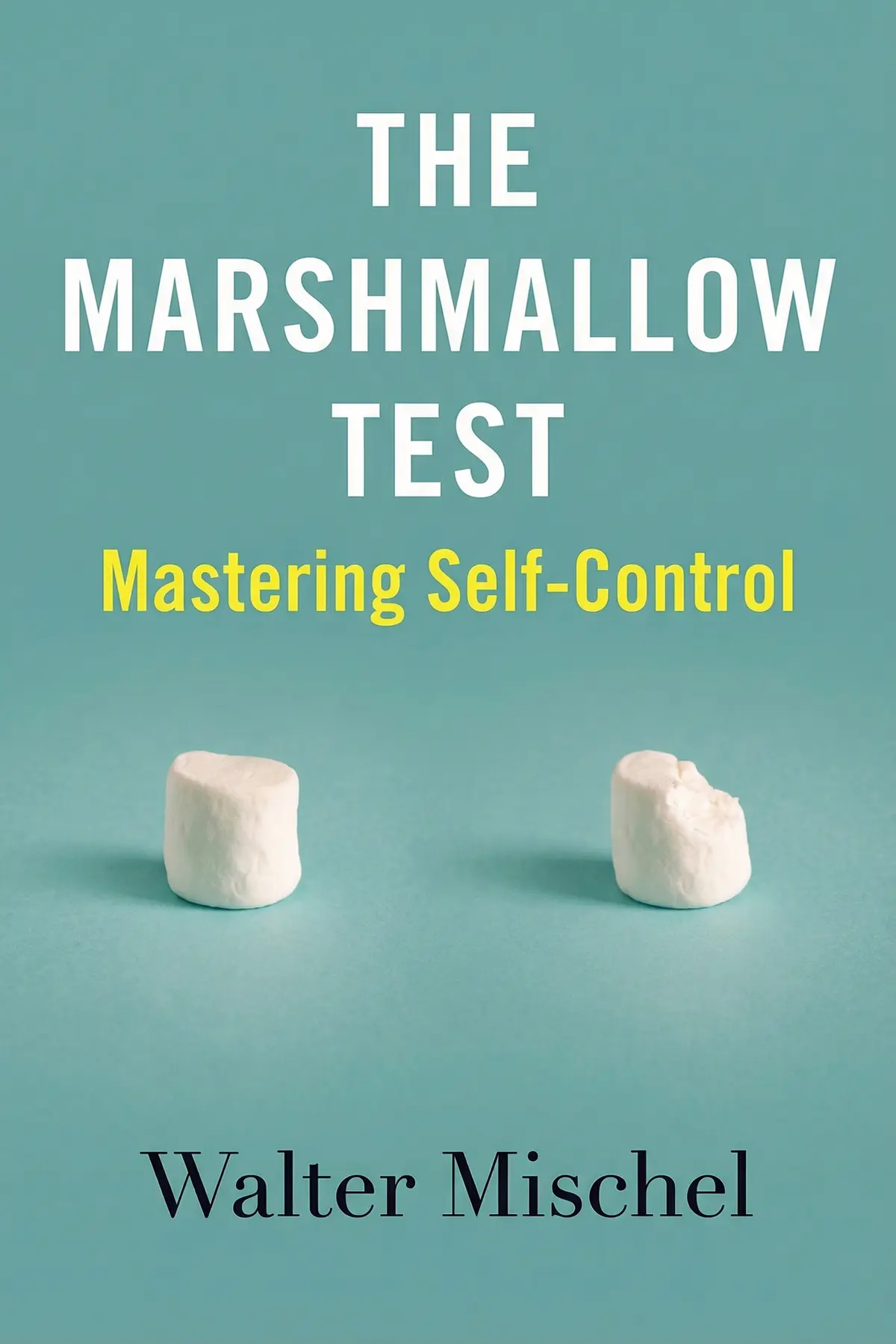
Table of Content
1. Introduction
57 sec
If you keep promising to resist the next cigarette, snack or angry reply, and keep losing, the problem may be where you are looking. In The Marshmallow Test, psychologist Walter Mischel reports that the preschoolers who managed to wait for a second treat did not stare it down. They sang, played with their chairs and turned their attention elsewhere.
Mischel designed that experiment in the 1960s and then followed the children for decades. His conclusion is that self-control is not a fixed gift. It is a skill run by a cooler part of the brain, shaped by upbringing and surroundings, and open to training at any age.
What follows explains the two brain systems that fight over every temptation, why your belief about your own stamina changes how much you have, and the small rules and distancing tricks that help children and adults wait for the better reward.
2. Beat a craving by looking somewhere else
1 min 39 sec
Some children left alone with a treat managed to resist it without eating it. They were not the most determined children in the room, and what they did instead works just as well on an adult’s worst habit.
3. See what a preschooler's wait predicts decades later
1 min 39 sec
Whether a preschooler could wait in front of a treat turned out to echo through school results, friendships and even brain scans in adulthood. The link is real, and so is the reason it need not be destiny.
4. Know when your hot brain is in charge
1 min 46 sec
Inside every tempted person, two systems pull in opposite directions, and one of them arrives years late. Knowing which is speaking in a given moment changes how a tantrum, a teenager or your own lapse looks.
5. Surroundings that teach restraint from the cradle
1 min 46 sec
Rats bred to be smart got worse in one kind of maze, while dull ones improved in another. The same principle explains why a crying baby handed a toy may be learning more than how to stop crying.
6. Your discipline depends on context, so use it wisely
1 min 44 sec
A president’s private scandal led many to doubt his public judgment. Mischel thinks they reasoned badly, and a simple handgrip experiment suggests your supply of self-control depends partly on what you believe about it.
7. Use time and space to cool a craving
1 min 34 sec
A smoker reaching for a cigarette and a spouse about to snap over the trash can both use the same move. It costs nothing, takes seconds, and works by changing where you stand rather than how hard you try.
8. Raise children who can wait and choose well
1 min 39 sec
Some children learn patience at home, and many never get the chance. Mischel looks at what parents can do, and at a school program and a TV character with no self-control that filled the gap for others.
9. Conclusion
1 min 04 sec
The image Mischel leaves is a small child in an empty room, singing to herself while a marshmallow waits on the tray. Raw strength has little to do with it. She has found a way to let her cooler mind take charge, and that way can be taught. Self-control starts forming in the first years of life, keeps responding to surroundings, and stays open to change, so nobody is stuck with the score they got at four.
What the book supports is practical. When a craving hits, move away from it, in space by leaving the room or in time by picturing the future self who would pay the price. Choose the one situation where you reliably lose control and write a single if-then rule for it, keeping it until the behavior runs by itself. And if children are watching you, let them see the waiting, praise their hard work, and offer a toy, a song or a plan when the moment gets hot.
The second marshmallow was always on its way. The skill was learning where to look until it arrived.
About this book
What is this book about?
Most of us know the feeling of losing to a craving we swore we would resist: one more cigarette, one more snack, one more sharp reply. Walter Mischel studied that moment, starting in the 1960s with a now famous experiment in which preschoolers could eat one treat at once or wait for two, and researchers later ran follow-up studies as the children grew older. In The Marshmallow Test, he explains what separated the children who waited from those who could not, and what happened to them as adults. He describes a hot brain system that reacts instantly and a cool system that plans and restrains, and he argues that self-control is shaped more by environment and upbringing than by genes. Readers get a clear model of how temptation works in the brain, evidence on why early self-control matters, and practical methods: if-then plans, putting distance in time or space between yourself and a temptation, and ways parents, teachers and even a television show can help children learn to wait.
Book Information
Who it's for
Battling the same temptation
People who keep losing to the same craving, from cigarettes to late-night snacks to angry replies.
Hoping kids learn patience
Parents and teachers who want children to handle frustration and wait for bigger rewards.
Professionals curious about focus
Professionals curious about the psychology behind focus, planning and resisting distraction.
About the Author
Walter Mischel
Walter Mischel (1930 to 2018) was a Vienna-born American psychologist whose work centered on personality theory and social psychology. He studied at New York University, City College of New York and Ohio State University, and held the Robert Johnston Niven Professorship of Humane Letters in Columbia University's psychology department. He created the marshmallow test in the 1960s while researching child psychology, and a 2002 survey ranked him twenty-fifth among the most cited psychologists of the twentieth century.
Ratings & Reviews
Ratings at a glance
What people think
Listeners view this title as essential, especially for parents of young children, and respect the thorough research and hands-on tactics for self-regulation. The content is both amusing and evocative, with one listener praising how it makes biological ideas easy to grasp. While some listeners think it is skillfully written, others find the prose style problematic. Listeners treasure the work's legacy, with one emphasizing the intriguing tracking of subjects over many years, and find it beneficial, with one listener noting the useful ways adults can apply the advice.
Top reviews
Ooi
This book is a masterclass in longitudinal research and an absolute must-read for any parent or educator. Walter Mischel doesn’t just recount the famous candy experiment; he explains the biological 'hot' and 'cool' systems in a way that is incredibly accessible to the average reader. I was particularly fascinated by how he followed the children for decades, linking their early willpower to SAT scores and even BMI later in life! The writing style is professional yet engaging, providing a great balance between data and storytelling. It made me realize that self-control isn't just a fixed trait we're born with, but a skill that can be cultivated through specific mental strategies. Frankly, I think every family with young children should have a copy on their shelf. It completely changed how I view my own impulsive habits and gave me hope for my kids' futures.
Show moreSawit
Mischel successfully bridges the gap between high-level neurobiology and the messy reality of human behavior. I picked this up because I have always struggled with impulsive decisions, and the 'Hot vs. Cool' framework gave me a new way to analyze my choices. The idea that we can literally change our brain’s response to triggers by using 'if-then' planning is revolutionary. It is not just about being 'tough' on yourself; it is about being smart with your environment. The chapter on the 'expert rule' and how willpower can be exhausted—or not, depending on your mindset—was particularly eye-opening. Some might find the writing style a bit dry, but the depth of the data makes it worth the effort. This isn't just a book about candy; it is a guide to understanding the foundations of human success and emotional health. Highly recommended for anyone serious about growth.
Show moreAna
Wow, I was genuinely surprised by how much this book resonated with me on a personal level. I have always been a 'one marshmallow' kind of person, and reading Mischel’s research helped me understand the biological and environmental factors that shaped that. The way he explains epigenetics and how our environment can trigger certain genes is fascinating. It is not just about the test; it is about how we can rewire our brains at any age to achieve our long-term goals. I especially appreciated the sections on overcoming emotional pain and using self-distancing to handle breakups. The writing is clear and the anecdotes about the original Stanford kids are heart-warming. It is a rare science book that feels both intellectual and deeply human. I finished it feeling much more optimistic about my ability to change my habits. A truly meaningful read.
Show moreDavid
Ever wonder why your coworker can turn down a second slice of pizza while you are already on your third? Mischel dives deep into the mechanisms of self-regulation, showing that it is not just about raw grit but about the mental tricks we use to distract ourselves. I loved the practical approach to 'heating up' the future goal and 'cooling down' the immediate temptation. For example, imagining a delicious cake as just a picture or something unappealing like a cockroach really works to kill the craving! The book is a bit heavy on the neuroscience at times, which might turn off some readers, but the real-world applications for adults are undeniable. My only gripe is that it feels a little dated in its assumptions about success. Still, the core message that willpower is malleable is incredibly empowering. It is a thought-provoking read that offers more than just the surface-level advice you find in most self-help books.
Show moreLadawan
After hearing about this study for years, I wanted to go straight to the source for my own parenting journey. I was pleasantly surprised by how much practical advice Mischel includes for raising children with better self-regulation. The emphasis on praising effort rather than intelligence is a game-changer for me. I also loved the section on 'if-then' scenarios—it is such a simple way to help a kid navigate high-stress moments before they happen. While the book can be a bit dense with biological concepts, the real-life stories about the original test subjects kept me hooked. It is a fascinating look at nature versus nurture and how our environment triggers certain gene expressions. Not every chapter was a page-turner, and some of the adult-focused tips felt repetitive, but the overall influence of this work is undeniable. Definitely a useful resource for anyone interested in behavioral science.
Show moreAhmed
To be fair, I expected this to be a light read, but it turned out to be quite a dense deep-dive. Mischel covers everything from the original 1960s experiments to modern neuroscience. The correlation between a four-year-old's patience and their future success is staggering, though I am glad he acknowledges that these traits are not set in stone. The 'if-then' strategy is something I have started using at work, and it actually helps with my daily focus. However, I do agree with other reviewers that the book is a bit repetitive. You could easily cut one hundred pages without losing the core message. It feels like the author was trying to turn a single great idea into a massive tome. Still, the practical tips for both kids and adults make it a worthwhile investment of time. If you can get past the slower chapters, there are some real gems of wisdom here.
Show moreChamnong
As someone who frequently reads psychology books, I found Mischel’s work to be a bit of a mixed bag. On one hand, the insights into 'if-then' plans and self-distancing are genuinely useful for anyone struggling with procrastination or bad habits. On the other hand, the prose can be incredibly dry and repetitive. It often feels like you are reading a long-winded academic paper rather than a book meant for the general public. I enjoyed the case studies, but I had to push myself through the more technical sections about gene expression and brain circuitry. In my experience, the second half of the book is much more practical than the first. It is a solid three-star read: informative and grounded in real science, but definitely a slog at times. If you have the patience for it, there is a lot of wisdom to be found here, but don't expect to be entertained.
Show moreOtt
The core premise of the Stanford experiments is legendary, yet I could not shake the feeling that the book glosses over some massive variables. Recent critiques suggest that the marshmallow test might actually be measuring a child’s trust in their environment rather than innate self-control. If you grow up in a chaotic home where promises are often broken, eating the marshmallow now is the only logical choice! Mischel touches on this, but I wish he had explored the impact of socioeconomic status and stability more deeply. The book is well-written and the research is undeniably extensive, but it feels a bit one-sided. I appreciated the tips on self-evaluation and overcoming emotional pain, though many of the 'tools' seemed a bit like common sense. It is an interesting look at a classic study, but take the findings with a grain of salt. A decent read for psychology fans, but not the definitive word on human nature.
Show moreThida
Finally got around to reading this classic, but I found it surprisingly thin on substance. While the original Stanford experiment is a cornerstone of psychology, Mischel takes far too long to get to the point. Most of the chapters felt like unnecessary padding or a scientific literature review that failed to offer the practical guidance I was craving. Truth is, you could probably learn just as much from a fifteen-minute summary as you can from these three hundred pages. He talks about 'cooling' your emotions, but the advice feels like common sense wrapped in fancy psychobabble. If you want a deep dive into the history of the test, it's fine. If you want a self-help guide with actionable data and a punchy writing style, you are better off looking elsewhere. It is not a bad book, just a very bloated one.
Show moreChanon
Look, this is essentially a very long academic paper disguised as a trade paperback. While the initial description of the marshmallow experiment is cute and engaging, the rest of the book is quite dull. I was hoping for a punchy, actionable guide to better willpower, but instead, I got three hundred pages of psychobabble and unremarkable findings. Many of the strategies mentioned, like distracting yourself or thinking about your future, are things most people figure out by the time they hit puberty. It is a well-written book in a technical sense, but it lacks the spark of other popular science writers. I found myself skimming large sections just to get to the end. It is okay if you have a deep scientific interest in the topic, but for the average reader, it is a lot of fat that needs trimming. A disappointing experience.
Show moreQuestions about this book
What is the main idea of The Marshmallow Test?
Walter Mischel argues that self-control is a learnable skill, not a fixed trait. It depends on a cool brain system in the prefrontal cortex that develops through childhood and is shaped more by environment than by genes. Children who waited for a second treat did so by distracting themselves, and the same strategies, plus putting distance between yourself and a temptation, help adults too.
What did the marshmallow test children who waited do differently?
They did not stare at the treat and force themselves to resist. They moved their attention elsewhere, singing songs or tilting and playing with their chairs. When researchers later taught children if-then plans, such as starting a song whenever a hand moved toward the treat, waiting became much easier. Distraction activated the cool system and calmed the hot one.
Does the marshmallow test predict success in life?
Follow-up studies found that children who waited longer were later judged more successful: better at concentrating and planning, higher scoring on the SAT, and better at keeping relationships. Brain scans showed those who waited least had more activity in a region linked to pleasure and addiction. Mischel presents these as correlations and stresses that self-control keeps changing with environment.
How can adults improve self-control using The Marshmallow Test?
Mischel recommends creating distance from temptation. In time, picture your future self facing the consequences, such as a smoker imagining a lung cancer diagnosis. In space, leave the room where the temptation sits. He also suggests if-then rules for specific triggers, like counting to ten when a partner forgets a chore, and viewing self-control as energizing rather than draining.
Featured in
Readers also enjoyed


A Liberated Mind: How to Pivot Toward What Matters
Steven C. Hayes



Acting with Power: Why We Are More Powerful Than We Believe
Deborah Gruenfeld




Age of Propaganda: The Everyday Use and Abuse of Persuasion
Anthony Pratkanis
AUDIO SUMMARY AVAILABLE
Listen to The Marshmallow Test in 15 minutes
Get the key ideas from The Marshmallow Test by Walter Mischel, plus 5,000+ more nonfiction titles.
- 5,000+ titles
- Listen as much as you want
- 7-day free trial
- Cancel anytime









