

59 Seconds: Change Your Life in Under a Minute
Richard Wiseman
 English
 ไทย
Shows how to build the self-belief that makes big goals reachable, through a daily pep talk, confident habits, better company, respect for others and a curious, practical way of studying every setback.
59 sec
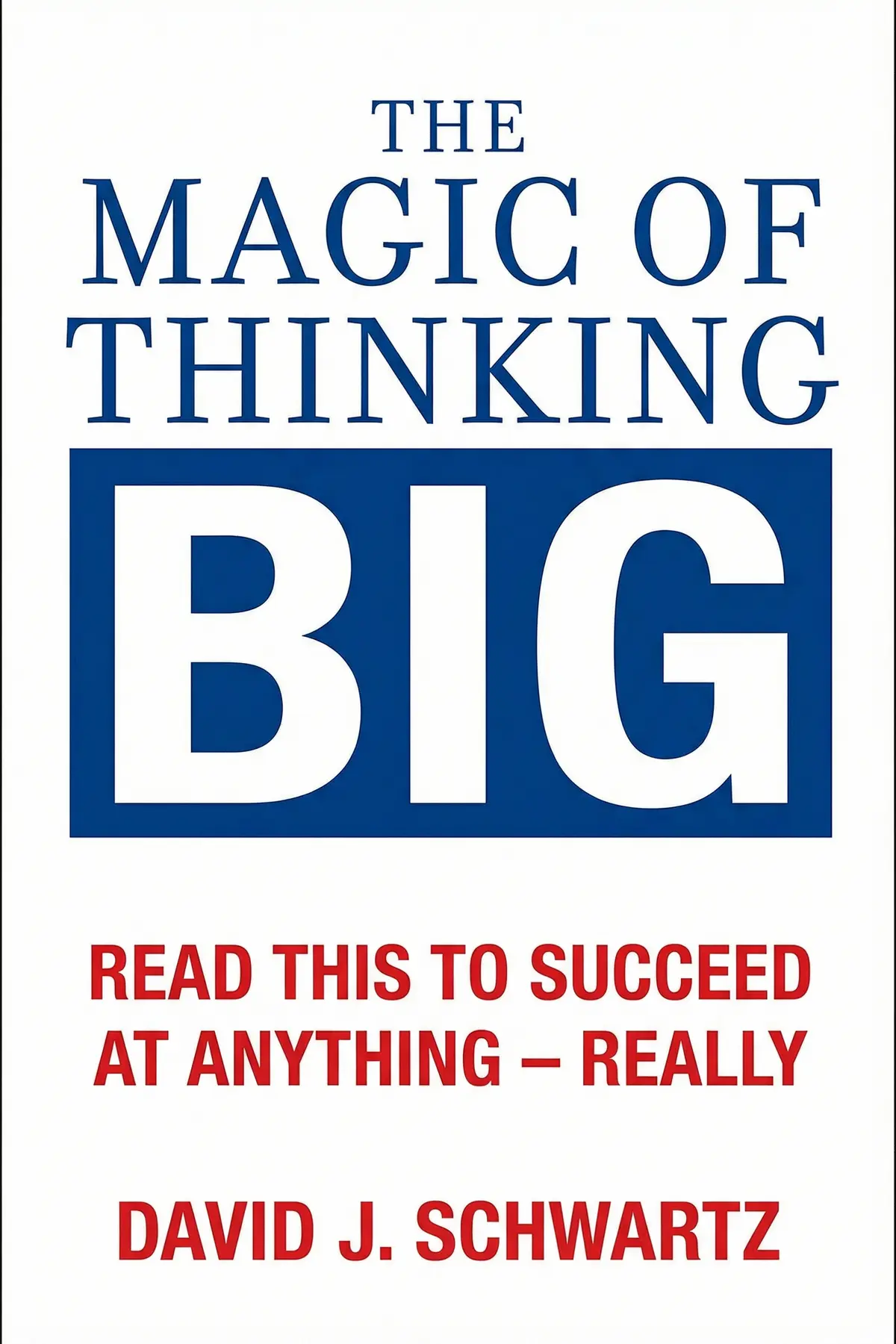
If a goal feels too big for you, David J. Schwartz has an unexpected first step: believe, completely, that you can reach it. In The Magic of Thinking Big, he argues that real belief sets the mind hunting for ways to get there, and that other people notice it and start backing you. Schwartz chaired the marketing department at Georgia State University and gave motivation talks to close to 3,000 groups. He first published this argument in 1959.
His case is that the people who reach big goals have simply built a stronger belief in themselves, and that this belief can be trained with ordinary daily habits. The habits are concrete: a short pep talk you write and read aloud, a faster walk, a seat in the front row, a better circle of friends and a fresh way to read every setback. Each one makes a bigger goal feel like something you can schedule.
1 min 47 sec
Leaders across business, government, science and religion were asked what they most wanted in the people they work with. Their top answer was neither skill nor experience, and it starts with how you see yourself.
1 min 53 sec
The news, advertising and even your closest friends keep telling you what you cannot do. A marketing professor’s answer borrows a tool from his own field, and it takes only a few minutes a day.
1 min 54 sec
Fear of bosses, clients and crowds stops more careers than missing talent. Schwartz compares confidence to something your body already has, and his cure starts with where you sit and how fast you walk.
1 min 43 sec
Spend enough evenings with a certain kind of person and you start to sound like them. Schwartz names the two relationships that shape your ambition most, and one of them is probably giving you the wrong advice.
1 min 49 sec
A rude co-worker seems like someone to avoid. Schwartz sees a future ally, and he points to an American president’s habits to show why almost nobody reaches the top by their own effort alone.
1 min 49 sec
Knowing more facts is supposed to make you more capable, yet Schwartz compares most stored facts to boxes in a garage. A young couple without a down payment shows what he would rather you practice.
1 min 47 sec
Knowing your goal feels like the hard part is over. Schwartz says it has barely begun, and he borrows a habit from doctors and air crash investigators to keep disappointments from stopping you.
1 min 14 sec
Schwartz’s closing claim is that successful people are no more talented or deserving than anyone else. They are more driven and more confident, and the raw material for both sits inside everyone. What the book adds is a set of handles for that belief. It can be spoken in a private commercial, carried into a room at a faster walk, borrowed from ambitious friends, returned by a difficult co-worker you chose to respect, and rebuilt after every setback.
That turns belief into a practice, something you do daily until it holds.
So begin small and soon. Tonight, write the few sentences that name what sets you apart, and read them aloud tomorrow before your ten minutes on doing better work. Then take the goal you have quietly shrunk to fit your doubts, restore its real size, and give it a plan with steps, methods and dates. When the plan stumbles, study the stumble before you judge yourself.
The young couple had no down payment, only a refusal to treat that as the end of the story. That refusal, more than anything they knew, put them in their house.
Plenty of people know what they want, from a bigger role at work to a home of their own, and then shrink the goal until it fits their doubts. David J. Schwartz argues that self-belief is the real key, since belief must match a goal's difficulty. In his view, successful people are no more talented than anyone else. They simply believe more strongly that they can succeed, and that belief turns the mind toward solutions and makes others want to back them. Schwartz, a marketing professor, treats self-belief as something you can build. He offers a written commercial that sells you to yourself and physical habits that grow confidence before you feel it. He also gives rules for choosing friends, advisers and surroundings. He adds a habit of treating everyone as important, ten minutes of creative thinking each morning and a plan that studies every setback the way an investigator studies a crash site. Readers get a practical, old-school method for aiming higher, along with stories such as a young couple who found a way to buy a house they could not afford.
Young professionals who keep shrinking their goals to match their doubts.
Salespeople, students and new managers who freeze in front of bosses, clients or crowds.
Career changers who need a clear plan and a steadier way to handle setbacks.
David J. Schwartz (1927 to 1987) was an American writer and coach on motivation. A marketing professor who chaired his department at Georgia State University, he also worked as a self-help coach and ran a leadership consultancy, Creative Educational Services Inc. He gave motivational talks to nearly 3,000 groups, from sales firms and trade bodies to management meetings. In The Magic of Thinking Big, first published in 1959, he urges readers to set high goals and think positively to reach them.
Listeners consider this work an essential read filled with valuable insights and useful advice, highlighting how much it motivates them to develop a more optimistic outlook. The content broadens horizons toward better ways of thinking and offers daily utility, with one listener remarking that even just the first 100 pages provide immense value. Although listeners view it as an enduring masterpiece, some feel the material is slightly old-fashioned.
Finally got around to reading this staple of the self-help genre, and I’m genuinely glad I did. David Schwartz has a way of making "big thinking" feel like a tangible skill rather than some abstract concept. I found the section on "Excusitis" particularly convicting because it highlights how often we hide behind age, health, or lack of intelligence to avoid taking risks. While the 1950s business-man vibe is undeniably strong, the underlying principles of belief and action are timeless. It’s one of those books that serves as a mental reset button whenever you start feeling small or stuck. If you can look past some of the archaic social norms, there is absolute gold in these pages for anyone looking to level up their career or personal life. It really is a must-read for building a resilient, positive mindset.
Show moreAfter hearing about this from my mentor, I decided to dive in and see if the hype was real. I wasn't disappointed at all! The book teaches you how to stop being your own worst enemy by expanding your vision of what is possible. I’ve read a lot of modern productivity books, but many of them seem to just repackage what Schwartz wrote back in the fifties. The way he breaks down how to "think big" in terms of relationships and income really helped me identify where I was playing small. It’s more than just "positive thinking"; it’s about creating a psychological environment where success becomes inevitable. Even though some of the language is a bit "old school," the mojo this book carries is undeniable. It’s a genuine classic for a reason.
Show moreAs someone who struggles with procrastination, the chapter on "curing the fear of action" was worth the price of the book alone. David Schwartz hits you with the reality that waiting for the "perfect time" is just a sophisticated way of being afraid. I gotta say, the writing style is very punchy and keeps you engaged, though it does get a bit repetitive toward the end. It's interesting to see where so many modern motivational speakers get their material, as this seems to be the source code for many of them. Just be prepared for the 1950s workplace dynamics which haven't aged well at all. If you can read it for the principles rather than the specific social examples, you'll get a lot out of it. Definitely a solid addition to any personal development library.
Show morePick this up if you need a serious kick in the pants to start moving toward your goals. I was skeptical about a book from 1959 being relevant today, but the psychology of confidence hasn't changed much in sixty years. Schwartz explains that success is a result of the size of one's thinking, and he provides actual exercises to help you expand that mental horizon. I loved the advice on "memory bank deposits"—intentionally putting positive thoughts into your mind so you can draw on them during tough times. It’s a practical guide that doesn't just tell you to "be happy," but shows you how to build a foundation for genuine achievement. Yes, it’s a bit dated in its view of women, but the core wisdom is still incredibly potent. I’ve already recommended it to three colleagues this week!
Show moreEver wonder why some people with less talent seem to get further in life than those with high IQs? This book answers that question by focusing on the power of belief and the "magic" of refusing to think small. It's an incredibly motivational read that makes you feel like you can take on the world after just a few chapters. I particularly enjoyed the section on how to turn defeat into victory by learning from every setback rather than moping about it. The tone is very encouraging and "can-do," which is exactly what I needed during a recent career transition. It’s a timeless classic that opens your mind to possibilities you might have previously dismissed as "impossible." Seriously, don’t let the old-fashioned examples stop you from absorbing these life-changing lessons.
Show moreLook, I know some people find these old-school books cringey, but there’s a reason this one is still in print after all these years. The advice on how to treat others and how to command respect through your own self-image is gold. Schwartz reminds us that we are exactly what we think we are, and if we think small, our lives will stay small. I found the "action cures fear" mantra to be particularly helpful in my daily life as a manager. I did find the author's reference to Hitler in the solitude chapter to be a very strange and off-putting choice, though. It definitely reminded me that I was reading something from a different era. Overall, it's a very solid motivational tool if you can filter out the occasional weirdness and the 1950s social tropes.
Show moreThis classic self-help guide provides a fantastic blueprint for anyone wanting to escape a mediocre mindset. I especially loved the concept that action cures fear; it’s a simple shift, but seeing it laid out with practical steps made it click for me. Truth is, the book is a product of its time, so you have to filter out the rigid gender roles where women are mostly relegated to supportive wives. If you can get past that 1959 lens, the advice on visualization and goal-setting is remarkably fresh. I found myself highlighting dozens of passages about how we see ourselves compared to how the world sees us. It’s definitely a motivational powerhouse, even if some of the "real-life" anecdotes feel a bit like unverifiable parables. The first half is definitely the strongest part of the entire experience.
Show moreThe chapter on 'Excusitis' was the highlight for me, but the rest of the book felt like a bit of a mixed bag. Frankly, the author’s perspective on women is so archaic it’s almost comical, and it really pulled me out of the experience several times. He talks about "the wife" as if she’s a household appliance meant to support the husband’s "big thinking" without having any ambitions of her own. Beyond that, the advice is quite standard for the self-help genre—think positive, work hard, and visualize success. It’s not that the advice is bad; it’s just that it’s been done better and more inclusively in the years since this was published. It’s worth a skim for the historical value, but I wouldn't call it the "bible" of success like some people do.
Show moreTo be fair, the core message here is quite powerful, but I struggled with the delivery. The book relies heavily on "anecdotal evidence" involving nameless characters like "a baker" or "a salesman I know," which makes the advice feel less grounded in reality. I also found the repetitive nature of the chapters a bit exhausting; he could have easily made his point in 100 pages instead of nearly 300. That said, his breakdown of "Excusitis"—the disease of the failure—is brilliant and very relatable even today. We all make excuses for why we aren't where we want to be. I think it’s a decent read for the historical context of self-help, but I’d suggest taking the more "magical" claims with a grain of salt. It’s helpful, but certainly not a perfect book by any means.
Show moreNot what I expected given the glowing reputation this book has in entrepreneur circles. While I appreciate the core message of positivity, I found the author’s tone frequently condescending and his examples incredibly dubious. He constantly references unnamed friends or random businessmen to prove his points, which makes the whole thing feel manufactured. Plus, the ending was genuinely jarring—bringing up Hitler as an example of solitude-driven success felt like a massive lapse in judgment, even for a book written decades ago. The blatant misogyny is also hard to ignore, as it implies women aren't capable of the same "big thinking" as men unless it's in a domestic context. I’d recommend Napoleon Hill or even modern writers over this if you want something that doesn't feel so incredibly dated and problematic.
Show moreDavid J. Schwartz argues that self-belief is the most important tool for success. Successful people, in his view, are not more talented or deserving than others; they are more driven and confident because they believe in themselves. That belief releases creative power to find solutions, and it makes other people trust and support you. He then shows how to build it through daily habits.
It is a short pep talk you write like an advertisement, naming your best traits and what sets you apart from others. Schwartz recommends speaking it aloud when alone, at minimum daily, and also going over it silently a number of additional times. His example is a teacher who makes students laugh and uses that trait as a reminder of real influence, which builds daily confidence.
He treats confidence as an immune system against fear and says you build it by acting confident before you feel it. His specific actions are sitting in the front row at classes or presentations, making more eye contact and walking 25 percent faster than usual. He also recommends doing what you believe is right, dressing well and believing your work matters.
Schwartz compares setbacks to the autopsies doctors perform and the crash sites the Civil Aviation Administration studies: they are chances to learn what went wrong. Instead of blaming yourself, focus only on what would make you more deserving of the next opportunity. He also tells of a young couple who could not afford a down payment and found a creative way to buy their house anyway.
Richard Wiseman





William B. Irvine


Andrew D. Thompson


Deepak Chopra
AUDIO SUMMARY AVAILABLE
Get the key ideas from The Magic of Thinking Big by David J. Schwartz, plus 5,000+ more nonfiction titles.









