

12 min 02 sec
Available in: English
The Journey of Leadership: How CEOs Learn to Lead from the Inside Out
Shows how chief executives become better leaders by examining their own ego, fears and upbringing, so they listen more, admit weakness, learn from failure and build the range to handle crises they cannot yet see.
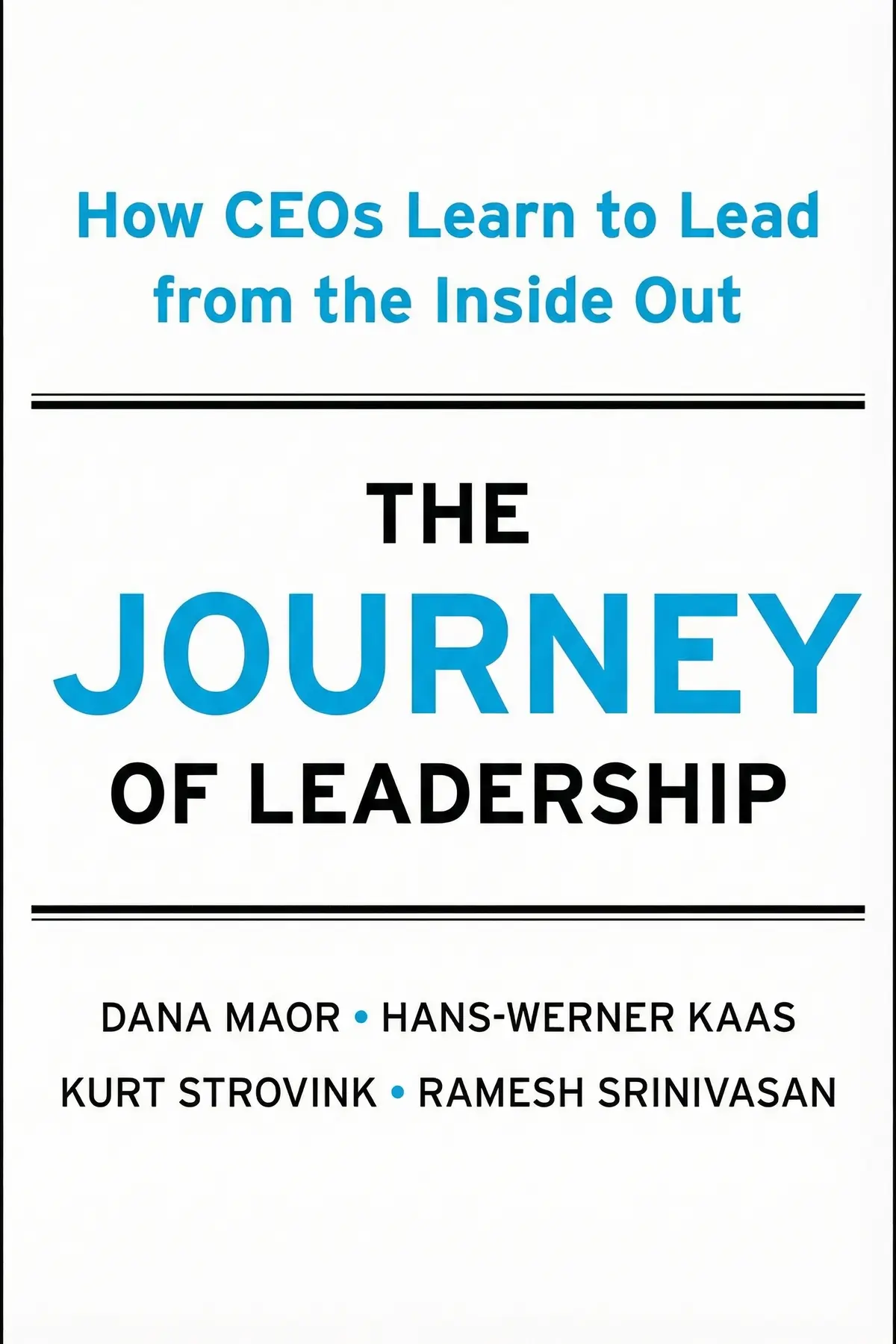
Table of Content
1. Introduction
1 min 06 sec
The higher a leader climbs, the less truth reaches them. People stop bringing bad news, stop arguing, and the boss begins to believe that every answer must come from the top. In The Journey of Leadership, four McKinsey leaders, Dana Maor, Hans-Werner Kaas, Kurt Strovink and Ramesh Srinivasan, argue that the cure starts inside the leader rather than in the org chart.
Their stories come from the Bower Forum, a retreat where chief executives from around the world step back from daily pressure to work on themselves. The claim running through them is easy to say and hard to practice: leaders get stronger when they stop guarding the image of the all-knowing boss and look honestly at their own ego, fears and history.
The cases range from a carmaker that collapsed because its founder ignored warnings to a polite family man who finally held one difficult conversation. Each one ends with a habit you can try with your own team, whether you run a company or a group of five.
2. Get better answers by not needing all of them
1 min 58 sec
A room full of nodding heads can feel like support. One famous carmaker learned too late what that silence was hiding, and what the team had been trying to say all along.
3. Master your ego to bring out your team's best
2 min 03 sec
A software CEO had a sound strategy and a capable team, yet nothing moved. The obstacle a fellow executive spotted at a Florida retreat was sitting in his own chair.
4. Turn your own story into a source of trust
2 min 02 sec
An executive could not bring himself to confront a relative who was harming his company. On a rainy day in Paris, he found the reason at a childhood dinner table.
5. Bounce forward after a setback by studying yourself
1 min 56 sec
Careers are getting longer and more varied, which makes serious failure close to certain for anyone ambitious. What decides the outcome is the question a leader asks right after it happens.
6. Build the range to lead through any crisis
1 min 49 sec
Leaders who rode the dot-com boom suddenly had to steer toward profit with almost no warning. The authors explain how to prepare for a test you cannot yet see coming.
7. Conclusion
1 min 08 sec
The Bower Forum takes some of the world’s busiest executives out of their offices and asks them to look inward, and the book argues that this is where leadership actually changes. The software CEO in Florida already had a strategy and a capable team. What held him back was his need to be right. The Paris executive’s obstacle was a childhood lesson that conflict should be smoothed over. Once the Paris executive saw how his upbringing shaped his leadership, he found the courage to change, while the Florida CEO was advised to stay open to new views and put the company ahead of personal credit.
The practice the authors support is modest. Invite disagreement before you speak, and keep a few advisers whose role is to tell you when you are wrong. Before a hard call, check whether your ego or the organization is driving it. When something fails, look first at your own blind spots, and when a role gets comfortable, find one that stretches your range.
DeLorean’s team saw the danger coming and said so. The leaders worth following make sure that warning is heard.
About this book
What is this book about?
The higher people rise in an organization, the less honest news reaches them. Teams stop challenging the boss, and the boss starts to believe every answer must come from the top. Four McKinsey authors, three of them senior partners, argue that the fix begins inside the leader, with an honest look at ego, fear and the habits learned long before the first promotion. Their material comes from the Bower Forum, a retreat where CEOs from around the world step away from daily pressure to work on themselves. Readers meet a software chief in Florida whose insecurity was stalling his team and an executive in Paris who finally confronted a difficult relative. They also hear the authors' reading of DeLorean, Steve Jobs, Benjamin Franklin and the dot-com crash. The book turns these stories into habits any manager can practice. Seek out disagreement and keep advisers who push back. Test decisions against ego, and share real struggles. Study your own blind spots after a setback, and choose roles that widen your range before a crisis demands it.
Book Information
Who it's for
Managers with quiet meetings
Managers and team leads whose meetings have gone quiet and who suspect people are holding back the truth.
Founders and executives
Founders and executives who feel they must always have the answer and want a healthier way to carry authority.
Planning a long career
Ambitious professionals planning a long career who want to recover from setbacks and build range on purpose.
About the Author
Dana Maor
The book is written by four McKinsey & Company leaders, three of them senior partners, whose work brings them close to chief executives. Dana Maor co-leads the firm's global People and Organizational Performance Practice. Hans-Werner Kaas headed its Automotive Practice, coaches CEOs and is co-dean of the Bower Forum, the firm's leadership program for CEOs. Kurt Strovink leads McKinsey's global CEO special initiative and sits on its Board of Directors. Ramesh Srinivasan is the Global Dean of the Bower Forum and leads the firm's social responsibility work in North America.
Ratings & Reviews
Ratings at a glance
What people think
Listeners find this work to be an intriguing exploration that captures the essence of leading others, providing useful perspectives for those in any stage of their career. The text is highly accessible and offers actionable guidance, while one listener mentions how the content assists in managing competing pressures. Listeners value the way it extracts wisdom from CEO narratives, and one individual points out the skillful integration of real-world examples. They also prize the book's profound emotional resonance, with one listener characterizing the experience as a strong emotional power bust.
Top reviews
Rose
Finally got around to reading 'The Journey of Leadership' and it’s basically an emotional power boost for anyone in management. It’s not just for the C-suite; even for my work with non-profits, the advice on leading through influence without positional power hits home. The way the authors break down the internal vs. external traits feels remarkably fresh for a 2024 release. Truth is, most business books are dry, but this one captures the actual soul of what it means to lead other humans. I particularly enjoyed the sections on selflessness and how that actually creates more long-term value than ego-driven decisions. If you're looking for a guidebook that balances professional grit with genuine humanity, this is it.
Show moreElan
The chapter on being 40% humble and 60% courageous really changed my perspective on how I approach my board meetings. Most books tell you to be one or the other, but Maor and her co-authors understand the nuanced reality of being at the top. It’s a lonely position, and this book addresses that isolation with a level of emotional depth I didn't expect from a McKinsey publication. In my experience, the best leaders are those who can admit they don't know the answer yet, and this text gives you the 'permission' to be that kind of leader. The 'Big Four' techniques for staying calm during a crisis are worth the price of the book alone. This is an essential read for anyone who wants to lead with both their heart and their head.
Show morePot
Wow, what a refreshing take on the 'CEO as a human' instead of the CEO as a machine. I loved the advice about spending the first 30 minutes of your day being present and seeing your family as a source of strength rather than a distraction. It’s rare to find a business book that encourages you to bring your whole self to work, including your vulnerabilities. The MRI approach to slicing problems into thin pieces has already helped me tackle a massive project that seemed impossible last week. Not gonna lie, I was moved by some of the narratives about leaders overcoming their own egos to create something better for their employees. This is more than a management manual; it's a guide for being a better person in a high-pressure world.
Show moreElena
As someone who has navigated the messy reality of executive life for a decade, I appreciated the focus on holding two opposed ideas at once. The book highlights the tension between being certain and remaining willing to change, which is a rare perspective in traditional leadership manuals. I found the '12 essential traits' framework to be a solid mental map for self-evaluation, even if some parts felt a bit redundant. Gotta say, the emphasis on empathy and 'fearless learning' is exactly what’s needed in today’s stakeholder-driven economy. While I wished for a few more tactical, 'day-one' action items in the later chapters, the high-level strategy is undeniable. It’s a strong 4-star read that encourages you to look inward before you try to change the organization.
Show moreBird
Picked this up because I wanted to see how the pandemic changed the conversation around corporate authority and I wasn't disappointed. The case studies are incredibly current, reflecting the modern shift toward human-centric leadership where vulnerability isn't seen as a weakness. Not gonna lie, I was skeptical about the authors' backgrounds, but they do a great job of humanizing Fortune 500 CEOs and military generals. The distinction between having a 'voice' and a 'vote' on projects was a lightbulb moment for me. It provides a practical way to manage expectations and accountability without crushing morale. The writing style is accessible, though the sentence structure can get a bit formulaic in the middle sections. Overall, it’s a valuable resource for anyone trying to balance performance with people-first values.
Show morePierre
Look, leadership books are a dime a dozen, but 'The Journey of Leadership' stands out because of its focus on psychological safety and candor. I appreciated the specific examples of how to encourage healthy dissent within a team without losing control of the narrative. The authors masterfully weave in real-world examples from admirals to non-profit heads, showing that these principles are universal across industries. My only gripe is that it occasionally leans too heavily on the 'Bower Forum' as the only place where these revelations happen. Aside from that, the checklists and self-evaluation questions at the end of each chapter make it very functional. It’s a book I’ll likely keep on my desk to reference during those inevitable 'shit storm' moments. It helps you keep moving when you're tempted to just quit.
Show moreRafael
After hearing several colleagues rave about this, I decided to dive in and see if the hype was real. It’s a fascinating read that captures the evolving soul of leadership in an era where employees demand more than just a paycheck. The authors successfully argue that you must lead yourself before you can lead an organization, which is a truth often overlooked by ambitious executives. I found the section on 'rehearsing your fear' particularly helpful for my own professional development. To be fair, some of the CEO stories feel a bit sanitized, but the underlying lessons remain poignant and applicable. It’s an easy read that manages to be both strategic and deeply personal at the same time. Definitely a solid addition to the 2024 business canon.
Show moreBunyarit
Ever wonder why every leadership book eventually starts sounding the same? This one tries to break the mold with its focus on the 'internal journey,' but it still falls into the trap of being somewhat repetitive for retention's sake. Personally, I found the first half about self-mastery much more engaging than the second half, which felt a bit more like standard management theory. The advice is solid—things like 'pre-mortems' and the 'MRI approach'—but experienced managers might find themselves skimming the more basic sections. It’s definitely a useful tool for a new manager who needs a comprehensive overview of 2024 leadership trends. However, if you've already read the 'greats' of the genre, you might find this to be a collection of well-packaged reminders rather than groundbreaking new insights.
Show moreAnong
To be fair, the book is a decent compilation of what it takes to be a modern executive, but it lacks a certain 'edge.' It feels very safe, which is ironic considering how much it talks about being bold and taking risks. I liked the focus on 'grit vs. quit' and understanding sunk costs, but I wanted more data and fewer anecdotes. Some of the advice feels like it was written for people who have never had a difficult conversation in their lives. However, the 12 traits framework is a helpful way to structure a leadership development program if you're starting from scratch. It’s a 3.5-star book for me—practical and well-written, but just a little too polished to feel truly raw and authentic.
Show moreFon
This book felt like an extended brochure for the Bower Forum, which got pretty old after the tenth mention. Frankly, it’s disappointing when McKinsey partners just recycle grade school chestnuts like 'it's hard to dislike someone once you know them.' While the case studies are from 2024, many of the CEOs mentioned feel like no-name generic characters facing 'meh' crises that are conveniently solved by more McKinsey intervention. The structure is fine, but the content often lacks the intellectual depth I expected from such high-level authors. To be fair, there are a few nuggets about vulnerability, but they are buried under layers of corporate-speak and repetitive themes. It’s a pass for me unless you really love hearing about how great consulting forums are.
Show moreQuestions about this book
What is the main idea of The Journey of Leadership?
Four McKinsey authors, three of them senior partners, argue that CEOs become better leaders by working on themselves first. Drawing on stories from the Bower Forum, a retreat for chief executives, they show how isolation, ego and old habits from childhood get in the way. Leaders who face these honestly listen more, admit weakness, learn from failure and adapt to change, which helps their teams perform better.
Who should read The Journey of Leadership?
It suits anyone who leads people, from CEOs to new team leads. It speaks most directly to leaders who feel isolated at the top, who believe they must have every answer, or who avoid difficult conversations. Professionals planning a long and varied career will also find its advice on failure and versatility useful, especially the idea of choosing roles that widen their range.
What does the book say about ego in leadership?
The authors say leaders need a healthy sense of self-worth, but an inflated ego, often rooted in a need to prove oneself, breeds politics, self-promotion and arrogance. They describe a software CEO in Florida whose insecurity made him feel he must always be right, which disconnected him from his team. The suggested fix is servant leadership and a regular check on whether ego is driving a decision.
How can I apply the ideas in The Journey of Leadership?
Ask people to name the risks in a plan before you share your view, and keep a few advisers who will push back. Before a big decision, check whether your ego or the organization is driving it. After a failure, list your own behaviors and blind spots that contributed. Over a career, choose varied roles, such as a restructuring or a growth assignment, to build versatility.
Why do the authors see vulnerability as a strength?
They argue that sharing real struggles builds trust and deeper relationships, especially with millennials who value transparency. Their examples include a CEO in Paris who linked his fear of conflict to a polite upbringing and then resolved a problem with a relative, and Steve Jobs speaking openly about cancer in his 2005 Stanford commencement speech. Openness, they say, makes teams feel safe to share ideas.
Readers also enjoyed


A Year with Peter Drucker: 52 Weeks of Coaching for Leadership Effectiveness
Joseph A. Maciariello



Acting with Power: Why We Are More Powerful Than We Believe
Deborah Gruenfeld

All In: How Great Leaders Build Unstoppable Teams
Mike Michalowicz



7 Powers: The Foundations of Business Strategy
Hamilton Helmer
AUDIO SUMMARY AVAILABLE
Listen to The Journey of Leadership in 15 minutes
Get the key ideas from The Journey of Leadership by Dana Maor, plus 5,000+ more nonfiction titles.
- 5,000+ titles
- Listen as much as you want
- 7-day free trial
- Cancel anytime









