

14 min 22 sec
Available in: English
The French Revolution: A History
Carlyle's classic history follows the French Revolution as one moral arc, from a king nobody mourned to the Terror and Napoleon's guns, showing how decay, hunger and crowds overturned an old order.
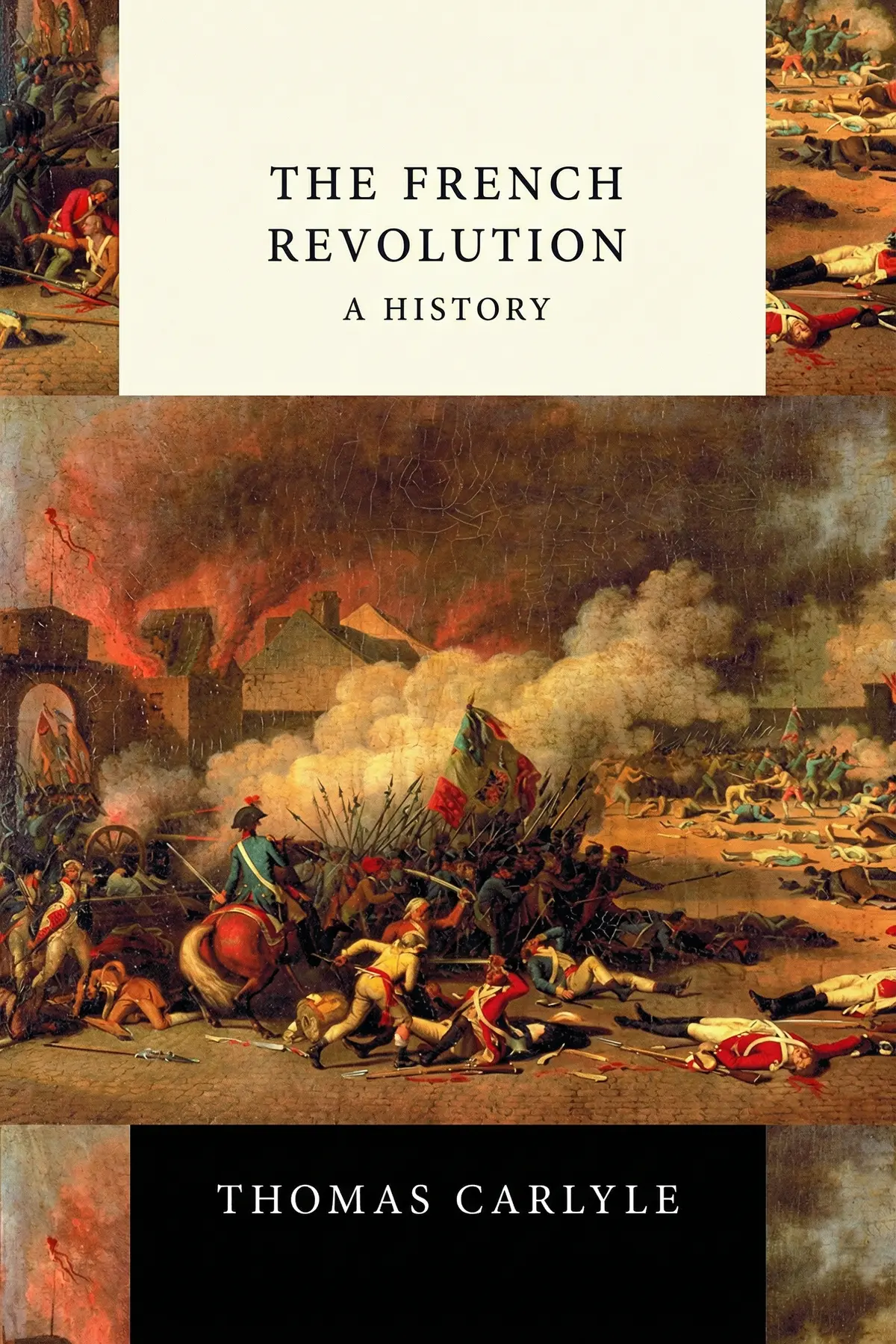
Table of Content
1. Introduction
1 min 01 sec
If the French Revolution feels like a blur of dates and slogans, Thomas Carlyle offers a way to hold it in your head as one story. In The French Revolution: A History, published in 1837, Carlyle tells it as a moral reckoning: a ruling class that had stopped serving anyone was swept away by the hungry people beneath it. His opening scene makes the case by itself. In 1744 France packed its churches to pray for a sick king and named him the Beloved. Thirty years later the same king lay dying, and nobody bothered to pray.
The throughline is simple and grim. Power that has lost its purpose invites the crowd, and the crowd, once it learns its strength, turns on its own until a soldier ends the story. Follow it from Versailles to the Bastille, the scaffold and the cannon, and you will be able to retell the whole Revolution in a few minutes, and to recognize its pattern when institutions decay in your own time.
2. Spot the signs of an order that has rotted
2 min 07 sec
A king once wept over by an entire nation was carried to his grave at night while Parisians jeered. Carlyle reads that change of mood as the first crack in a whole society.
3. A locked door that turned citizens into a nation
2 min 04 sec
Commoners found their meeting hall shut and moved into a sweaty tennis court. Within weeks the king’s own soldiers had changed sides, and a fortress that stood for tyranny was under fire.
4. Hunger moves a crowd faster than petitions
1 min 46 sec
One young woman grabbed a drum from a guardhouse and started beating it. By the next afternoon the royal family was riding to Paris as captives, surrounded by bread on pikes.
5. Indecision can cost a leader everything
2 min 04 sec
A secret escape, a disguise and a coach built for the purpose should have carried the royal family to safety. A sharp-eyed postmaster and one moment of surrender ended the monarchy instead.
6. Recognize when virtue becomes a license to kill
2 min 10 sec
A man in a sky-blue coat who worked eighteen-hour days and wanted only a purer France sent thousands to the scaffold. Then his own colleagues found the courage to shout him down.
7. Exhaustion hands power to whoever holds the guns
1 min 56 sec
After the Terror, Paris danced at Victim Balls while the poor queued for two ounces of bread. When the crowd rose once more, an unknown artillery officer had a brutal answer ready.
8. Conclusion
1 min 14 sec
Carlyle’s Revolution has a cruel symmetry. It opens with a king nobody mourned and closes with a crowd nobody feared. In between, people ignored for generations discovered they could act, first in a tennis court, then at the Bastille, then on the muddy road to Versailles. That discovery became a weapon that kept turning inward, each phase bloodier than the last, until it reached Robespierre himself and finally exhausted the people who had wielded it.
What Carlyle gives a modern reader is a way to read decay. Watch for the moment when loyalty to leaders turns into indifference, as it did around the dying Louis XV, because by then legitimacy has already left. Be wary when a cause starts sorting people into the pure and the suspect, since every committee of virtue in this story ended up feeding on its own members. And remember that hunger, more than argument, moved the crowds that remade France.
The image to keep is the young Napoleon’s cannon on a Paris street: a revolution the people had made, ended because they were too tired to keep it.
About this book
What is this book about?
The French Revolution is often remembered as a jumble of dates, slogans and severed heads. Thomas Carlyle, writing in 1837, turned it into one vivid story with a moral at its center. For him, the upheaval was a reckoning: a court and nobility that had stopped serving any purpose collapsed under the weight of a hungry, overtaxed people. Carlyle follows that story from the deathbed of Louis XV, once called the Beloved and finally jeered in his coffin, through the Tennis Court Oath, the fall of the Bastille and the women's march on Versailles. He tracks the royal family's doomed escape to Varennes, the shootings on the Champ de Mars, Robespierre's Reign of Terror and its collapse, and finally the moment a young artillery officer named Napoleon Bonaparte fired into a Paris crowd. Readers get a clear, retellable narrative of the whole Revolution and a lens for seeing how legitimacy drains away, how crowds learn their strength, and how a cause that claims perfect virtue can end up consuming its own people.
Book Information
Who it's for
Big-picture history listeners
Curious listeners who want the French Revolution as one clear story instead of scattered dates.
History and politics students
Students of history or politics looking for the classic narrative behind later accounts.
Professionals and leaders
Leaders and professionals interested in how institutions lose legitimacy and how crowds, purges and exhaustion follow.
About the Author
Thomas Carlyle
Thomas Carlyle was born in Ecclefechan, Dumfriesshire, in 1795 and studied at the University of Edinburgh, first preparing for the ministry before turning to literature. He wrote for the Edinburgh Encyclopædia, worked as a translator and became known for his writing on German Romantic thought. His history of the French Revolution, published in 1837 after his move to London, made him a celebrity. Known as the sage of Chelsea, he founded the London Library, later wrote On Heroes and Frederick the Great, and died in 1881.
Ratings & Reviews
Ratings at a glance
What people think
Listeners consider the prose style to be exceptional and value the work as a worthwhile investment. It is a powerful resource for learning about the French Revolution, with one listener observing how it merges historical events and literature into a fascinating story. Ease of reading gets conflicting reactions, with several listeners finding it particularly difficult to get through. The momentum is praised, as one listener points out how every line throbs with passion and excitement. Views on the narrative's accuracy and overall storytelling are varied.
Top reviews
Kung
The energy within these pages is absolutely electric. Carlyle doesn't just record history; he resurrects it with a feverish, almost manic intensity that makes modern textbooks look like dry dust. It is easy to see why Charles Dickens was so captivated by this work while writing A Tale of Two Cities. The prose is admittedly dense, demanding your full attention as it weaves through the chaos of 1789. Truth is, you don't read this book for a simple timeline of events. You read it to feel the pulse of the Parisian mob and the desperation of the monarchy. While the Shakespearean affectations might alienate some, I found the "doom-trumpet" tone perfectly suited to the cataclysmic subject matter. It's a masterpiece of Victorian literature that happens to be about the guillotine and the death of an era.
Show moreUbolrat
Wow. This is easily the most unusual history I have ever encountered. Carlyle’s prose doesn't just describe the revolution; it mimics the sheer, unbridled chaos of the era. Every line seems to throb with a mixture of excitement and dread, as if the author himself is standing on a street corner in Paris watching the guillotine fall. The way he handles the death of Louis XV and the rise of the Jacobins is nothing short of epic. Yes, it is incredibly difficult to speed-read this, and the vocabulary is enough to make a dictionary weep. But for those who persevere, the reward is a visceral connection to the past that no modern author can replicate. It’s an investment of time that pays off in pure, terrifying atmosphere and historical weight.
Show moreArjun
Every line throbs with such passion that you almost forget you’re reading a book written nearly two centuries ago. Carlyle's French Revolution is a masterpiece of verbal coinages and high-stakes drama. I loved the way he divided the work into acts, like the Insurrection of Women and the September massacres, giving the whole thing the weight of a Greek tragedy. It is definitely not for the faint of heart or those who want a quick summary. You have to commit to the rhythm of his labyrinthine sentences. If you can get past the initial shock of the style, you’ll find a work that is as much about the human soul as it is about the fall of the Bourbons. It is a stunning blend of history and literature.
Show moreWaree
Picking this up felt less like opening a history book and more like stepping into a grand, tragic theater production. Carlyle writes with a distinct, "historical present" tense that places you right in the middle of the Insurrection of Women. He paints portraits of people like Marat and Camille Desmoulins with such vivid, gritty detail that they stop being names in a ledger and become breathing men. To be fair, the language is archaic and can be quite a slog if you aren't used to 19th-century stylistic flourishes. There were moments where I had to reread paragraphs three times just to find the main verb. Despite the difficulty, the way he captures the Paper Age dissolving into the Terror is hauntingly beautiful. It’s a rewarding challenge for those who love literature as much as history.
Show moreKomsan
As someone who usually prefers modern, data-driven histories, I found this Scottish philosopher's take on the Revolution to be a fascinating anomaly. It is less a recitation of facts and more a philosophical drama. Carlyle’s bias against the Republican principles of Rousseau is obvious, yet his research into the day-to-day movements of the French commoners is surprisingly deep. The book serves as a remarkable historical document of how the British viewed the "Terror" during the mid-1800s. While I wouldn't rely on it as my sole source for accuracy—his portrayal of Danton is a bit overly Herculean—the narrative sweep is undeniable. It's a work that deserves its classic status, even if the prose feels like wading through thick molasses at times. It is excellent value for the money.
Show moreDylan
Is this a history book or a sprawling epic poem? Carlyle manages to turn the "Feast of Pikes" into a scene out of Homer. I was struck by the meteoric genius of his descriptions, even when I struggled to keep track of the political factions. The truth is, the book is a bit of a mixed bag; the storytelling is top-tier, but the readability is a genuine hurdle for the modern reader. He has this way of personifying the Revolution as a living, breathing monster that I found incredibly compelling. I did find the lack of clear dates and timelines frustrating, as I often had to check external sources to see exactly where we were in the chronology. Still, it’s a brilliant, fiery mess that any history lover should attempt at least once.
Show moreEllie
The chapter on the Bastille alone is worth the price of admission. It’s written with a "Doom-trumpet" intensity that makes the hair on your arms stand up. While I agree with other reviewers that the prose is often dense and impenetrable, there is a certain magic in Carlyle’s madness. He manages to blend history and literature into a compelling, albeit biased, tale of social grievances and resuscitation. Personally, I think it’s a great resource for anyone who already has a basic grasp of the Revolution and wants to see it through a more poetic lens. Just don't expect a straightforward narrative; this is history told through lightning strikes and thunderclaps. It’s a demanding but ultimately rewarding classic that every serious reader should own.
Show moreJin
After hearing so many scholars praise Carlyle, I finally delved into this massive chronicle. Frankly, it was one of the most exhausting reading experiences of my life. The author treats the reader like an insider who already knows every minor figure of the Revolution, tossing out nicknames and obscure references without a second thought. If you are looking for a clear, introductory text, this isn't it. However, the sheer value of the scholarship and the unique British perspective on characters like Robespierre and Danton are undeniable. It feels more like a long-form prose poem than a standard history book. I appreciated the passion, but the labyrinthine sentence structures often left me feeling more confused than enlightened about the actual political shifts of the Third Estate.
Show moreNum
Look, I really tried to love this one because of its massive reputation. There are moments of absolute brilliance, particularly his description of the "squalidest bleared mortal" Jean Paul Marat. However, the incessant use of nicknames and French words that my e-reader couldn't even translate made for a very disjointed experience. It’s a book that requires a lot of cultural effort to enjoy. To be fair, the pacing is excellent during the high-drama scenes of the Terror, and you can tell Carlyle cares deeply about the human cost of these events. I just wish it was written with a bit more clarity for those of us who aren't specialists in 19th-century Scots-British verbiage. It’s a 3-star read that left me feeling more exhausted than educated.
Show moreSudarat
Not what I expected at all. I wanted to fill the holes in my knowledge regarding the French Revolution, but instead, I got a tortuous journey through metaphors and flowery Romanticism. Carlyle seems more interested in his own clever coinages than in explaining why the Bastille fell. He refers to Maximilien Robespierre as "the seagreen" reformer so often it becomes a distraction, and the lack of basic context for major events is baffling. In my experience, a history book should actually help you understand history, not act as a barrier to it. If you’re an English major, you might love the proto-Joyce experimentation, but for a casual history buff, it’s mostly just a headache. I’ll be looking for something more readable like Tuchman to actually learn the facts.
Show moreQuestions about this book
What is The French Revolution by Thomas Carlyle about?
Carlyle’s 1837 history tells the Revolution as a moral reckoning. A decadent court under Louis XV and Louis XVI left the poor hungry and overtaxed, and the people rose: the Tennis Court Oath, the Bastille, the women’s march on Versailles, the king’s execution and Robespierre’s Terror. The story ends when Napoleon Bonaparte fires on a Paris crowd and the army replaces the people as the force that decides.
Why did the French Revolution start, according to Carlyle?
Carlyle points to a society that had lost its purpose. The nobility had become ornamental, the Church spoke to empty pews, a court of favorites ruled through the king’s mistress, and taxes and hunger crushed the poor. When an empty treasury forced Louis XVI to summon the Estates-General in 1789, the Commons, who spoke for 98 percent of the population, refused to be outvoted again.
What role did women play in Carlyle's account of the Revolution?
A central one. In October 1789 nearly 10,000 Paris women, angry over bread shortages, gathered at the Hôtel de Ville, seized weapons and marched twelve miles to Versailles behind a bailiff named Maillard. They broke into the palace and forced the royal family back to Paris. Carlyle treats this as the moment petitions gave way to crowds and direct action.
What is the whiff of grapeshot in The French Revolution?
It is Carlyle’s name for the moment in October 1795 when a little-known artillery officer, Napoleon Bonaparte, defended the Convention by firing cannon directly into an advancing Paris crowd. For Carlyle it ended the right of insurrection that had driven every earlier turn of the Revolution, and from then on the army, not the people, decided French politics.
What lessons does Carlyle's French Revolution offer today?
The book suggests watching for signs that leaders have lost legitimacy, such as people no longer caring when they fall, as with Louis XV. It warns that a cause claiming perfect virtue, like Robespierre’s, can justify killing even its own allies. And it shows how a population exhausted by upheaval may accept order from whoever holds the guns.
Readers also enjoyed
Alexander Hamilton
Ron Chernow

Alexander the Great
Philip Freeman


A History of Iran: Empire of the Mind
Michael Axworthy

A History of the World in 6 Glasses
Tom Standage

A Long Way Gone: Memoirs of a Boy Soldier
Ishmael Beah


AUDIO SUMMARY AVAILABLE
Listen to The French Revolution in 15 minutes
Get the key ideas from The French Revolution by Thomas Carlyle, plus 5,000+ more nonfiction titles.
- 5,000+ titles
- Listen as much as you want
- 7-day free trial
- Cancel anytime









