

14 min 50 sec
Available in: English
The Fourth Turning: An American Prophecy
Strauss and Howe show how modern history repeats four seasons of about twenty years each, how each season shapes a generation, and what households and communities can do to prepare for a Crisis.
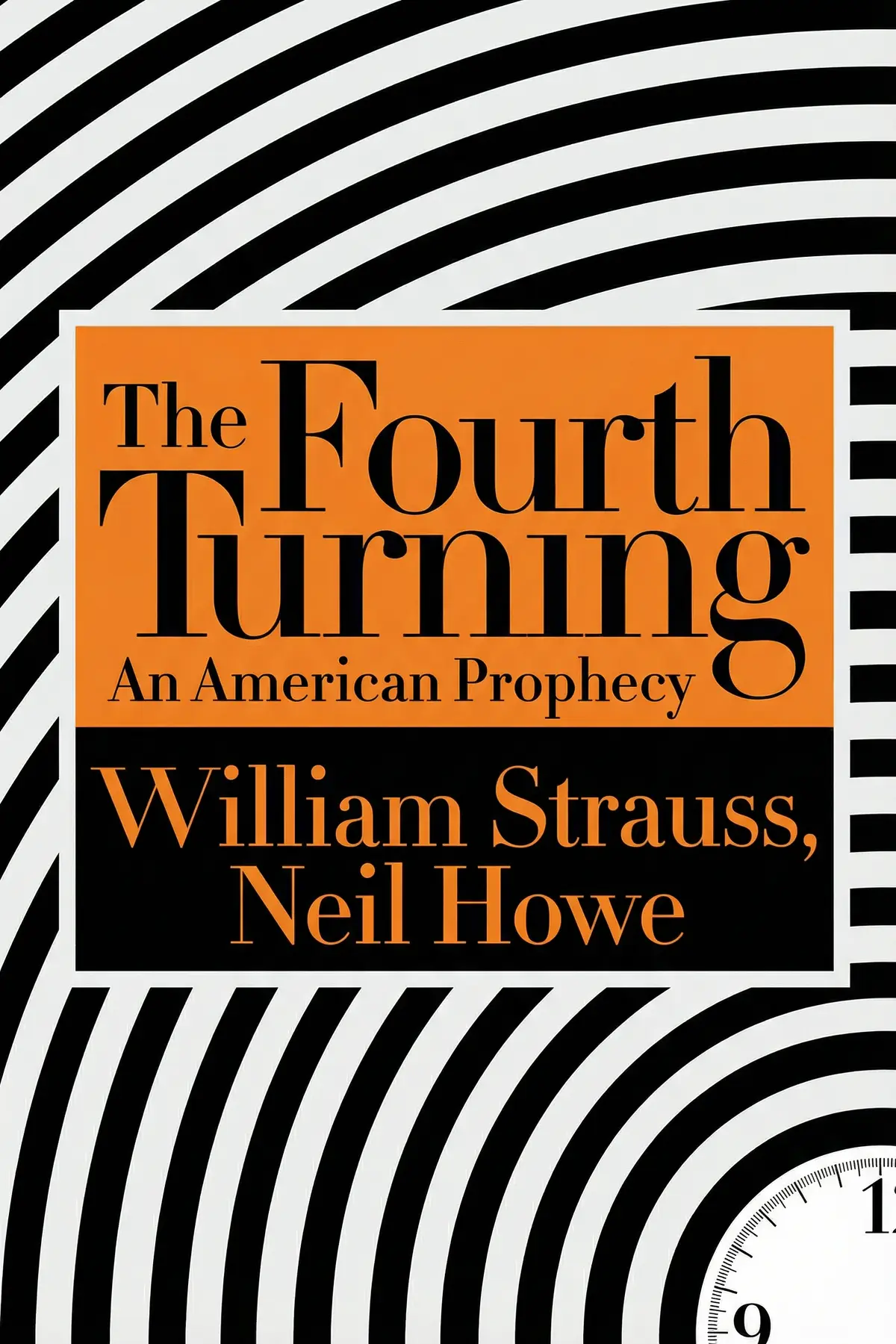
Table of Content
1. Introduction
58 sec
If the news feels like a storm with no pattern, Strauss and Howe offer a calmer way to read it. They argue that modern societies move through four seasons of about twenty years each, always in the same order. In The Fourth Turning, William Strauss and Neil Howe, who coined the word Millennials, name the four seasons High, Awakening, Unraveling, and Crisis. Together they make a cycle of about a century, roughly one long human life.
Writing in 1997, the authors used this model to forecast a coming winter for America and to explain why each generation turns out the way it does. History, they say, moves like a spiral. It repeats its seasons, and people who know which season they are in can prepare for it and even help steer it. What follows is a way to place yourself, your parents and your children on that wheel, plus a set of moves for getting ready before the cold arrives.
2. Read history as a spiral instead of a line
1 min 45 sec
Each civilization has carried its own picture of time, and each picture decides how much power people think they have. The modern one feels freeing, yet it may be setting us up for bigger floods.
3. Recognize the spring and summer of a nation
1 min 56 sec
Calm, prosperous decades feel as if they will last forever, and the stormy ones that follow seem to come from nowhere. The authors trace how a society’s greatest strength plants the seeds of its next rebellion.
4. See how trust drains away before the winter
1 min 51 sec
Tribal politics, cynical markets and short-term thinking can look like a modern disease. Writing in the 1990s, the authors read them as the signs of autumn and sketched the kinds of sparks that would light the next fire.
5. See how your childhood season shaped your generation
1 min 58 sec
Grandparents, parents and children often seem to speak different languages about duty, rebellion and reward. The authors claim those differences follow a fixed pattern that has repeated since fifteenth-century England.
6. Spot the generations who hold the middle together
1 min 57 sec
Some generations get the glory and others get overlooked, yet the friction among all four is what turns one season into the next. One simple rule explains why children never repeat their parents’ role.
7. Use the autumn to strengthen your own community
1 min 33 sec
If a hard season cannot be avoided, the urge is to wait it out or fight it head on. The authors recommend a third path, and it starts much closer to home than national politics.
8. Spread your skills, savings and people wide
1 min 45 sec
Nobody can say whether the next shock will be inflation, a crash or something stranger. The authors’ answer is a personal strategy built for any outcome, and its strongest part has nothing to do with money.
9. Conclusion
1 min 07 sec
The dammed river is the image that stays. A country that believes it has escaped nature’s rhythms may simply be storing up a bigger flood, and Strauss and Howe saw America doing exactly that. Their spiral asks for a humbler stance. History moves forward, yet it keeps coming back to the same four seasons.
That stance is not fatalism. Winter is also when the seeds of the next High are planted, when trust is rebuilt and a young generation finds a common cause. The book leaves you with a question: which season are you standing in, and do your habits fit it?
If the answer is autumn or early winter, the authors’ advice all points one way. Keep company with people who see the world differently. Put your effort into your street, your school and your local meeting. Spread your skills and savings so that no single shock can sink you. And build a web of family, chosen or born, before you need it.
Seasons cannot be canceled. They can be met prepared.
About this book
What is this book about?
Most people picture history as a straight line, so each new upheaval feels like a shock nobody could have seen coming. William Strauss and Neil Howe offer another picture. They argue that history moves in a spiral: a cycle of about a hundred years, made of four turnings of roughly twenty years each, always in the same order. First comes the High, then the Awakening, then the Unraveling, and finally the Crisis. The authors follow these seasons through modern America, from the postwar Best Years to the Consciousness Revolution and the Culture Wars. Writing in the 1990s, they forecast the winter they expected next. They also show how each season shapes the children who grow up in it, which gives four recurring generational types: Heroes, Prophets, Nomads and Artists. The book ends with practical advice. During an Unraveling, they say, build alliances across divides and invest in local community. People should spread their skills and savings widely and build a family web, chosen or born, that can hold when institutions fail.
Book Information
Who it's for
Bewildered by today's politics
Readers who find today's politics and economy bewildering and want a long-cycle way to make sense of them.
Curious managers and parents
Managers and parents curious why different generations hold such different values.
Planning for hard times
Planners who want to prepare their careers, savings and families for hard times.
About the Author
William Strauss
William Strauss and Neil Howe developed the Strauss–Howe generational theory, which describes a repeating generational cycle in American history, and together they coined the term Millennials. Howe studied history and economics at Yale, where he earned graduate degrees. He has been a senior associate at the Center for Strategic and International Studies and a senior advisor to the Concord Coalition. Strauss was an author, playwright, theater director and lecturer. He co-founded and directed the satirical troupe the Capitol Steps and helped start the Cappies awards for high school theater. He died in 2007. The two founded the consultancy LifeCourse Associates together.
Ratings & Reviews
Ratings at a glance
What people think
Listeners find this title to be a required volume for students of history, providing gripping historical analysis and a distinctive lens for viewing Anglo-American history. The work is extensively researched and intellectually stimulating, with one listener highlighting how international events have recurred across the ages. They prize its prophetic accuracy, with one review pointing to its predictive value for the 2000s to today. While many enjoy the absorbing momentum, some label it a "turgid mess."
Top reviews
Charlotte
Picked this up because the concept of cyclical history has always fascinated me, even if it feels a bit like reading a secular prophecy. Strauss and Howe offer a compelling look at how Anglo-American society moves through predictable seasons, which they call turnings. It’s hard to ignore how the 'Crisis' period they predicted back in 1997 seems to align with the current state of the world. While the prose can be a bit dense in the middle, the overall framework provides a unique lens for understanding our cultural upheaval. I found the descriptions of generational archetypes—Prophets, Nomads, Heroes, and Artists—to be surprisingly resonant. Whether you buy into the deterministic nature of their theory or not, the historical research is incredibly well-documented. It’s a thought-provoking read that forces you to think about where we are headed next.
Show moreWatcharee
This book is absolutely chilling in its accuracy, especially considering it was published over two decades ago. The authors managed to forecast the general mood of the 2020s with a level of specificity that feels almost eerie. I loved the breakdown of the four seasons of society and how each generation reacts to the previous one's values. It’s a fascinating framework for understanding why Millennials and Gen Z are so different from the Boomers. Gotta say, the ending feels a bit like a warning, but it’s one that we probably need to hear right now. Some of the charts and tables are a bit much, yet they add a layer of depth to the historical studies. This isn't just a book; it’s a roadmap for the future that everyone should at least consider. Highly recommended for those who want to understand the deeper currents of American life.
Show moreSomrutai
As a long-time student of history, I found this book to be an essential addition to my shelf. Strauss and Howe offer a unique framework for understanding how Anglo-American history isn't just a series of random events. Instead, they demonstrate how society moves through distinct cycles of spiritual upheaval and secular renewal. The historical studies included here are deep and well-documented, providing a solid foundation for their more radical predictions. I was particularly impressed by how they identified the 'Awakening' period of the 60s and 70s and its long-term impact. Not gonna lie, some of the prose is quite dense, but the insights are well worth the effort. It’s a must-read for anyone who wants to understand the deep-seated patterns that shape our world. Even if you don't agree with every conclusion, the perspective it provides is invaluable for navigating the current Crisis.
Show moreSomchai
After hearing so much about this book's influence on modern political figures like Steve Bannon, I felt compelled to see what the fuss was about. To be fair, you have to separate the authors' ideas from the way they’ve been weaponized by various pundits over the years. The core thesis suggests that history isn't just a straight line but a repeating cycle of highs, awakenings, unravelings, and crises. I was struck by how world events have indeed repeated throughout history in patterns that feel uncannily familiar today. Some sections are definitely a turgid mess, filled with repetitive jargon and overly selective historical data. However, the predictive value regarding the 2000s and beyond makes it a must-read for any student of history. It’s not a perfect science, but the logic holds up better than I expected.
Show morePrae
Ever wonder why the world feels so chaotic right now? This book suggests it’s not just bad luck, but a predictable stage in a century-long cycle called the saeculum. The authors argue that we are currently in the Fourth Turning, a period of secular upheaval where the old civic order is replaced by something new. Truth is, seeing the 2008 crash and subsequent social unrest through this lens makes a strange kind of sense. The writing is academic and sometimes dry, but the insights into generational behavior are quite engaging. I did find the focus on only Anglo-American history a bit narrow for a theory claiming to be universal. Still, it’s a well-documented study that challenges the way you view the passage of time. If you can get past the occasional pseudo-scientific tone, there is real wisdom to be found here.
Show moreAiden
Strauss and Howe have created a fascinating, if somewhat controversial, look at the rhythms of our society. The idea that we are currently in a 'Crisis' phase that will resolve around 2025 is both terrifying and oddly comforting. It suggests that there is a purpose to the current turmoil and a light at the end of the tunnel. Look, the book isn't exactly light reading; it requires a lot of focus to get through the dense socio-political analysis. But the way they link the Great Depression and WWII to the current era is incredibly thought-provoking. I appreciated how they documented the shift from individualism back toward a new civic order. Whether or not their specific predictions come true, the logic behind their cycles is hard to dismiss. This is a significant piece of work for anyone interested in futurism and sociology.
Show moreKomsan
Finally got around to this after seeing it referenced in so many news articles lately. The 'Fourth Turning' concept is a powerful tool for analyzing the current political polarization in the United States. In my experience, most history books are just a collection of dates, but this actually tries to explain the 'why' behind the shifts. The sections on the Hero and Artist generations provided some great context for the cultural clashes we see today. My only real gripe is that it can feel a bit repetitive, as the authors drive home the same points across multiple chapters. Still, the predictive value for world events is high enough that I’d recommend it to anyone. It’s a well-documented and unique framework that makes you see the news in a totally different way. Definitely one of the more influential books I’ve read this year.
Show moreAudrey
The timing of this book's recent surge in popularity is no accident. With the world feeling like it's on the brink, people are desperate for a map, and Strauss and Howe provide one. Their theory of the four turnings offers a compelling, if slightly rigid, view of how generations interact to shape history. I found the analysis of the 'Unraveling' era particularly poignant, as it captured the cynicism of the late 20th century perfectly. Personally, I think some of their archetype descriptions—like the 'Nomad' or 'Prophet'—are a bit too broad to be truly useful. However, the overarching theme of repeating world events is handled with a lot of skill and research. It's an engaging read that manages to be both academic and accessible at the same time. If you're looking for a new way to understand our past and future, start here.
Show moreTanyaporn
Frankly, it’s hard to know whether to call this genius or just very clever storytelling. The authors present a cyclical system that is undeniably captivating, but I found myself questioning the 'evidence' they provided at several points. It feels like they are frequently cherry-picking historical events to fit a pre-packaged narrative of turnings. While the pacing is mostly engaging, some chapters definitely qualify as a turgid mess of repetitive theories. I struggle with the idea that human affairs are governed by a clock-like mechanism that never fails. On the other hand, the descriptions of the 'Unraveling' era in the 80s and 90s were quite spot-on. It’s a compelling historical study, even if you remain skeptical of the prophetic claims. It’s worth a read for the unique framework alone, but take it with a grain of salt.
Show moreOak
A complete waste of time that reads more like a work of numerology than actual history. The authors take a handful of events from a very narrow slice of time and pretend they’ve discovered a universal law of nature. It’s a charlatan’s game where they toss out terms like 'saeculum' and 'generational archetype' to sound more scientific than they actually are. I found the writing style to be rambling and repetitive, making it a real struggle to finish. They completely ignore most of world history, focusing only on a simplified version of England and America to make their theory work. To be honest, the predictions they made for the early 2000s only look 'accurate' if you squint and ignore all the misses. It’s a dangerous kind of pseudo-history that feeds into a desire for easy answers. Avoid this if you value rigorous scholarship.
Show moreQuestions about this book
What is the main idea of The Fourth Turning?
William Strauss and Neil Howe argue that history moves in a spiral. A cycle of about a hundred years, called a saeculum, contains four turnings of roughly twenty years each: a High, an Awakening, an Unraveling and a Crisis. They always come in that order, like the seasons of a year. Each turning shapes the generation that grows up in it, and the generations in turn push society into its next season.
What are the four generational archetypes in The Fourth Turning?
The authors name Heroes, Prophets, Nomads and Artists. Heroes come of age in a Crisis and fight through it, as the GI generation did in World War II. Prophets, like the Boomers, grow up in a High and become moral crusaders. Nomads, like Generation X, raise themselves during an Awakening and turn practical. Artists, like the Silent Generation, grow up during a Crisis and become sensitive, deferential adults.
What did Strauss and Howe predict about the Crisis?
In the 1990s they predicted sparks like a terrorist attack, a pandemic or a fiscal crisis. One would set off a chain of emergencies that exposed what America had neglected. Trust would collapse. Elders would find they had saved too little, people in midlife would see stalled incomes and the young would face debts and taxes. They wrote that in the end a new High would follow, as trust was born again.
How do you prepare for a Fourth Turning according to the book?
The authors advise acting in step with the season. During an Unraveling, they recommend building alliances across divides, resisting polarization and putting effort into local schools, housing, transport and public spaces. On a personal level, they suggest diversifying: learn languages and many technologies, protect any business against total market change, and invest in equities and foreign markets instead of counting on pensions.
Why does The Fourth Turning stress family support?
Strauss and Howe expect social and institutional supports to weaken during a Crisis, which leaves family as the strongest safety net. They recommend a connected web of relatives across generations. A wealthy elder might pass assets to heirs early to avoid estate taxes later. People who are young, single or without children should build an alternative family from neighbors, friends and coworkers, so they are never socially stranded.
Readers also enjoyed


A Promised Land
Barack Obama


A River in Darkness: One Man’s Escape from North Korea
Masaji Ishikawa

A Splendid Exchange: How Trade Shaped the World
William J. Bernstein

A Theory of Justice
John Rawls

A Spy Among Friends: Philby and the Great Betrayal
Ben Macintyre


AUDIO SUMMARY AVAILABLE
Listen to The Fourth Turning in 15 minutes
Get the key ideas from The Fourth Turning by William Strauss, plus 5,000+ more nonfiction titles.
- 5,000+ titles
- Listen as much as you want
- 7-day free trial
- Cancel anytime









