

14 min 27 sec
Available in: English
The End of Marketing: Humanizing Your Brand in the Age of Social Media and AI
By Carlos Gil
Shows why pushy ads and bought followers no longer sell, and how to win attention on social media by starting conversations, showing personality and letting employees, customers and relatable storytellers speak for your brand.
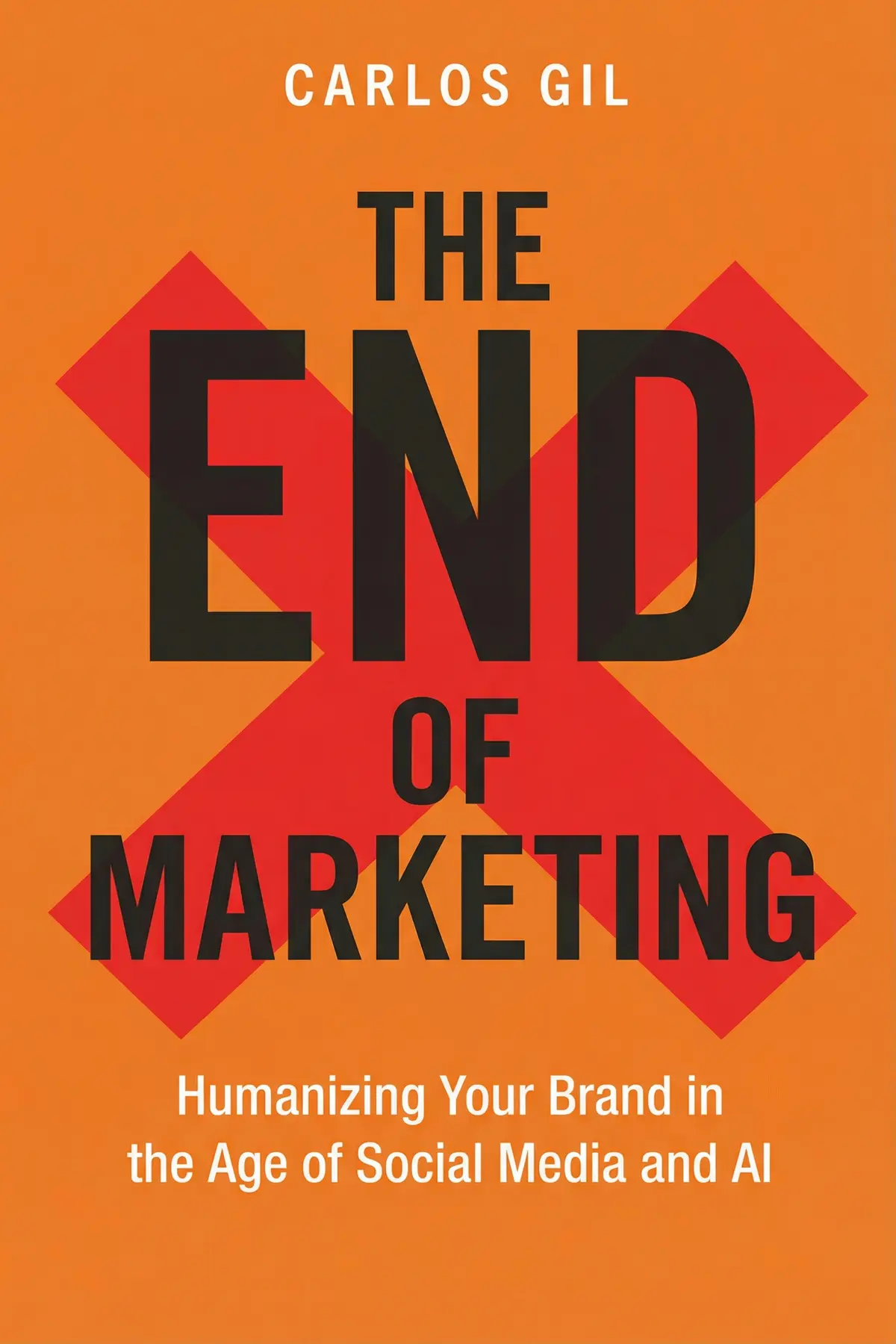
Table of Content
1. Introduction
1 min 01 sec
Most brands on social media sound like a billboard that learned to type, and most people scroll straight past them. In The End of Marketing, social media strategist Carlos Gil argues that the fix is to behave like a person, because people buy from people they know and a friend’s tip beats any ad. Gil, who has built social strategies for LinkedIn, Winn-Dixie and BMC Software, says traditional marketing, the kind that talks and never listens, is finished.
His case comes down to one claim: online, the brand that acts most human wins attention, then trust, then sales. The ideas move from why hard selling fails, through the numbers worth tracking and the posts that start real talk, to the storytellers, employees and customers who can speak for you. Along the way come a Wendy’s tweet, a DJ stranded on a Jet Ski and a hashtag for Walmart staff, plus a short audit you can run on your own accounts this week.
2. Sell the way a trusted friend recommends
1 min 44 sec
The last thing you bought probably did not come from an ad at all. Gil builds his whole approach on that everyday fact, and on the patient sellers who waited for exactly the right moment to speak.
3. Bought followers never become paying customers, so build real engagement
1 min 47 sec
A huge follower count looks wonderful on a slide and can convince a whole team that a campaign is working. Gil explains why that number may be the most misleading figure on your dashboard.
4. Turn silent posts into real conversations
1 min 44 sec
Posting again and again into silence can feel like being stranded on an island with nobody to talk to. Gil insists the audience is right there, and that a few small habits bring it to life.
5. Give your brand a voice people remember
1 min 47 sec
When a famous pancake chain changed one letter of its name, a rival saw an opening and took it in a single tweet. The episode shows how a brand can be funny and still sell.
6. Choose storytellers who sound like your buyers
1 min 49 sec
A DJ stuck at sea and a reality star posting her ordinary days both turned attention into sales. Yet Gil remains wary of paying influencers, and he names a different kind of voice he trusts more.
7. Turn your own staff into your best advocates
1 min 46 sec
Many companies already have hundreds of people posting about them every single day without realizing it. Gil shows how to support those voices without turning them into scripted mouthpieces.
8. Use automation without losing the human touch
1 min 43 sec
Bots can already follow accounts and send messages while you sleep, and platforms keep shifting under every brand. Gil argues the smarter the tools become, the more one old-fashioned quality decides who gets heard.
9. Conclusion
1 min 06 sec
Gil’s title sounds like an obituary for advertising, and in one sense it is. Shouting has lost its power, and that power has moved to whoever can talk like a person: the follower who sends the right message at the right time, the burger chain with a sense of humor, the employee posting about the job, the DJ telling a story from a stranded Jet Ski. Bought followers and clever automation cannot stand in for any of them.
The practical starting point Gil offers is an audit. List the platforms your brand uses and compare their users with the people you want to reach; an account where your buyers never go is probably wasted effort. Then read your recent posts as a stranger would. Check whether they ask questions, teach something or tell a story people can relate to, and whether they sound like a person or a corporate logo. Adjust from there, and look around your own company for the people who already speak about it.
Marketing as a loudspeaker may be finished. A brand that sounds human still has every chance to belong to whatever comes next.
About this book
What is this book about?
Brands can now reach customers more easily than at any earlier time through social platforms, yet people push back against pitches from faceless companies, and a weak post can feel like shouting into a void. Carlos Gil argues that the problem is the old marketing habit itself: ads that push and talk but never listen. People buy from people, and they tune out faceless accounts that are obviously there only to sell. Gil's answer is to humanize the brand. He shows how simple questions and follow-up replies start real conversations, why bought followers and other vanity metrics produce nothing, and how a little personality, like a famous Wendy's tweet aimed at IHOP, can entertain and promote at once. He looks at how DJ Khaled and Kim Kardashian West sell through stories, explains why he prefers ambassadors to paid influencers, and shows how employees and customers can become a brand's most credible voices. Readers get a practical way to audit their own accounts, pick the platforms their buyers actually use and track the numbers that matter, along with a clear view of where automation and AI fit and where only a person will do.
Book Information
Who it's for
Founders and small businesses
Founders and small business owners whose social posts get likes but no replies or sales.
Marketers tempted by followers
Marketers and social media managers tempted by follower counts and paid influencers.
Wanting a personal brand
Job seekers and professionals who want to build a personal brand online in their own voice.
About the Author
Carlos Gil
Carlos Gil has spent more than a decade building social media strategies for brands including LinkedIn, Winn-Dixie, Save-A-Lot and BMC Software. He is the founder and CEO of Gil Media Co, based in Los Angeles, and an international keynote speaker who presents in English and Spanish. His advice covers newer platforms such as TikTok as well as AI technologies. The End of Marketing is his first book.
Ratings & Reviews
Ratings at a glance
What people think
Listeners find the material provides significant perspectives on social media's evolution and brand humanization, complete with excellent examples and practical advice. Additionally, the work is approachable for any experience level, proving simple to follow, and listeners view it as essential for digital marketing professionals. They value how it reveals innovative marketing strategies and encourages authentic relationships with customers.
Top reviews
Monthon
Carlos Gil hits the nail on the head regarding the "human" element of digital connection in this fast-paced guide. In an era where every brand feels like a faceless bot trying to steal your wallet, the advice to simply be relatable is incredibly refreshing. I loved the case studies; they provide a roadmap for anyone trying to navigate the noise of modern platforms. Transitioning from traditional "yelling" to actual listening is a huge shift, but Gil makes it feel achievable through his actionable tips. Not gonna lie, I was skeptical about the TikTok and Twitch sections at first, but the logic holds up. This is a must-read for any digital media marketer who feels like they are shouting into a void. It’s about building a community, not just a following.
Show moreKek
Wow, the concept of "Return on Engagement" (ROE) really shifted my perspective on what metrics actually matter for my business. I’ve spent years chasing likes, but this book taught me that a thousand silent followers are worth less than ten active participants. Carlos Gil writes with an energy that is contagious, and his examples are easy to relate to, regardless of your industry. I especially appreciated the actionable advice on how to audit your brand's current social presence. Are you asking questions? Are you telling stories? These seem like simple things, but seeing them laid out in a checklist format was super helpful. This is the kind of book you keep on your desk to flip through whenever your strategy feels stale.
Show moreBae
Stop chasing the algorithm and start talking to your customers like they are actual people—that’s the biggest takeaway from this gem. I've been in social media for years, and this is the most pragmatic content I’ve consumed in a long time. It’s full of to-do lists and ideas that you can implement the very next day. I loved the honesty regarding vanity metrics; it's so easy to get caught up in the numbers that don't actually drive sales. The book humanizes the author as much as it tells brands to humanize themselves. For anyone who wants to remain relevant as Generation Z takes over the market, this is essential reading. It’s bold, straightforward, and exactly what the industry needs right now to cut through the noise.
Show moreFon
Finally got around to reading this, and I was pleasantly surprised by the specific focus on emerging platforms like TikTok and the longevity of Facebook. Most marketing books are outdated by the time they hit the shelves, but Gil manages to capture the current pulse of the industry. The concept of "Growth Hacking" without cheating is something every brand needs to study closely. I’ve seen way too many people focus on vanity metrics like follower counts, only to realize their engagement is zero. This book forces you to look at ROE (Return on Engagement) instead. The only reason I'm not giving it five stars is that the tone can be a bit arrogant at times. Still, the information provided is genuinely useful for navigating the social media landscape.
Show moreSebastian
As someone who has been skeptical of the "social media is dying" narrative, this was a breath of fresh air. Gil argues convincingly that Facebook and other giants are here to stay, provided we learn how to use them as social tools rather than billboards. The section on Facebook Groups was particularly eye-opening for me. I’ve started implementing some of the engagement tactics he suggested for my brand, and the initial feedback from our community has been great. Truth is, we often forget that there is a person on the other side of the screen. While the book could have been about fifty pages shorter, the core message is vital. It’s a pragmatic look at how to stop being an annoying advertiser and start being a conversation starter.
Show moreCooper
To be fair, the advice here is largely targeted at larger organizations with existing budgets, but the "be human" philosophy is universal enough for a solo entrepreneur. I liked the focus on the "Data Office" and the shift away from traditional marketing departments. The author isn't afraid to tell you that what you're doing probably isn't working anymore. It’s a wake-up call for brands that are still stuck in the 2010s. The only downside is that the title is incredibly misleading; it’s not the end of marketing, it’s just the evolution of it. However, the case studies are fantastic and provide real-world proof that these methods work. If you want to future-proof your career, you should probably pay attention to what Gil is saying here.
Show moreHassan
Is this book ground-breaking for a seasoned marketing veteran? Probably not, but it certainly serves as a solid refresher for anyone needing to get back to basics. The writing style is very accessible and easy to digest, which makes it perfect for a weekend read or a gift for a recent graduate entering the workforce. However, I did find it quite repetitive in places. The central theme—that people buy from people—is hammered home so many times that I started skimming by the halfway point. To be fair, some people need that repetition for the message to stick. The advice is practical, even if it feels a bit geared toward massive corporations rather than small businesses. It’s a decent guide, just don’t expect an academic masterclass.
Show moreKamol
Picked this up during a commute and finished it in just two sittings because the prose is so conversational and direct. It’s definitely not a difficult read, which is a plus if you’re busy. That said, I found the "bragging" that other reviewers mentioned to be quite prominent. It’s very much an American style of business writing—lots of "I did this" and "I was the first to do that." If you can get past the ego, the insights on humanizing your brand are solid. It's a great choice for interns or junior specialists who need to understand the shift from traditional ads to social engagement. It won't change your life, but it will definitely give you a few new tricks for your toolkit.
Show moreOrm
Look, I wanted to love this because the premise of moving away from faceless corporate ads is solid, but the execution fell short for me. It felt more like a long, drawn-out LinkedIn post than a cohesive business book. The "End of Marketing" title is clearly just a hook to sell copies because the content is essentially "Social Media 101" with some updated app names. The truth is, if you’ve spent more than a year managing a professional account, you likely already know 80% of what is being discussed here. There is a lot of filler, and the cultural references felt a bit like the author was trying too hard to stay relevant. It’s an easy read, sure, but it lacks the depth required for a professional-level strategy book.
Show moreWan
The title is a total bait-and-switch. I expected a deep dive into the evolution of marketing psychology, but instead, I got a book that is exclusively about social media tactics. It’s frustrating because "The End of Marketing" sounds so revolutionary, yet Carlos Gil just tells us that marketing is now... well, marketing on Facebook and LinkedIn. Frankly, the constant self-promotion and bragging throughout the chapters made it difficult to stay focused on the actual message. While I appreciate the nerve it takes to claim the end of an entire industry, the reality is that this is just a collection of blog posts with a fancy cover. If you are already working in the field, there is almost nothing new here. It lacks the polish I expect from a high-level business text.
Show moreQuestions about this book
What is the main idea of The End of Marketing by Carlos Gil?
Gil argues that traditional, pushy marketing no longer works because people buy from people, not from faceless brands. On social media, a brand succeeds by acting human: asking questions, replying to comments, showing personality and letting real people such as employees, customers and relatable ambassadors speak for it. Engagement, not follower count, is what eventually turns into sales.
What are vanity metrics according to Carlos Gil?
Vanity metrics are figures that look impressive but say little about business results, such as follower counts and total reposts. Gil warns that many people buy likes and followers to inflate them, yet those followers have no interest in the product and may be automated accounts, so they never engage or buy. He recommends tracking engagement and, above all, return on engagement.
What is the difference between influencers and ambassadors in The End of Marketing?
Gil is wary of paid influencers because many have bought their followers and use tricks that produce engagement without sales. Ambassadors, in his view, are people who resemble a brand’s target buyers and genuinely understand the value of its product, so they can act almost as spokespeople. He sees DJ Khaled’s promotions as feeling like advice from a successful friend.
How can employees help a brand on social media?
Companies with many staff, such as supermarkets and cafes, often have a wider social presence than they realize because employees post daily. Gil recommends an employee advocate program, backed by content hubs such as Dynamic Signal, Sprinklr or Bambu from Sprout Social, which provide a script and basic guidelines. Staff should still be themselves, and the best storytellers can be rewarded with a takeover of the main account.
How can I apply The End of Marketing to my own brand?
Start with Gil’s audit. Compare the users of each platform you post on with your target buyers and drop the ones where your customers do not spend time. Then review your content: check whether you ask questions, educate your audience and tell relatable stories, and whether you sound like a person or a logo. After posting, return to reply and thank people.
Readers also enjoyed

AUDIO SUMMARY AVAILABLE
Listen to The End of Marketing in 15 minutes
Get the key ideas from The End of Marketing by Carlos Gil, plus 5,000+ more nonfiction titles.
- 5,000+ titles
- Listen as much as you want
- 7-day free trial
- Cancel anytime









