

59 Seconds: Change Your Life in Under a Minute
Richard Wiseman
 English
 ไทย
A psychiatrist's model of the mind as an emotional chimp, a rational human and an automatic computer, with practical ways to calm your impulses, rewrite harmful beliefs and speak up without starting fights.
1 min 04 sec
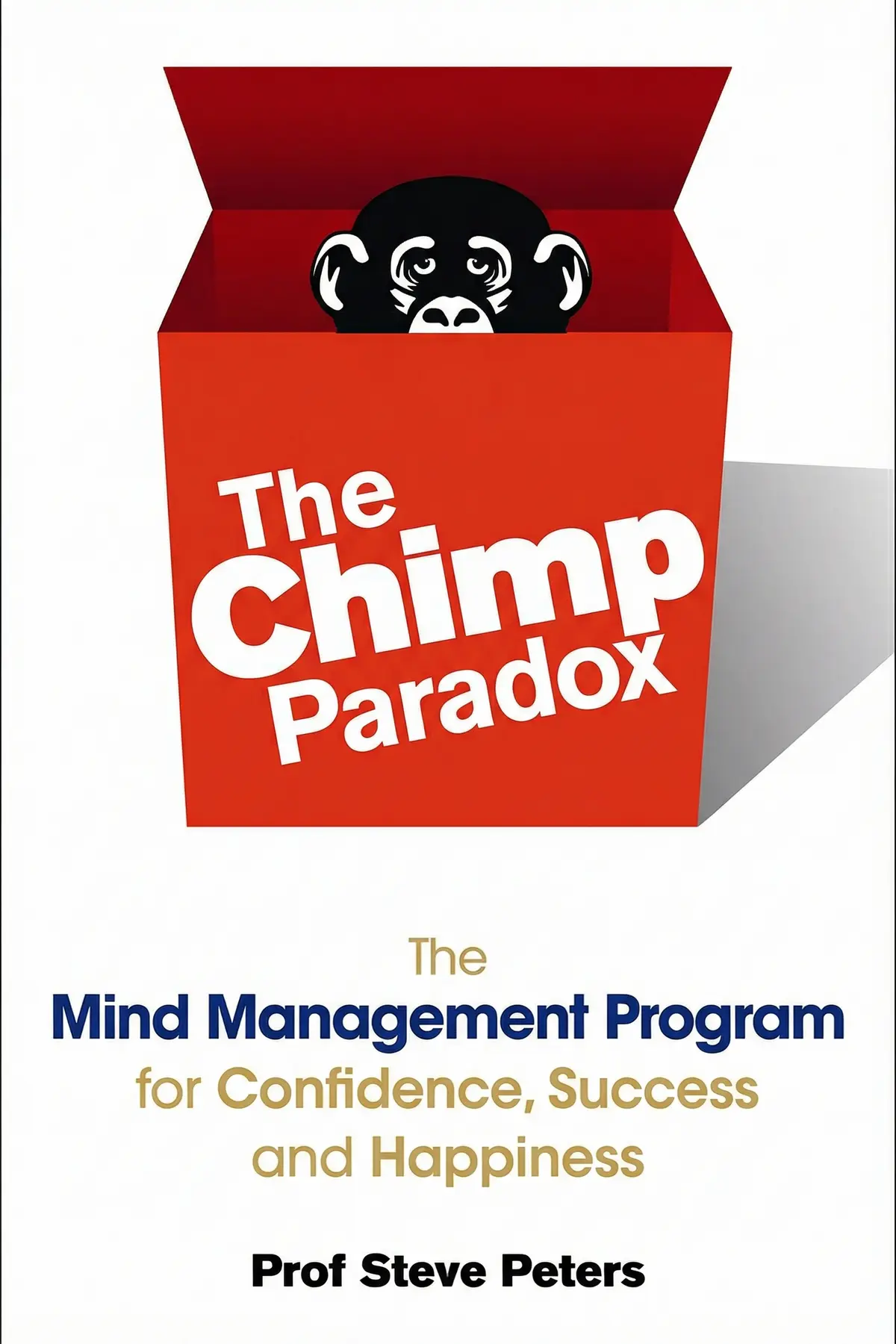
If your feelings keep making decisions you regret later, a sharp reply, a skipped workout, a silence when you meant to speak, the cause may be one part of your brain moving faster than the rest. In The Chimp Paradox, psychiatrist Steve Peters calls that part your inner chimp: an emotional system in the limbic region that is older, quicker and louder than the rational frontal lobe.
Peters, best known for his work with British Cycling, argues that this chimp can be managed. Beside it sit the human, who reasons from facts, and the computer, which stores the habits and beliefs both of them fall back on. His whole program rests on one move: notice which part is in charge, then give the human the tools to lead.
What follows is a quick test for catching the chimp, a safe way to let it vent, a method for rewriting harmful beliefs and a three-step script for standing your ground calmly.
1 min 20 sec
A husband complains about a blocked driveway, his wife makes a reasonable comment, and suddenly they are arguing about something else entirely. Peters traces fights like this to a split inside every brain, and to which side moves first.
1 min 32 sec
The venting should happen somewhere safe and private, never aimed at the person who caused the anger. Peters describes a third option that sounds strange at first, and one condition that decides whether it helps or hurts.
1 min 37 sec
A proud father praises his daughter’s school drawing and pins it to the fridge. It looks like perfect parenting, yet Peters warns it could plant a belief that follows her into adulthood.
1 min 30 sec
Someone cuts in front of you in a coffee queue, and you say nothing, though part of you wanted to object. Peters argues the silence was decided before either your reason or your temper could act.
1 min 39 sec
A father came home each evening to a flood of questions from his son, who emptied a whole bottle of shampoo with every shower. The solution he found was simple, and it says a lot about understanding anyone.
1 min 34 sec
Your friend starts shouting because you arrived late to dinner. Shouting back feels natural and staying silent feels weak. Peters offers a short script that lets you hold your position while cooling the room.
1 min 26 sec
Feeling bad about your weight seems like it should push you to the gym. Peters argues it does the opposite, and suggests an odd remark to a training partner that can get you back on track.
1 min 22 sec
An athlete wins national title after national title on her way toward Olympic gold, and never feels any of it. Peters explains why reaching the top might leave her just as empty.
1 min 10 sec
Peters gives the mind a cast of characters, and the cast makes it easier to direct. A rational human, an emotional chimp and an automatic computer share your head, each with its own logic, and they will clash. His claim is that awareness and training can keep those clashes from running your life.
The practice starts small. When a feeling grips you, ask whether you want it, and if not, give it ten private minutes before you act. When you freeze or flare up in the same way again and again, look for the goblin behind it and keep replacing it with a better belief. When a conversation heats up, say what you don’t want, how it feels and what you would like instead. And when you reach a goal, stop and enjoy it.
Peters even applies the model to choosing a partner. Someone’s human side might be loving, generous and fun while their chimp firmly rejects monogamy. Since basic traits rarely change, he advises deciding early which ones would end things for you. Look at the whole person, chimp included, starting with yourself.
Most people know the feeling of reacting in a way they regret: snapping at a partner over nothing, freezing when they should speak, skipping the workout they planned. Steve Peters, a psychiatrist best known for his work with British Cycling, argues that these moments follow a pattern. One part of the brain, which he calls the inner chimp, reacts to feelings faster and more forcefully than the rational part he calls the human. Peters adds a third part, the computer, which stores the habits and beliefs both of them fall back on, including destructive patterns he calls goblins. His program shows how to tell which part is in control, how to let the chimp vent without harm, and how to replace goblins with better beliefs. From there he applies the model to everyday life: understanding people whose minds work differently, speaking assertively instead of aggressively, sticking to health goals and learning to enjoy success. Readers get a simple vocabulary for their own reactions and specific steps for managing them.
Professionals who snap, freeze or overthink under pressure and want a simple model for their reactions.
People whose health or personal goals keep collapsing after a strong start.
Managers, coaches and parents who want calmer conversations and fewer pointless fights.
Steve Peters is an English psychiatrist, born in 1953, best known for his work with British Cycling. He has advised Liverpool FC, England football and many Olympic and national teams, and has also worked with executives, teachers, students, hospital staff and patients. Earlier he was Clinical Director of mental health services at a National Health Service district hospital, a consultant forensic psychiatrist at Rampton and Undergraduate Dean at Sheffield University. The Chimp Paradox, first published in 2012, has sold over a million copies. He has also held world records in masters athletics.
Listeners find this book thought-provoking, as it helps clarify mental processes and offers a compelling framework for understanding human behavior. Furthermore, the content is accessible thanks to straightforward analogies, with listeners praising its clear prose and approachable style. They also appreciate its practical impact; one listener mentions it offers genuine tools for enhancing quality of life, while another emphasizes its value within cognitive therapy contexts.
Ever wonder why you snap at people for no reason or sabotage your own goals? This book finally gave me the vocabulary to understand my own reactions. The Chimp model isn't just a metaphor; it’s a toolkit for emotional regulation that feels immediately applicable. I loved the sections on 'The Troop' and how we communicate within our social circles. Frankly, I’ve read a dozen self-help books this year, but this is the only one that provided real, actionable tools for improving my life quality. It takes complex cognitive therapy concepts and strips away the jargon until only the useful parts remain. By learning to 'box the chimp,' I’ve found myself much calmer during stressful work meetings. It is a well-written guide for anyone wanting to move from reactive behavior to considered, logical decision-making.
Show moreIn my experience, self-help books usually lack substance, yet this one provides a surprisingly rigorous framework based on actual clinical practice. It’s basically CBT in a very accessible package. I found the concept of 'gremlins'—those unhelpful beliefs stored in our mental computers—to be a game-changer for my self-esteem. Peters doesn't just tell you to be happy; he explains the mechanics of why your brain is currently generating unhappiness. The writing style is direct and lacks the usual fluff you find in this genre. I particularly liked the focus on the 'Human' being your true self, while the Chimp is just a machine you have to manage. It’s an empowering way to look at mental health. Even the simple task of listing ten things that make you happy felt like a breath of fresh air during a stressful week.
Show moreGotta say, the section on 'Boxing the Chimp' changed how I view my morning routine and overall impulse control. As someone who struggles with consistency, understanding that my emotional brain is five times stronger than my logical brain was a huge 'aha' moment. It’s not about willpower; it’s about management and reward. Peters provides a structured approach to success that appeals to my love of lists and plans. The book is very readable and avoids the 'woo-woo' vibes of many other self-help titles. It feels like a manual for the mental game of life. Whether you are an athlete or just someone trying to survive a corporate job, these techniques for neutralizing the Chimp are invaluable. It has certainly helped me stop 'spanking the monkey' of procrastination and start making better choices.
Show moreFinally got around to reading this, and it feels like I've finally been handed a manual for my own brain. The way Peters explains how the Chimp interprets experiences through a filter of fear while the Human uses logic is a revelation. It makes so much sense of those moments where you know you're being irrational but can't seem to stop. The 'Computer' concept—where we store our habits and beliefs—helped me identify exactly where my negative self-talk was coming from. It’s a very grounding read that makes you feel more in control of your destiny. I've already recommended it to three friends. It’s simple, yes, but sometimes simplicity is exactly what you need to actually make a change in your behavior.
Show moreAfter hearing several elite athletes like Chris Hoy mention Professor Steve Peters, I decided to see what the hype was about. The premise is deceptively simple. Peters argues that your brain is divided into a rational Human and an emotional Chimp, both fighting for control of a internal Computer. While the science is simplified for the masses, the readability makes it incredibly easy to digest in just a few sittings. I particularly appreciated the advice on replacing 'should' with 'could' to reduce self-imposed guilt. Truth is, the MS Paint-style illustrations are a bit of an eyesore, but the actual mind management programme is quite effective. It provides a powerful model for understanding why we sometimes act against our own best interests. It’s not a deep academic text, but for practical, everyday behavior change, it hits the mark.
Show moreThe first half of this book is absolute gold, but the second half lost me a little bit in the stars. The core concept of the Human and the Chimp is a brilliant way to visualize the struggle between the frontal lobe and the limbic system. It’s helpful, insightful, and surprisingly funny at times. However, once Peters starts introducing the wider 'Psychological Universe' with different planets for every personality trait, it gets a bit muddled. It reminded me of that scene in The Matrix where the Architect explains everything with far too much complexity, leaving the audience more confused than before. Still, the early chapters on managing the Chimp’s input are worth the price of admission alone. If you can ignore the slightly confusing planetary metaphors at the end, there is a wealth of wisdom here for anyone struggling with their temper or anxiety.
Show moreTo be fair, I was skeptical of the cutesy drawings at first, but the advice on managing social interactions is genuinely useful. The book excels when it talks about how to deal with other people’s Chimps without letting your own take over. It’s all about creating an environment where the rational 'Human' can lead the conversation. I've started using his suggestions for difficult conversations at work, and the results have been impressive. My only gripe is that the model becomes increasingly convoluted as you get deeper into the chapters about success and confidence. It feels like Peters tried to fit every aspect of human existence into one single animal metaphor. That said, the core message is powerful and easy to remember in the heat of the moment. It’s a solid 4-star read for the practical communication tips alone.
Show moreLook, this is a great entry point for beginners, though more advanced readers might find themselves rolling their eyes at the MS Paint diagrams. The core of the book revolves around the struggle between your inner Chimp and your Human self, which is essentially a simplified version of CBT principles. I found the concept of 'gremlins' and 'goblins' in the computer brain quite helpful for identifying negative thought patterns, even if the terminology is a bit twee. It’s written in an accessible style that doesn’t require a PhD to understand, making it perfect for someone just starting their self-improvement journey. While it doesn't reinvent the wheel, the practical advice on managing stress and understanding your 'Troop' is solid. I’ve noticed a real difference in how I handle workplace conflicts since finishing it. It isn't a literary masterpiece, but the mind management programme it offers is surprisingly effective for daily life.
Show morePersonally, I found the whole 'Chimp' metaphor incredibly patronizing and far too simplistic for anyone who has read a single psychology textbook. The author treats the reader like a child, using cutesy names for complex neurological processes. It’s telling that Ronnie O'Sullivan is quoted on the cover, as the book feels like it’s aimed primarily at people who have never stopped to think about their own thoughts before. The assertion that your 'ideal' logical self is your only true personality is total nonsense that completely disregards the validity of human emotion. While there are some okay tips on communication and stress, you could find the same advice in a five-minute blog post. The 'Psychological Universe' diagrams are chaotic and don't add much to the actual learning experience. It’s just too lightweight for me.
Show moreThis would probably make a fantastic 8-bit platform game, but as a psychology book, it’s remarkably underwhelming. Steve Peters presents the 'radical' idea that we have an emotional side and a rational side, which isn't exactly groundbreaking news to anyone with a pulse. He illustrates this with some of the most bizarrely amateurish hand-drawn graphics I have ever seen in a professional publication; they look like fifteen minutes of work in MS Paint. While I respect the impact he's had on Olympic cyclists, the 'Psychological Universe' metaphor—complete with eight planets and various moons—is just too much. It feels like he's trying to explain basic impulse control to a toddler by using space-chimps and brain-computers. If you have ever engaged in even a shred of self-reflection, you will find this incredibly patronizing. A wasted opportunity for a deeper dive into neuroscience.
Show moreSteve Peters argues that the brain has distinct parts with their own logic. The human, in the frontal lobe, reasons from facts. The chimp, in the limbic system, reacts from feelings and is faster and stronger. The computer stores automatic habits and beliefs. Because these parts clash, Peters teaches readers to recognize which one is in control and to manage the chimp through awareness and training.
Peters suggests asking yourself questions that begin with “Do I want”. For example, do I want to behave like this, or do I want to feel this way? If the answer is no, the chimp is driving. Someone worrying obsessively about being late to a meeting can ask whether they want that worry, and a no shows it needs managing.
Goblins are destructive automatic patterns stored in the computer part of the mind, formed from experience. One example is a child who comes to believe she is unlovable unless she performs well. Because both the chimp and the human consult the computer when unsure, a goblin can make you back down. Peters advises identifying it, choosing a positive replacement and repeating the new belief until it becomes automatic.
He recommends raising issues directly with the person involved and speaking assertively, never aggressively, since aggression triggers an emotional reply. Assertiveness has three steps: say what you don’t want, explain how the situation makes you feel and state what you would like instead. When a friend yells at you for turning up late, you can tell them that being yelled at is unwelcome, that it makes you feel intimidated, and request a gentler, calmer way of speaking.
Richard Wiseman





William B. Irvine


Andrew D. Thompson


Deepak Chopra
AUDIO SUMMARY AVAILABLE
Get the key ideas from The Chimp Paradox by Steve Peters, plus 5,000+ more nonfiction titles.









