The Way of Zen
Alan Watts
 English
 ไทย
Alan Watts argues that the sense of being a separate, isolated self is a cultural mistake. He shows how recognizing your unity with the universe changes how you see God, cause and effect, opposites and death.
1 min 03 sec
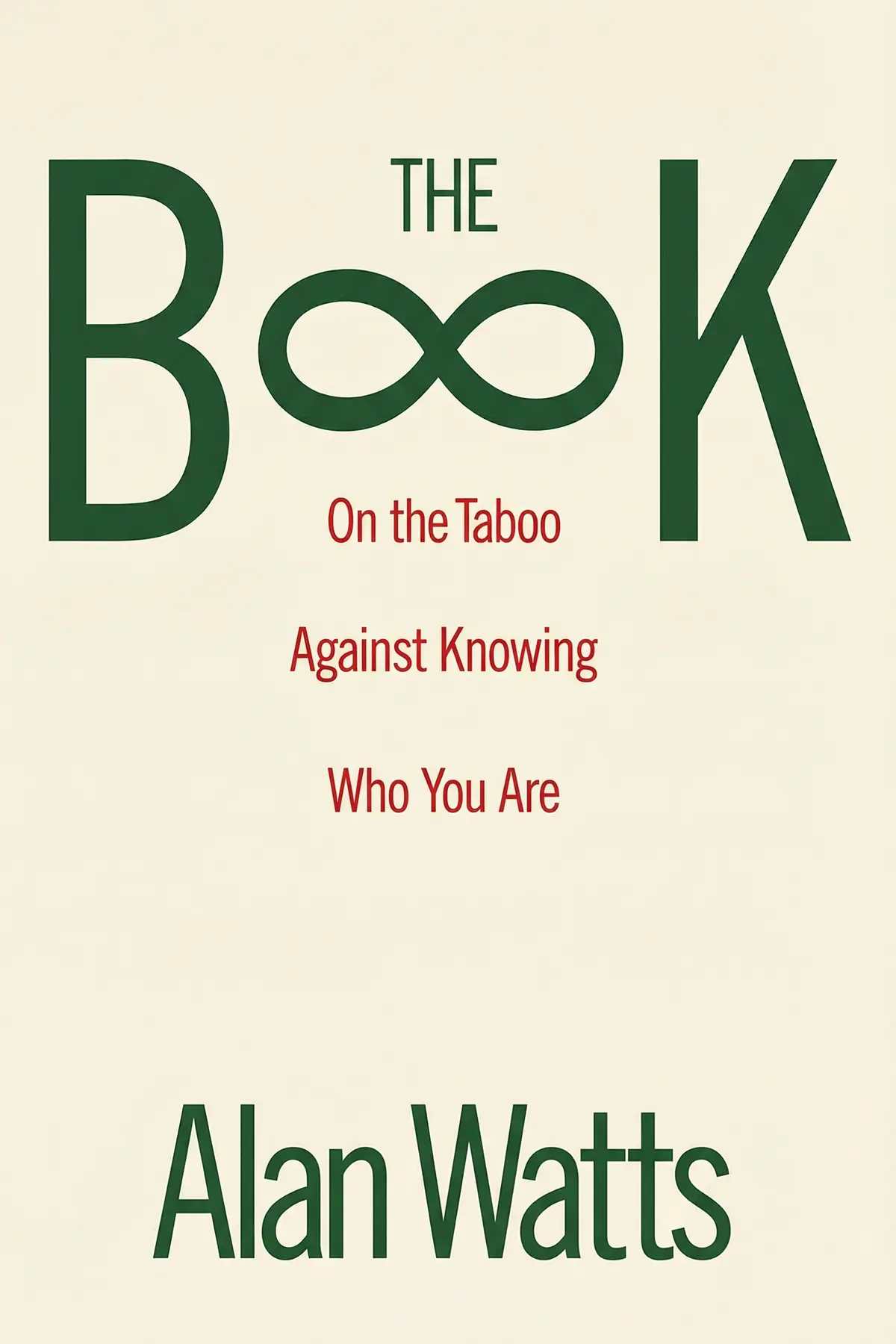
Most people feel like a lone self pushing against a world out there, and almost nobody questions that feeling. In The Book, subtitled On the Taboo Against Knowing Who You Are, writer and former Episcopal priest Alan Watts argues that the feeling rests on a mistake. People, he says, are born out of the world, the way waves rise from the sea. Watts wrote in the 1960s, long before phones and feeds, and he already saw people failing to connect with each other or to face the large questions of life.
His throughline is easy to say and hard to live. The separate ego is an illusion, and seeing through it makes life lighter and less afraid. The path runs through ancient Indian scripture, a cat glimpsed through a fence, words for snow and the fear of dying. What the book offers is a fresh answer to the oldest question, who am I, plus a good reason to take yourself less seriously.
1 min 45 sec
Societies tend to shed taboos over the generations, and sex, once a major one, now turns up in pop songs and on billboards. Watts names the one that survives, and it hides inside phrases you probably used this morning without noticing.
1 min 41 sec
Freud and Jung mapped the hidden corners of the mind, yet Watts believes they walked past something far simpler. The reason it stays unseen has to do with mirrors.
1 min 52 sec
An idea of God from ancient India made pride almost pointless and gave people a reason to honor even stones. Yet its followers insisted that believing the idea was never enough.
1 min 40 sec
Imagine watching the world through a tiny gap and seeing the same strange sequence again and again. Watts uses that picture to question one of the habits people trust most.
1 min 46 sec
Night seems to be the absence of light, and day the absence of darkness. Watts argues that both beliefs come from what our attention chooses to see, and language reveals the choice.
1 min 43 sec
A strict judgment, a heaven of harps or simple nothingness: no wonder people avoid the subject. Watts points to traditions that see the end very differently, and to a teacher who wanted it remembered daily.
1 min 43 sec
Decades before smartphones, Watts imagined humanity joined into one electronic body. He saw real dangers in that future, and an unexpected reason not to despair about it.
1 min 15 sec
What Watts finally offers is a different answer to the question of who you are. The usual answer is a separate ego, standing alone and facing a world outside it. His answer is a wave of the same energy that made the grass, the trees and the birds, briefly shaped as you. He believes the usual answer is spiritually starving, and that each step toward connection with the world brings you closer to your real identity.
The advice he leaves is surprisingly light: do not take things too seriously. Should existence be God playing hide-and-seek with us, then humor turns into one of the handiest abilities anyone can possess, above all the capacity to laugh at oneself. Truth as each of us experiences it is relative and personal, so hold your certainties loosely.
The next time a setback feels final, or your own importance feels heavy, picture the cat passing the gap in the fence, or a wave rising from the sea. Then let yourself smile at it. In Watts’s view, all things pass, and all of them come round again.
Most of us assume we are separate individuals: a self inside a body, facing a world outside it. Alan Watts, writing in the 1960s, calls this assumption the last great taboo of Western life. He means the one subject people avoid thinking about clearly, which is what a human being actually is. His claim is that we are born out of the world, the way a wave rises from the ocean, and that the lonely ego is a self-deception. Watts builds the case from many directions. He draws on the Vedanta of ancient India, a saying of Jesus, a cat seen through a hole in a fence and the words different languages have for snow and forest wandering. He then turns the same lens on death, which he believes Western religion has made needlessly frightening, and on a future in which electronic media might bind humanity into one nervous system. Readers get a different answer to the question of who they are. They also get practical shifts in perspective: less either-or thinking, a calmer view of mortality and permission to laugh at themselves.
Professionals worn down by stress who feel cut off from people and from meaning.
Spiritual seekers curious how Vedanta and Christian sayings point to the same idea of the self.
Anyone uneasy about death, or about a hyperconnected world, who wants a calmer way to see both.
Alan Watts was born in Chislehurst, England, in 1915 and moved to the United States in 1938. He studied theology at Seabury-Western Theological Seminary and became an Episcopal priest in 1945, then left the ministry in 1950 and settled in California. He built a following through radio, including volunteer programs at KPFA in Berkeley. His book The Way of Zen was among the earliest best sellers about Buddhism. He wrote more than 25 books in all and died in 1973.
Alan Watts

Listeners find this work both profound and indispensable for spiritual seekers, written in a clear style that pushes people to broaden their worldview. The book is frequently called life-changing for the way it shifts perspectives, and one listener mentions its particular value for navigating the challenges of today’s world. However, listeners are divided on its accessibility; while some describe the message as simple and direct, others find the material difficult to follow.
This book acts as a sledgehammer to the ego, and I mean that in the best way possible. Watts has this incredible ability to dismantle the 'separate ego in a bag of skin' myth without relying on heavy religious dogma. To be fair, some of the 1960s cultural references feel a bit dated now, but the core metaphysics are timeless. I found myself putting the book down every few pages just to stare at a tree or my own hands, realizing I’m not just an observer of the universe, but an actual expression of it. It’s a short read, but the implications are massive if you let them sink in. Frankly, it’s essential for anyone feeling disconnected from the world. It won't give you a 'how-to' list for life, but it changes the 'who' that is living it.
Show moreFinally got around to reading Watts, and I feel like I've been asleep for thirty years. This isn't just a book about philosophy; it's a fundamental shift in how you perceive your own existence. The way he explains how we are 'it'—the whole works—is both terrifying and liberating. Personally, I think this is the perfect antidote to the anxiety of the modern world. We spend so much time trying to survive and protect our little egos that we forget we are the very thing we’re afraid of losing. The writing is surprisingly clear for such a heavy topic, though I can see why some might find his conversational style a bit 'loose.' If you are a spiritual seeker who is tired of the same old platitudes, this is the one. It really opens your eyes to the taboo of our own identity.
Show moreEver wonder why society feels like everyone is walking on eggshells or trapped in a game they didn't agree to play? Watts hits the nail on the head here. He explores the 'unwritten taboo' against knowing who we truly are—not the personas we wear for work or family, but the underlying reality of our being. This book is a powerful attack against the 'separate ego' and it totally changed my perspective on death and birth. He describes it as a game of hide and seek that the universe plays with itself, which is such a beautiful and humorous way to look at life. It’s a very readable book, though it does require you to be open-minded. Not everyone will appreciate being told their 'self' is a myth, but for me, it was pure grace.
Show moreThe chapter on 'The Game of Black and White' is worth the price of admission alone. It perfectly illustrates how we can't have light without shadow, or self without other. Watts has a gift for taking complex Eastern thought and making it accessible, even if his style is a bit wordy at times. I’ve read a lot of self-help, but this feels different—it’s not about fixing yourself, but about realizing that the 'you' who needs fixing is a social construct. Some might find it difficult to follow his logic because it doesn't move in a straight line, but that's part of the point. Life isn't a straight line. Essential for seekers.
Show moreNot what I expected from a book written in the sixties; it feels incredibly relevant to our current digital isolation. Watts explains that we aren't just 'thrown' into this world, but that we come out of it, like leaves from a tree. This perspective is so much more comforting than the traditional view of being a lonely soul trapped in a body. I found the writing to be clear and direct, though it definitely challenges your worldview. It’s one of those rare books that makes you feel more awake after you finish a chapter. It addresses the 'taboo' of our identity with such wit and grace that it’s hard not to be moved. If you’re feeling lost in the chaos of modern life, this book offers a profound sense of connection. It’s not just a read; it’s an experience. To be fair, you have to be willing to let go of your traditional Western upbringing to really enjoy it, but the payoff is immense. You'll never look at a sunset—or yourself—the same way again.
Show moreAs someone who usually sticks to Western philosophy, the jump into Eastern metaphysics was surprisingly smooth here. Watts acts as a brilliant bridge, though I must say, many of these ideas aren't exactly 'new' if you've read Hegel or even some of the Neoplatonists like Plotinus. He focuses heavily on the idea that an individual doesn't really exist in isolation, which is a powerful concept to grapple with. However, the book does occasionally feel a bit shallow in its rigor. He tends to gloss over practical realities like self-preservation in favor of a flowing, almost stream-of-consciousness narrative. It’s a delightful read, filled with humor and wit, but don't expect a dense academic treatise. It’s more of a poetic invitation to see the world as a unified field of play rather than a battlefield of separate things.
Show morePicked this up during a particularly stressful month, and it helped ground me in a way I didn't expect. Alan Watts does a fine job of breaking through that narcissistic wall we all build around ourselves. He challenges the idea that we are just observers in a world that is 'outside' of us. The book is essentially an updated take on Vedanta, but written for a Western audience that is obsessed with technology and 'getting ahead.' I did find my eyes glazing over a bit in the middle sections, as the prose can get quite dense and repetitive. Some of the talk about 'cosmic milk' and being part of the 'Whole Everything' can feel a bit 'woo-woo' if you aren't in the right mood. Still, it’s a vital read if you want to stop feeling like a stranger in your own life.
Show moreLook, Alan Watts is a master of the metaphor, but you have to be in the right headspace to really 'get' his flow. He writes with a sense of humor and humanness that is often missing from spiritual texts. I particularly enjoyed his commentary on the 'schizophrenic' nature of Western morality—how we try to be idealistic while being unscrupulously competitive. It’s a sharp critique of society that still feels incredibly relevant today. On the downside, some of his arguments feel like they belong in a 1960s campus coffee shop, and the 'no ego' concept can be a bit much to swallow if you’re looking for practical life advice. It’s more of a metaphysical exploration than a guide for living.
Show moreTruth is, I found the core message here a bit repetitive despite the beautiful prose. The main theme is that there is no ego and we are all part of a singular cosmic process. Okay, I get it. But after the third chapter, I felt like Watts was just finding flowery ways to say the same thing. It started to feel a bit like a lecture from a charming professor who refuses to get to the point. While I appreciate the sentiment of mindfulness, the book lacks a certain groundedness. If a dog bites your leg, you are very much an individual in that moment. It’s an interesting intellectual exercise, but I struggled to find the useful context Watts promised.
Show moreWow, what a bizarre, unfocused experience this turned out to be. I picked this up because of the brilliant quotes I’d seen online, but reading the full text was a different story entirely. To be fair, there are grains of wisdom here, but they are buried under tons of chaff. The flowing nature of the writing makes it hard to stay engaged, and at times, it honestly feels like a stoned hippy unloading a stream of consciousness onto the page. He takes a whole book to state the obvious: that opposites can't exist without each other. He ignores basic human instincts like self-preservation, which makes the whole 'you don't exist' argument feel like a parlor trick. My recommendation? Stick to the highlight reels and save yourself the time. There are much more practical works out there for self-improvement.
Show moreWatts argues that the last real taboo in Western society is honest talk about what a human being is. Most people believe they are separate individuals who came into the world from elsewhere. Watts says we are born out of the world, like waves out of the ocean, and part of one universe of energy that creates everything. Seeing this, he believes, is the way to a more fulfilling and less fearful life.
According to Watts, the rational mind cannot grasp the true self because it is trying to look at itself. He compares it to seeing your own eyes without a mirror, or naming the color of a mirror when all you can see are the leaves and sky it reflects. He also blames popular culture for glorifying the rugged individual.
Watts thinks Western religions made death frightening, offering either a strict Final Judgement or the nothingness of the atheist view. He points to traditions that see death as a doorway to spiritual growth and a chance to let go of the ego. He also cites G. I. Gurdjieff, who believed a constant reminder of death’s certainty would greatly benefit people.
Because Watts pictures the universe as God playing hide-and-seek, his parting counsel is to hold things lightly and learn to laugh at yourself. The book also suggests questioning either-or thinking, looking for the larger whole behind events that seem to cause each other, and treating people, animals and plants with respect as parts of the same source.
It suits readers who feel isolated or anxious and want a broader way to see themselves. It will also interest people curious about Vedanta, about how language shapes perception, or about Watts’s 1960s warnings that electronic media could make humanity more uniform and erase privacy. It is an idea-driven work, not a step-by-step program.


Marianne Williamson


Deepak Chopra

Pico Iyer

Alcoholics Anonymous World Services


William B. Irvine


AUDIO SUMMARY AVAILABLE
Get the key ideas from The Book by Alan Watts, plus 5,000+ more nonfiction titles.