
14 min 37 sec
Available in: English
The Bestseller Code: Anatomy of the Blockbuster Novel
Explains what a computer model learned from reading over a thousand bestsellers with the author names removed: the topics, emotional rhythm, plain style and driven characters behind blockbuster novels, and how writers and readers can spot them.
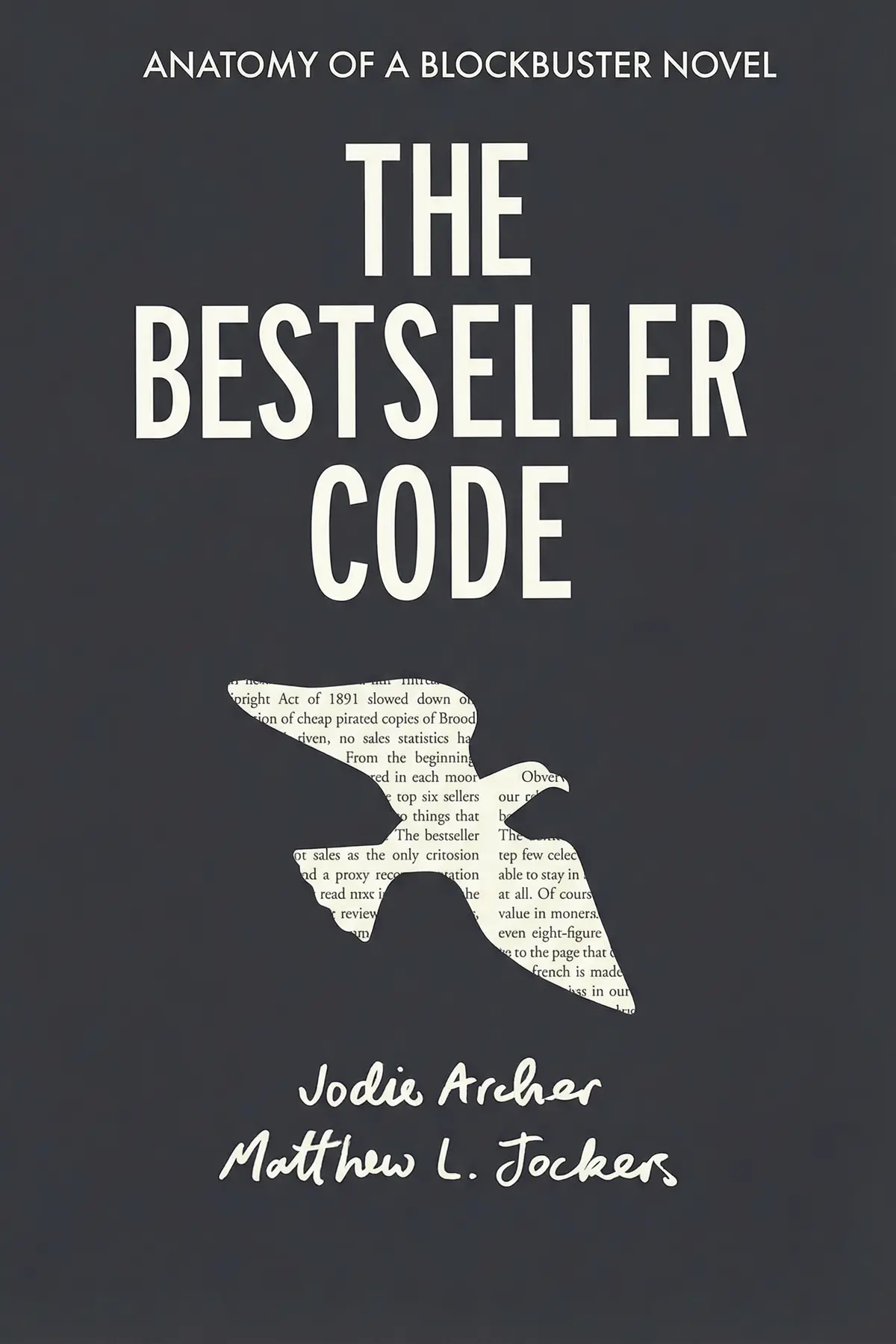
Table of Content
1. Introduction
1 min 04 sec
If you write, edit or simply love novels, a book’s rise to the top of the charts probably looks like luck. In The Bestseller Code, former Penguin editor Jodie Archer and Matthew L. Jockers, a scholar of English and data analytics, argue that it follows a pattern. Their computer model read novels with the authors’ names removed and still correctly identified between 80 and 90 percent of the titles that went on to reach the New York Times bestseller list.
That result goes against what critics have said for more than a century, that popular books are simply badly written ones. The authors’ case is that a blockbuster leaves fingerprints in its own text. The signals are the right mix of topics, a story that keeps lifting and dropping the reader’s feelings, plain sentences and a main character who needs something. Each of these can be measured, and each can be learned. By the end you will know what to look for in the first pages of any novel, and what to change in your own draft or pitch.
2. Stop expecting critics to spot the next hit
1 min 42 sec
For well over a century, reviewers have tried to explain why so many bestsellers are books they dislike. The numbers behind the list show how hard picking a winner is, and why praise is the wrong guide.
3. Spot a hit by reading the text alone
1 min 42 sec
A machine was handed famous novels stripped of their authors’ names and asked to judge them cold. Its scores raise an awkward question about every manuscript an editor has ever turned away.
4. Choose the topic before you choose the shelf
1 min 46 sec
Bookstores sort novels into neat categories, but in the model a book’s topic counts for more than its genre. What it counts instead explains why some subjects sell across every genre, and why one famous selling point barely shows up at all.
5. Give readers a ride of rising and falling feelings
1 min 41 sec
A novel that should have scored badly on paper became one of the biggest sellers of its time. When the model charted how it moves readers, the shape it found matched only one other book.
6. Write plain sentences that millions can follow
2 min 08 sec
Writing classes reward the clever phrase and the fresh image. The bestseller list rewards something else, and the evidence comes from a famous pen name, two tiny words and a strange result about gender.
7. Build a needy hero to sell your book
1 min 45 sec
A run of hit titles seems to share one magic word. The real pattern is broader, and inside the books it points to a single verb that keeps stories moving and readers turning pages.
8. Turn the patterns into your own reading radar
1 min 36 sec
A book the critics shrugged at earned a perfect score from the model. That gap matters most to new writers, and to any reader willing to keep a simple notebook for a few months.
9. Conclusion
1 min 13 sec
The Bestseller Code takes something publishers have long put down to luck and shows that it has a shape. Novels that reach the top tend to resemble one another. Crime or love runs through their topics, and the line of feeling keeps climbing and falling. Their sentences are so plain they disappear, and their heroes’ needs drive every scene. Critics may miss all of it. A computer reading more than a thousand bestsellers, with no author names to sway it, did not.
For writers, the upshot is humbling and freeing at once. Clever prose counts for less than you were taught, and a character who wants something counts for more. On your next revision, trace the emotional highs and lows of your plot and fix the flat stretches. Strip out spare adjectives, adverbs and the word very, and check that your title describes your main character in a few striking words.
Readers and anyone who pitches stories can use the method too. Keep a notebook on the bestsellers you finish and record what kept you turning pages. The editors who turned down Harry Potter twelve times were reading on instinct. A few months of careful notes will give you something better.
About this book
What is this book about?
Of the roughly 50,000 novels published in the United States each year, only about 200 reach the New York Times bestseller list. Publishers have long treated picking those winners as guesswork, and critics have long complained that the books that sell are often the badly written ones. Jodie Archer, a former Penguin editor, and Matthew L. Jockers, a scholar of English and data analytics, spent five years studying the words of bestselling novels. From the patterns they found, they built a model they call the bestseller-ometer. Given books with no author name attached, it picked 80 to 90 percent of the titles that went on to make the list. It also gave the first Harry Potter book a 95 percent chance, after that book had been rejected twelve times. The book explains what the model measures and why it works. It weighs topic over genre and charts a story's emotional highs and lows. It favors plain sentences over clever ones, and it rewards characters driven by need and titles that make them intriguing. Writers get a checklist for revision, and readers get a sharper way to understand why some books grip millions.
Book Information
Who it's for
Novelists in the making
Aspiring novelists who want to know which parts of a draft really decide whether readers keep going.
Picking winners from manuscripts
Editors, agents and publishers who have to pick a few winners from thousands of manuscripts.
Puzzled by bestseller lists
Curious readers who wonder why critics' least favorite books keep topping the charts.
About the Author
Jodie Archer
Jodie Archer studied English at the University of Cambridge and worked as an acquisitions editor at Penguin. She later researched contemporary fiction and bestsellers at Stanford, earned her PhD and led book research at Apple. Matthew L. Jockers studies literature with computational methods. He has been a professor of English and data analytics, Dean of Arts and Sciences at Washington State University, and a research manager for Apple Books personalization. He also wrote Macroanalysis.
Ratings & Reviews
Ratings at a glance
What people think
Listeners consider this a compelling listen filled with essential perspectives and a vast amount of research. The narrative approach is perfectly tailored for authors, and one listener highlights its ability to map out a system for tackling intricate challenges. The book is also praised for its scrutiny of the reading audience and its use of tension. Nevertheless, its reliability draws divided views, with some lauding the incredible science and others voicing dissatisfaction with the ultimate conclusions.
Top reviews
Max
Finally got around to reading this exploration of the 'bestseller-ometer' and I am genuinely impressed by the depth of research involved. Archer and Jockers don't just guess; they provide a fascinating look at how machine learning can dissect a novel's DNA. While some might find the data-heavy approach a bit dry, I thought it illustrated a brilliant process for solving the complex problem of why some books take off while others flop. The insight into how 'okay' is actually a marker for high-performing prose was a total surprise to me. It's not just a manual for writing hits, but a deep dive into readership habits and the underlying rhythms of popular fiction. To be fair, you might not agree with every conclusion, but the sheer scale of the 5,000-book analysis is hard to ignore. This is a must-read for any writer who wants to understand the mechanics of the market without losing their artistic soul.
Show moreAir
What a wild ride through the world of big data and literature! I never thought I’d be so engrossed in a book about algorithms, but the way they used the computer to unmask J.K. Rowling’s pseudonym was brilliant. The level of readership analysis here is top-tier. It challenges the snobbish idea that bestsellers are just trash; instead, it proves they are often the most meticulously structured books on the shelf. Not gonna lie, I was skeptical at first about a machine 'reading' for plot, but the results speak for themselves. The authors have a way of making complex science feel like a page-turner. If you’re interested in how the publishing industry is changing, you need this on your shelf. It’s a massive research project that manages to be both informative and deeply entertaining.
Show moreAom
As a novelist who usually avoids the technical side of the industry, I found this study surprisingly suspenseful. It’s a bit like watching a forensic scientist take apart your favorite painting to see what chemicals were used in the oil. The breakdown of plot curves—specifically how books like 'Fifty Shades of Grey' and 'The Da Vinci Code' hit specific emotional beats—was incredibly eye-opening. Frankly, it makes the publishing world feel a little less like a lottery and more like a craft that can be mastered. The authors write in a style that is approachable for writers, even if you aren't a math whiz. My only gripe is that it feels a bit like a long-form advertisement for their algorithm services at times. Still, the data on word choice and verb usage is gold. I'll definitely be thinking about my use of 'need' and 'want' differently from now on.
Show moreAnawin
The chapter on topic analysis is where this book truly shines, even if the math gets a little fuzzy toward the end. I was fascinated by the idea that a computer can distinguish between a 'bar' as a legal exam and a 'bar' as a place to drink based on surrounding nouns. That kind of precision shows how far natural language processing has come. Look, the 80% accuracy claim is bold, and while they don't give you the full secret sauce, the principles they outline are solid. It provides a unique lens through which to view your own work or the books on the bestseller list. I did notice the occasional slip-up between 'theme' and 'topic,' which was annoying for a book about linguistics. Regardless, the insights into how bestsellers lean into human connection and workplace settings are valuable. It’s a compelling look at the intersection of tech and art.
Show moreAna
After hearing all the buzz about this book in my writing group, I had to see if the 'code' was legitimate. The authors make a strong case for the importance of active characters who 'grab' and 'think' rather than just exist in the scene. I loved the breakdown of how verb choice impacts the reader's engagement. It’s one of those rare nonfiction books that actually gives you something to apply to your craft immediately. There are some flaws in the presentation—some of the charts are a bit hard to decipher without a statistics degree—but the core message is clear. It’s about more than just word counts; it’s about the emotional arc of the story. Frankly, it’s a relief to see some real science applied to the 'gut feeling' of publishing. It’s definitely worth the time for anyone serious about the industry.
Show moreNikolai
Ever wonder why certain novels just seem to explode while others vanish without a trace? This book attempts to solve that mystery using a massive database of modern fiction. I found the analysis of 'human closeness' as a winning topic to be particularly insightful. However, I did notice a few inconsistencies in their math, specifically when they were counting the number of topics in their 'perfect' novel vs. their general rule. It makes you wonder if the editing was as rigorous as the data collection. Still, the overarching themes are hard to argue with. It provides a fascinating look at the 'DNA' of a hit. For a writer, it's a great tool for self-editing and understanding how to structure a narrative that keeps people turning pages. The suspense of seeing which books the computer liked was a fun bonus.
Show moreGiulia
Direct and provocative, this book challenges the traditional gatekeepers of the literary world. Archer and Jockers argue that the secret to success isn't just luck; it's a specific writing style that uses contractions and shorter sentences to create intimacy. I found their readership analysis to be the most compelling part of the work. It’s less about 'dumbing down' and more about how humans naturally process stories. While the book can be a bit repetitive in its praise for its own algorithm, the critical insights are undeniable. To be fair, it's a commercial for their tech, but the information they share is still high-quality. Any aspiring author would benefit from understanding these patterns. It’s a solid addition to any writing library.
Show moreMo
Is there really a secret formula for a blockbuster hit, or is this just another case of finding patterns where none exist? This book sits in that weird space between a brilliant breakthrough and a glorified magazine article. Truth is, I felt like the most actionable advice could have been condensed into a few pages. Following the 'read the fourth chapter' rule for business books might have saved me some time here. They spend a lot of pages repeating their success rates without showing enough of the raw data to satisfy my curiosity. That being said, the sections on John Grisham and Danielle Steel were quite interesting for their consistency. It’s a decent read for the curious, but don’t expect a magic button that writes your novel for you. It’s an engaging read, though perhaps a bit padded.
Show morePranee
Picked this up because I wanted to see if a computer could actually tell me why I like what I like. The results were a bit of a mixed bag for me. While the science is incredible, I was disappointed to find that their model basically tells you to avoid writing fantasy or science fiction if you want to be a 'bestseller.' Personally, I think that's a bit of a narrow view since those genres are huge in the YA and digital markets. It feels like the data is skewed toward a very specific type of New York Times listee. To be fair, the advice on sentence length and avoiding 'very' is standard but validated well here. The book is well-written and clear, but it lacks the depth I wanted for more niche genres. It's a good effort, but it feels like it’s missing a few pieces of the puzzle.
Show moreMaya
Not what I expected from a book that claims to have cracked the code of successful storytelling. While I appreciate the massive research, much of this felt like opinion trying to dress up as hard science. The fact that the authors spent so much time on the word 'okay' being a predictor of success felt more like a statistical anomaly than a real insight. Honestly, it felt like a 5,000-word article stretched out to book length with a lot of unnecessary padding. I also struggled with the lack of transparency regarding 'false positives'—how many duds did the computer think were hits? Without that data, the 80% accuracy claim feels a bit like a marketing gimmick. It’s an engaging enough read if you want some light trivia about Dan Brown, but as a serious tool for writers, it falls short. Too much sales pitch, not enough substance.
Show moreQuestions about this book
What is The Bestseller Code about?
Jodie Archer and Matthew L. Jockers spent five years studying the text of bestselling novels and built a computer model, the bestseller-ometer, from the patterns they found. Given books with no author names, it picked 80 to 90 percent of the titles that reached the New York Times list. The book explains what the model measures: topic, emotional rhythm, style, and how strongly the main character is written.
What makes a novel a bestseller according to The Bestseller Code?
The authors point to a few signals. Topic matters more than genre, and crime is the strongest topic, while sex barely appears. The emotional line of the story should rise and fall often. Sentences should be plain, short and light on adjectives and adverbs. A strong main character driven by need helps, and so does a title that describes that character in a few intriguing words.
Could the algorithm have predicted Harry Potter?
Yes, by the authors’ account. The first Harry Potter book was turned down twelve times before anyone published it, yet the model rates its odds of turning into a bestseller at 95 percent. The authors use this to ask how many other promising writers were turned away because publishers had no reliable way to judge a manuscript on its text alone.
How can writers use the ideas in The Bestseller Code?
During revision, chart the emotional highs and lows of your plot and fix long flat stretches. Make sure your story spends real space on strong topics like crime or close relationships. Simplify your sentences, cutting words like very and extra adjectives. Give your main character a clear need that forces action, and consider a title that describes that character, starting with the rather than a.
Who should read The Bestseller Code?
It suits aspiring novelists who want to understand what keeps millions of readers turning pages, and editors and agents who must choose among thousands of manuscripts. Readers curious about why critically mocked books like Fifty Shades of Grey and The Da Vinci Code sell so well will also find clear answers based on what the authors’ model measured.
Readers also enjoyed




AUDIO SUMMARY AVAILABLE
Listen to The Bestseller Code in 15 minutes
Get the key ideas from The Bestseller Code by Jodie Archer, plus 5,000+ more nonfiction titles.
- 5,000+ titles
- Listen as much as you want
- 7-day free trial
- Cancel anytime









