

14 min 59 sec
Available in: English
The AI-Driven Leader: Harnessing AI to Make Faster, Smarter Decisions
By Geoff Woods
Shows executives how to brief AI well and use it as an interviewer, communicator and challenger on decisions. It also covers how to put the hours it saves into strategy, clients and team strengths.
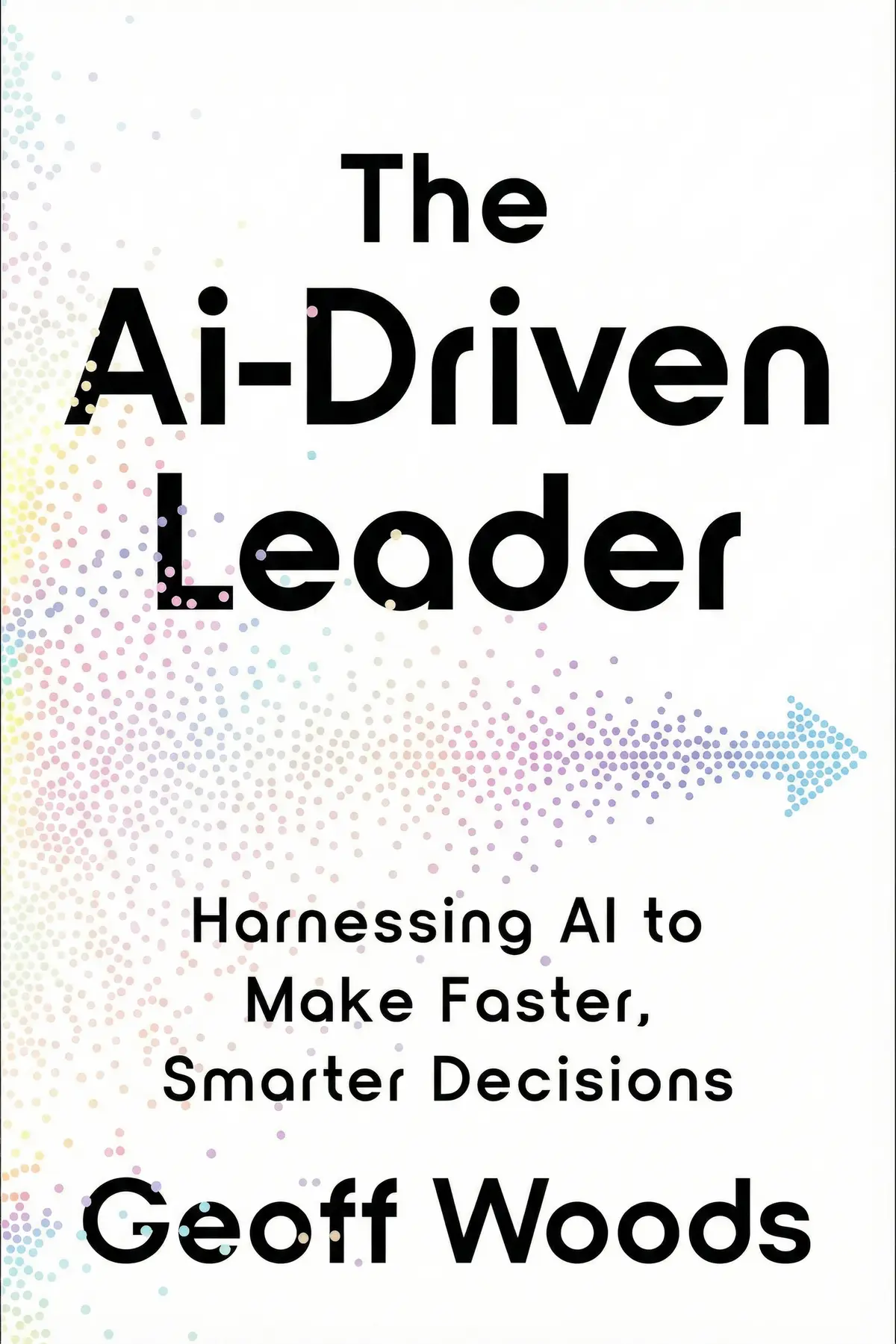
Table of Content
1. Introduction
57 sec
Most executives spend their days buried in operational work, with strategy pushed to the edges of the calendar. In The AI-Driven Leader, Geoff Woods argues that the leaders pulling ahead treat AI as a thought partner that interviews them, sharpens their message and argues against their plans. His case is that AI makes leaders better decision makers when they direct it to question their own thinking, and then spend the hours it frees on the small share of work only people can do.
Woods, a former chief growth officer at Jindal Steel & Power, builds that case step by step. He covers how to brief an AI so its answers are worth reading and the three roles it can play in any decision. He shows how it exposes the assumptions that quietly drain budgets, and how a team can turn reclaimed time into deeper client relationships instead of extra status meetings. The prompts are concrete enough to try on your next big decision.
2. Get sharper answers by writing a real brief
2 min 08 sec
A vague request gets a vague reply, and many leaders give up on AI right there. The fix is the same discipline you would demand from any team preparing an important presentation.
3. Let AI question, clarify and challenge your plans
2 min 09 sec
Leaders rarely run short of ideas. What they lack is someone with the time to pull those ideas apart, put them into plain words and argue against them before money is spent.
4. Catch the costly assumption before it ships
2 min 09 sec
A software company spent millions on a product its users were never going to open. AI could have flagged the mistake, or made it worse, depending on one choice the leaders made.
5. From a pile of data to a decision in minutes
2 min 05 sec
Some companies drown in millions of daily data points while others guess from a few dozen comments. Both end up deciding too late, and one fitness brand shows what changes when the analysis shrinks from weeks to minutes.
6. Spend the saved hours where competitors can't follow
2 min 15 sec
Two managers adopt the same AI tools and save the same hours. Six months later one team is stuck and the other is closing bigger deals, and the difference lies in a decision made before automating anything.
7. Give every person on your team tenfold reach
2 min 08 sec
Many employees hear about AI and privately wonder if their role is next. Woods sets a far bolder goal for each of them: multiplying their impact tenfold. One marketing manager’s reshaped day shows what that looks like in practice.
8. Conclusion
1 min 08 sec
The leaders Woods writes about changed who sits beside them when they think. An AI that interviews you finds the parts of the plan you had not finished. One that argues against you finds the assumption that would have cost a year, like the app built for phones that users opened on desktops. One that sorts data in minutes hands back weeks. The book’s deeper point is what happens next: those weeks are worth something only when they move to the 20 percent of work that relationships and judgment decide, as the sales director’s team showed and the marketing director’s did not.
Starting is modest. Write your next prompt as a real brief, with a persona, context and limits, and end it by asking what the AI needs to know from you. Take the assumption your biggest plan rests on and ask the AI to make your competitor’s case against it. Then, before automating anything, name the conversations the saved hours will buy.
The goal was never a smarter machine. It is a leader who asks the questions no one else in the room thought of, and still has the time to act on the answers.
About this book
What is this book about?
Most executives are buried in operational work, and strategy gets whatever time is left over. Geoff Woods argues that AI can change that, but only for leaders who use it as a thinking partner instead of a faster way to do the same tasks. Woods explains what AI is, a prediction machine trained on patterns in language, and why a well-built prompt matters as much as a good brief for a team. He then gives AI three roles in any decision. As Interviewer it draws out your thinking. As Communicator it turns complex ideas into plain messages. As Challenger it argues against your plans to expose bias and hidden assumptions. He also shows how AI can handle both too much data and too little. The second half is about what leaders do with the time AI frees. Using the 80/20 principle, Woods argues that AI should take the routine 80 percent of work so people can focus on the 20 percent that drives results: relationships, creativity and hard problems. Readers get sample prompts, a test for great questions and a way to make every person on a team more effective.
Book Information
Who it's for
Busy founders and executives
Executives and founders buried in operations who want AI to sharpen their strategic decisions.
Leads ready to automate
Team leads who want AI to take routine work so their people can focus on clients and ideas.
Supervisors drafting with AI
Managers who use AI for drafts but have never asked it to challenge a plan.
About the Author
Geoff Woods
Geoff Woods founded AI Leadership, which helps executives use AI for strategic growth and escape operational overload. As chief growth officer of Jindal Steel & Power, he saw its market value rise from $750 million to over $12 billion in four years. He also co-founded the training and consulting company behind The ONE Thing, working with client companies whose annual revenues ranged from 10 million to 60 billion.
Ratings & Reviews
Ratings at a glance

What people think
Listeners find that this guide provides lucid illustrations of how AI can enhance management and delivers actionable advice through impactful real-life scenarios. Furthermore, the material is captivating and 10x more efficient, helping audiences reach decisions with strategic clarity. They also value the forward-thinking perspective, as one listener points out the inventive uses of AI while another mentions its wide relevance for individuals at any stage of leadership.
Top reviews
Pawinee
Woods really nails the transition from being a reactive manager to becoming a strategic architect through the power of machine intelligence. Instead of focusing on technical jargon, he explains how to treat AI as a sophisticated thinking partner that can actually challenge your underlying assumptions. I found the 80/20 summaries at the end of each chapter incredibly helpful for distilling the most impactful takeaways without the fluff. Using the system as an 'interviewer' to poke holes in my own logic has already saved me from two potentially expensive mistakes this month. It’s about reinvesting the time you save into higher-value activities like relationship building and creative exploration. This isn't just a book about tech; it's a blueprint for the next decade of leadership.
Show moreSuvannee
The way we think about leadership is fundamentally broken, and this book acts as a much-needed reset button for the modern era. Geoff Woods argues that the most forward-thinking leaders aren't just automating emails; they are using AI to elevate their entire cognitive process. By adopting the roles of Communicator and Challenger, I've started to see my daily workflow through a much more efficient lens. Not gonna lie, I was skeptical about another AI book hitting the market, but the focus on human potential over machine replacement is refreshing. It’s an enlightenment that encourages you to show up differently for your team and your clients. This is essential reading if you want to remain relevant in 2025 and beyond.
Show moreSamuel
After hearing Geoff on a podcast, I wanted to see if his 'copilot' theory held water in a longer format, and it absolutely does. He identifies three essential roles—Interviewer, Communicator, and Challenger—that turn a standard chatbot into a strategic partner for any organization. This book isn't about replacing people; it's about unlocking human potential by removing the administrative burden from our daily schedules. The story of Sarah the marketing manager was a perfect illustration of how to pivot toward high-value work like relationship building. In my experience, most leaders are drowning in data, and this provides the filter they desperately need. It’s a game-changer for anyone who wants to lead with intention rather than just reacting to the latest fire. I'm already seeing a shift in how my team approaches problem-solving.
Show moreEye
Look, most AI books focus on the tech, but Woods focuses on the questions, which is far more valuable for a real leader. He pushes you to move from operational firefighting to strategic orchestration, which is a shift I desperately needed to make this year. The real-world case studies provide a roadmap for navigating the age of big data without getting overwhelmed by the sheer volume of information. I've already started using the 'challenger' prompts in my weekly strategy sessions, and the results have been eye-opening. It helps you ask the questions you never thought to ask, revealing risks before they manifest. If you want to stop being a 'mere manager' and start being an influential leader, this is the manual you need. Highly recommended for the strategic clarity it provides.
Show moreMint
Finally got around to reading this, and while I’m not a C-suite executive, the prompting advice felt universal for anyone trying to gain a competitive edge. The author makes a compelling case that the quality of your output depends entirely on the specificity of your 'strategic brief' to the AI. I appreciated the practical guidance on using AI to analyze customer interactions, which is something my sales team can implement immediately. Truth is, the book could have been shorter, as it repeats the core message about AI as a 'co-pilot' quite frequently. However, the graphics are high-quality and the framework for reducing decision-making bias is genuinely innovative. It helped me realize I was using GPT for basic tasks when I should have been using it for strategic clarity.
Show moreMaksim
The CRIT framework alone is worth the price of admission for leaders who struggle with the noise of information overload. It provides a structured way to use AI as a devil’s advocate, helping you spot blind spots before they turn into full-blown crises. I found the examples of HR directors screening resumes and CFOs forecasting cash flow to be very grounded and relatable to my actual work life. To be fair, the constant reminders to visit the author's website were a bit distracting and felt like a persistent sales pitch. Despite that, the methodologies for crafting context-rich prompts are some of the best I have encountered in recent business literature. It effectively moves the conversation from 'what is AI' to 'how do I lead with it'.
Show moreAnawin
Picked this up expecting another dry tech manual, but I was pleasantly surprised by the human-centric approach to high-level decision making. Woods illustrates how AI can handle the 80 percent of routine tasks that bog down progress, freeing up humans for creativity and innovation. The case studies, though a bit standard, offer clear examples of how AI can improve leadership effectiveness across different departments. I particularly liked the physical quality of the hardback; it’s a well-made book with detailed graphics that help explain complex feedback loops. While the tone can be a bit 'rah-rah' at times, the underlying message about bias-busting is crucial for today’s fast-paced market. It’s a solid 4-star read that offers 10x more efficiency if you actually apply the frameworks.
Show moreMeen
As someone who leads a small team, I found some of the high-level C-suite talk a bit alienating at first. The book is clearly aimed at top-tier executives, though the prompting logic is definitely applicable to middle management if you’re willing to adapt it. I liked the focus on how AI can either enhance or challenge our natural biases, which is a conversation we need to have more often. However, the repetition of certain points felt like the book was trying to hit a specific page count. It’s a decent guide for beginners, but those already deep into AI might find the information a bit basic. Good for a high-level overview, but it lacks the deep technical dive some might be looking for.
Show moreMai
Is this just another corporate cash grab or a legitimate manual for the future? Personally, I found it to be a bit of a mixed bag, leaning heavily on tired cliches like the Netflix and Blockbuster saga that we've all heard a hundred times. While the concept of 'strategic prompting' has some merit, the book often feels like a long-form advertisement for the author’s high-priced coaching community. The writing style is laden with typical business lingo that says much while delivering very little substance in the first hundred pages. I was disappointed by some technical inaccuracies, specifically regarding how LLMs and AGI are categorized. There are some okay prompts tucked away in there, but you’ll have to dig through a lot of regurgitated motivational speak to find them.
Show moreHassan
Frankly, this felt like an AI-generated cash grab that could have been summarized in a single, short email. When a book feels the need to define basic vernacular just to fill pages, I quickly lose interest in the 'groundbreaking' claims being made. It relies on the trite 'definition of insanity' quote and other recycled business tropes that feel incredibly dated for a book about cutting-edge technology. The claim that your leadership is the difference that makes the difference isn't a revelation; it's a platitude. I didn't find anything worth highlighting in the first half, and the repetitive nature of the content made it a chore to finish. Save your money and just use a search engine for prompting tips.
Show moreQuestions about this book
What is the main idea of The AI-Driven Leader?
Geoff Woods argues that leaders get the most from AI when they treat it as a thought partner, not only a productivity tool. Briefed well, AI can interview you to clarify your thinking, turn complex ideas into simple messages and argue against your plans to expose bias. The time it saves should then go to the 20 percent of work, such as client relationships and creative problem-solving, that produces most results.
What are the three roles of AI in The AI-Driven Leader?
Woods names the Interviewer, the Communicator and the Challenger. The Interviewer asks you probing questions until it understands your full plan, which reveals gaps. The Communicator translates technical or complex ideas into benefits your audience understands. The Challenger argues against a decision from different stakeholders’ views, surfacing risks and biases. He adds further uses such as decision trees, scenario planning and critiques from the view of investors, customers or competitors.
How do you write a good AI prompt according to Geoff Woods?
Woods compares a prompt to the brief you would give a team before a big presentation. A strong one describes the task clearly, gives relevant context, assigns a persona, sets requirements and limits, explains your reasoning and invites the AI to ask you questions. His sample casts the AI as a retail transformation consultant asked to find three ways to improve customer retention, then asks what information would refine the analysis.
How can AI help avoid bias in business decisions?
Woods warns that AI can either challenge your biases or reinforce them, depending on how you direct it. He suggests asking it to attack your key assumptions, name value propositions you might be missing and argue your biggest competitor’s case. In his manufacturing example, this kind of questioning reveals that customers value reliability over cost, leading to a premium strategy with higher margins.
Will AI replace employees, according to The AI-Driven Leader?
Woods argues the opposite goal: AI should make each employee ten times more effective. It takes over data analysis, first drafts, scheduling and routine messages, so people can focus on strategy, relationships and creativity. He suggests everyone ask why they do their routine tasks and whether AI could do them instead. His example manager, Sarah, uses the freed hours for product strategy and deep client conversations.
Readers also enjoyed


A Year with Peter Drucker: 52 Weeks of Coaching for Leadership Effectiveness
Joseph A. Maciariello




Acting with Power: Why We Are More Powerful Than We Believe
Deborah Gruenfeld

21 Lessons for the 21st Century
Yuval Noah Harari

All In: How Great Leaders Build Unstoppable Teams
Mike Michalowicz

AUDIO SUMMARY AVAILABLE
Listen to The AI-Driven Leader in 15 minutes
Get the key ideas from The AI-Driven Leader by Geoff Woods, plus 5,000+ more nonfiction titles.
- 5,000+ titles
- Listen as much as you want
- 7-day free trial
- Cancel anytime









