

14 min 04 sec
Available in: English
The Achievement Habit: Stop Wishing, Start Doing, and Take Command of Your Life
By Bernard Roth
Explains how you can narrow the distance separating your desires from your daily actions. You drop fixed labels and excuses, reframe stuck problems, decide faster and start seeing yourself as someone who acts.
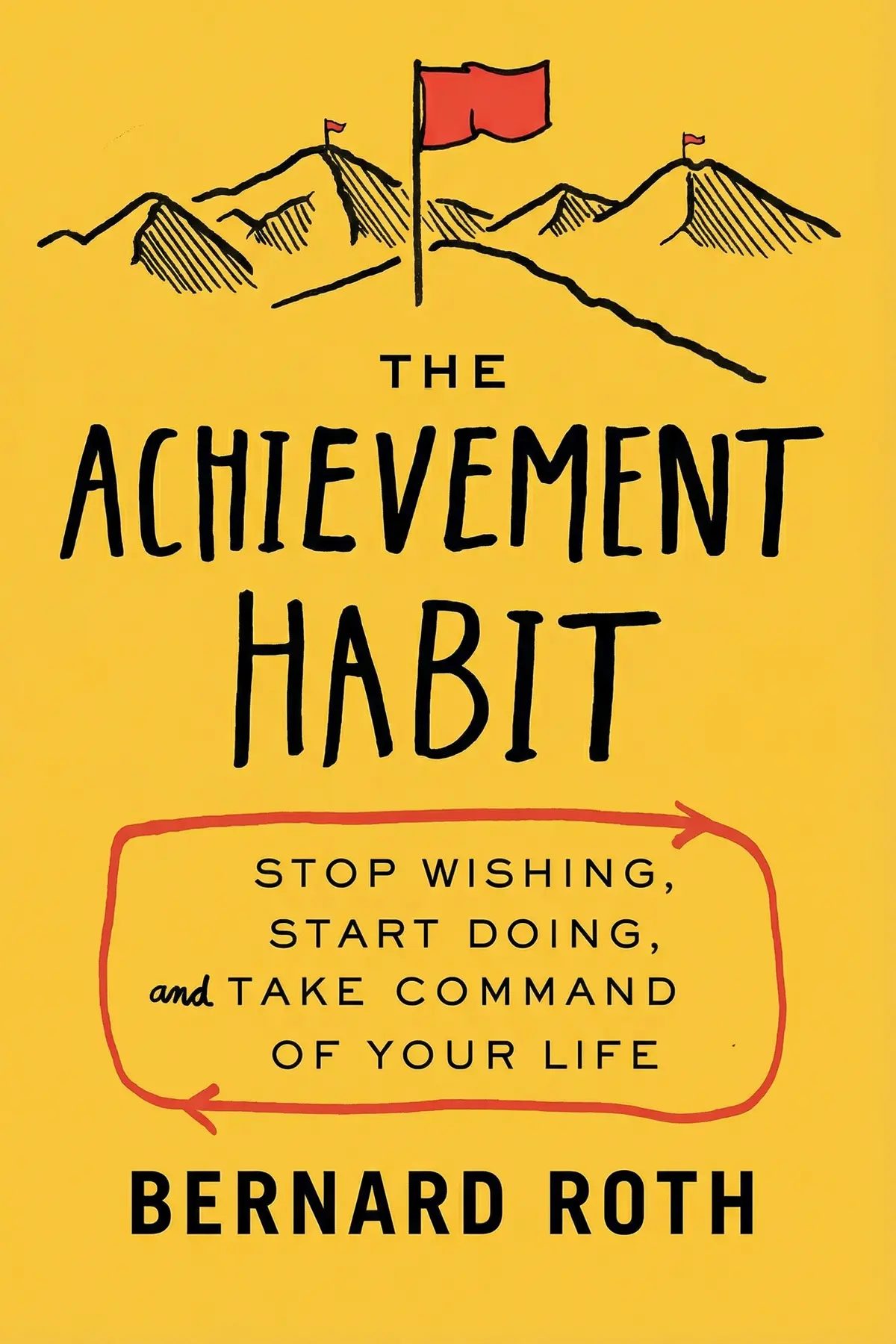
Table of Content
1. Introduction
1 min 06 sec
Many people who dream of running their own company end up working for someone else, yet the distance between wanting and doing is something you can learn to close. In The Achievement Habit, Stanford engineering professor Bernard Roth argues that this distance can be crossed by anyone. Achievers are not born with a special gene. They have trained themselves to do instead of try.
Roth, academic director of Stanford’s d.school, makes a blunt claim. The only real obstacle is you. Almost everything else that feels like one turns out to be a label, an excuse or a badly framed problem.
That claim runs through every idea that follows. Change how you name your failures, how you explain your delays, how you define your problems and how you see yourself, and action gets far easier. Along the way there is a fifteen-second test for stalled decisions, a two-word swap that dissolves false conflicts, and a feedback method that lets people hear criticism without flinching.
2. Stop trying and start doing
1 min 53 sec
Reach for something in another person’s hand and you will probably come away empty. A simple physical game shows the difference between people who wish and people who act, and it begins with how you move.
3. Drop the labels that keep you stuck
1 min 57 sec
Two families faced the same frightening diagnosis in someone they loved. One dreaded every visit and the other looked forward to them. The difference had nothing to do with the illness itself.
4. Make hard decisions in fifteen seconds
1 min 52 sec
Long meetings full of pros and cons often end exactly where they started. Roth offers a blunt test that cuts the debate short, and it works because of something most people never admit about their own choices.
5. Solve the problem you actually have
2 min 01 sec
A man spent repair after repair on a broken bed and still could not sleep. One honest question ended the struggle at once, and the same question works on goals far bigger than a good night’s rest.
6. Friends and feedback that move you forward
2 min 06 sec
Networking events promise connections that open doors, yet Roth thinks they often lead nowhere worth going. His alternative changes who you learn from, how you share ideas and even where people sit in a meeting.
7. Become the person who gets things done
1 min 56 sec
Most of us still carry a picture of ourselves drawn by parents and teachers long ago. Roth argues that achievement comes down to how we picture ourselves, and he offers a simple exercise for taking a fresh look at that picture.
8. Conclusion
1 min 13 sec
Underneath every technique in The Achievement Habit sits one belief: there are no losers and no lucky people. There are only fixed labels and habits of thought, and both can be changed. The fifteen-second decision, the swap from but to and, and the bed that needed replacing more than repairing all point the same way. The world is less fixed than it looks, and so are you.
Roth adds one more habit worth dropping: arguing over who is right and who is wrong. He thinks the game only makes people angry and produces nothing useful, because right and wrong depend on where you stand. Letting go of false certainty, and accepting that people can see things differently, frees energy for doing.
So start small this week. When you catch yourself explaining why something did not happen, ask whether the reason is really an excuse. Rewrite your most stubborn problem as a sentence about what you actually want. Ask five friends for five words that describe you, and compare them with your own.
And the next time you reach for something you want, do not try to take it. Take it.
About this book
What is this book about?
Plenty of people dream of starting a company or changing their life, and most of them never do. Bernard Roth, a Stanford engineering professor and academic director of the university's d.school, argues that achievers are not a different species. Achievement is a habit, and anyone can learn it once they see that the main thing in their way is themselves. Roth borrows from Design Thinking, especially its openness to failure, and turns it on everyday life. He shows how the meanings and labels we attach to events keep us stuck. He shows how the reasons we give for our behavior are often excuses that let us avoid deciding. And he shows how reframing a problem, sometimes by changing a single word, can make an obstacle disappear. Readers get practical tools: the fifteen-second Gun Test for decisions, the swap from but to and, a two-likes-and-a-wish feedback format, and simple exercises for testing your self-image and finding out what you really want. The promise is modest and concrete. You stop wishing and start doing.
Book Information
Who it's for
Professionals stuck planning
Professionals who keep planning a change, such as a new business or career, but never start.
Youth stuck on setbacks
Young people stuck on setbacks and labels like failure or loser.
Team leads
Team leads who want faster decisions, more open meetings and feedback people can actually hear.
About the Author
Bernard Roth
Bernard Roth, known as Bernie, is the Rodney H. Adams Professor of Engineering at Stanford University, where he joined the Design Division faculty in 1962. He is academic director of Stanford's Hasso Plattner Institute of Design, the d.school, and a pioneer of robotics whose field is kinematics, the study of motion. He created courses in which students work on personal issues that matter to them. He is also the main developer of the Creativity Workshop, which has taught students, faculty and professionals worldwide for more than thirty years.
Ratings & Reviews
Ratings at a glance

What people think
Listeners describe the book as superbly crafted and accessible, valuing the hands-on advice and concrete tips provided. It offers an engaging experience packed with applicable anecdotes that help people regain their bravery to take initiative while offering effective methods for tackling challenges. Many view it as essential, with one listener even remarking that it should be mandatory for university seniors.
Top reviews
Noi
Picked this up after a recommendation from a colleague and I was pleasantly surprised by the 'design thinking' approach to life. Roth doesn't just give you vague motivation; he provides a toolkit for dismantling the mental structures that keep us stuck. I especially loved the concept of 'prototyping' your life instead of waiting for perfection. Look, we all know the Yoda quote about 'do or do not,' but seeing it applied through the lens of mechanical engineering is fascinating. It’s an easy read that manages to be both entertaining and deeply practical. My only minor gripe is that it occasionally feels a bit too focused on the Stanford bubble. However, the actionable insights on problem-solving are genuinely top-tier.
Show moreEvelyn
Finally got around to reading this and I can see why it's required reading for some college seniors. The blend of engineering logic and life coaching is unique and provides a fresh perspective on achievement. Roth’s insistence that our excuses are mostly 'bullshit' is a tough pill to swallow, but it’s undeniably effective. I’ve started using the linguistic shifts he suggests, and I’ve noticed a real difference in how I approach difficult tasks. The book is excellently written and avoids the dry, academic tone you might expect from a professor. It’s full of relevant stories that help illustrate his points without feeling too bogged down in theory. It really helps you reclaim your courage.
Show morePong
This book is a masterclass in shifting your perspective from passive observer to active participant in your own life. Roth’s wisdom feels earned over decades of teaching, and his voice comes through clearly on every page. I loved the idea that we are the ones giving everything in our lives meaning, which means we have the power to change it. It’s an empowering read that encourages you to stop waiting for permission and start prototyping your goals. While the author’s confidence can occasionally border on hubris, the quality of the insights makes it easy to overlook. I’ve already recommended it to several friends who are struggling with procrastination. Truly an excellent guide for personal growth and practical problem solving.
Show moreArthit
Bernard Roth’s background in engineering really shines through in the way he deconstructs our habitual excuses. I found the 'but vs. and' linguistic trick surprisingly effective for reframing my daily roadblocks. To be fair, some chapters felt a bit repetitive, yet the core message of a 'bias toward action' is exactly what I needed to hear right now. It reads like a distilled version of a high-end Stanford seminar, making complex psychological shifts feel manageable. While some might find his tone a bit blunt, I appreciated the lack of sugar-coating. If you're tired of overthinking and want a practical framework for doing, this is worth your time. It’s a very fluid, easy-to-absorb read.
Show moreSelin
After hearing so much about the Stanford d.school, I had high hopes for this one. Roth delivers a high-energy guide that feels like a personal coaching session. The 'Achievement Habit' isn't about some secret formula; it’s about shifting your mindset from a dreamer to a doer through small, iterative changes. I particularly liked the 'Your Turn' exercises because they force you to actually interact with the material rather than just nodding along. Some of the stories felt a little dated, and the author definitely likes to remind you of his credentials. However, the practical guidance on ignoring distractions is worth the price of admission. It's a must-read for anyone feeling stagnant in their career or creative projects.
Show moreHassan
The chapter on reframing problems changed the way I look at my business obstacles entirely. Bernard Roth writes in a very accessible way, making high-level concepts from the d.school feel like common sense. I appreciated how he emphasized that achievement is a muscle you have to train through practice. Not gonna lie, I was skeptical about the 'no reasons' philosophy at first, but it really helps cut through the noise. The book is full of actionable advice that you can implement immediately, which is rare for this genre. It’s entertaining and keeps you engaged with plenty of real-world anecdotes. This is a solid resource for anyone looking to transition from dreaming to actually doing the work.
Show moreCharles
Ever wonder why some people just seem to get things done while you’re stuck in the planning phase? This book attempts to answer that by stripping away the 'reasons' we give for our failures. Personally, I found the chapter on 'No Meaning' to be the most challenging part of the entire experience. Roth suggests we project meaning onto everything, and by removing it, we can finally see things for what they are. It's a bold take, though it might clash with your personal values or faith. The writing style is conversational and fluid, making it a quick weekend read. It’s a solid book—useful, but not necessarily life-altering for everyone. Sometimes it takes a new perspective for a concept to finally click.
Show moreViroj
As someone who reads a lot of self-development books, most of these concepts weren't exactly revolutionary to me. However, Roth’s specific framing through design thinking adds a layer of practicality that other books often miss. Truth is, the 'achievement habit' is really just about consistency and removing self-imposed barriers. I found the section on 'getting unstuck' to be particularly valuable for my creative projects. My main criticism is that the author’s 'just do it' attitude can feel a bit dismissive of legitimate external challenges. It’s a good book for a quick boost of motivation, even if it doesn't offer a silver bullet. Definitely a worthwhile addition to your shelf, just don't expect a revelation on every page.
Show moreRosa
Not what I expected from a Stanford professor, frankly. The book feels like a collection of anecdotal fluff that leans heavily on the 'just do it' mantra without addressing the root causes of procrastination. I felt that Roth's dismissal of personal meaning was a bit too postmodern and nihilistic for my taste. He spends a lot of time talking about his own successes, which occasionally crosses the line into hubris. There are a few decent exercises tucked away at the end of chapters, but you have to slog through a lot of self-congratulatory storytelling to find them. It’s light, fast-reading material, but it ultimately lacks the deep substance of a true psychological study. It's essentially self-development cotton candy.
Show moreSirichai
Wow, this was a massive disappointment for a book with such high ratings. To be honest, it felt like the author was more interested in sharing his resume than providing actual help. Roth’s advice to 'admire your depression' or pretend a boring meeting is amazing felt incredibly tone-deaf and superficial. It’s the kind of 'mind over matter' rhetoric that ignores the complexities of real-world obstacles and mental health. I pushed through it to see if it got better, but it stayed in the realm of empty cheerleading. If you enjoy hearing a professor talk about how wonderful his classes are, you might like it. Otherwise, save your money. There is simply not enough content to handle the hubris.
Show moreQuestions about this book
What is the main idea of The Achievement Habit?
Bernard Roth argues that achievement is a learnable habit, not a gift. The main obstacle between what people want and what they do is themselves: the fixed meanings and labels they attach to events, the reasons they use as excuses, and problems framed the wrong way. Change those, lean toward action and accept failure, and doing replaces trying.
What is the Gun Test in The Achievement Habit?
The Gun Test is Roth’s method for stalled decisions. Lay out the pros and cons of each option, then point a finger at the person who must decide and give them fifteen seconds. Roth says it works because people have usually decided already and are only reluctant to commit, and more reasoning rarely leads to a better choice.
How does Bernard Roth suggest reframing problems?
First, check you are solving the real problem, as when someone seeking a spouse may really want companionship. Then ask what you actually want, as Roth’s friend did when he stopped fixing a broken bed and bought a new one to sleep well. Language helps too: replace but with and, and say want to instead of have to.
What is the I like, I like, I wish feedback method?
It is a group feedback structure Roth recommends. Each person names two things they genuinely appreciated about someone’s performance, then adds one constructive suggestion, without using the word but. It keeps feedback positive and useful, and it fits his wider advice to make workplaces more open, with circle seating, flatter hierarchies and room for play.
Who should read The Achievement Habit?
It suits people who know what they want but keep not doing it, such as would-be founders, career changers and anyone stuck after a setback. Managers also get practical tools, including the fifteen-second Gun Test and a feedback format. Its exercises are simple, like asking five friends for five words that describe you.
Readers also enjoyed




A Guide to the Good Life: The Ancient Art of Stoic Joy
William B. Irvine


A High-Performing Mind: Strengthen Your Mind and Live Your Best Life
Andrew D. Thompson


Abundance: The Inner Path to Wealth
Deepak Chopra

AUDIO SUMMARY AVAILABLE
Listen to The Achievement Habit in 15 minutes
Get the key ideas from The Achievement Habit by Bernard Roth, plus 5,000+ more nonfiction titles.
- 5,000+ titles
- Listen as much as you want
- 7-day free trial
- Cancel anytime









