


14 min 32 sec
Available in: English
The 4 Day Week: How the flexible work revolution can increase productivity, profitability, and wellbeing, and help create a sustainable future
Shows how paying full salaries for four days of focused work can cut stress, keep output steady and give workers the security and genuine choice that gig jobs promise but rarely deliver.
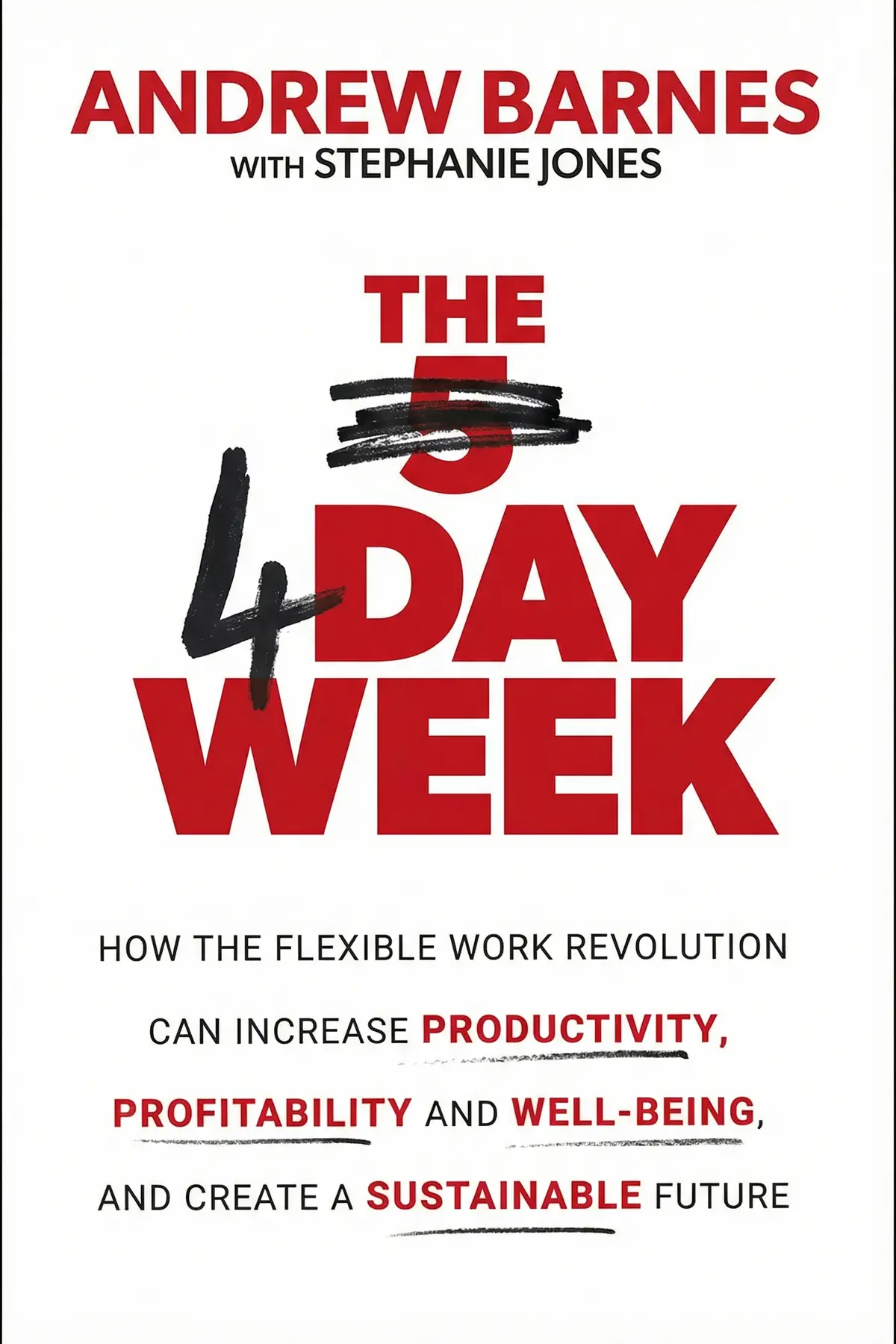
Table of Content
1. Introduction
1 min 06 sec
If your job follows you home on your phone, the real problem may be how little of your working time produces anything. In The 4 Day Week, New Zealand business owner Andrew Barnes, who wrote it with Stephanie Jones, begins with research on office staff in Canada and the United Kingdom, drawn from a pair of separate studies. They found people did productive work for only about 1.5 to 2.5 hours of an eight-hour day.
If that holds, Barnes reasoned, a company could pay full salaries for four focused days and lose nothing. The authors argue that this one trade answers the stress of insecure, always-on work, and that it can serve companies, society and the planet at the same time.
Their case moves from a Christmas parcel passing through gig workers’ hands to a trial that collapsed over Fridays and a scheme that sends staff out to volunteer. At its center sits a ratio worth memorizing, 100-80-100, together with the rules that make it hold and the errors that break it.
2. See what insecure work really costs everyone
1 min 30 sec
Gig contracts are sold as freedom for workers and savings for companies. Barnes and Jones follow the bill to see who ends up paying it, and the answer includes the very firms that thought they were saving.
3. Recognize who pays for your next fast delivery
1 min 35 sec
A gift ordered from abroad arrives in days with one click. Trace its route, and a chain of people appears, each carrying a risk the buyer never sees, and the old ways of fighting back no longer reach them.
4. Get five days of output in four
1 min 41 sec
A magazine article read at thirty thousand feet made a business owner do some unsettling arithmetic about his own staff. The gap he found was large, and closing it took far less than he expected.
5. Roll out a shorter week your staff will back
1 min 33 sec
One company handed every employee a long weekend, and the trial still collapsed. The authors explain what went wrong, and why the way a four-day week is introduced matters as much as the idea itself.
6. Let people choose when and where they work
1 min 38 sec
Gig jobs advertise flexibility, yet their workers are never really off duty. The authors describe a different kind of freedom, and the numbers from two large firms suggest employers gain from it as much as staff.
7. Keep the extra day by protecting productivity
1 min 21 sec
Barnes insists he is no charity boss, and his reasons shape the whole model. The extra day comes with a condition, and the way it is enforced turns out to be gentler than the gig economy’s rules.
8. Shorter weeks can ease the inequality crisis and secure workers
1 min 33 sec
A venture capitalist looked at today’s wealth gap and reached for the years before the French Revolution. Barnes takes the warning seriously, yet his response is to defend capitalism with a change to the working week.
9. A shorter week that cuts traffic and emissions
1 min 28 sec
Taking a day away from the office sounds like a private benefit. The authors run the numbers on commuting and on donated time, and the effect on a whole country turns out to be surprisingly large.
10. Conclusion
1 min 07 sec
The 4 Day Week is a business case resting on one uncomfortable number. If most office days hold only two or so hours of real work, the five-day week is largely habit, and the stress and insecurity wrapped around it are a cost nobody needs to bear. Barnes keeps the profit motive and changes the deal: full pay, four days, the same output, with the fifth day serving as both reward and safeguard.
The book also asks readers to look again at the parcel on the doorstep and the flexible gig job, as arrangements someone else pays for, and to judge any work offer by whether it brings time and security together.
For a team, a careful start is to measure what each person truly produces, ask them what would make them faster and let them choose their own day off. Agree in writing what happens if output falls, so the extra day becomes something everyone guards.
The authors’ simplest claim may be their strongest. Time is the currency people value most, and a company that pays in it gets paid back.
About this book
What is this book about?
Many people now work in jobs that never switch off and never feel safe: classed as freelancers, always on call, without holiday pay or a pension, and worn down by long commutes. Andrew Barnes and Stephanie Jones argue that this model harms workers and drains the companies that rely on it. Their alternative began when Barnes read about two studies showing that office staff were truly productive for only 1.5 to 2.5 hours a day. He tested a simple deal at his New Zealand trustee firm, Perpetual Guardian: full pay for 80 percent of the time, provided staff deliver all of the agreed output. The book explains the reasoning behind that 100-80-100 ratio, how to introduce it without the mistakes that sink trials, why staff should choose their own day off and why productivity must stay at the center. Readers also get the larger case the authors make: that a shorter week could ease a widening wealth gap, cut traffic and emissions, and turn spare days into volunteering, while keeping businesses profitable.
Book Information
Who it's for
Leaders doubting long hours
Managers and founders who suspect long hours hide low output and want a tested way to trial a four-day week.
Worn-down office workers
Office workers worn down by always-on jobs who want a clear case to bring to their employer.
Weighing gig work
Readers weighing gig work against secure employment who want to understand the trade-offs.
About the Author
Andrew Barnes
Andrew Barnes is a business leader born in Carlisle in the United Kingdom who built his career across the UK, Australia and New Zealand, where he shook up the fiduciary and legal services industries and conceived the four-day week. He served in the Royal Navy, holds a master's in archaeology from Cambridge and attended Harvard Business School's Program for Management Development. He speaks internationally on the future of work. Stephanie Jones is a writer and editor with a background in journalism, magazine publishing and public relations, who has worked with Barnes since 2015.
Ratings & Reviews
Ratings at a glance

What people think
Listeners find this book to be an intriguing examination of how work will change, though reactions are divided on whether it focuses too much on social commentary and gig economy politics over actionable steps. People appreciate the inclusion of the "100-80-100" rule, which suggests keeping total pay and output consistent while decreasing hours on the job. Furthermore, they emphasize the research-backed perspective, with one listener highlighting the fascinating data from the real-world trial at Perpetual Guardian. They also note that the framework provides a viable method for enhancing staff wellness and potentially lowering environmental emissions.
Top reviews
Tantipat
Finally, a business book that recognizes we are humans rather than just replaceable gears in a corporate machine. The authors eloquently argue that our current way of working is fundamentally unsustainable for our mental health and the planet. By reducing the work week, we aren't just helping employees; we are cutting down on commuting emissions and massive office energy consumption. I found the section on the Fourth Industrial Revolution particularly insightful because it explains why our old 40-hour models are obsolete. The 100-80-100 rule is the logical conclusion of an automated world where quality should matter more than quantity. It is a bold, visionary, and deeply humane look at how we can reclaim our lives. Every HR professional needs a copy of this on their desk immediately.
Show moreTim
Bold, data-driven, and absolutely necessary for the modern era. Barnes doesn't just theorize; he provides a blueprint based on a real-world financial company trial that actually worked. I loved the contrast between his philosophy and the 'work until you drop' mentality we see in Silicon Valley. This book proves that when you treat employees with respect and give them back their time, they reward the company with higher focus and loyalty. The 100-80-100 rule is the most sensible thing I’ve read in a business book in years. It’s not about doing less work; it’s about doing the same work smarter. If you care about change leadership and innovation, you have to read this. It is a masterclass in rethinking the social contract between employer and employee.
Show moreNew
Andrew Barnes presents a compelling case for the future of employment through his famous experiment at Perpetual Guardian. The 100-80-100 rule—100% pay for 80% time, provided 100% productivity is maintained—is a game-changer for anyone interested in organizational efficiency. I appreciated the data-driven approach used to silence critics who believe that longer hours always equal better results. It is refreshing to see a CEO challenge the toxic grind culture perpetuated by figures like Elon Musk. However, I do agree with some other readers that the book occasionally veers too far into labor politics. While the context is important, the focus on the gig economy felt slightly repetitive toward the end. Still, it is a vital read for leaders who want to improve employee well-being without sacrificing the bottom line.
Show moreEmily
As a project manager accustomed to Agile methodologies, I found the discussion on productivity versus time spent very relevant. The book successfully debunks the myth that sitting in a chair for forty hours leads to maximum output. By focusing on the Perpetual Guardian experiment, Barnes shows that focused, intense work periods are far more valuable than the traditional slog. I liked the emphasis on empowering staff to find their own efficiencies rather than having management dictate every move. Some of the criticisms regarding Agile in the book felt a bit misplaced, perhaps based on poor implementations of the framework. Nevertheless, the overarching message about the 100-80-100 rule is powerful. It challenges us to rethink what a 'full' work week actually looks like in a digital age.
Show moreJoy
After spending the last year teaching and facilitating remotely, I’ve realized just how much 'filler' exists in our standard work days. This book perfectly articulates that feeling. The authors make a strong case that our current employment models are outdated and damaging to our collective well-being. I was particularly struck by the idea that a 4-day week offers the flexibility people crave from the gig economy but with the safety of a full-time salary. It's about security and flexibility combined. While some of the sections on global labor regulations felt a bit heavy, the core message about productivity is spot on. We need to stop measuring success by how many hours we can sit in a cubicle. This is a great starting point for that conversation.
Show moreBond
The concept of a four-day work week is undeniably attractive, yet I’m not entirely convinced by the feasibility described here. Barnes writes with a very specific European or ANZ-centric worldview that might not translate well to high-pressure 'face time' cultures in Asia or Latin America. He makes some great points about how technology has essentially chained us to our desks, but the solutions feel a bit idealistic for smaller businesses. To be fair, the Perpetual Guardian case study is fascinating and provides some much-needed empirical evidence. My main gripe is that the writing can be a bit polarizing, often painting every aspect of the gig economy as an absolute evil. It’s a thought-provoking piece for your shelf, but don't expect it to solve all your management hurdles overnight.
Show moreVimolwan
Ever wonder if we can truly dismantle the 9-to-5 grind without the whole system collapsing? This book attempts to answer that, though the results are mixed. The evidence from the New Zealand trials is definitely the highlight, offering a glimmer of hope for a more balanced future. I found the segments on environmental benefits and reduced worker burnout to be the most persuasive parts of the narrative. On the flip side, the writing style can be a bit dry and overly academic in parts. It spends a lot of time on the history of labor movements, which might bore someone looking for quick business tips. It’s a decent introductory text for the movement, but it lacks the 'punch' of a truly transformative management book.
Show moreDavid
Not what I expected based on the title, but still worth a look for the curious. I thought this would be a productivity guide, but it’s really more of a macro-economic look at labor. The author is very critical of the gig economy, which he views as a precarious and stressful trap for most workers. While I agree with some of his points, the book lacks a bit of balance regarding the benefits of freelancing. The four-day week is presented as the ultimate antidote to these modern ills. It’s an interesting premise, even if the implementation details are a bit thin on the ground. I’m still skeptical if this would work in a fast-paced retail or service environment. It feels like a solution designed specifically for white-collar office work.
Show moreSebastian
Picked this up hoping for a manual on restructuring my team’s workflow, but I was met with a dense political manifesto instead. While the core idea of a four-day week is brilliant, Barnes spends roughly eighty percent of the pages complaining about the gig economy and praising European social safety nets. It felt less like a business strategy book and more like a long-form op-ed on why modern capitalism is failing. I wanted more about the 100-80-100 rule and significantly less social commentary on global pension schemes. Frankly, the one chapter dedicated to actual implementation was useful, but it wasn't enough to justify the slog through the rest of the rants. If you are looking for a practical 'how-to' guide, you might find yourself as frustrated as I was by the lack of actionable steps.
Show moreNoah
To be fair, the author clearly has a passion for labor reform, but the book’s title is somewhat misleading. I expected a deep dive into the mechanics of a shorter work week, yet I received a lecture on why the gig economy is a disaster. It is a very 'European' book in its political leanings, often ignoring the nuances of why certain labor markets function the way they do. The tone felt a bit aggressive and one-sided, leaving little room for a balanced discussion on flexible work. There is a great idea buried in here, but the social rants make it difficult to find the practical gems. I wanted a roadmap, not a critique of global social security programs. It’s a missed opportunity to truly convert the skeptics of the four-day movement.
Show moreQuestions about this book
What is the main idea of The 4 Day Week?
Andrew Barnes and Stephanie Jones argue that most office workers are productive for only 1.5 to 2.5 hours a day, so companies can pay full salaries for four days of focused work without losing output. Their 100-80-100 ratio means full pay for 80 percent of the time, provided staff deliver all of the agreed productivity. They present this as an answer to the stress and insecurity of always-on, gig-style work.
What is the 100-80-100 rule?
It is the deal at the center of the book. Staff receive 100 percent of their pay and work 80 percent of their usual time, on the condition that they deliver 100 percent of the agreed output. Barnes worked it out after realizing that, if people produce for about two and a half hours daily, winning back roughly 40 extra productive minutes a day would fit five days of output into four.
How do you introduce a four-day week successfully?
The authors stress constant communication. Explain that the goal is productivity, retention and well-being, not a free long weekend. Ask employees openly what would help them work better, adjust for individual needs such as religious observance or study, and avoid imposing decisions from the top. They describe a company that made Friday the day off for everyone without consulting staff, and the trial failed.
What happens if productivity drops under a four-day week?
The five-day week returns until output recovers, and then the team goes back to four days. Barnes describes this as a carrot-and-stick approach. Unlike gig work, where poor results often mean dismissal, a dip here costs only an extra day at the office. Because the whole team shares the outcome, everyone has a reason to make the arrangement work.
How can a four-day week help the environment?
The authors estimate that if staggered days off cut daily office headcount by 20 percent, cars on city roads could fall by up to 40 percent. With transportation producing up to 29 percent of US greenhouse emissions, they calculate a national cut equal to removing 10 million cars. Perpetual Guardian also requires staff to volunteer one free day each quarter, about 1,000 days a year in total.
Featured in
Readers also enjoyed


A Year with Peter Drucker: 52 Weeks of Coaching for Leadership Effectiveness
Joseph A. Maciariello





Acting with Power: Why We Are More Powerful Than We Believe
Deborah Gruenfeld

All In: How Great Leaders Build Unstoppable Teams
Mike Michalowicz

AUDIO SUMMARY AVAILABLE
Listen to The 4 Day Week in 15 minutes
Get the key ideas from The 4 Day Week by Andrew Barnes, plus 5,000+ more nonfiction titles.
- 5,000+ titles
- Listen as much as you want
- 7-day free trial
- Cancel anytime









