

13 min 50 sec
Available in: English
The 1% Windfall: How Successful Companies Use Price to Profit and Grow
Shows how to set prices from customer value instead of cost, fit prices and product versions to different buyers, save stalled sales with better payment plans, and protect profit through recessions and inflation.
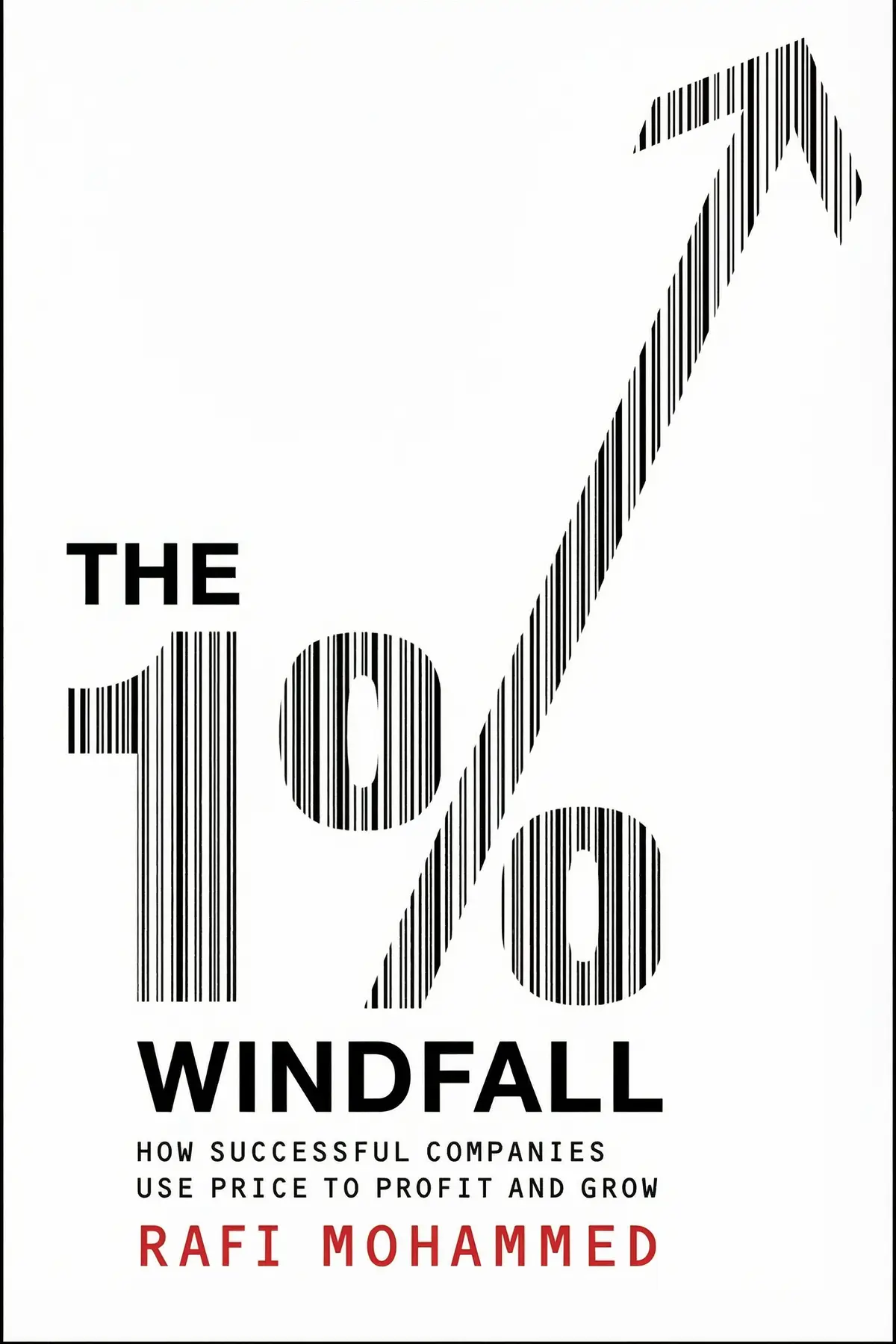
Table of Content
1. Introduction
1 min 01 sec
If you set prices by adding up your costs and doubling them, you are probably leaving profit on the table. In The 1% Windfall, pricing consultant Rafi Mohammed cites a study in which a price rise of just 1 percent produced an 11 percent jump in operating profit. Price may be the smallest lever with the largest effect, and most companies barely touch it.
Mohammed’s argument is that price deserves the same care as the product itself. Start from what the customer could buy instead, shape the price to fit different buyers and situations, and plan ahead for bad years. Then profit grows without a new factory or a bigger sales team. His cases run from a rented house with a pool to Disney World tickets, a steakhouse chain’s beef contracts and a guitar maker that rode out the 2008 recession. What you get is a working method for setting a price, several ways to rescue a stalled sale, and a plan for the day demand drops.
2. Set your price from the buyer's next option
1 min 58 sec
Two rental houses are identical except for a pool, and the neighbor’s asking price could be fair, greedy or far too low. Each case calls for a different answer, and one of them is easy to get wrong.
3. Map demand to find your most profitable price
1 min 57 sec
A high price earns more on each sale, a low one wins more buyers. Somewhere between them sits the price that earns the most, and it is rarely where instinct would put it.
4. Rescue the sale when the answer is no
1 min 59 sec
A star pitcher, a steakhouse chain and an electronics retailer each faced a buyer close to yes but held back by money. None of them solved it by lowering the price.
5. Charge different buyers different prices for one product
1 min 57 sec
The same hotel suite can cost $136 or $257 a night, and Disney sells a fifth park day for $3. Both choices look strange until you see who each price is really for.
6. Offer basic, premium and exclusive versions
1 min 59 sec
Ralph Lauren sold a shirt for $365 using designs it already had. The Lakers sell seats for $10. Both moves come from one idea about what different customers actually want.
7. Protect your profit through recessions and inflation
1 min 47 sec
During the 2008 recession, a maker of $3,000 guitars lost a fifth of its sales. Its answer kept prices high, grew its customer base, and set up future upgrades.
8. Conclusion
1 min 12 sec
Mohammed’s book turns price from a number you set once into a set of choices you keep making. The cost-plus habit treats every customer the same and every year the same. His approach starts from the buyer’s real alternative, accepts that buyers differ in what they value and what they fear, and expects the economy to change. Every case in the book, from Schilling’s contract to Disney’s $3 fifth day, is a company refusing to lose money through a careless price.
That 1 percent study is why this matters. If a tiny price move can lift operating profit by 11 percent, pricing deserves a regular place on the calendar.
The starting points are modest. For your main product, write down the customer’s next-best option and what your difference is worth. Ask a sample of customers what they would pay at several prices, and find where profit peaks instead of where volume peaks. And before the next downturn, decide which basic version you would launch, so your best products never need a discount.
Martin’s budget guitar holds the whole idea in one object: a cheaper product, sold for a while, that kept the expensive ones at full price.
About this book
What is this book about?
Many businesses set prices the easy way. They add up what a product costs to make and double it. Rafi Mohammed argues that this habit leaves real money behind, and he points to a study in which a 1 percent price increase lifted operating profit by 11 percent. His alternative is value pricing. You start from what the customer would buy instead and adjust for what makes your product different, then use market research to find the price where profit peaks. From there, Mohammed shows how to shape price around real buyers. Success fees, price guarantees and financing can turn a hesitant no into a sale. Different prices for different customers and different versions of the same product reach both premium and budget buyers. Fighter brands and smaller packages protect margins when recession or inflation hits. The cases are concrete and varied: Disney World's five-day pass, Morton's beef contracts, the Boston Red Sox and Curt Schilling, American Express cards, Ralph Lauren's Purple Label and a guitar maker that grew its customer base during the 2008 recession. Readers get a method they can apply to their own prices this week.
Book Information
Who it's for
Pricing by doubling costs
Founders and small business owners who set prices by doubling their costs.
Wanting a pricing method
Product, sales and marketing managers who want a clear method for pricing tiers, discounts and payment plans.
Operators worried about margins
Operators worried about protecting margins in a recession or a period of inflation.
About the Author
Rafi Mohammed
Rafi Mohammed has worked in pricing for about 20 years. Through his firm, Culture of Profit, he helps businesses shape and improve the way they price what they sell. Alongside his consulting work he writes business books, among them The Art of Pricing and The 1% Windfall.
Ratings & Reviews
Ratings at a glance

What people think
Listeners find the book to be a vital manual featuring clearly articulated principles and practical strategies for pricing. They value its utilitarian style, with one listener mentioning it includes a variety of real-world examples, and describe it as straightforward and easy to digest. Listeners view the material as influential, with one review pointing out its revealing insights into human behavior. The ideas section receives mixed feedback, as one listener notes that certain concepts are restated in multiple ways.
Top reviews
Montri
Finally got around to reading this after hearing colleagues rave about it, and it did not disappoint. What I loved most was how it reveals the subtle ways human behavior dictates what we are actually willing to pay for goods. It is not just about math; it is about understanding the perceived value of your product in different market scenarios. The writing is clear and accessible, making even the more complex pricing models easy to digest for someone without a formal finance background. I have already started implementing some of the strategies in my own firm with positive results. If you are an entrepreneur, you should consider this a mandatory part of your business toolkit.
Show moreBun
This book completely changed my perspective on how to drive growth without necessarily increasing sales volume. Most managers focus on cutting costs or ramping up marketing, but Mohammed proves that the pricing lever is actually the most powerful tool we have. The real-life case studies are the highlight for me because they show these theories in action across various industries. It is easy to read, engaging, and remarkably practical. I particularly liked the summary at the end of each chapter, which helped cement the key takeaways. This isn’t just dry theory; it is a manual for increasing your bottom line almost immediately. Every manager should have a copy on their desk.
Show morePiyanart
Mohammed nails the psychology behind profit in a way that few authors do. Instead of just looking at spreadsheets, he looks at why people buy, which is where the real pricing power lives. This book is an invaluable guide for anyone who feels stuck in a cost-plus pricing rut. The strategies are clearly explained and, more importantly, they are actionable. I have read a lot of books on strategy, and this one stands out for its clarity and the immediate impact it had on my thinking. Do not be fooled by the simplicity of the title; there is a wealth of strategic depth here for those willing to look past the examples.
Show moreOwen
As a small business owner, I often feel like I am throwing darts in the dark when it comes to setting my prices. Rafi Mohammed offers a much-needed flashlight here. The premise is simple: a tiny 1% shift in pricing strategy can lead to massive profit gains, and he backs this up with a ton of real-life examples that actually make sense. I appreciated the actionable tactics, though I will admit some sections felt a bit padded with redundant explanations. Still, the chapter summaries are lifesavers for when you need a quick refresher without re-reading everything. It is a solid guide that moves beyond basic accounting into the psychology of value. Definitely worth the read if you want to stop leaving money on the table.
Show moreJin
Ever wonder why some brands can charge a premium while others struggle to stay afloat? This book breaks down that mystery with incredible precision. Mohammed focuses on value pricing and gives you a roadmap to identify exactly where your pricing power lies. I found the section on different tiers of consumers particularly eye-opening because it challenged my assumptions about market segments. My only gripe is that it leans heavily toward retail goods, leaving those of us in B2B or service industries to do some of the heavy lifting ourselves. However, the foundational logic is universal. It is an insightful read that provides immediate, practical value for any product launch.
Show moreNiphon
Picking this up was a gamble, as most business books are hit or miss, but this one is a winner. The structure is fantastic—the early chapters establish a firm foundation in strategy, while the later parts offer more specific tactics. I gotta say, the focus on windfall profit through small adjustments is a game-changer for anyone running a tight ship. My only minor complaint is that the examples can get a bit repetitive after a while. You start to see the pattern early on, and the subsequent chapters do not always add enough new information to justify their length. Nevertheless, the actionable advice is top-notch and the tone is very encouraging.
Show moreParichat
It is rare to find a business book that manages to be both academic and incredibly easy to read. Mohammed has a gift for taking complex pricing theories and making them feel like common sense. I was particularly fascinated by the insights into consumer behavior and how small psychological triggers can change a person's willingness to pay. This is not just about greed; it is about matching price to value in a way that benefits both the buyer and the seller. While it could have been a bit shorter, the quality of the insights makes up for the occasional filler. A must-read for anyone looking to optimize their revenue strategy through smart tactics.
Show moreCameron
The core concept of value-based pricing is brilliant, but this book really tests your patience with its length. Frankly, the first forty pages tell you everything you actually need to know to transform your business. After that, it feels like a lot of the same ideas are just being rephrased and dressed up in different examples to hit a specific page count. I found myself skimming the middle sections because I had already grasped the logic of the 1% windfall early on. It is essentially a very insightful Econ 101 lecture stretched into a full-length manuscript. While the strategies are sound, the constant repetition makes it a bit of a slog to finish.
Show moreChatri
The first half is pure gold, offering a deep dive into value-based strategy that every entrepreneur needs. However, the second half tends to drag as the author repeats the same core premises over and over. I also would have appreciated more focus on service-based businesses, as most of the examples are geared toward physical retail products. The 1% windfall concept is a great hook, and the math checks out, but the book feels like it is trying too hard to be a big business book when a shorter manual would have sufficed. It is a decent introduction to pricing, just be prepared for some redundant chapters and a lot of familiar territory.
Show moreGift
To be fair, I expected more than a basic overview of concepts I learned in my first year of college. The book takes about twenty pages of genuinely good content and inflates it into two hundred pages of repetitive fluff. It honestly felt like a high school essay where the student is trying to meet a word count by saying the same thing three different ways. While the 1% profit impact is a powerful hook, the author does not provide enough depth to justify the time investment for experienced professionals. If you have never read a business book before, you might find it revolutionary. For everyone else, it is just a lot of noise around a single good idea.
Show moreQuestions about this book
What is the main idea of The 1% Windfall?
Rafi Mohammed argues that price is a neglected source of profit. He cites a study in which a 1 percent price increase raised operating profit by 11 percent. Instead of doubling production costs, he recommends value pricing: start from the customer’s next-best alternative, adjust for your product’s differences, then shape prices around different buyers, their worries and changing economic conditions.
What is value pricing according to Rafi Mohammed?
Value pricing uses the price of the customer’s next-best alternative as the base, then adds or subtracts for how your product differs. In Mohammed’s rental example, if a similar house rents for $1,000 and renters pay 20 percent more for a pool, the house with the pool should rent for $1,200. For mass-market products, he adds a demand curve built from market research to find the price where profit is highest.
How can pricing turn a customer's no into a yes?
Mohammed describes three plans. A success fee lowers the base price and adds payments when results are met, as the Boston Red Sox did with Curt Schilling’s contract. A peace-of-mind guarantee fixes a price for a period, like the beef contracts Morton’s uses. Financing spreads a large payment over time, as Best Buy did with two interest-free years on purchases over $999.
How should a company price during a recession?
Mohammed advises against cutting prices on core products, because they are hard to raise again. He suggests a fighter brand, a basic and cheaper line for hard times. C.F. Martin & Co. launched a guitar under $1,000 during the 2008 recession and sold more than 8,000 in a year, then withdrew it later so new customers would move up to its premium models.
Who should read The 1% Windfall?
It suits business owners, founders and managers who set or influence prices and suspect they are leaving money behind. It is especially useful for anyone weighing product tiers, deciding how to price for different customer groups, or planning how to protect margins during a recession or inflation, with examples from Disney World, American Express, Ralph Lauren and Unilever.
Readers also enjoyed






AUDIO SUMMARY AVAILABLE
Listen to The 1% Windfall in 15 minutes
Get the key ideas from The 1% Windfall by Rafi Mohammed, plus 5,000+ more nonfiction titles.
- 5,000+ titles
- Listen as much as you want
- 7-day free trial
- Cancel anytime









