

15 min 01 sec
Available in: English
Thank You for Arguing: What Aristotle, Lincoln, and Homer Simpson Can Teach Us About the Art of Persuasion
Shows how to treat arguments as a craft you can learn. Set a clear goal, keep disputes focused on future choices, and use Aristotle's tools of logic, emotion and character to win people over without a fight.
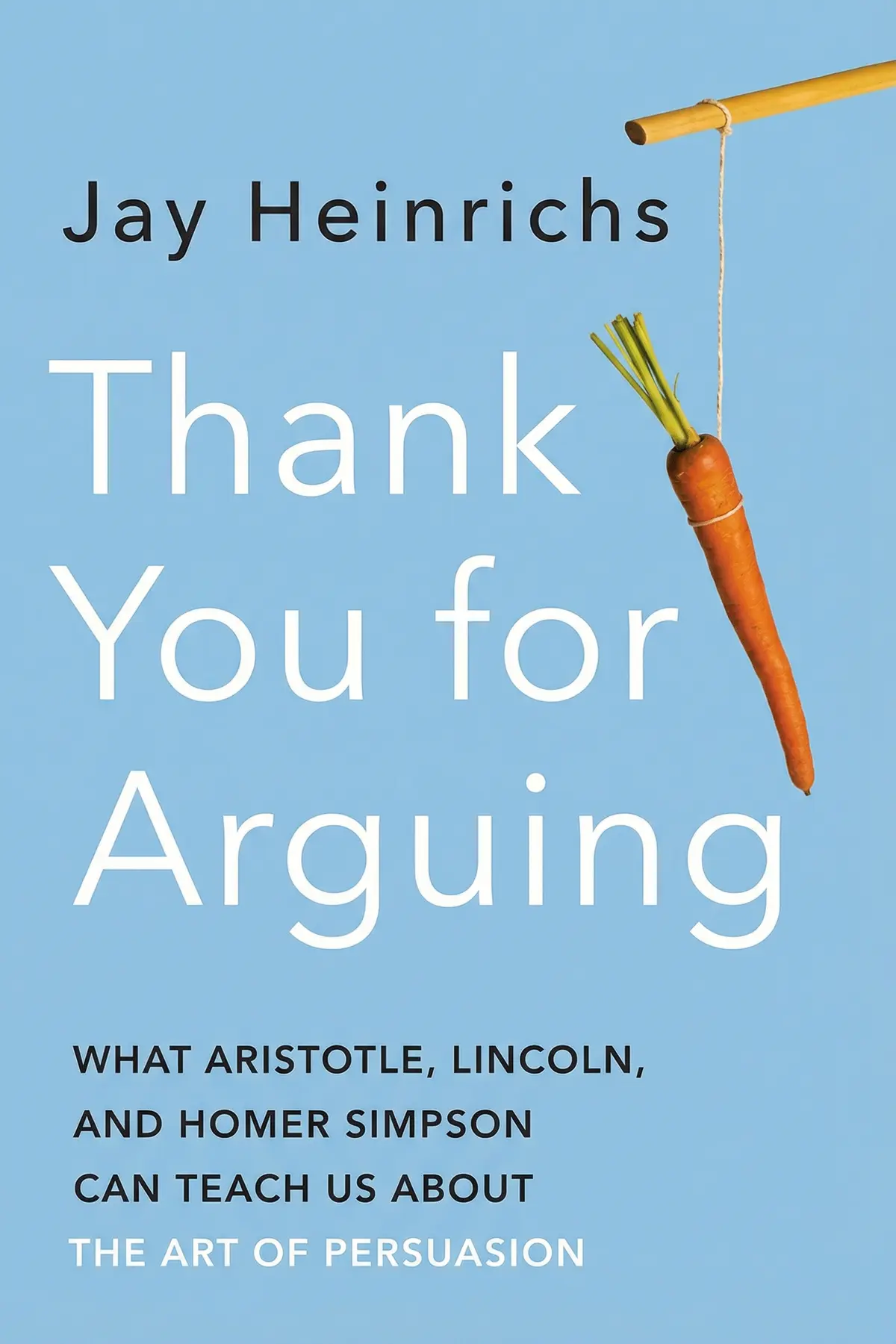
Table of Content
1. Introduction
1 min 05 sec
If disagreements leave you either steamrolled or feeling guilty for winning, the trouble may be how you picture an argument. In Thank You for Arguing, rhetoric teacher Jay Heinrichs points to a study of couples in therapy led by psychology professor John Gottman. The pairs who stayed married clashed just as often as the pairs who split up. The difference was that the survivors used each dispute to settle something together, while the others simply fought.
Heinrichs builds his book on that difference. His case, borrowed largely from Aristotle, is that persuasion is a learnable craft whose aim is a decision both sides share. Goals, tenses, logic, feeling, character and an eye for cheap tricks all serve that aim. Along the way come a traffic stop, a living room standoff over the Rolling Stones, Lincoln’s likability and a rap battle from the film 8 Mile. What you gain is practical: fewer arguments that go in circles, and more that end with people choosing what you hoped they would.
2. Make every argument end in shared agreement
1 min 55 sec
Couples who stay together disagree just as often as couples who divorce. A therapist’s observations reveal what separates them, and it changes what you should be trying to achieve the next time a conversation heats up.
3. Know your goal before you start arguing
1 min 48 sec
A driver caught one mile over the limit and a candidate who won every debate share the same lesson. Being right in the moment can cost you the very thing you wanted from the exchange.
4. Break a stalemate by talking about the future
1 min 55 sec
A quiet evening collapses into a fight about record collections and thin walls. The fix Heinrichs proposes is almost grammatical, and it works on office deadlocks as well as on living room standoffs.
5. Concede first, then share their feelings
1 min 45 sec
Telling an upset coworker to cheer up feels kind and almost always fails. Two of Aristotle’s oldest tools explain why, and how to make someone more open to your view by agreeing with them first.
6. Earn trust by sounding like your audience
1 min 57 sec
A rap battle in a club and Lincoln’s fight against slavery turn on the same ingredient. It is not the quality of the reasoning, and copying your listeners will not supply it either.
7. Three traits that make listeners trust you
1 min 42 sec
A president with exceptional credentials failed to win a second term, while a veteran’s lived experience can win an audience’s trust. The difference lies in three qualities you can show deliberately, starting with your next request at work.
8. Catch the cheap tricks in a weak argument
1 min 47 sec
Children, salespeople and politicians lean on the same handful of moves to get their way. Once you can name them, they lose their grip on you, and a few can even be turned to your advantage.
9. Conclusion
1 min 07 sec
Heinrichs takes a word most people dread and gives it back its old meaning. An argument, in his telling, is a craft with a purpose, and the purpose is a decision people share. That is why Gottman’s lasting couples could argue as much as anyone and still stay together. Logic counts, but Kerry’s debate wins show how little it can do against character and seduction.
What the book asks of you is modest. Before a hard conversation, name the outcome you want and let the other person keep their points. When a dispute starts looping, pull it into the future tense. Meet feelings before facts, concede what is true, and let your listeners see the values, practical sense and selflessness they hope to find in you.
Heinrichs closes with a move Aristotle liked: every point has a flip side, and a concession can turn the tables. If your spouse complains that the two of you never go out anymore, agree, and say it is only because you want them all to yourself. It earns a smile, and enough time to choose the restaurant.
About this book
What is this book about?
Most people think of an argument as a shouting match with a winner and a loser. Jay Heinrichs argues that this picture costs us. Rhetoric, the art of argument, was the base of education in ancient Greece. It still shapes the ads, speeches and conversations around us, and its real aim is consensus: a decision both sides trust. Drawing mainly on Aristotle, Heinrichs turns persuasion into practical moves. Decide what you want before you start, and let the other person keep their points. Notice whether a dispute is about blame, values or choice, and steer it toward the future tense. Concede before you counter, meet feelings instead of fighting them, and build the character audiences trust: shared values, practical wisdom and selflessness. His examples range from a traffic stop and a living room standoff over the Rolling Stones to Lincoln, Jimmy Carter, the 2004 Kerry and Bush debates and the rap battle in 8 Mile. Readers learn to spot cheap tricks in other people's arguments and to make disagreements at home and at work end in agreement more often.
Book Information
Who it's for
Professionals needing a yes
Professionals who win debates at work but still fail to get projects, budgets or raises approved.
Tired of circular arguments
Partners and parents tired of arguments at home that go in circles.
Hoping to learn persuasion
Students and new managers who want a practical grounding in rhetoric and persuasion.
About the Author
Jay Heinrichs
Jay Heinrichs is the author of Thank You for Arguing, a New York Times bestseller published in four editions and 14 languages and used in more than 3,000 college rhetoric classes. Middlebury College named him Professor of the Practice in Rhetoric and Oratory. Before turning to rhetoric full time, he was deputy editor of Outside, founding editor of Southwest: The Magazine and an editorial director at Rodale Inc. He runs workshops and consults on persuasion and conflict for clients including NASA and Harvard.
Ratings & Reviews
Ratings at a glance
What people think
Listeners find the text accessible and value the educational insights into rhetoric, with one mentioning its benefits for developing speech skills. The caliber of the writing earns praise, as one listener notes how the author incorporates solid argument inventions. While some listeners believe it is worth the 6 dollars spent, others find the content tedious.
Top reviews
Wichai
As a parent, I never expected a book on rhetoric to change my household dynamics so drastically. The section on how to teach your children to debate instead of just screaming 'no' was a revelation. I actually tried some of the techniques when my daughter was angling for a late-night dessert, and she managed to persuade me using a perfectly constructed argument about nutrition and rewards. It was impressive! Heinrichs makes these concepts incredibly accessible, moving away from the stuffy atmosphere of a textbook. The book is filled with wit and real-world examples that bring Aristotle into the twenty-first century. Look, it might be a bit cheesy at times, but the practical value is undeniable. It teaches you to look for the 'sweet spot' in any discussion. This is hands down the most interesting 'child-rearing' book I’ve ever picked up, even though it wasn't originally intended to be one.
Show moreChatri
Who knew Aristotle could be this much fun? I picked this up for six dollars, and it has already paid for itself in the confidence I’ve gained during work meetings. The concept of 'verbal ju-jitsu' is brilliant—learning to use an opponent's momentum against them rather than just clashing heads. Heinrichs writes with a lot of energy and humor, which keeps the material from feeling like a chore. I particularly loved the chapters on humor and how it can be used to defuse a hostile audience. Some reviewers complain about the anecdotes, but I found the stories about his kids to be the perfect way to illustrate the techniques in a relatable setting. It’s not just a book for scholars; it’s for anyone who wants to navigate life more effectively. Truly enlightening and incredibly practical for everyday situations. If you want to learn how to be more persuasive without sounding like a robot, this is the one.
Show moreWararat
Truth be told, I bought this on a whim and it is easily one of my best investments this year. Rhetoric usually gets a bad rap, but Heinrichs cleans it up and shows how it can be a tool for empathy and understanding. He explains how to find common ground with an audience that doesn't necessarily agree with you, which is a skill we desperately need right now. The writing is snappy and the pop culture references actually helped me remember the terms better. I didn't mind the family stories at all; they made the 'art' of arguing feel human rather than just academic. Whether you're a student or a professional, there is something in here for you. It's a rare book that is both educational and genuinely entertaining. It's a shield and a sword for the modern age. Highly recommended for everyone.
Show moreWipada
Finally sat down with this one after hearing it was the go-to for improving speech skills and general persuasion. It is surprisingly easy to read for a book that delves into ancient Greek concepts like ethos and logos. Heinrichs manages to take the dry, dusty world of rhetoric and give it a modern facelift, making it feel applicable to the boardroom and the dinner table. While some might find the heavy reliance on pop culture references a bit much, I think it helps the medicine go down. The truth is, the book serves as a fantastic shield against the shady tactics of politicians. You start seeing the 'verbal ju-jitsu' everywhere you look. It isn't just about winning fights; it’s about understanding the mechanics of how we communicate and influence others every single day. Some chapters felt a bit longer than necessary, but the information provided is genuinely top-tier for anyone wanting to sharpen their tongue.
Show moreDarawan
If I had this in high school instead of a dry textbook, I might have actually paid attention during English class. It makes the core concepts of ethos, pathos, and logos feel alive and relevant to modern life. The author’s expertise is clear, and he does a great job of breaking down complex Latin terms into something manageable. I especially appreciated the focus on the 'future tense' for problem-solving, which is a tip I’ve already started using at my job. Not gonna lie, the author's wit can be a little much at times—he definitely thinks he's the funniest guy in the room. That said, the actual strategies for solid argument invention are excellent. It’s a breezy read that manages to pack in a ton of information without being daunting. It’s a solid 4-star resource for anyone looking to improve their communication skills.
Show moreSupaporn
The concept of arguing in the future tense alone makes this book worth the price of admission. Heinrichs does a stellar job of distinguishing between 'fighting' to win and 'arguing' to reach a conclusion. This distinction is vital. While the author's persona is a bit 'language maven' for my taste, the quality of the rhetorical tools he provides is undeniable. He takes you through the basics of persuasion in a way that is modern and colloquial. You’ll find yourself recognizing these tactics in every advertisement and political speech you see. My only real gripe is that it feels a bit sporadic in the middle sections, jumping around between topics without a clear transition. Still, for an accessible guide to a complex subject, it’s very successful. It’s a much better alternative to a standard textbook and actually gives you things you can use in a real conversation.
Show moreNuk
There is no denying that Heinrichs knows his stuff when it comes to the ancient art of persuasion. The book is a highly competent introduction to rhetorical terms, and I did walk away with a better grasp of the difference between an argument and a fight. However, the tone is a major hurdle. One minute he's being self-deprecating, and the next he's acting like a smug 'maven' who has mastered the human psyche. It’s a strange mix. I appreciated the modern examples, like using Homer Simpson to explain logical fallacies, but the sarcasm eventually wears thin. I found myself skipping the sidebar text boxes because they were often just repetitive jokes. It's a decent read for a college student needing a supplement for AP English, but for a casual reader, the narrative voice might be too condescending. It’s useful, but proceed with a bit of patience for the author's ego.
Show moreFort
Reading this is like being trapped at a cocktail party with an incredibly smart, incredibly smug professor. On one hand, you’re learning a lot about how to explain yourself clearly and how to spot a logical fallacy from a mile away. On the other hand, you kind of want to walk away because he won't stop cracking one-liners. The information is dense and valuable, but the presentation is hit-or-miss. I found the layout with the constant text boxes to be a bit chaotic, making it hard to maintain focus on the main points. Is it informative? Absolutely. Is it a bit boring and repetitive by the halfway mark? Yes. It’s a good reference book to keep on the shelf, but I wouldn't recommend trying to power through it in one sitting. Take it in small doses so the narrative voice doesn't grate on your nerves too much.
Show moreIce
The author is clearly a fan of his own voice, and that becomes apparent within the first fifty pages. I was looking for a serious exploration of logic, but instead, I got a memoir about his kids and a lot of self-congratulatory anecdotes. He calls himself a 'language maven,' but his style feels more like a guy at a party who won't stop making dad jokes. To be fair, the actual content regarding rhetorical inventions is solid, but you have to dig through mountains of filler to find it. The constant text boxes are distracting and often redundant, breaking the flow of what could have been a much tighter argument. If you enjoy a very conversational, almost arrogant narrative voice, you might like this. Personally, I found the lack of structure frustrating. There are better, more concise books on rhetoric that don't involve this much fluff or smugness about 'manipulating' family members.
Show moreKiattisak
I really wanted to learn the mechanics of logic, but this felt like a handbook for sociopaths. The author doesn't just explain rhetoric; he actively praises the art of manipulation as if it's a moral virtue. When he starts talking about how 'happy couples' manipulate each other to get their way, I almost threw the book across the room. It’s cynical and frankly exhausting. Beyond the ethics, the writing quality is quite grating. It is stuffed with pop culture references that will likely be dated in five years and excessive text boxes that add nothing but clutter. He spends more time bragging about his own rhetorical prowess than actually teaching the reader how to construct a sound, honest argument. If you value truth and straightforwardness, avoid this. It’s all about winning at any cost, even if it means redefining terms or being intentionally vague. Not what I was looking for at all.
Show moreQuestions about this book
What is the main idea of Thank You for Arguing?
Jay Heinrichs argues that an argument is not a fight but a learnable craft aimed at consensus, a decision both sides trust. Drawing on Aristotle, he shows how to set a clear goal, keep the dispute on the right issue, and persuade through logic, emotion and above all character, so that people come to want what you want.
What are logos, pathos and ethos in Thank You for Arguing?
They are Aristotle’s three tools of persuasion. Logos is argument by logic, such as conceding a point before making your own. Pathos is argument by emotion, which means matching your audience’s feelings instead of telling them to feel differently. Ethos is argument by character, which Aristotle valued most because a good reputation persuades more than good reasoning.
How do you stop an argument that keeps going in circles?
Heinrichs says stalemates often happen when people argue about different issues: blame, values or choice. Blame lives in the past tense and values in the present, while choice points to the future. Shifting the conversation toward what to do next, as in asking whether to turn the music down or play something else, turns it into a decision both people can make.
Who should read Thank You for Arguing?
It suits anyone whose disagreements end in frustration instead of results: professionals pitching ideas to a boss or client, parents dealing with teenagers, partners stuck in repeated arguments and students of rhetoric. The examples run from a traffic stop and the 2004 presidential debates to Lincoln, Jimmy Carter and the rap battle in 8 Mile.
How can I apply Thank You for Arguing at work?
Before a meeting, write down the outcome you want and ignore chances to score small points. Concede what is true in a colleague’s view before adding yours. Show selflessness, for example by offering to work late on a project even if someone else gets the credit. And test claims you hear by asking what actually connects the evidence to the conclusion.
Readers also enjoyed









AUDIO SUMMARY AVAILABLE
Listen to Thank You for Arguing in 15 minutes
Get the key ideas from Thank You for Arguing by Jay Heinrichs, plus 5,000+ more nonfiction titles.
- 5,000+ titles
- Listen as much as you want
- 7-day free trial
- Cancel anytime









