

15 min 06 sec
Available in: English
Team Intelligence: How Brilliant Leaders Unlock Collective Genius
By Jon Levy
Shows why a group of talented people can still fail together, and how leaders can build trust, the right mix of roles, a shared purpose and protected focus so the team thinks better than any single member.
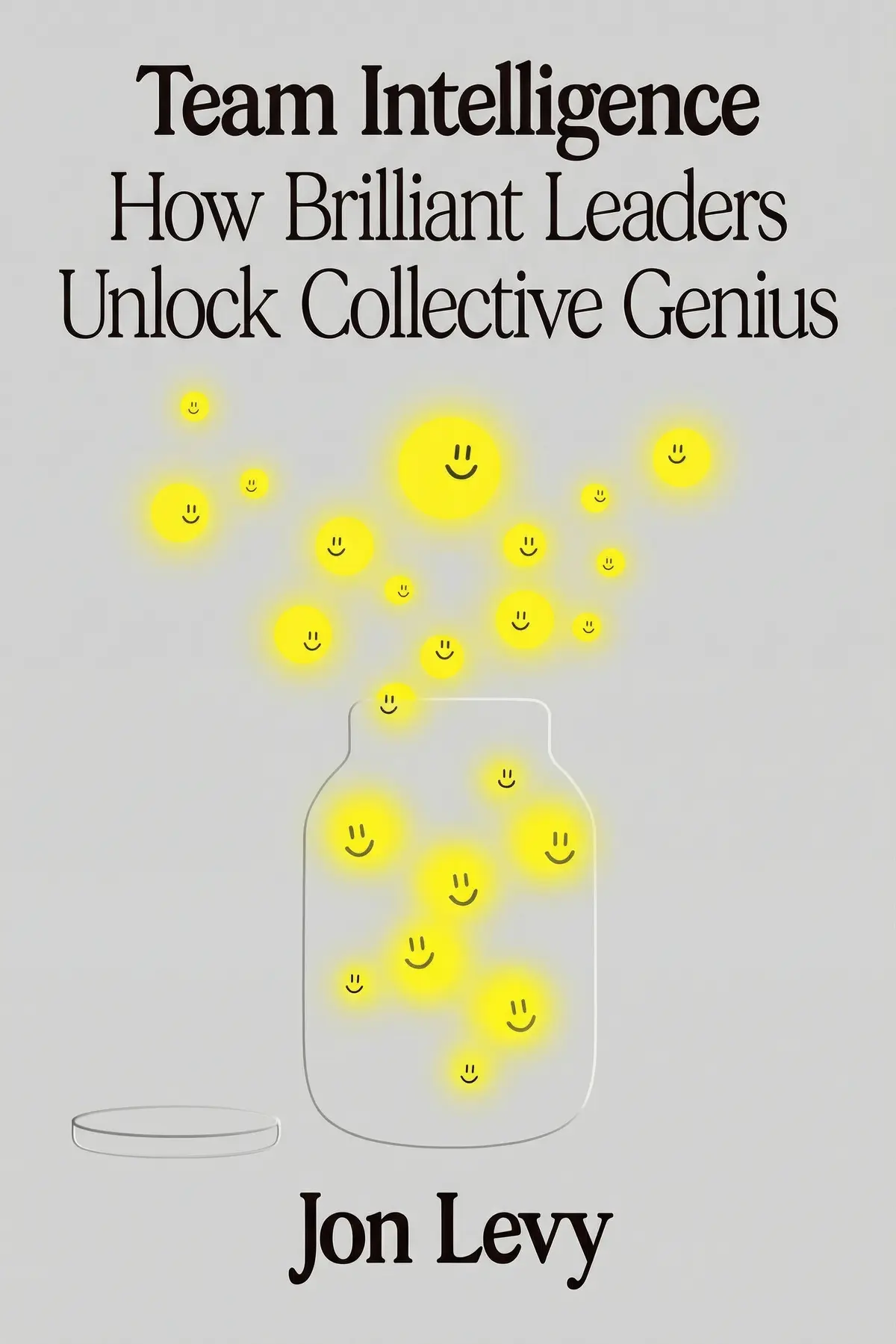
Table of Content
1. Introduction
1 min 02 sec
Hiring the smartest people you can find does not give you a smart team, and Jon Levy has the expensive failures to prove it. In Team Intelligence, the behavioral scientist recalls Quibi, a streaming service that raised nearly two billion dollars under Jeffrey Katzenberg, with former HP chief executive Meg Whitman running operations, and still folded within six months. Google Glass had advanced technology and celebrity backing, yet its fifteen hundred dollar prototype became a joke and was banned from venues.
What those ventures missed, Levy argues, is team intelligence: a group’s capacity to handle varied work together by talking, coordinating and thinking as one unit. His case is that leaders build it on purpose, through trust, the right mix of people, a shared mission and protected focus. If your team has talent but keeps tripping over itself, his ideas translate into specific moves for your next meeting, your next hire and your most difficult colleague.
2. Turn nine reporting lines into forty-five connections
1 min 34 sec
Neanderthals were stronger than our ancestors and, Levy says, smarter as well. They still disappeared. The reason has a lot to do with how most offices route information today, and why so much of it gets stuck.
3. Admit a mistake first to earn your team's trust
1 min 24 sec
Most leaders assume people open up once trust is in place. Levy reverses that order, and his version asks the person at the top to take the first uncomfortable step, with help from a lesson about flat-pack furniture.
4. Avoid the trap of a team packed with stars
1 min 38 sec
A breeding experiment set out to create the most productive hens possible. After six generations, almost none were left alive. The outcome says a lot about who you should hire, praise and promote.
5. Build a crew where every role is irreplaceable
1 min 53 sec
A vault guarded by ten layers of security and a crew of specialists who emptied it in a single weekend. Their method had nothing to do with hiring capable all-rounders, and everything to do with fit.
6. Let everyone talk and the group gets smarter
1 min 29 sec
When strangers solve puzzles together, the winning group is rarely the one with the highest IQs. A Carnegie Mellon researcher found what predicts success instead, and part of it means the boss should sometimes leave the room.
7. Repeat the mission until people can improvise
1 min 29 sec
Most employees could not tell you what their organization is trying to achieve, and that confusion carries a price in the hundreds of billions. The fix comes from soldiers whose plans fall apart under pressure.
8. Protect deep work with short bursts of contact
1 min 46 sec
A toy company that sold hundreds of billions of bricks nearly broke itself chasing every new idea. Its recovery rested on doing less, and on a kind of meeting where the listener is not allowed to speak.
9. Keep a brilliant jerk from poisoning your team
1 min 44 sec
The traits that make some colleagues exhausting can also drive results, and Apple’s history shows what happens when a company simply removes them. Levy offers a third path between putting up with them and pushing them out.
10. Conclusion
1 min 07 sec
Levy’s book adds up to a claim about the leader’s real job. Quibi had money and famous names; what it lacked, in his framing, was the design that turns capable people into a capable group. That design hides in small places: how many people talk to each other without the boss, who gets thanked for an assist, how often the purpose is said aloud, which hours stay free of messages.
The best teams in his account work as networks, with trust and information moving straight between members and no single desk where everything waits. Getting there can start this week. Admit one mistake to your team before asking anyone else to. In your next meeting, track who speaks and draw out the quiet people. Say the mission in one plain sentence until people repeat it without you. And when you next hire, listen for the candidate who talks about what we achieved.
Muir’s chickens are the image worth keeping. The most productive birds, bred together, destroyed each other, while the ones that got along flourished. A team is a flock too, and its leader decides what it is bred for.
About this book
What is this book about?
Quibi raised nearly two billion dollars and had famous leaders. It still shut down within six months. Jon Levy uses failures like this to make an uncomfortable point: collecting brilliant individuals does not produce a brilliant team. What matters is team intelligence, the ability of a group to take on varied work together by communicating and coordinating well. Levy, a behavioral scientist, treats that ability as something a leader can design. He shows why a team linked like a highway network outperforms one where every question passes through the boss, and how admitting mistakes builds trust. He explains why a squad with too many stars plays worse, and what a Carnegie Mellon researcher found about equal speaking turns. Lego's near collapse and a famous diamond heist add lessons on focus and on clearly defined roles. Readers get practical moves for meetings, hiring and daily communication, from repeating the mission until people can act on it alone to scheduling short bursts of contact. There is also a strategy for handling a difficult but gifted colleague without letting them damage the whole group.
Book Information
Who it's for
Managers whose teams stall
Managers whose skilled teams still miss deadlines and send every decision through them.
Founders making first hires
Founders hiring their first people and deciding who will make the group stronger.
Leading a difficult star
Team leads dealing with a gifted but difficult colleague who wears everyone else down.
About the Author
Jon Levy
Jon Levy is a behavioral scientist and New York Times bestselling author whose work focuses on trust, leadership and teams. He has applied research on influence and decision making to help companies with marketing, sales and culture. He founded Influencers, a private community that began as a secret dinner where leaders from many fields, including Nobel laureates, Olympians and executives, cook together before revealing who they are. His earlier book, You're Invited, argues for trust and community as keys to achieving what matters most.
Ratings & Reviews
Ratings at a glance
What people think
Listeners value the way Jon Levy dismantles common leadership myths, arguing that team success relies more on trust and social bonds than on individual talent. They also find his tactical advice for creating top-tier teams to be both thought-provoking and entertaining, with one listener highlighting that the author’s plain English and sense of humor keep the material accessible. Furthermore, although some listeners think specific case studies move a bit slowly at times, they also remark that the attention given to task interdependence and "glue players" delivers helpful, real-world insights applicable to any career field.
Top reviews
Patcharaporn
Ever wonder why a startup with $200 million in funding like Quibi can fail so spectacularly while smaller, less 'talented' teams thrive? Jon Levy dives into this paradox by exploring collective genius and the specific behaviors that unlock it. His breakdown of the Google Glass failure was eye-opening, illustrating that even the most elite experts can’t succeed if they aren’t communicating effectively. The writing is punchy and often funny, which makes the scientific research much more digestible for a casual reader. Truth is, most business books are dry, but this one kept me engaged through most of its chapters. My only gripe is that the tone occasionally feels a bit too academic when discussing the data points. If you want to understand how to actually foster collaboration, this is a must-read.
Show morePun
The concept of 'team intelligence' is a total game-changer for how I view my professional relationships. Jon Levy manages to blend social science with practical advice in a way that feels both rigorous and deeply human. I was especially struck by the argument that overloading a team with top performers can actually sabotage its overall success. It’s a counterintuitive thought, but the evidence he presents makes it hard to argue with his conclusions. The book is packed with humor and clarity, making it a breeze to get through even when the topics get complex. Personally, I think every department head needs a copy of this on their desk to remind them that connection is the ultimate competitive advantage. This is easily one of the best leadership books I've read in years.
Show moreGabriel
Look, we’ve all been on those 'dream teams' that turn into absolute nightmares because of ego and poor communication. Levy’s book is the antidote to that common corporate tragedy. He brilliantly explains that intelligence isn't just an individual trait, but a property of the system itself. By prioritizing trust and psychological safety, leaders can build something that is truly greater than the sum of its parts. I loved the practical tools for identifying and rewarding the 'glue players' who keep everything running smoothly behind the scenes. The book is engaging, insightful, and provides a much-needed reality check for those obsessed with traditional metrics of success. It’s a call to action for leaders to become architects of connection rather than just managers of tasks. Absolutely loved it.
Show moreValentina
As a manager in a high-growth tech firm, I often find myself obsessed with hiring the brightest minds available. Levy completely flips that script, arguing that the social architecture of the group matters more than any individual’s resume. The section on 'glue players' resonated deeply because those quiet contributors are usually the ones we overlook during performance reviews. I will say, a few of the anecdotes felt like they could have been trimmed down to get to the point faster. Regardless, the emphasis on trust and vulnerability as functional tools rather than just 'soft skills' is incredibly refreshing. It’s a solid blueprint for anyone trying to move away from rigid hierarchies toward a more fluid, networked style of operating.
Show moreOrm
Jon Levy’s approach to leadership is exactly what the modern corporate world needs right now. Instead of focusing on power dynamics, he highlights how task interdependence and shared ownership create a resilient culture. I particularly loved the idea that leaders should sometimes step back to allow the collective intelligence of the group to surface naturally. It’s a brave suggestion in an era where 'strong' leadership is often confused with being the loudest person in the room. The book provides a wealth of actionable strategies, from reducing meeting fatigue to fostering psychological safety through open vulnerability. Not gonna lie, I’ve already started implementing some of these communication patterns with my direct reports. The results have been subtle but definitely positive in terms of morale.
Show moreMax
Finally got around to finishing this, and I have to say, the chapter on 'bursty' communication changed my entire perspective on remote work. We spend so much time on Zoom calls thinking we are collaborating, when we are actually just draining our collective energy. Levy shows that high-performing teams alternate between periods of intense coordination and stretches of quiet, individual focus. It’s a simple shift, but the logic behind it is grounded in how humans actually process information and solve problems together. The book does a great job of explaining why diversity in background and perspective leads to better decision-making. I did feel that the middle section was a bit slow, but the ending tied everything together beautifully. A very solid four-star read for anyone in a management position.
Show moreElias
Frankly, I was tired of books that just tell you to hire 'A-players' and get out of their way. This book offers a much more nuanced look at how groups actually function as networks rather than just collections of individuals. Levy's focus on the 'glue players'—those who facilitate and support—is a breath of fresh air for those of us who don't fit the typical 'star' mold. The writing is clear and the frameworks are easy to follow, providing a step-by-step guide to building trust. I appreciated the specific examples of how to model vulnerability as a leader to create a safer environment for everyone else. While some of the animal group analogies felt a bit stretched, the overall message remains incredibly powerful. It’s a practical manual for anyone looking to unlock the hidden potential of their colleagues.
Show moreElan
This book is a bit of a mixed bag for me, though the core message is undeniably important. While I appreciate how Levy challenges the myth of the 'lone genius,' I found some of the stories dragged on far longer than necessary. There were moments where the narrative momentum stalled because of an overly detailed case study that didn't seem to add much new value. To be fair, the insights regarding 'bursty' communication and the need for uninterrupted deep work are practical and immediately applicable to my own team’s workflow. I just wish the editing had been a bit tighter to keep the energy consistent throughout the entire read. It’s worth picking up for the framework, but you might find yourself skimming a few sections.
Show moreNuk
After hearing so much about it on LinkedIn, I decided to give this a try. It’s a very interesting read that highlights why some 'dream teams' end up being nightmares. I definitely notice some of the same issues at my own workplace, especially the bottlenecks caused by rigid hierarchies. The book provides some great philosophies on how leadership should evolve, but some of the stories were definitely dragged on longer than they needed to be. In my experience, these types of books could usually be about 50 pages shorter. However, the takeaways on clarity of purpose and mission are excellent. It's a 3-star for me because of the pacing, but the core ideas are definitely 5-star quality.
Show moreThongchai
Not what I expected based on the hype surrounding this release. While the premise of 'Team Intelligence' is fascinating, the execution left me feeling a little disconnected from the author's vision. Several of the case studies focusing on business failures felt overly negative and actually dampened my enthusiasm for the more constructive parts of the book. It’s one thing to learn from mistakes, but the shift in tone felt jarring at times. Also, I didn't find the 'glue player' concept to be particularly revolutionary; it felt like a rebranding of ideas I've seen in other management texts. There are definitely some good takeaways here, but I struggled to stay engaged with the prose. It’s a decent enough read if you’re new to the topic, but seasoned leaders might find it repetitive.
Show moreQuestions about this book
What is the main idea of Team Intelligence by Jon Levy?
Levy argues that gathering the smartest people does not guarantee success, as the collapse of Quibi shows. What matters is team intelligence, a group’s ability to work together by communicating and coordinating well. Leaders build it through trust, cooperative team members, clear roles, equal participation, a repeated mission and protected focus, so the team works as a network where information flows directly between members.
What are glue players and why do they matter?
The term comes from basketball, where glue players have modest statistics but set screens, defend and pass to open teammates, making everyone better. Levy cites research suggesting performance drops once more than about 60 percent of a team are top performers, and William Muir’s chicken experiment, where aggressive superstar hens pecked each other to death while cooperative birds thrived. Rewarding collaboration turns talent into a strong team.
What is bursty communication?
Bursty communication means brief, intense bursts of collaboration, after which people get extended stretches of solo work without interruption. Levy suggests daily stand-ups or fixed collaboration windows, hours without email, solving problems yourself before messaging, and cutting meetings to essentials. He links it to Lego, which recovered from heavy losses by cutting its product lines by 30 percent and returning to its basics.
How should a leader handle a toxic team member according to Levy?
Levy separates bad days from real toxicity, which usually involves narcissism, a lack of empathy or manipulation. Such people can still drive results, as Steve Jobs did at Apple. His strategy is buffering: hire people who are skilled at collaboration, who talk about what we achieved and how they helped colleagues. Enough connectors and glue players act like an immune system for the team.
How can I apply Team Intelligence to my team this week?
Start by admitting one of your own mistakes, since Levy says vulnerability comes before trust. In meetings, encourage roughly equal speaking turns and step back if you tend to dominate. Write the mission in one clear sentence and repeat it often, praising decisions that serve it. Schedule a fixed window for collaboration and protect the rest of the day for focused work.
Readers also enjoyed


A Bigger Prize: How We Can Do Better Than the Competition
Margaret Heffernan





A Year with Peter Drucker: 52 Weeks of Coaching for Leadership Effectiveness
Joseph A. Maciariello



Acting with Power: Why We Are More Powerful Than We Believe
Deborah Gruenfeld
AUDIO SUMMARY AVAILABLE
Listen to Team Intelligence in 15 minutes
Get the key ideas from Team Intelligence by Jon Levy, plus 5,000+ more nonfiction titles.
- 5,000+ titles
- Listen as much as you want
- 7-day free trial
- Cancel anytime









