


15 min 03 sec
Available in: English
Talent: How to Identify Energizers, Creatives, and Winners Around the World
Shows how to spot exceptional people that résumés and scripted interviews miss, using unusual interview questions, a realistic view of IQ, and fresh attention to disability, gender and cultural bias.
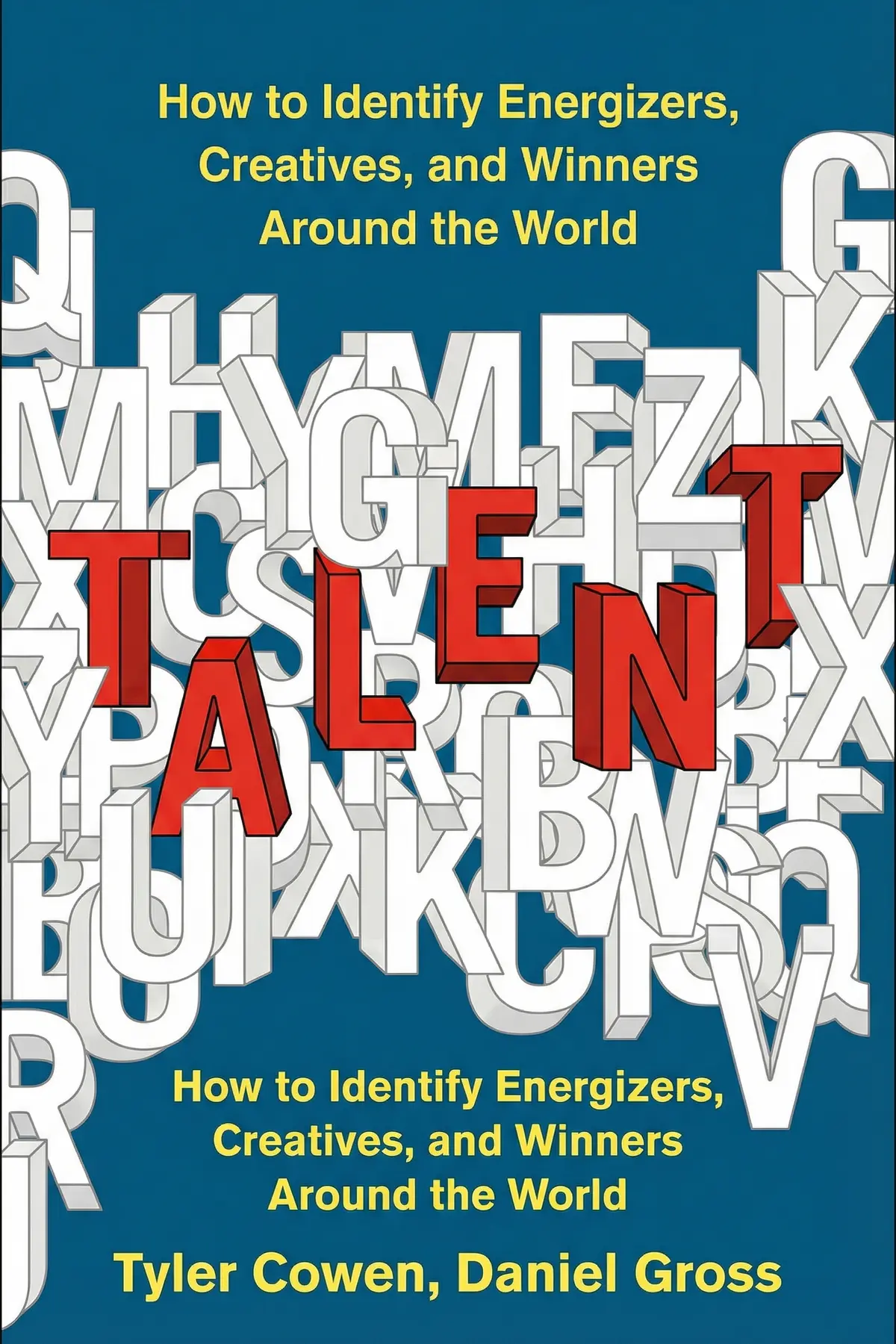
Table of Content
1. Introduction
1 min 07 sec
If you hire, manage or choose collaborators, your judgment of people shapes almost everything else, and most selection systems are tuned to reward polished résumés over unusual minds. In Talent, economist Tyler Cowen and entrepreneur and investor Daniel Gross argue that spotting exceptional people is a learnable skill. They add that the best candidates often look strange on paper: the hobbyist serving a tiny fan base, the Stanford graduate who joined a circus, the applicant whose politeness reads as timidity.
Their case is that talent hides wherever conventional filters stop looking. Finding it takes better conversations, a realistic view of intelligence, fresh eyes for groups the usual methods misjudge, and settings that make people aim higher.
The payoff is practical. Expect a few interview questions to try this week, a clearer sense of when an IQ score actually tells you something, and a short inventory of the biases most likely to make you pass over the person you needed.
2. Find the strong candidates your filters throw away
2 min 01 sec
Some of the people who changed whole industries would never have passed a standard résumé screen. The authors explain what those filters reward, what they miss, and what the mistake costs an entire economy.
3. Ask questions that get past rehearsed answers
2 min 05 sec
Candidates arrive with polished stories about their past jobs, and most interviews simply collect them. One small question about a web browser can reveal more than an hour of prepared answers.
4. Know when a high IQ really matters
2 min 23 sec
In one country’s workforce, intelligence decided who became an inventor far more than who became a doctor or lawyer. That gap points to when brainpower should weigh heavily in a hiring decision, and when it shouldn’t.
5. See the strengths that come with different minds
2 min 08 sec
One activist who protested alone outside a parliament became a global voice, and she credits traits linked to her autism for part of it. The authors find similar hidden advantages in dyslexia, ADHD and even the inability to picture images.
6. Correct the biases that hide strong candidates
2 min 01 sec
A former circus acrobat built a nonprofit that helped thousands of people leave prison safely. Her path shows how easily selectors misread unusual careers, and how gender and cultural signals push good people down the list.
7. Raise ambition and keep your exceptional people
2 min 08 sec
A future president only considered the top job after one speech won wide public acclaim. The authors argue many capable people are waiting for a similar push, and show what organizations can do to give it.
8. Conclusion
1 min 10 sec
Talent, as Cowen and Gross describe it, is mostly a problem of attention. The people who could change your team are often already close by: a hobbyist with an obsessive side project, a dyslexic thinker who sees the whole picture, a polite candidate whose calm you mistook for indifference, a capable colleague nobody ever told to aim higher. Standard filters were built to find people who resemble past hires, so they keep missing these.
The book supports a few concrete changes. In your next interview, ask something the candidate could not rehearse, like what is open in their browser, and keep asking for examples until the prepared ones run out. Treat an IQ score as most informative for young people with short records, and weigh drive and track record for everyone else. Before you reject someone, check whether you are penalizing a trait the job does not need. And once you find strong people, show them a larger version of what they could do.
Obama needed one speech to see a bigger future. Someone on your team may need only one sentence from you.
About this book
What is this book about?
Most hiring systems sort people by degrees, job titles and polished interview answers. Tyler Cowen and Daniel Gross argue that this approach throws away many of the most valuable people: the obsessive hobbyist, the candidate with a strange career path, the applicant whose way of thinking does not fit the template. An economist and a start-up investor, the authors treat talent spotting as part art and part science. They offer interview questions that get past rehearsed stories, such as asking what is open in a candidate's browser. They use data from Finland to show where intelligence predicts success and where it barely matters. They also explain how autism, dyslexia and ADHD can come with real strengths, and how gender and cultural bias lead interviewers to misread capable people. The book ends on what happens after the hire. Drawing on examples from Barack Obama to Renaissance Florence, Cowen and Gross show how mentorship, exposure and the right environment can raise someone's ambition. Readers get a practical way to find people others overlook and to help them grow once they arrive.
Book Information
Who it's for
Questioning their hiring filters
Founders and hiring managers who suspect their screening process filters out unusual but brilliant people.
Team leads and trainers
Team leads and L&D staff who want better interview questions and ways to raise their people's ambition.
Recruiters fighting hiring bias
Recruiters working to reduce bias against women, minorities and neurodivergent candidates.
About the Author
Tyler Cowen
Tyler Cowen, born in 1962, is an economics professor at George Mason University, linked to its Mercatus Center. He co-writes the blog Marginal Revolution, hosts the podcast Conversations with Tyler, and was named one of Foreign Policy's Top 100 Global Thinkers in 2011. Daniel Gross is an entrepreneur and investor who joined Y Combinator at 18, worked for Apple, founded the search engine Cue and now leads the venture firm Pioneer as CEO.
Ratings & Reviews
Ratings at a glance
What people think
Listeners view this book as a thoughtful and non-conformist resource for talent scouting that motivates leaders to ignore traditional qualifications. They find the precise interview techniques and tactics for gauging perseverance useful, with one listener remarking that the focus on neurodiversity and recruiting people with "different brains" is exceptionally beneficial. Even though perspectives are mixed concerning the authors' use of subjective anecdotes and musings, most listeners agree that the original model for uncovering hidden talent is deeply effective. Furthermore, they suggest the text serves as a practical glimpse into Silicon Valley’s professional world for recruiters and applicants alike.
Top reviews
Pairot
Ever wonder how the top 1% of talent scouts in the tech world actually operate? This book is a fascinating window into that mindset, providing a non-traditional framework for spotting high-potential people before the market catches on. Cowen and Gross argue that we overvalue degrees and IQ while drastically undervaluing traits like stamina and the ability to learn independently. To be fair, some of the advice is esoteric, but that’s exactly what makes it useful; it’s not the same recycled HR garbage you find in every other business book. The section on how to evaluate talent across different cultures was particularly eye-opening for me. It’s a must-read for anyone building a team in a fast-growing environment where the old rules simply don't apply anymore.
Show moreWeera
Finally, a business book that recognizes that being "non-traditional" isn't a bug, it's a feature. As a person with a checkered background who felt like the corporate world would never see my value, reading the chapter on neurodiversity felt like a massive validation. The authors argue that we need to stop looking for the most "polished" version of a person and start looking for raw potential and unique cognitive styles. It’s an emotional read for anyone who has been overlooked by the standard credentialing system. Sure, Cowen can be a bit eccentric with his cultural references, but his heart is clearly in the right place regarding human potential. This book changed how I view my own career path and gave me a lot of hope.
Show moreRungtip
Not what I expected from a book on hiring, but in a good way. Cowen and Gross have created a guide that is less about HR procedures and more about the art of observation. The true value lies in the mental models they provide for categorizing talent types and understanding the "meta-skills" that lead to long-term success. I particularly liked the advice on how to spot ambition in people who haven't had the chance to prove it yet. Some of the interview techniques feel a bit like a game of 4D chess, which might be overkill for most hiring managers. However, if you're looking for that 1% difference in your team's quality, these unconventional strategies are exactly what you need. A masterful look at human potential.
Show moreWanida
Cowen and Gross offer a refreshing, if slightly eccentric, roadmap for finding individuals who don't fit the standard corporate mold. Truth is, the most valuable part of the book is the deep dive into neurodiversity and how "different brains" can provide a massive competitive advantage if you know where to look. I appreciated the specific interview questions, even the ones that felt a bit off-the-wall, because they force you to think about character over credentials. However, be prepared for a lot of anecdotal storytelling that occasionally feels a bit thin on hard data. It’s definitely a Silicon Valley book, but it’s one that challenges the usual "safe bet" hiring practices that lead to stagnation. If you’re tired of the same old resumes, this is a solid read.
Show moreYulia
As someone who spends all day interviewing developers, I found the distinction between grit and stamina to be the most practical takeaway from this book. Cowen and Gross provide a useful framework for identifying people who don't just work hard, but who have the "internal engine" to keep going for decades. Not gonna lie, I’ve already started using a few of the non-standard interview questions to see how candidates handle unexpected pivots in conversation. The book does lean heavily on the authors' personal experiences in the VC world, which might alienate some readers outside of tech. Still, the core message about looking for "undervalued assets" in the labor market is a powerful one for any leader. It’s a smart, quick read.
Show moreNattapong
The most striking thing about "Talent" is how it manages to be both deeply elitist and radically inclusive at the same time. On one page, Cowen is name-dropping obscure Haitian art, and on the next, he’s explaining why a person with autism might be your most valuable employee. It’s a strange mix, but it works because the goal is always to find the signal in the noise. I found the strategies for evaluating candidates from different cultural backgrounds to be incredibly sophisticated compared to the usual diversity training. To be fair, it’s a bit light on data, relying instead on the authors' track records as talent scouts. If you can get past the "intellectual polymath" tone, there is a wealth of practical wisdom here.
Show moreNina
There is no denying that Tyler Cowen is a brilliant thinker, but this collaboration feels a bit uneven in its delivery. On one hand, you get these incredibly sharp insights about the "hidden" signals of ambition and how to use the "flipped funnel" to attract better candidates. On the other hand, a lot of the chapters are buried under layers of caveats and "Straussian" observations that make it feel more like a philosophy text than a hiring guide. I found the chapter on women and minorities to be well-intentioned but a bit impractical for a mid-sized company's HR department. It’s a conversation-starter for sure, though I wouldn't call it an "evergreen" manual like High Output Management. It’s worth a skim if you're in the startup scene.
Show moreAnthony
Picked this up because I enjoy the authors' perspectives, and it definitely delivers that specific Cowen-esque flavor of "weird but interesting." The book is basically a toolkit for talent arbitrage, teaching you how to find high-ability people who are currently being ignored by the gatekeepers. Personally, I think the advice on identifying "stamina" is the real gold here, as that’s much harder to fake than a high GPA. My main gripe is that it feels a little disorganized and repetitive in the middle sections. It’s a quick, punchy read, but don’t expect a rigorous academic study on organizational behavior. It’s more of a curated collection of high-level heuristics for people who like to think outside the box.
Show moreKomsan
I wanted to like this, but the tone is just so relentlessly "venture capitalist" and elitist that it’s hard to get through the actual advice. The authors seem convinced that identifying talent requires some mystical, out-of-the-box intuition that only they possess. While there are a few decent tips on assessing persistence, most of the book feels like a collection of blog posts from Marginal Revolution stitched together with loose threads. Frankly, some of the suggested interview questions—like asking what someone did that morning—come across as pretentious rather than insightful. It’s a shame because the core idea of looking for undervalued talent is important. Unfortunately, it gets lost in a sea of self-congratulatory anecdotes and a lack of scientific rigor.
Show morePannipa
If you’re looking for a book that perfectly encapsulates the pomposity of the modern intellectual class, look no further. This entire text reads like a satire of a venture capitalist trying to explain human nature through a lens of extreme privilege and anecdotal "vibes." The authors dismiss traditional metrics but replace them with bizarre personal heuristics that seem more about stroking their own egos than finding actual talent. I mean, who seriously thinks they can judge a candidate's potential by their Zoom background? It’s a collection of pseudo-intellectual musings that ignores the reality of survivor bias and structural inequality. Save your money and just read a basic psychology textbook instead of this vacuous fluff.
Show moreQuestions about this book
What is the main idea of Talent by Tyler Cowen and Daniel Gross?
The authors argue that exceptional people often go unnoticed because hiring relies on credentials, scripted interviews and narrow measures. Spotting talent, they say, is part art and part science. It means asking unrehearsed questions, understanding where intelligence matters, seeing strengths in people with disabilities, correcting gender and cultural bias, and creating environments that raise ambition, as Athens, Renaissance Florence and Silicon Valley did.
What unusual interview questions do Cowen and Gross recommend?
They suggest asking how many browser tabs a candidate has open and what is in them, which blogs or subreddits they follow, how they spent their morning, and the farthest they have ever been from another person. They also recommend moving interviews to a coffee shop or a walk, and asking for repeated examples of success until the candidate’s prepared answers run out.
Does Talent say IQ is important for success?
Partly. Finnish data the authors cite show IQ explained 66 percent of the measurable factors behind becoming an inventor, but only 8 percent for doctors and 5 percent for lawyers. Intelligence matters most for complex, new problems and for judging young people with short records. In fields like chess and music, persistence, creativity and resilience multiply with intellect, and the link between IQ and earnings is fairly modest.
How does Talent view disabilities in hiring?
Cowen and Gross argue that many conditions come with real strengths. Autism often brings pattern recognition, attention to detail and less susceptibility to framing effects. Dyslexia can push people toward big-picture thinking, as Richard Branson describes. Pixar co-founder Ed Catmull succeeded in a visual field despite aphantasia. Their advice is to ask what a different way of thinking makes someone unusually good at.
How can managers apply the ideas in Talent?
Add one unscripted question or a change of setting to your interviews. Check whether your criteria reward boldness or aggression the job does not need, since these traits are often judged differently in women and minority candidates. After hiring, raise ambition with structured mentorship that turns goals into steps, plus exposure to role models, events and high achievers, as the authors recommend.
Readers also enjoyed


A Year with Peter Drucker: 52 Weeks of Coaching for Leadership Effectiveness
Joseph A. Maciariello



Acting with Power: Why We Are More Powerful Than We Believe
Deborah Gruenfeld

All In: How Great Leaders Build Unstoppable Teams
Mike Michalowicz



7 Powers: The Foundations of Business Strategy
Hamilton Helmer
AUDIO SUMMARY AVAILABLE
Listen to Talent in 15 minutes
Get the key ideas from Talent by Tyler Cowen, plus 5,000+ more nonfiction titles.
- 5,000+ titles
- Listen as much as you want
- 7-day free trial
- Cancel anytime









