

14 min 06 sec
Available in: English
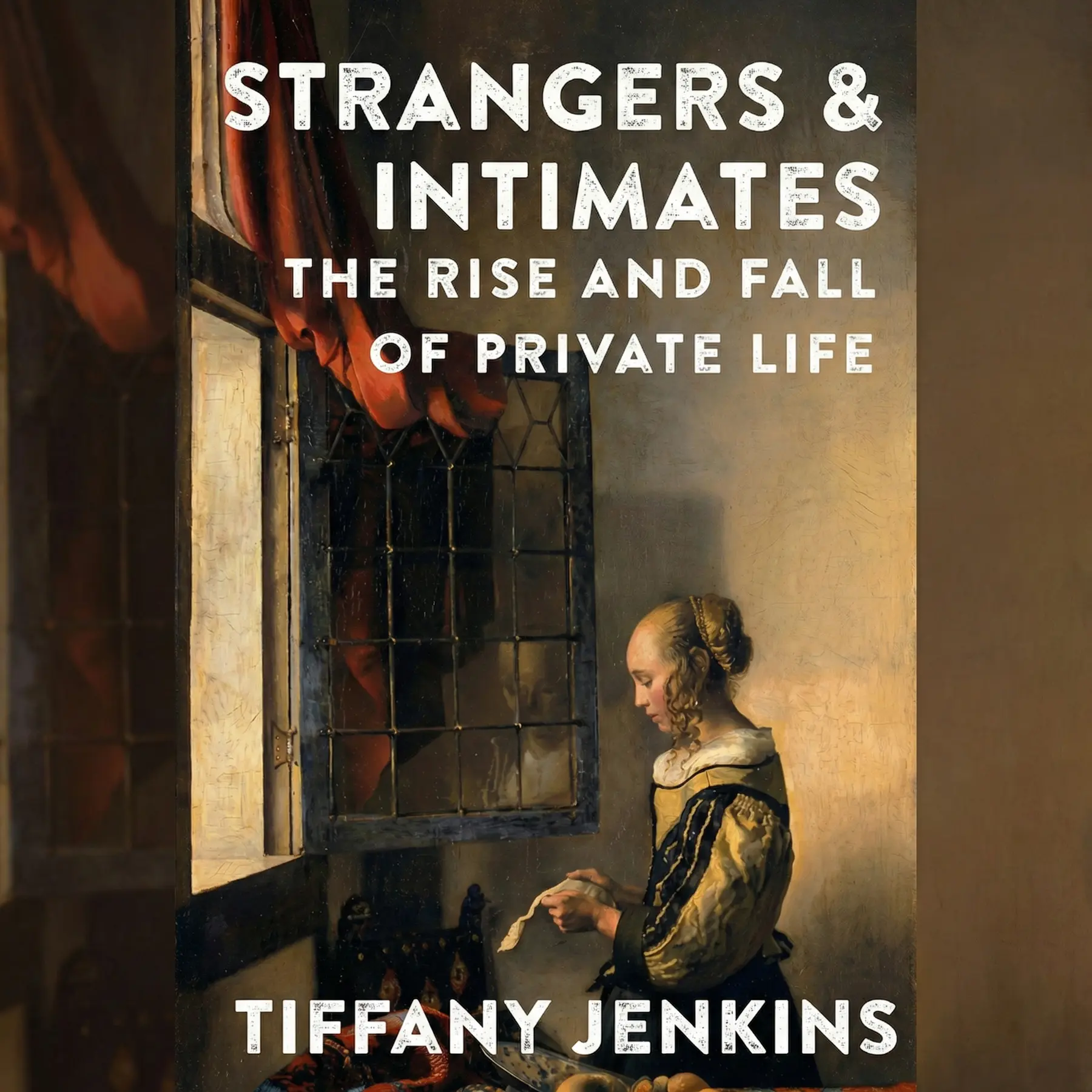
Strangers and Intimates: The Rise and Fall of Private Life
Tiffany Jenkins shows that private life is a historical invention. She traces how Luther, Victorian homes, feminist activism and digital platforms each redrew the line between public and private, and what that means for privacy today.

Table of Content
1. Introduction
1 min 09 sec
Most of us want two things that pull against each other: we expect openness from everyone else, and we guard our own lives fiercely. In Strangers and Intimates, cultural writer Tiffany Jenkins argues that this tension makes sense once you see that a private life is not natural at all. It is an invention with a history. Athenians of the ancient city split existence into two spheres: the polis, which held public politics and citizenship, and the oikos, which meant the household. Medieval Europeans, by contrast, treated privacy as suspicious, close to dangerous secrecy.
Jenkins uses this history to make sense of puzzles like Harry and Meghan, who stepped back from royal duties in 2020 asking for privacy, then gave tell-all interviews and wrote memoirs. Her throughline is simple. Every era has redrawn the line between public and private for its own reasons, and each line protected some people and exposed others. Follow those redrawings from a monk’s conscience to a webcam in a dorm room, and your own privacy settings start to look like choices instead of defaults.
2. Find where your private inner self was born
1 min 54 sec
A monk standing before an emperor refused to take back his words, and the reason he gave changed what people believed they owned inside themselves. That inner claim still shapes how you defend your own thoughts.
3. Discover the home as a shelter from work
1 min 52 sec
London’s public life was never busier than in the eighteenth century, with coffee houses, museums and pleasure gardens. So why did the private home grow stronger at the same moment, and who was left outside it?
4. Understand how privacy stopped meaning secrecy
2 min 02 sec
A stamp stuck over another stamp, a missing poppy seed and a furious Charles Dickens. One exiled Italian agitator’s suspicious mail turned a word that once suggested plotting into something ordinary people felt they deserved.
5. Ask whom your privacy protects, and from what
1 min 58 sec
A queen went to court over some family sketches. Decades later a novelist demanded a room of her own. Both wanted privacy, yet they meant almost opposite things by it, and protected very different people.
6. Learn how private stories became political proof
2 min 00 sec
Twelve women stood up in a New York church and told strangers their most dangerous secrets. Their courage won a new kind of authority, and it also cost private life something it never got back.
7. Spot the ways you give your privacy away
1 min 53 sec
The people who promised that computers would set the individual free ended up building something else entirely. A webcam in a college dorm hinted at where the rest of us were heading, mostly by our own choice.
8. Conclusion
1 min 18 sec
Jenkins’s history leaves a useful and unsettling thought. The privacy we defend is not a fixed natural right waiting to be found. People built it, piece by piece: a monk’s conscience at Worms, servants’ bell pulls in new houses, a poppy seed that never arrived in Mazzini’s post, a queen’s injunction, a room of one’s own. Each piece answered a need of its time, and each one left some people outside.
That makes the present choices sharper. The twentieth century turned private experience into political authority, and the digital age invites us to hand over the rest, often willingly. Harry and Meghan’s mix of retreat and confession looks like everyone’s problem in miniature.
The book gives you ways to act on that. When you are asked to share, whether a story in a meeting or a photo of your kitchen, ask whom the exposure serves. When a service wants your data, remember that Britain erupted in anger over one man’s opened letters, and ask why you should accept less. And when you need space to think, claim it the way Woolf did, as the ground for your own work.
Privacy has always been something people decided to build. It still is.
About this book
What is this book about?
Many of us live with a contradiction. We demand openness and authenticity from public figures, yet we guard our own private lives hard, all while posting for an audience and leaving data trails everywhere. Tiffany Jenkins argues that this confusion makes sense once you see that private life is neither natural nor universal. It was invented, and it keeps being reinvented. Jenkins follows the idea from ancient Athens and medieval suspicion of secrecy to Martin Luther's stand for individual conscience in 1521. She shows eighteenth-century London building walls between home and work, and a postal spying scandal in the 1840s turning privacy into something people expected. Queen Victoria's leaked family etchings and Virginia Woolf's call for a room of one's own reveal two opposite uses of the same idea. Then the feminist slogan that the personal is political opened private life to public judgment, and Silicon Valley's platforms made exposure a daily habit. Readers get a clear, story-led history of where the line between public and private came from, whom it protected, and why the question of what privacy means is open again in an age of AI and surveillance.
Book Information
Who it's for
Professionals torn about sharing
Professionals who feel pulled between sharing online and keeping parts of their life to themselves.
Curious about celebrity privacy
Readers curious why public figures like Harry and Meghan seem to want privacy and publicity at once.
Students seeking privacy's backstory
Students of history, sociology or media who want a short story of how private life was made.
About the Author
Tiffany Jenkins
Tiffany Jenkins is a writer and cultural policy consultant. For four years she wrote a weekly column on social and cultural issues for the Scotsman, and her work has appeared in the Guardian, the Independent, the Spectator and BBC Culture. She has advised universities and museums, including scholars at the University of Oslo, directed the Institute of Ideas program on arts and society, and been a visiting fellow in the London School of Economics law department. She holds a degree in art history and a PhD in sociology.
Ratings & Reviews
Ratings at a glance
What people think
Listeners find this to be a thoroughly researched and evocative study of the way privacy has transformed from the ancient world to the modern day. They value the deep historical context, with one listener highlighting the captivating look at how the Reformation and Martin Luther’s focus on individual conscience helped define the modern private self. Furthermore, while perspectives on the author's interpretation of the digital age are mixed, many find the writing style absorbing and the extensive scope very informative. They also note that the book provides a singular and detailed outlook on the "rise and fall" of private life.
Top reviews
James
Tiffany Jenkins has managed to turn a dry sociological concept into a gripping narrative that tracks the very soul of Western individuality. I was particularly struck by the sections on Martin Luther and the Reformation; the idea that privacy began as a sanctuary for the individual conscience was a revelation to me. The writing is incredibly polished and compelling, making a complex historical evolution feel like a real page-turner. While some might find the later chapters on digital surveillance a bit cynical, I found her analysis of how we trade our dignity for convenience to be chillingly accurate. It is rare to find a non-fiction book that balances academic rigor with such an engaging, accessible tone. If you want to understand why we feel so exposed in the 21st century, start here.
Show moreAlejandra
Finally got around to reading this, and it’s easily one of the most provocative books of the year. Jenkins takes you on a high-level journey from the ancient Greeks to the smartphone age without ever feeling rushed. I was especially fascinated by the discussion on how the home became a sanctuary during the industrial revolution, and how those boundaries are now being systematically dismantled. The writing style is sophisticated yet very readable—it’s the kind of non-fiction that stays with you long after you close the cover. She doesn't just give you dates and names; she gives you a new lens through which to view your own daily interactions. An absolutely essential read for anyone worried about the erosion of the private self in our hyper-connected world.
Show moreTantipat
The chapter on Queen Victoria’s leaked sketches was a total eye-opener for me, showing how even the most powerful figures struggled with the boundaries of the domestic sphere. Jenkins does a masterful job of weaving together specific historical anecdotes—like the Mazzini mail-opening scandal—with broader philosophical shifts. I appreciated the nuance she brought to the 'personal is political' era of the 1970s, though at times I felt the focus was a bit too centered on the UK and US experience. The transition from the Victorian 'home as a castle' to our current era of oversharing is handled with great care and research. It’s a dense read but well worth the effort for anyone interested in cultural history. My only minor gripe is that I wished for more diverse perspectives from outside the Western bubble.
Show moreKiattisak
Ever wonder why we’re so obsessed with sharing every meal on Instagram while simultaneously fearing government surveillance? Jenkins explores this exact paradox with a sharp, analytical eye. I loved the way she connected Virginia Woolf’s 'room of one's own' to the broader movement for individual autonomy, showing that privacy isn't just about hiding secrets—it's about the freedom to grow. The prose is lively, and the research into how coffeehouses transformed 18th-century sociability was fascinating. I did find some of her conclusions about modern technology a bit pessimistic, but she raises questions that are impossible to ignore. It’s a thought-provoking look at how our internal lives have been shaped by external laws and architectural shifts over hundreds of years.
Show moreArjun
After hearing several podcasts mention Jenkins, I decided to see if the hype was real. I’m glad I did. The way she links the invention of the postal system to the modern expectation of inviolate correspondence was brilliant. It makes you realize that what we consider 'natural' rights are actually very recent social inventions. The book is dense with historical detail, from the oikos to the Mazzini affair, and it really makes you think about who controls the terms of our social exchanges. Look, it’s not a light read, and the author definitely has some strong opinions on the 'death' of privacy that I don't entirely agree with, but the historical groundwork she lays is undeniable. A very strong four stars for the research alone.
Show moreNikolai
Picked this up on a whim and was pleasantly surprised by the intricate depth of the research. Jenkins succeeds in showing that privacy is a shifting target, constantly redefined by technology and social norms. The transition from the communal living of the Middle Ages to the 'Englishman's castle' was particularly well-handled. I also liked the critique of how we've moved back toward a world where visibility is synonymous with existence. While I think she misses some of the nuances of modern digital resistance—like the rise of VPNs and encrypted messaging—her core thesis about the blurring of public and private life is hard to argue with. The book is an excellent account of how we got here, even if the ending feels a bit unfinished.
Show moreCarter
As much as I enjoyed the deep dive into the Middle Ages and the early concepts of the 'oikos' versus the 'polis,' the book lost significant steam once it hit the 21st century. Jenkins provides plenty of provocative reflections on how privacy fits within historical norms, but her arguments become noticeably flimsier as she approaches the modern digital world. There are several odd takes and over-generalizations regarding social media that feel like they were written by someone with only a cursory understanding of how these platforms actually function. The adage about realizing the limits of a commentator as soon as they enter territory you know well definitely applies here. It’s a decent historical overview, but the lack of focus in the final third prevents it from being truly great.
Show moreBird
Truth is, I found the early sections of 'Strangers and Intimates' much more robust than the concluding chapters. The historical work on how the concept of 'secrecy' evolved from being a sign of sin to a mark of dignity was excellent. However, I felt the book had an overly narrow focus, occasionally leaning too heavily on a specific feminist viewpoint at the expense of a broader perspective on how privacy affects different social classes today. It also lacked any real analysis of Eastern or Middle Eastern views on private life, which would have provided a much-needed contrast to the Western narrative. It’s a well-written book, but it feels somewhat under-researched when it reaches the era of data exfiltration and modern algorithms. A mixed bag, but still worth a look for the history.
Show moreAubrey
This book offers a fascinating look at the 'rise and fall' of private life, though it’s a bit of a slog in the middle. The level of detail regarding the 17th-century legal frameworks is impressive, but it can be quite dry if you aren't a dedicated history buff. I appreciated the case study on Meghan and Harry, as it perfectly illustrated the modern struggle for 'controlled' privacy versus total secrecy. That said, the author sometimes drifts into straw-man arguments when discussing pro-privacy advocates and the power of technology to manipulate. I ended up feeling quite neutral about the book overall. It's informative and well-researched, but the narrative voice can be a bit detached, making it hard to stay consistently engaged throughout the longer chapters.
Show morePhu
Not what I expected from a cultural history, to be perfectly frank. While the early chapters on the Tudor court and the evolution of architecture were informative, the author’s tone eventually turns into a weirdly condescending scolding of individuals for the current state of privacy. She seems to suggest that we’ve simply 'given up' our private lives for likes and convenience, which completely ignores the massive collective action problems and the predatory nature of big tech. Her minimization of the Cambridge Analytica scandal was particularly hard to swallow, framing it more as 'elite anxiety' than a genuine violation of trust. It felt like she was trying to force a specific narrative about the 'fall' of private life that doesn't account for the grassroots movements fighting for digital rights today. Disappointing and a bit out of touch.
Show moreQuestions about this book
What is the main idea of Strangers and Intimates?
Tiffany Jenkins argues that private life is a historical invention. Ancient Athens separated public politics from the household, medieval Europe treated privacy as suspicious, and later eras kept redrawing the line: Luther’s inner conscience, the Victorian sacred home, the feminist idea that the personal is political, and today’s voluntary exposure online. Each version protected some people and left others out, and the meaning of privacy is now open again.
How did Martin Luther shape the idea of privacy?
At the Diet of Worms in 1521, Luther refused Emperor Charles V’s demand to take back his writings, saying his conscience was bound to the Word of God. Medieval faith had been communal, reached through priests and sacraments. By making conscience sovereign and Scripture open to every believer, Jenkins argues, Luther created a private inner space beyond outside authority, which she calls the birth of modern interiority.
What was the Mazzini Affair?
In 1844, the Italian exile Giuseppe Mazzini, living in London, noticed a stamp placed over another stamp on his mail. Small items his friends tucked into letters never arrived. The Austrian ambassador had asked Home Secretary James Graham to intercept his post. Public outrage followed, Charles Dickens mocked Graham on his own letters, and the Post Office largely stopped reading mail until World War One.
What does the book say about privacy in the digital age?
Jenkins argues that we are now helping privacy disappear. Silicon Valley’s self-styled rebels built platforms that track every click and purchase, and the public embraced exposure, from Jennifer Ringley’s JenniCam in 1996 to reality television and round-the-clock coverage of the Clinton and Lewinsky affair. With big data, AI and devices in our homes, she asks whether privacy is needed for people to thrive, and what it means today.
Readers also enjoyed

A History of Iran: Empire of the Mind
Michael Axworthy

A History of the World in 6 Glasses
Tom Standage

A Long Way Gone: Memoirs of a Boy Soldier
Ishmael Beah




A Splendid Exchange: How Trade Shaped the World
William J. Bernstein

A Spy Among Friends: Philby and the Great Betrayal
Ben Macintyre

AUDIO SUMMARY AVAILABLE
Listen to Strangers and Intimates in 15 minutes
Get the key ideas from Strangers and Intimates by Tiffany Jenkins, plus 5,000+ more nonfiction titles.
- 5,000+ titles
- Listen as much as you want
- 7-day free trial
- Cancel anytime









