

59 Seconds: Change Your Life in Under a Minute
Richard Wiseman
 English
A six-step program for people who keep setting the same goal and keep undermining it. It shows how to spot self-defeating thoughts, find what triggers bad habits and build a plan that holds when willpower runs low.
1 min 02 sec
A resolution that dies by February usually says less about your character than about how your brain is built to protect you. In Stop Self-Sabotage, clinical neuropsychologist Judy Ho traces the problem to two survival drives every brain runs on: chasing rewards and avoiding threats. Both feel good when they work, which is why the junk food and the impulse purchase win so easily. The trouble starts when the two drives fall out of balance and short-term relief beats the long-term goal.
Ho’s answer is a six-step program built from her years of clinical work and from scientific research, with exercises at every stage. Its throughline is simple: self-sabotage follows a predictable chain from event to thought to feeling to action, and each link can be caught and changed. Follow her steps and the goal you have set for years gets a written plan for the tired moments when it usually dies, plus a single poster that keeps everything in view.
2 min 01 sec
An unanswered text, a coworker who walks past, a compliment you wave away. Each looks harmless, yet Ho finds six patterns of thought hiding in moments like these, and a simple alarm exercise exposes yours.
2 min 03 sec
One woman’s fear over slow replies ended the very relationship she was afraid to lose. Ho shows where her pattern could have been interrupted, using a short sentence anyone can say to themselves.
2 min 10 sec
A chronic procrastinator kept filling her days with chores and television, and kept paying for it with sleepless nights. In one instance, her delay traced back to something that had happened a full week earlier.
2 min 08 sec
A single number between 1 and 10 can tell you whether a goal is set up to fail. Ho pairs that rating with a written plan meant for the evenings when your willpower has already gone home.
1 min 58 sec
Halfway to a goal, many people start wondering if it was ever worth wanting. Ho’s answer involves 33 index cards, seven days of the week and a second chance one woman set out to give after an unremarkable first date.
2 min 05 sec
Insights written across scattered pages tend to vanish the moment life gets busy. Ho’s final exercise turns everything into a single picture, ending with one arrow you will enjoy drawing.
1 min 10 sec
Ho’s six steps add up to one idea: self-sabotage is a sequence, and every sequence has openings. A text goes unanswered, a boss criticizes a draft, a cookie sits on the counter, and the old chain starts to run before you have decided anything. Each exercise in the book is a way to step into that chain at a different link, early enough that the ending changes. Planning for the hard moments in advance gives you a guide to lean on when you are tired and your willpower runs low.
The easiest place to begin is tomorrow. Set four alarms across your waking day, write down what is on your mind each time, and look for the traps that keep coming back. When one of them fires, put the observer’s frame in front of it before you send the message or open the snack cupboard. Then take the goal you keep abandoning, score it, list what stands in its way and score it again. If it lands under 7, make it smaller and write down what you will do when each obstacle shows up.
The resolution was never the problem. What was missing was a plan for the moment right after the trigger.
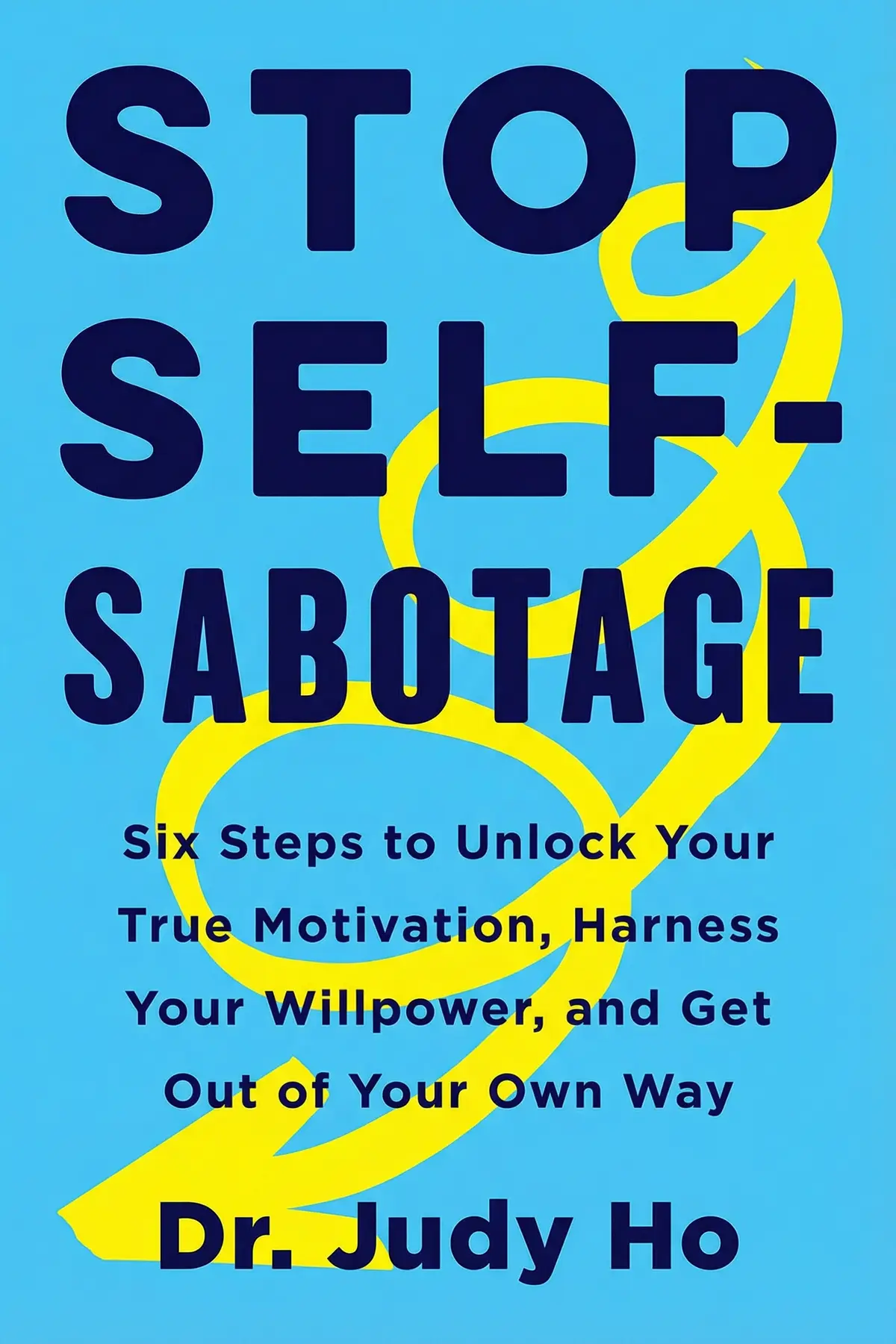
Many people set the same goal every year, whether it is eating better, saving money or finishing work on time, and watch it fade within weeks. Neuropsychologist Judy Ho traces this pattern to two survival drives, seeking rewards and avoiding threats, that have fallen out of balance. Self-sabotage grows out of two survival drives, seeking rewards and avoiding threats, and the trouble starts when the two fall out of balance. Ho's answer is a six-step program drawn from her clinical experience and from scientific research, with exercises at each stage. Readers learn to name six kinds of distorted thinking, to step back from a triggering thought before acting on it, and to trace bad habits back to the situations that set them off. They then rate how realistic a goal is, write a plan for the moments when willpower is low, and tie their effort to their personal values. Two people show how the steps work in practice: Alice, whose suspicion pushed a boyfriend away, and Ho's client Janie, who had a long history of putting off work projects. The program ends with one hand-drawn poster that puts the whole plan in view.
People who set the same goal every year and watch it fade within weeks.
Procrastinators and anxious overthinkers who want to know what really sets off their worst habits.
Anyone who likes structured, pen-and-paper exercises for changing behavior.
Dr. Judy Ho is a triple board-certified clinical and forensic neuropsychologist and a tenured professor at Pepperdine University. She runs a private practice in Manhattan Beach, California, doing neuropsychological assessments and expert witness work, and has twice received the National Institute of Mental Health Services Research Award. She earned her doctorate in clinical psychology through the joint program of San Diego State University and the University of California and completed a fellowship at UCLA's Semel Institute. She has appeared as a host and expert on television shows such as The Doctors.
Listeners find that this self-help guide offers actionable advice and activities, backed by clear research, and is simple to navigate through a direct six-step method. The material is an engaging read that aids in positive personal growth, as one listener notes it divides exercises into bite-size chunks. Listeners value its transparency, with one mentioning it leaves little room for confusion.
Dr. Judy Ho really hit the nail on the head with her analysis of why we become our own worst enemies. I’ve read a lot of self-help, but the way she connects biological triggers to daily habits felt fresh and actionable. Unlike other books that just tell you to 'be better,' this one gives you a literal roadmap with specific homework that actually makes sense. Personally, I loved the self-assessments because they weren't just fluff; they actually forced me to look at my fear of failure in a new light. It’s written in a very supportive, encouraging tone that makes you feel like she’s right there in the room with you. If you’re tired of failing at your New Year’s resolutions by February, buy this. It’s a well-written and insightful journey into the mind.
Show moreTruth is, I wasn't expecting much from another self-help book, but Dr. Judy’s approach to self-sabotage is genuinely insightful. She doesn't just tell you what to do; she explains the why behind our most self-destructive tendencies in a way that is easy to digest. I’ve started using her 'quick' exercises whenever I feel a spiral coming on, and they’ve honestly helped me stay on track with my healthy eating goals. The book is well-paced and moves quickly from theory to practice, which I appreciated. It feels like having a private therapy session for a fraction of the cost. Highly recommend for anyone who feels stuck in a cycle they can’t seem to break on their own. It transforms your thought patterns into something more effective.
Show moreAfter hearing Dr. Ho speak on a podcast, I knew I had to get her book, and it did not disappoint. The way she breaks down the science of motivation into bite-sized chunks makes the daunting task of self-improvement feel actually achievable. I’ve always been my own worst critic, but this book taught me how to recognize those internal sabotage voices before they take over. The 6-step plan is straightforward and leaves very little room for confusion, which is exactly what I need when I’m feeling overwhelmed. It’s an empowering read that puts the control back in your hands. If you’re ready to actually do the work and stop making excuses, this is the perfect guide to help you get out of your own way.
Show moreFinally got around to reading this after seeing it everywhere, and I have to say the structured six-step plan is actually quite effective. I usually struggle with self-help books that are too 'woo-woo,' but this one feels grounded in actual research and clinical experience. The way Dr. Ho breaks down our psychological triggers helped me realize why I always sabotage my fitness goals right when I start seeing progress. Not gonna lie, some of the middle chapters felt a bit repetitive, and I did skim a few of the longer anecdotes. However, the exercises are manageable and don't feel like a second job. If you’re looking for a straightforward guide to getting out of your own way without too much fluff, this is a solid choice. It gives you the language to understand your own brain.
Show morePicked this up on a whim during a particularly bad week of procrastination and found it surprisingly grounded. The author avoids the usual 'just think positive' nonsense and instead focuses on how our brains are literally wired to keep us safe, even when that safety is holding us back. Look, the exercises do take effort—you can't just read it and expect to change—but the steps are clear enough that you won't get lost. I particularly liked the distinction between short-term and long-term habits. My only real gripe is that the tone can be a bit 'TV personality' at times, which might not be everyone’s cup of tea. Still, for a practical guide on behavior change, it's one of the better ones out there. It’s clear, researched, and very easy to follow.
Show moreEver wonder why you start checking Instagram the minute you have a big deadline looming? This book dives deep into those exact behaviors and provides a very logical explanation for why our willpower fails us so often. I found the sections on triggers to be incredibly eye-opening because I never realized how much my environment was dictating my choices. It’s a very practical, no-nonsense kind of read that focuses on results rather than just theory. While I think some of the case studies were a bit simplified, the actual tools for managing stress in real-time are excellent. It's definitely a book you need to sit down with and actually do the work for it to be worth your time. The self-assessments are especially helpful for finding your specific starting point.
Show moreThe chapter on identifying primary motivators was definitely the highlight for me, as it provided a clear framework for understanding my own behavior. That being said, the book often feels a bit long-winded for the amount of unique information it actually provides. While I appreciated the 'bite-size chunks' of the exercises, some of the language used felt a bit dated or overly clinical for a general audience. To be fair, I did find a few useful tips regarding my work procrastination habits, but I’m not sure I needed over 200 pages to get there. It’s a decent introductory text for those new to psychology, but hardened skeptics might find the tone a bit too much like a motivational speech. It’s okay, but it didn't quite revolutionize my life the way the marketing suggested it would.
Show moreNot what I expected given the high praise, but it’s certainly not a bad book by any means. The structure is very logical and the Six Steps are easy to follow, but I felt like I had heard a lot of this advice before in other podcasts and articles. It’s a very Western, individualistic approach to change—very much about 'harnessing willpower' and 'controlling the self.' While that works for some, I think it misses the mark on how our relationships and community impact our success. The writing is clear and the research is definitely there, but it didn't quite provide the 'Aha!' moment I was hoping for. It’s a good starter guide, but maybe not for those who have already read extensively in this genre or been in therapy for years.
Show moreAs someone who has spent years in therapy, I found this book to be a bit of a letdown in terms of depth. It heavily relies on the 'ego' as a tool for change, which often just reinforces the very patterns of self-judgment that lead to sabotage in the first place. The 'Beth' case study felt like a cardboard cutout designed to make the doctor look good rather than a nuanced look at human struggle. I’m also skeptical of any book that promises a simple six-step cure for complex psychological issues. It feels very aimed at a specific demographic of women who have First World problems but lack the tools for deeper introspection. There’s some okay advice on willpower, but it lacks the soul of more holistic or relationship-based approaches to growth. I felt like I was being sold a product rather than being helped.
Show moreMaybe it’s just me, but I found the entire premise of the fictional character 'Beth' to be incredibly grating and obviously fabricated to fit a specific narrative. Dr. Ho’s approach feels like another attempt to capitalize on a Westernized self-help culture that completely ignores systemic issues like class or race. It focuses so heavily on the ego and personal willpower that it actually feels counterproductive to true self-acceptance. If you’re struggling with deep-seated addiction or trauma, a few journaling prompts won’t replace the community found in a 12-step program or intensive therapy. Frankly, the advice is quite basic—things like breaking your goals into steps—which anyone could find for free online. It felt more like a promotional tool for her TV career than a serious psychological manual. The constant 'shoulding' in the text just adds more pressure to an already stressed reader. It’s an egocentric look at change that misses the forest for the trees.
Show moreHo argues that self-sabotage grows from two survival drives, seeking rewards and avoiding threats, that have fallen out of balance. It follows a chain: an event sparks a thought, the thought creates a feeling, and the feeling drives an action. Her six-step program teaches you to catch distorted thoughts, find what triggers bad habits, set realistic goals, plan for obstacles, lean on your values and map it all on one poster.
Ho names overgeneralizing or catastrophizing, shoulds-based thinking, black-and-white thinking, mind reading, discounting the positive and personalization, which means constantly measuring yourself against others. To find yours, she suggests setting four alarms spread across your waking day, writing down your thoughts each time, and checking them against the six types over several days to see which ones keep coming back.
ABC stands for antecedents, behaviors and consequences. Ho suggests working backward: start with long-term consequences you dislike, find the behaviors behind them, including those that feel good only in the moment, then study what happens just before you act. Her client Janie found her procrastination began after criticism from her boss, because avoiding work helped her avoid stressful thoughts for a while.
MCII combines mental contrasting with implementation intentions. First, rate from 1 to 10 how much you believe you will reach your goal, list every obstacle, then rate it again. If the score falls below 7, adjust the timing, the outcome or break the goal into smaller steps. Then write specific instructions for handling each obstacle, so you have a guide ready when you are tired and willpower is low.
It suits people who keep returning to the same unmet goal, such as healthier eating, saving money or finishing work on time. It also helps overthinkers whose worries spill into relationships, like Alice in the book, and procrastinators like Janie. Readers who enjoy hands-on exercises, from index-card value sorting to a hand-drawn poster plan, will get the most from it.
Richard Wiseman





William B. Irvine


Andrew D. Thompson


Deepak Chopra
AUDIO SUMMARY AVAILABLE
Get the key ideas from Stop Self-Sabotage by Judy Ho, plus 5,000+ more nonfiction titles.









