
15 min 15 sec
Available in: English
Stop Reading the News: A Manifesto for a Happier, Calmer and Wiser Life
By Rolf Dobelli
Explains why a constant stream of headlines leaves you anxious, distracted and no better informed. It also shows how a 30-day news break and a shift toward deep reading can bring back calm and focus.

Table of Content
1. Introduction
58 sec
If you start the day scrolling headlines and end it feeling anxious and scattered, Rolf Dobelli has a blunt prescription: stop completely. In Stop Reading the News, the Swiss author argues that news is designed to grab attention, not to inform, and that a steady diet of it reshapes how your brain works and how your body handles stress.
Dobelli speaks as a former addict. He traces the habit back to the first daily newspapers, follows it into the brain and the bloodstream, and then shows what replaces it. His case is that giving up news entirely leaves you calmer, sharper and no worse informed about anything that truly affects your life.
Along the way you will hear why London taxi drivers have different brains from bus drivers, what a 30-day news fast looks like in practice, why a heart surgeon who ignores headlines is the one to trust, and how to remain a responsible citizen once the apps are gone.
2. Recognize how a news habit swallows your focus
1 min 33 sec
A teenager in a Swiss library wanted to become worldly and sophisticated. Years later, he could no longer finish a long article. His story shows how a respectable habit can turn on the person who feeds it.
3. Sort what is new from what matters
1 min 38 sec
Try to name the biggest headlines from five years ago and most people come up nearly empty. That blank is a clue to a business model that has barely changed in almost four centuries.
4. Protect your attention span by cutting constant headlines
1 min 42 sec
The brains of London cab drivers grow to fit their work. The same flexibility means every hour of headline hopping is training your mind for something, and it is probably not the thing you want.
5. Protect your body from the stress of bad news
1 min 48 sec
A falling share price hurts far more than a rising one pleases. The media did not create that bias but exploits it for clicks, and the cost lands in your bloodstream and your immune system.
6. Turn concern for disaster victims into real help
1 min 40 sec
When an earthquake strikes far away, refreshing for updates feels like an act of compassion. Dobelli asks who actually gains from all that attention, and his answer is not the people under the rubble.
7. A 30-day break that brings back calm
1 min 30 sec
Cutting down rarely works for a habit this sticky. Dobelli’s plan is far more drastic, and he is candid about the awkward first week and about what tends to happen once it is over.
8. Build deep skill inside your circle of competence
1 min 34 sec
Picture choosing between two heart surgeons on the morning of your operation. The choice feels obvious, and it says something unflattering about how most of us spend our spare attention.
9. Stay an informed citizen without daily news
1 min 40 sec
Quitting the news can feel like abandoning democracy. Dobelli looks back to Ancient Greece, the thinkers of the Enlightenment and the Watergate reporters to argue that the opposite may be closer to the truth.
10. Conclusion
1 min 12 sec
Dobelli’s manifesto rests on a reversal. The news presents itself as the price of being a serious, caring, informed adult. He argues it is closer to the opposite: a stream of novelty sold to advertisers that leaves you more scattered, more stressed and no more useful to anyone. The teenager in the Lucerne library wanted to become worldly. The adult who could no longer finish a book discovered the habit had taken far more than it gave.
What the book supports is a clean break. Delete the apps, clear the browser and get through 30 days without headlines. Put the reclaimed hours into books, careful reporting and the one field where you want to be excellent, and let a weekly digest cover the rest. When disaster strikes far away, send money to the people who can help, then put the screen down.
Dobelli also offers a small practice that holds the whole idea. Ask a friend to tell you about the one subject she knows best, talk it through in depth, and next time return the favor. An hour like that may teach you more than a month of alerts.
About this book
What is this book about?
Many people check the news before they are fully awake and keep checking all day, feeling more anxious with every update. Rolf Dobelli, a former news addict himself, argues that this habit gives almost nothing back. News is built around what is new and eye-catching, not what matters to your life, and the business model behind it depends on keeping you clicking. Drawing on brain research, Dobelli shows how heavy news reading trains the mind for skimming and erodes the capacity for deep thought. He explains how our bias toward bad news is exploited by the media and how the resulting stress can weaken the body. He also challenges the comfortable belief that following a disaster is a form of compassion. His remedy is radical: quit the news entirely for 30 days, then fill the freed time with books, long-form journalism and focused work inside your own circle of competence. He answers the obvious objection too, explaining why democracy and informed citizenship can thrive without rolling headlines. Readers get a clear case for stepping away and a practical plan for doing it.
Book Information
Who it's for
Professionals scattered by headlines
Professionals who check headlines first thing in the morning and feel scattered and anxious by noon.
Wanting their focus back
Former book lovers who now lose focus after a few pages and want their concentration back.
Worried about staying informed
Anyone who worries that quitting the news means becoming an uninformed citizen.
About the Author
Rolf Dobelli
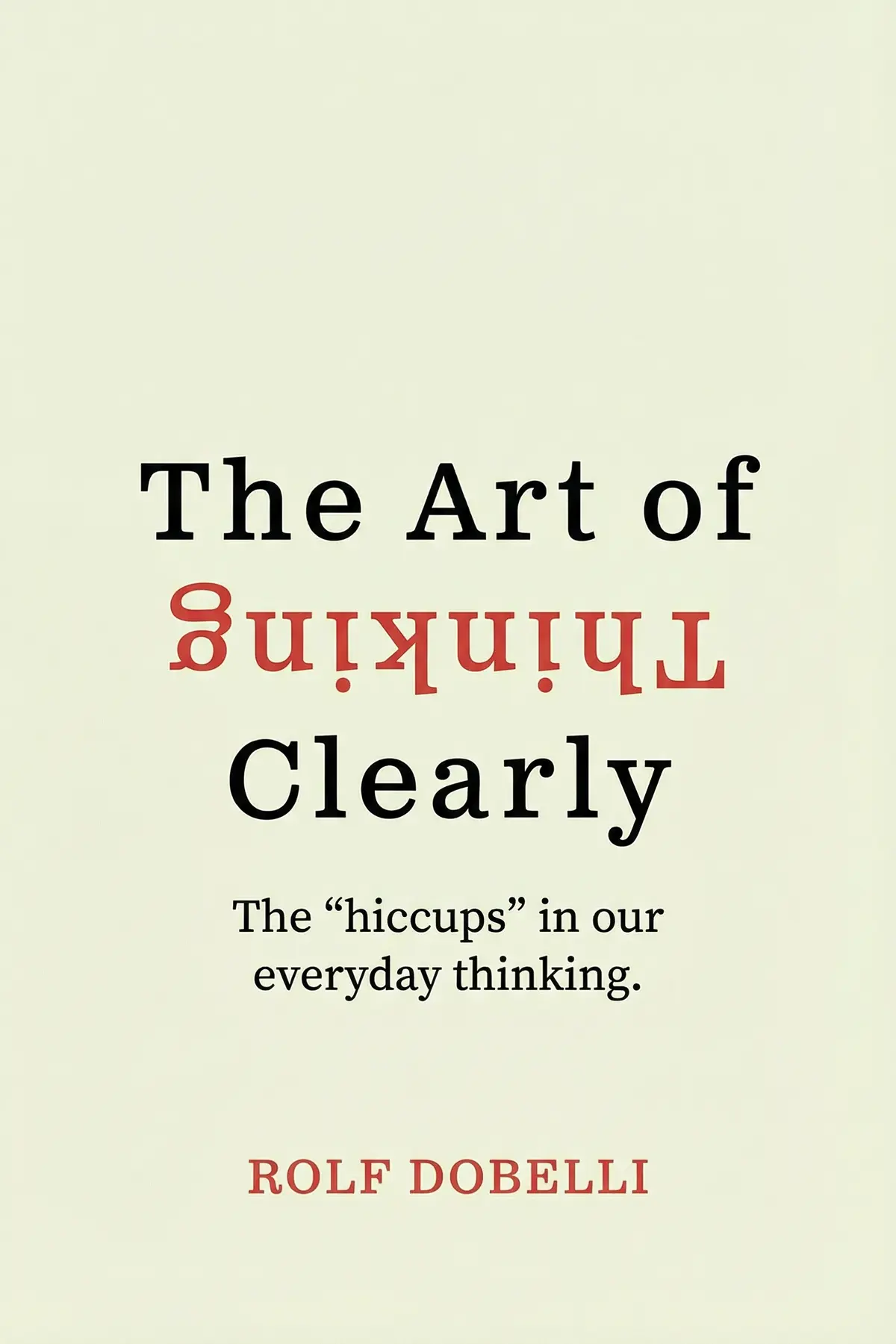
Rolf Dobelli was born in 1966 in Lucerne, Switzerland, and holds a PhD from the University of St. Gallen. He began as a novelist before his best-selling non-fiction book The Art of Thinking Clearly brought him international recognition. He founded World.minds, a community of leading figures from science, business, geopolitics and the arts. His books have been translated into 47 languages, and his own years of compulsive news reading shape this book.

Ratings & Reviews
Ratings at a glance

What people think
Listeners find the writing captivating and mentally stimulating, with one listener noting it helped them quit news consumption entirely. However, the work has drawn complaints for being unreadable and having pages out of sequence.
Top reviews
Witthaya
This book acts like a bucket of cold water for the digital age. Dobelli uses a sharp metaphor comparing news to sugar and books to actual nutrition, which really resonated with my recent feelings of burnout. I have been mindlessly scrolling for years, but this provided the push I needed to finally delete my news apps. Some chapters are admittedly quite short and a bit repetitive, yet the core message about protecting your 'circle of competence' is vital. If you’re feeling constantly riled up by things you can't control, give this a chance. It’s not perfect, but it is highly thought-provoking and engaging.
Show moreHannah
Ever wonder why you feel anxious after five minutes of checking the morning headlines? Dobelli explains that our brains are simply not wired for the constant stream of global tragedies that we have zero power to influence. Since finishing this, I have completely stopped watching the news and replaced that time with long-form biographies and technical books. My concentration has improved significantly and I feel much more at peace. To be fair, he wrote this before the pandemic, so some of his 'breaking news doesn't matter' logic feels slightly dated now. Regardless, the mental clarity I've gained is worth the price. It is truly life-changing.
Show moreOn
Finally got around to this manifesto and I'm glad I did. It is a refreshing, albeit radical, take on how we consume information in the 21st century. The chapters are very short, which makes it easy to digest, though the author would probably prefer I read a massive textbook instead! I found his arguments about news killing creativity and reinforcing hindsight bias to be particularly strong. It’s a very engaging read that challenges the modern assumption that being 'informed' is a moral duty. If you're tired of the constant outrage cycle, this book offers a viable way out. I feel much lighter now that I've stopped scrolling.
Show moreManee
Picking this up felt like a necessary intervention for my attention span. Dobelli argues that news is a toxic distraction that inhibits deep thought, and frankly, looking at my own productivity, he’s right. I appreciate the focus on long-form journalism and textbooks over the 'infotainment' that dominates our screens today. However, the book does feel slightly dated since it was written before the pandemic when breaking news actually became a matter of survival. I don't agree with every extreme conclusion, but the shift in perspective is worth it. It’s a fast read with very short, punchy chapters that get straight to the point.
Show moreSamroeng
After hearing so much about Dobelli’s other work, I had high expectations for this manifesto. The book is incredibly thought-provoking and makes a compelling case for why news is the 'sugar' of the information world. I especially liked the sections on how 'availability bias' ruins our ability to assess real risks in our lives. We worry about plane crashes but ignore our blood pressure. My only gripe is that it feels a bit 'boomer' in its dismissal of social media’s ability to highlight marginalized voices. Still, I’ve cut my news consumption by 90% since reading it and I don't feel less informed, just less stressed.
Show moreArt
Truth is, I’ve reduced my news intake significantly over the years, so this book confirmed many of my own suspicions. The author is a businessman, and it shows in his efficient, no-nonsense writing style. He correctly identifies that journalists are under pressure to churn out 'eye-catching' headlines for clicks, often at the expense of the truth. This 'churnalism' is exhausting. While I think he’s too extreme in saying we should avoid all news, his points about protecting our 'circle of competence' are brilliant. It's a quick read that will make you rethink your relationship with your smartphone. I definitely felt more productive after putting it down.
Show moreThanakorn
Frankly, the premise is excellent but the execution left me wanting more. I agree with the author that news makes us passive and miserable by constantly highlighting tragedies we can’t fix. But his repetitive use of 'dear reader' felt like he was trying too hard to be an 18th-century novelist. It got under my skin after the tenth time. The truth is that while the book is engaging, it’s also quite repetitive; he could have easily condensed these 160 pages into a long-form essay. It’s a decent starting point for a digital detox, just be prepared for some condescending lectures along the way.
Show moreKru
Not what I expected from a book about productivity. On one hand, the author is right that we spend too much time on 'disaster porn' that adds nothing to our lives. On the other hand, the writing is quite repetitive and he generalizes like mad throughout the middle chapters. Some of his advice is just impractical for the average person who needs to know if a local law is changing or if a road is closed. He sounds like someone who wants to live in the 1800s. I’d recommend it for the unique perspective, but don't take his 'cold turkey' advice as gospel. Just be more selective.
Show moreKet
Frustrating experience because the physical copy I received actually had pages out of order, making the second half almost unreadable. Even putting the manufacturing issues aside, the author’s tone is incredibly patronizing and feels quite superior. He repeats the same few arguments for 160 pages without offering much in the way of peer-reviewed research or nuance. While I agree that 'churnalism' is a problem, his demand for a total cold-turkey ban is unrealistic for anyone who wants to remain a functional member of society. It feels like a high school debate performance rather than a serious philosophical work. I expected better from the author.
Show moreAva
Look, I wanted to like this, but the author’s privilege is just too loud to ignore. He suggests that we should just ignore the news and let 'other people' tell us if something important happens. Who are these other people if everyone follows his advice? Also, claiming that consuming news is 'unintentionally supporting terrorism' is an absurd logical fallacy that made me want to throw the book across the room. It’s a very idealistic view that only works if you’re wealthy enough to not be affected by policy changes. There are some good points about mental health hidden in here, but they’re buried under a mountain of arrogance.
Show moreQuestions about this book
What is the main idea of Stop Reading the News?
Rolf Dobelli argues that news is built around novelty and clicks rather than relevance to your life. Heavy consumption, he says, rewires the brain for shallow, distracted thinking, exploits our bias toward bad information and causes stress that harms the body. His solution is to give up news entirely and replace it with books, long-form journalism and focused work in your own field.
How does Rolf Dobelli suggest quitting the news?
He calls his method radical abstinence: a complete break lasting 30 days. Delete news apps, remove news sites from your browser favorites, set a homepage without headlines, stop buying papers and turn off television and radio news. He admits the first days are hard, but expects that by the end of the month you will feel calmer, think more clearly and have little wish to return.
Does reading the news really change your brain?
Dobelli argues it does, because the brain keeps reshaping itself according to habit. He points to a University College London study showing London taxi drivers had more nerve cells in the hippocampus than bus drivers, and to University of Tokyo research linking heavy multi-media use with fewer cells in the anterior cingulate cortex, a region tied to attention and moral reflection.
Can you be an informed citizen without reading the news?
Yes, in Dobelli’s view. Citizens of early Greek democracy and thinkers like Rousseau, Locke and Hume relied on debate, essays and pamphlets, not rolling updates. He separates daily news from in-depth journalism, such as the Watergate investigations by Woodward and Bernstein, and suggests a weekly round-up like the Economist’s The world this week to keep up with current affairs.
Who should read Stop Reading the News?
It suits people who check headlines compulsively and feel anxious or unfocused as a result, readers who have lost the ability to concentrate on books, and professionals who want more time for deep work in their own field. It also speaks to anyone who follows disasters closely out of empathy and wants a more useful way to help.
Readers also enjoyed

59 Seconds: Change Your Life in Under a Minute
Richard Wiseman





A Guide to the Good Life: The Ancient Art of Stoic Joy
William B. Irvine


A High-Performing Mind: Strengthen Your Mind and Live Your Best Life
Andrew D. Thompson


Abundance: The Inner Path to Wealth
Deepak Chopra
AUDIO SUMMARY AVAILABLE
Listen to Stop Reading the News in 15 minutes
Get the key ideas from Stop Reading the News by Rolf Dobelli, plus 5,000+ more nonfiction titles.
- 5,000+ titles
- Listen as much as you want
- 7-day free trial
- Cancel anytime









