

14 min 38 sec
Available in: English
Stick with It: A Scientifically Proven Process for Changing Your Life – for Good
A practical, research-based method for keeping goals past the first few weeks: size them into small steps, find a group that pulls you along, clear obstacles from your home and replace bad habits instead of fighting them.
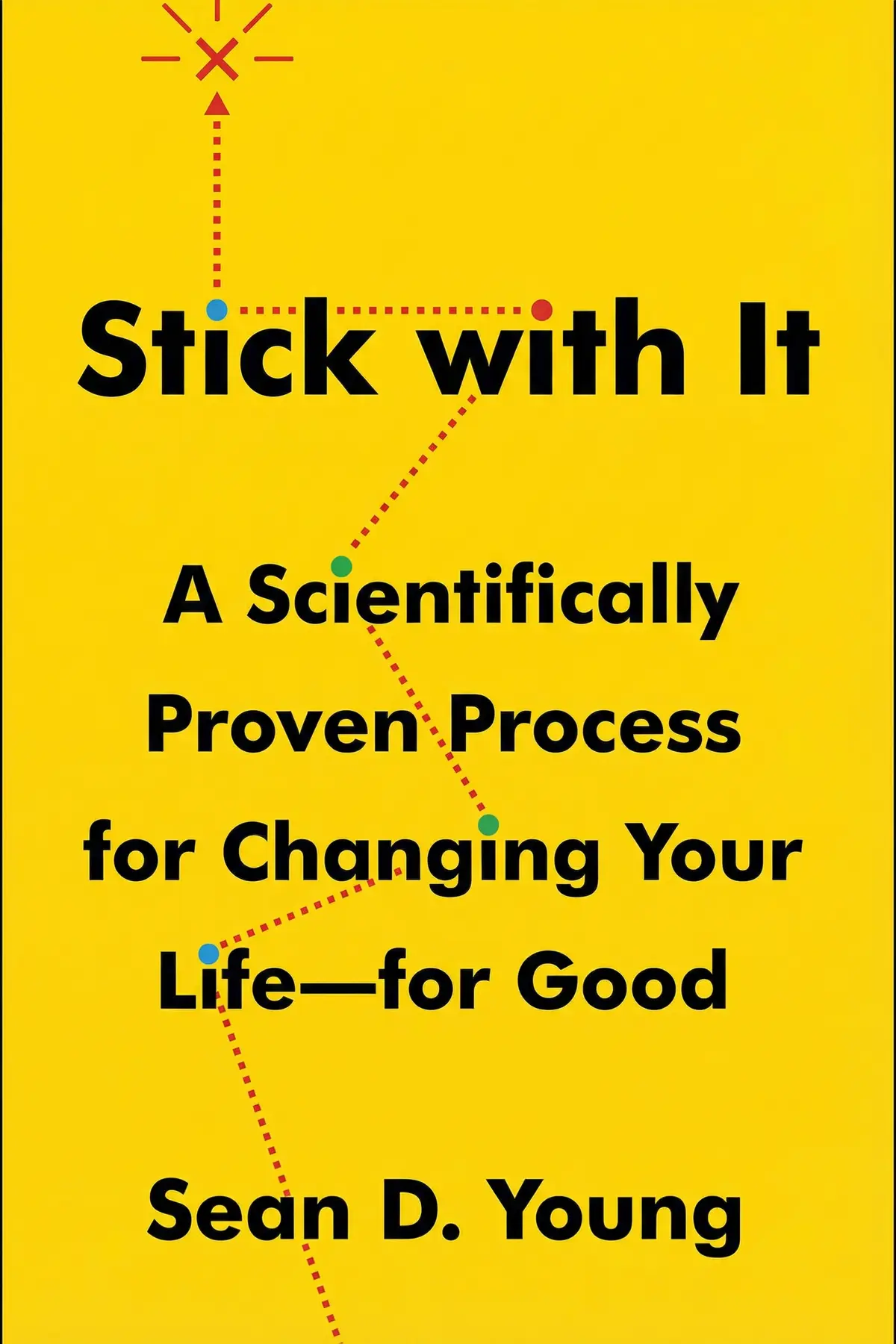
Table of Content
1. Introduction
1 min 00 sec
Most resolutions are dead by late February, and Sean D. Young blames plans that fight the way the mind works. In Stick with It, the UCLA professor, who leads the university’s Center for Digital Behavior, starts from a weight-loss finding: women who aimed at daily targets lost weight, while those chasing a monthly number gained. The brain rewards itself each time it ticks off a small goal, and that reward keeps people going.
Young’s throughline is that lasting change comes from working with predictable human tendencies: our appetite for small wins, our need for other people, our response to personal stakes and our habit of taking the easiest path. His evidence runs from smokers and voters to prisoners, patients and an online community he helped build. What follows is a toolkit for the goal you keep restarting: how to size it, who to share it with, how to set up your home and what to do with the habit standing in your way.
2. Break big dreams into steps you finish this week
1 min 46 sec
Among women trying to lose weight, those who fixed on hitting a target by the end of the month actually ended up heavier. The difference came down to how far away each group placed its finish line.
3. Let a like-minded group carry you further
1 min 41 sec
People who belonged to an anonymous online forum were found to be two times more likely to go for testing than those outside it. The reason reaches down to how the brain registers warmth and pain.
4. Make the stakes personal enough to picture
1 min 45 sec
A general health warning barely moves smokers, and a retirement plan barely moves savers. One small change to what people saw shifted both, and it has nothing to do with scaring them.
5. Clear the obstacles and draw yourself a map
1 min 44 sec
Two groups read the same leaflet about a dangerous infection, yet only one of them went and got protected. The missing piece had nothing to do with knowing the risks.
6. Act your way into confidence and a new identity
1 min 44 sec
Twelve minutes of conversation changed how a group of anxious men felt for months afterward, and a single word in a survey question changed who turned up to vote.
7. Use rewards wisely and skip fear to stay motivated
1 min 50 sec
A frightening health campaign was followed by falling condom use in the most at-risk areas, while inmates in a prison program that rewarded good behavior with padded chairs accounted for just two percent of rule violations. Yet rewards have a weakness of their own.
8. Swap each bad habit for a better one
1 min 56 sec
A soldier haunted by flashing lights and loud noises found relief where medication had failed. His story shows why bad habits are rarely beaten head-on, and why the right fix depends on the habit.
9. Conclusion
1 min 12 sec
Young treats lasting change as a design problem about people. Each of his tools borrows a predictable part of human nature: the small dopamine lift of a finished task, the pull of a group, the force of a vivid personal stake, our drift toward the easiest path, and the way actions and words reshape how we see ourselves. Willpower is left with far less work to do, and that is exactly why the plan survives a bad week.
This week, cut your largest goal down to a step you can finish within two days, and start calling yourself by the identity that goes with it. Take one temptation out of your home and write down where and when the first step happens. Find people, in a room or online, who want the same thing. When an old habit fires, ask whether it is automatic, burning or common, and give it a replacement instead of a scolding.
For a mind that handles change better, Young also suggests an improv or jazz class, since both train you to adapt and stay in the present moment. The resolution that lasts past February is usually the one that asked the least of willpower.
About this book
What is this book about?
Every year brings the same resolutions: get fit, eat better, quit smoking, finish the project. Most of them fall apart within weeks. Sean D. Young, a UCLA professor who studies digital behavior, argues that the problem is rarely weak character. Usually the plan works against the way the mind works. Young builds his method from studies of dieters, smokers, voters, prisoners and patients, and from HOPE, an online community he helped create for men at risk of HIV. He shows why daily targets beat distant ones, why a group can hold you better than resolve can, why a specific personal stake moves people where a general warning fails, and why a map to the clinic matters as much as the reasons for going. He also explains why fear-based motivation fades, where rewards stop working, and how to match a replacement habit to the kind of bad habit you have. Readers get a set of small, testable tools for any goal they keep restarting, along with the reasoning behind each one.
Book Information
Who it's for
Stalled health goal setters
People whose fitness, diet or quit-smoking resolutions collapse within weeks.
Workers postponing big goals
Professionals with a long project or savings goal that keeps slipping to next month.
Stuck habit changers
Anyone stuck on a habit like phone checking or snacking who wants a fix matched to the habit.
About the Author
Sean D. Young
Sean D. Young, PhD, is a professor at UCLA, where he works in the department of family medicine. He also leads the UCLA Center for Digital Behavior. In Stick with It he draws on behavioral research, including an online health community he helped design, to explain why attempts at change collapse and what makes them last.
Ratings & Reviews
Ratings at a glance
What people think
Listeners value the work's scientific rigor and the thorough blueprints for achieving goals, specifically highlighting the emphasis on habit formation through a scientific lens. Furthermore, the content is accessible and straightforward, with one listener describing it as a fast read packed with evidence-based ideas. Nevertheless, opinions on the prose are divided; while some think it is composed well, others find it terrible. The book's momentum also sparks differing views, as some feel the pacing is not captivating at all.
Top reviews
Teng
Sean Young’s approach to behavioral change feels like a breath of fresh air in an overcrowded self-help market because it actually relies on hard data. To be fair, most of these books are just collections of anecdotal fluff, but here we get a systematic breakdown of the SCIENCE method. I particularly appreciated the 'Easy' pillar, which focuses on controlling your environment to limit choices rather than just relying on willpower. It’s a fast-paced read, and the strategies are presented in a way that feels achievable for anyone struggling with long-term goals.
Show moreYanin
Look, I’m an introvert who usually avoids 'community-based' self-help, but the breakdown of social magnets changed my perspective on habit formation. I always thought I had to do everything through sheer self-discipline, but the chapter on 'Captivating' rewards and the need to fit in made a lot of sense. The book explains how trust is formed when people share small things about their day, which eventually creates a community that fosters lasting change. It’s a very sound approach to human psychology. Even though I’m self-employed and work alone, I can see how these principles apply to my own social circles.
Show moreSurasit
Honestly, it’s rare to find a habit book that prioritizes actual psychological studies over mere 'hustle' anecdotes, and Sean Young delivers a very readable summary of how to create engrained behaviors. The sections on controlling your environment to make good choices easy were the highlights for me. While the writing can be a bit simplistic in places, the evidence-based ideas are strong enough to carry the book. If you are struggling with procrastination or just want to understand your own brain better, this is a gem of a resource. It is much better than the typical motivational guides on the market.
Show moreMaja
As someone who works in behavioral therapy, I found the parallels between human habit formation and dog training to be quite fascinating. Young references how rewarding behavior works similarly for us as it does for animals, which is a concept anyone who watches Cesar Millan will recognize immediately. The truth is, we often aim for these massive changes without breaking them down into the tiny increments needed to build a chain link. This book does a great job of explaining how to turn vague goals into measurable steps. It’s practical, evidence-based, and highly applicable to my daily work with young people.
Show moreJin
Picked this up during a particularly bad bout of procrastination and found the 'stepladder' concept remarkably practical for my workflow. The idea is to stop staring at the top of the mountain and just focus on the very next rung, which really helped me stop overthinking my projects. In my experience, anchoring these new actions to existing routines makes them feel much more engrained over time. While some of the examples felt a bit repetitive, the focus on 'Neurohacks' kept me engaged enough to finish the book. It provides a very structured way to start thinking about systematic change.
Show moreJoe
Finally got around to finishing this, and while it’s a bit repetitive, the 'Neurohacks' chapter is worth the price of admission alone. It’s one thing to want to change, but it’s another to understand the brain science that actually allows a person to 'stick with it' over the long haul. Not gonna lie, I was skeptical about the chain link concept at first, but it works. I liked how the book emphasizes that we keep doing things that make us feel good about ourselves, focusing on self-worth. It’s a helpful guide for anyone who struggles with finishing projects.
Show moreMikael
After hearing so much about the 'SCIENCE' method, I finally cracked this open, but the tone really threw me off. The writing style feels a bit patronizing at times, almost as if it was written for middle school kids rather than adults. There’s a line where he explains that people aren't like tree leaves because we have brains, and I just had to pause and cringe. Look, the underlying psychological studies are actually quite interesting and provide a good overview of motivation. However, the delivery is a mixed bag of hokey stories and ego-scratching that makes the reading experience a bit of a slog.
Show moreChanon
To be fair, the core methodology here is solid even if the delivery is excruciatingly dull at times. I think this whole book could have been a ten-slide PowerPoint presentation without losing any of the actual value. The author spends a lot of time on his own accomplishments, which felt a bit like unnecessary name-dropping after the third or fourth time. If you can get past the 90s-style consultant mnemonics and the constant repetition, there are some real tools here. Simply read the last chapter where everything is finally summarized and avoid the fluff.
Show moreAubrey
Why am I being explained how an online group works in a book published recently? It felt like a bizarre 2002 time capsule. Sean Young spends way too much time detailing the basic concept of the internet and how people use things like ICQ or Meetup to connect. Frankly, if you’ve been online at all in the last fifteen years, this information is painfully basic and adds nothing to the actual science of behavior change. The core message that you need a like-minded community is fine, but the delivery is just so dated that it’s hard to take the rest of the research seriously.
Show moreMax
Not what I expected from a researcher at UCLA, as the 'cheese-meter' was definitely hitting red throughout most of the chapters. Between the cutesy acronyms and the weirdly specific detail about almost being in Linkin Park, it felt more like a celebrity memoir than a serious study. Personally, I find these types of 'S.C.I.E.N.C.E.' methods to be a bit reductive for the reality of complex human behaviors. While the root of what he’s saying about environment and small steps is definitely true, the presentation is just too much like a generic self-help manual for my taste.
Show moreQuestions about this book
What is the main idea of Stick with It by Sean D. Young?
Young argues that most goals fail because the plan works against human nature, not because people lack willpower. Lasting change comes from small finishable steps, a supportive community, personal stakes you can picture, a home with fewer temptations, actions and words that shape your identity, the right kind of motivation and good habits that replace bad ones. He supports each tool with studies of dieters, smokers, voters, prisoners and patients.
How does Stick with It suggest breaking down goals?
Young sorts ambitions into three layers. Steps take two days or less, like buying a workbook. Short-term goals take about a week and add up to long-term goals of about a month. Dreams take three months or more. For a book, that means a page a day, 2,000 words a week, a chapter a month and the finished book as the dream. Frequent small wins keep the brain’s reward system engaged.
Does fear work as motivation for changing habits?
Only briefly, according to Young. People treat fear as an immediate danger, so once time goes by and nothing bad occurs, old habits come back. Fear can also backfire: HIV campaigns built on frightening messages were followed by falling condom use in at-risk areas, as many people tuned the warnings out. Rewards work better, though Young warns that the improvement itself should be the main prize, since incentives alone fade.
What are the three types of bad behavior in Stick with It?
Automatic behaviors happen without awareness, like nail-biting, and are best handled by removing temptation and substituting something such as chewing gum. Burning behaviors are urge-driven compulsions, like constant phone checking, so you switch the phone off at set times and read instead. Common behaviors are conscious choices, like skipping exercise, and respond best to a like-minded group that keeps you accountable.
Who should read Stick with It?
It suits anyone who keeps restarting the same goal, from losing weight or quitting smoking to saving money or finishing a creative project. Readers who distrust pure willpower advice will find small, testable tools, such as clearing temptations from the home, calling yourself a runner instead of someone who runs, and joining a group that shares the goal.
Readers also enjoyed


A Liberated Mind: How to Pivot Toward What Matters
Steven C. Hayes



Acting with Power: Why We Are More Powerful Than We Believe
Deborah Gruenfeld




Age of Propaganda: The Everyday Use and Abuse of Persuasion
Anthony Pratkanis
AUDIO SUMMARY AVAILABLE
Listen to Stick with It in 15 minutes
Get the key ideas from Stick with It by Sean D. Young, plus 5,000+ more nonfiction titles.
- 5,000+ titles
- Listen as much as you want
- 7-day free trial
- Cancel anytime









