

11 min 57 sec
Available in: English
Status Games: Why We Play and How to Stop
Explains why the brain treats respect, praise and snubs as matters of survival, and how to keep your ambition while you stop living on the stress of constant comparison.
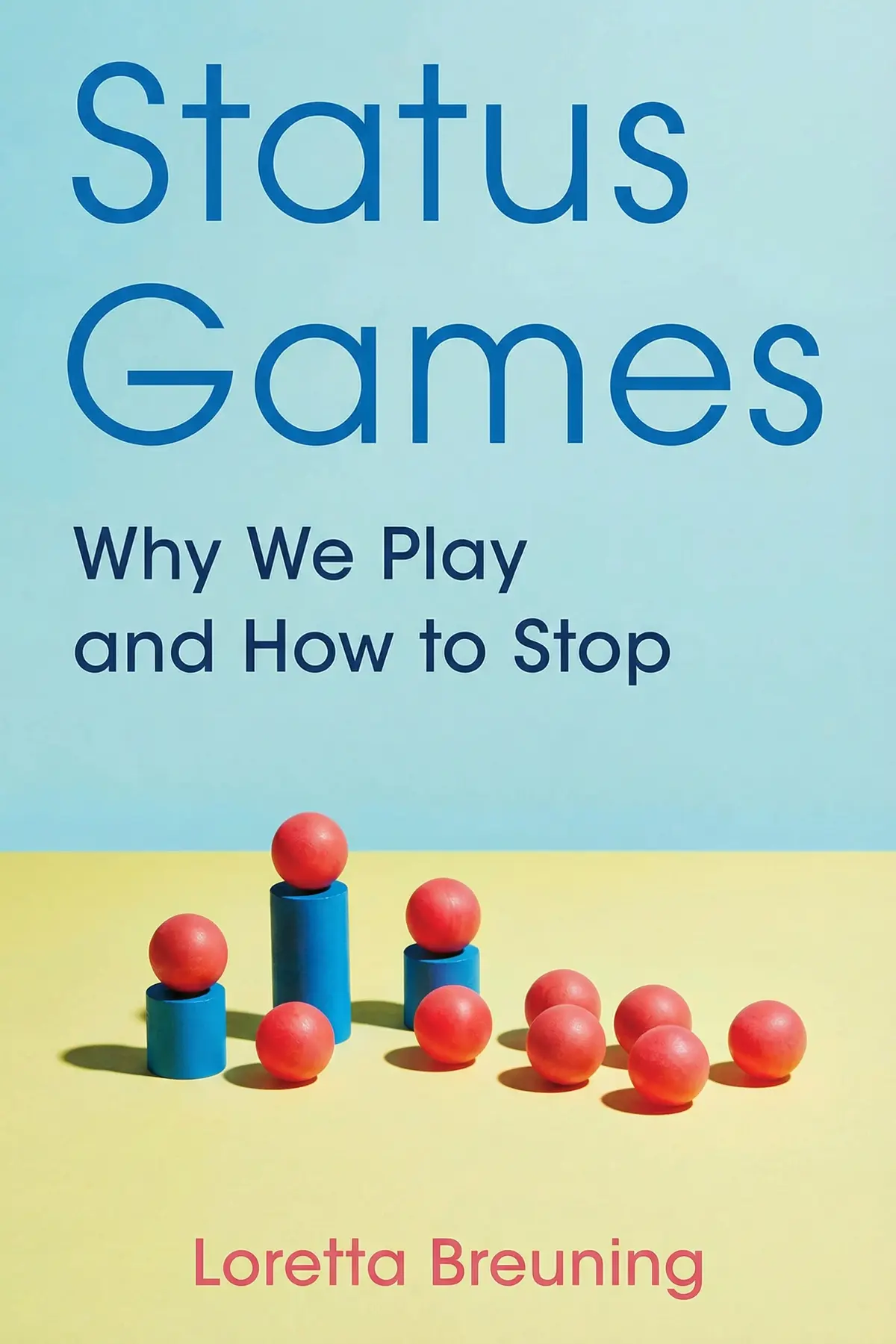
Table of Content
1. Introduction
1 min 05 sec
If you have ever replayed a small snub at work for hours, or checked a post again to see how many likes it gathered, you are not being shallow. In Status Games, Loretta Breuning, founder of the Inner Mammal Institute, argues that the hunger to feel important is biology. She holds that this drive sits deeper in us than the hunger for food or the desire for sex. We inherited it from earlier mammals, and the brain still rewards every sign of being respected and sounds an alarm at every sign of being overlooked.
Her throughline is simple. Once you see the status drive as old mammal wiring instead of a character flaw, you can stop letting it run you and point it somewhere better. That means understanding the two chemicals that keep your social score and finding a balance between endless striving and giving up. It also means swapping comparison for creation and helping others mostly through the way you live. The aim is calm ambition, on terms you set yourself.
2. Stop feeling ashamed of wanting to matter
1 min 43 sec
Confessing a wish to feel important can seem more awkward than discussing your love life. Breuning traces that wish back to a difference between how lizards and mammals raise their young, and the answer changes how it feels.
3. Read the two chemicals keeping your social score
1 min 40 sec
A compliment lifts you for an hour and a careless remark can ruin a whole afternoon. Breuning explains why the good feeling never lasts and why the bad one behaves as if your life were in danger.
4. See how other people's wins shape your feelings
1 min 35 sec
You can feel a jolt of envy at praise that has nothing to do with you. Breuning points to brain cells that treat what you watch almost as if it were happening to you.
5. Steady ambition without burnout or resentment
1 min 41 sec
Chasing every win wears you out, yet switching the drive off leaves its own bitterness. Breuning describes a third option, and it depends on rewards your brain gets without beating anyone.
6. Trade competing for creating
1 min 30 sec
Every ranking you enter produces a loser, and part of your brain keeps checking whether it is you. Breuning offers a route to feeling important that sidesteps the scoreboard entirely.
7. Help others by showing them, not telling
1 min 38 sec
Generosity feels like the opposite of status seeking. Breuning finds a small hidden reward inside it, and explains why the advice we rush to give so often misses what the other person needs.
8. Conclusion
1 min 05 sec
Breuning’s book offers a kind of relief. The part of you that counts likes, notices who got praised and stings at a careless remark is no flaw to hide. It is the brain of a nurturing, group-living mammal doing the job evolution gave it. Knowing that leaves your ambition intact and changes who is in charge of it.
The practical shift is to define winning on your own terms. When a snub sets off the alarm, remind yourself that no predator is present, and let the feeling pass before you act. Keep a steady supply of small, honest wins, progress you chose and connections you value, so your brain has rewards that do not depend on anyone losing. Where you have been competing, find something to build or solve instead. With the people you care about, let your example do most of the teaching.
Live that way and something else follows. Others, watching with the same mirror neurons you have, begin to learn calm from you. The game keeps running in every brain around you. You simply stop needing to win it.
About this book
What is this book about?
Most people spend more energy than they admit on wanting to matter: hoping for credit at work, counting likes, wincing at a small slight. Loretta Breuning argues that this is biology. The urge traces back to our mammal ancestors, and she sees it as even more deeply rooted in us than the drives to eat or mate. Her angle is brain chemistry. Serotonin rewards every sign of being respected but fades quickly. Cortisol sounds an alarm at every sign of being overlooked, as if a predator were near. Each experience leaves a trace, and mirror neurons let us absorb the status lessons of everyone we watch. From there the book turns practical. Readers learn to accept the drive without shame and to find a middle path between exhausting striving and resentful withdrawal. They also learn to feed the brain with progress and connection, and to swap competing for creating. A final section looks at the hidden status lift in helping others, and argues that example teaches more than advice.
Book Information
Who it's for
Professionals drained by comparison
Professionals who replay small slights at work and feel drained by constant comparison.
Hoping to stay driven
Ambitious students and early-career climbers who want to keep their drive without burning out.
Managers, parents and helpers
Managers, parents and natural helpers who want their support to land without advice that misses.
About the Author
Loretta Breuning
Loretta Graziano Breuning, PhD, founded the Inner Mammal Institute and is professor emerita of management at California State University, East Bay. Her books explain the brain chemistry humans share with earlier mammals, and they include Habits of a Happy Brain and Tame Your Anxiety, translated into many languages. Before teaching, she worked for the United Nations in Africa. She studied at Cornell and Tufts, and she leads zoo tours on animal behavior.
Ratings & Reviews
Ratings at a glance

What people think
Listeners find the book's content helpful, and one listener mentioned that it allowed them to see the world more clearly. Feedback on the work's clarity is mixed; one listener found the strategies simple to grasp, while another found it confusing.
Top reviews
Ning
Picked this up because I couldn't stop comparing myself to my coworkers, and Breuning really delivered. She explains how our serotonin is triggered when we feel "one-up" on the monkey next to us, and honestly, that perspective shift was exactly what I needed. It's wild to think our brains are still operating on these ancient mammalian hard-wirings where status equals survival. While some might find the biology a bit heavy-handed, I found the explanation of cortisol as an alarm system for social rejection very relatable. This book doesn't just tell you to "be better"; it explains why you feel bad in the first place. Understanding the "mammalian operating system" helps you step off the hamster wheel of constant competition. I’ve started noticing my own status surges and can finally just relax a bit more.
Show moreSomsri
Wow. I didn’t realize how much my daily anxiety was actually just my "inner mammal" freaking out about my social standing. Breuning explains that serotonin isn’t just about being "happy" or "aggressive"—it’s about the calm confidence of knowing your survival needs are met in a world of rivals. This completely changed how I view office politics and even my friendships. Instead of feeling guilty for wanting to be respected, I now see it as a biological drive that I can manage. The section on "hedonic treadmills" was a wake-up call; no matter how much status you gain, the chemical hit never lasts forever. You have to learn to produce that feeling through your own internal values rather than external validation. This is a must-read for anyone feeling burnt out by the modern comparison trap.
Show morePetch
In my experience, very few self-help books actually change the way you see the world, but this one did. Breuning strips away the romantic view of animals and humans to show the raw, competitive nature of our brains. Understanding that serotonin is metabolized quickly and that we’re wired to constantly seek more was a huge "aha" moment for me. It explains why the high of a promotion or a new car vanishes so fast. The advice on building new thought loops is practical and easy to implement. I’ve started focusing on intrinsic goals as she suggests, and the difference in my stress levels is night and day. If you’re tired of the hamster wheel of life, this book provides the biological map to help you hop off.
Show moreThanit
Ever wonder why that "like" on Instagram or that small nod from your boss feels so good, even if it's fleeting? Status Games breaks down the serotonin loop and why our brain keeps us chasing the next high. I appreciated the actionable strategies for building new thought loops to manage the inevitable cortisol drops when we feel "one-down." Truth is, the book is a bit repetitive in its middle sections, and you could probably get the gist from the first few chapters. However, the breakdown of how mirror neurons influence our status-seeking was eye-opening for me. It’s a helpful guide if you’re looking to redefine success on your own terms rather than constantly measuring yourself against the rest of the herd. The writing is accessible, though the mammalian metaphors are laid on quite thick throughout.
Show moreVera
Finally got around to reading this, and I’m glad I did, even if it was a bit of a dense journey. Breuning’s deep dive into how our brain chemistry drives us to climb social ladders is both enlightening and a bit unsettling. I found the explanation of how we use mirror neurons to learn status cues from those around us particularly relevant to how we use social media today. It’s not just about us; it’s about how we see others being rewarded. Look, the book can be a little confusing when she starts mixing historical analysis with neurobiology, but the practical advice in the final chapters is worth the effort. It’s a great tool for anyone who wants to stop being an unconscious competitor in a game they didn't even know they were playing.
Show moreWaree
As someone who has always felt a bit "less than" in social groups, this book offered a lot of comfort. It reframes that sinking feeling in your stomach as a natural cortisol response rather than a personal failure. Breuning’s writing style is quite casual, which makes the complex biology feel much more approachable for a layperson. I really liked the idea that we can recalibrate our internal status compass by focusing on skills and helping others, though she’s honest about how even "helping" can be a status game in disguise. The book does get repetitive, but I think that's intentional to help the concepts sink in. It's a useful manual for anyone trying to navigate the stresses of modern life without losing their mind to social comparison.
Show moreMoon
After hearing so much praise for Breuning's work on the mammalian brain, I had high hopes for this one. The core premise—that we are driven by primal urges for status—is fascinating and definitely rings true in our hyper-connected world. I particularly enjoyed the historical vignettes, especially the part about Jane Austen and her sharp eye for the marriage market. It puts a lot of "polite" human behavior into a much more animalistic, albeit logical, context. But gotta say, the book feels like it could have been a long essay. It circles back to the same points about serotonin and cortisol so many times that I found myself skimming by the halfway mark. It’s a solid middle-of-the-road read: great information, but the delivery is a bit clunky and repetitive.
Show morePun
Not what I expected. I thought this would be more of a "how-to" for winning at life, but it’s actually more about how to stop playing the game entirely. The scientific research into mammalian status conflict is definitely the highlight, and it gave me a lot to think about regarding my own motivations. However, the structure of the book is a bit messy, and some of the strategies felt a little too simplistic to be truly effective in a complex professional environment. One chapter says one thing, and the next seems to muddy the waters. It's a decent read for the biological insights alone, but don't expect it to solve all your social anxieties in one go.
Show morePhu
This book left me pretty frustrated with its heavy reliance on a very specific brand of evolutionary psychology. Breuning treats human behavior as if we are strictly mirrors of monkeys or lions, but she conveniently ignores other social structures in nature that don't fit her "status-obsessed" narrative. Why are we looking at a narrow band of mammalian behavior to explain the entire human experience? To be fair, she makes some interesting points about brain chemistry, but the "narrative crutch" of comparing every social interaction to a jungle hierarchy felt like a reach. The tone often feels like pseudo-self-help wrapped in a faux sense of scientific credibility. It also contains some odd biases, like praising early missionaries for being "unbiased" compared to modern academics, which is a bizarre stance to take. It’s certainly a book, but not one I’d recommend for a nuanced take.
Show moreAudrey
Frankly, I found the premise of this book a bit reductive and at times, logically inconsistent. While the author claims to offer a "simple explanation" of our operating system, she often relies on cherry-picked examples from nature to support her theories. She mentions how serotonin is a reward for being "stronger than the monkey next to you," but human social dynamics are infinitely more complex than a primate hierarchy. There was also a very strange section praising early missionary work for being "unaffected by academia," which ignores the massive cultural biases and harm those works often contained. It felt like the author was reaching for any historical example to fit her mold. If you like very basic evolutionary psychology, you might enjoy this, but for me, it lacked the necessary depth and academic rigor.
Show moreQuestions about this book
What is the main idea of Status Games by Loretta Breuning?
Breuning argues that the desire to feel important is biological, inherited from earlier mammals, and rooted deeper than our urges for food or sex. Serotonin rewards signs of respect but fades quickly, while cortisol treats social slights as threats to survival. Once you see the drive as wiring instead of a personal flaw, she says, you can stop being pulled along by it and choose a calmer path built on progress, creation and connection.
Why do mammals care about social status, according to Breuning?
Breuning contrasts mammals with reptiles. Reptiles produce many offspring and leave them alone, trusting numbers to keep the species going. Mammals have few babies and must protect them, which required brains that bond, learn and live in groups. Within groups, higher rank meant more resources and more mates, so nature made rising feel good. Humans kept that design, and every culture has found its own way to rank people.
How can I stop comparing myself to others?
Breuning suggests accepting the status drive instead of fighting it, then giving the brain rewards that do not depend on beating anyone. Small goals you are proud of bring dopamine, and real connection brings oxytocin. She also recommends creating instead of competing: building something, solving a problem or supporting someone. These actions ease the brain’s fear of scarcity and avoid the emotional cost of comparison.
What does Status Games say about helping other people?
Breuning notes that helping can carry a hidden status lift, since the helper may feel slightly above the person helped, and that we often project our own past struggles onto others. Because no one can rewire another person’s brain, she argues that example works better than advice. Through mirror neurons, people pick up your calm, your respect for small steps and the way you handle setbacks.
Who should read Status Games?
It suits anyone who feels worn down by chasing approval, whether at work, on social media or among friends, and who wants to keep their ambition without the constant stress. Readers interested in how brain chemistry shapes behavior will find a clear account of serotonin and cortisol. Managers and parents will find useful guidance on influencing others through example instead of advice.
Readers also enjoyed


Acting with Power: Why We Are More Powerful Than We Believe
Deborah Gruenfeld




Age of Propaganda: The Everyday Use and Abuse of Persuasion
Anthony Pratkanis



A Guide to the Good Life: The Ancient Art of Stoic Joy
William B. Irvine
AUDIO SUMMARY AVAILABLE
Listen to Status Games in 15 minutes
Get the key ideas from Status Games by Loretta Breuning, plus 5,000+ more nonfiction titles.
- 5,000+ titles
- Listen as much as you want
- 7-day free trial
- Cancel anytime









