

12 min 13 sec
Available in: English
Start with No: The Negotiating Tools That the Pros Don't Want You to Know
By Jim Camp
Jim Camp explains why chasing a win-win yes weakens your position. He shows how inviting no, asking open questions, staying calm and reviewing your own performance every day keep you in control of a negotiation.
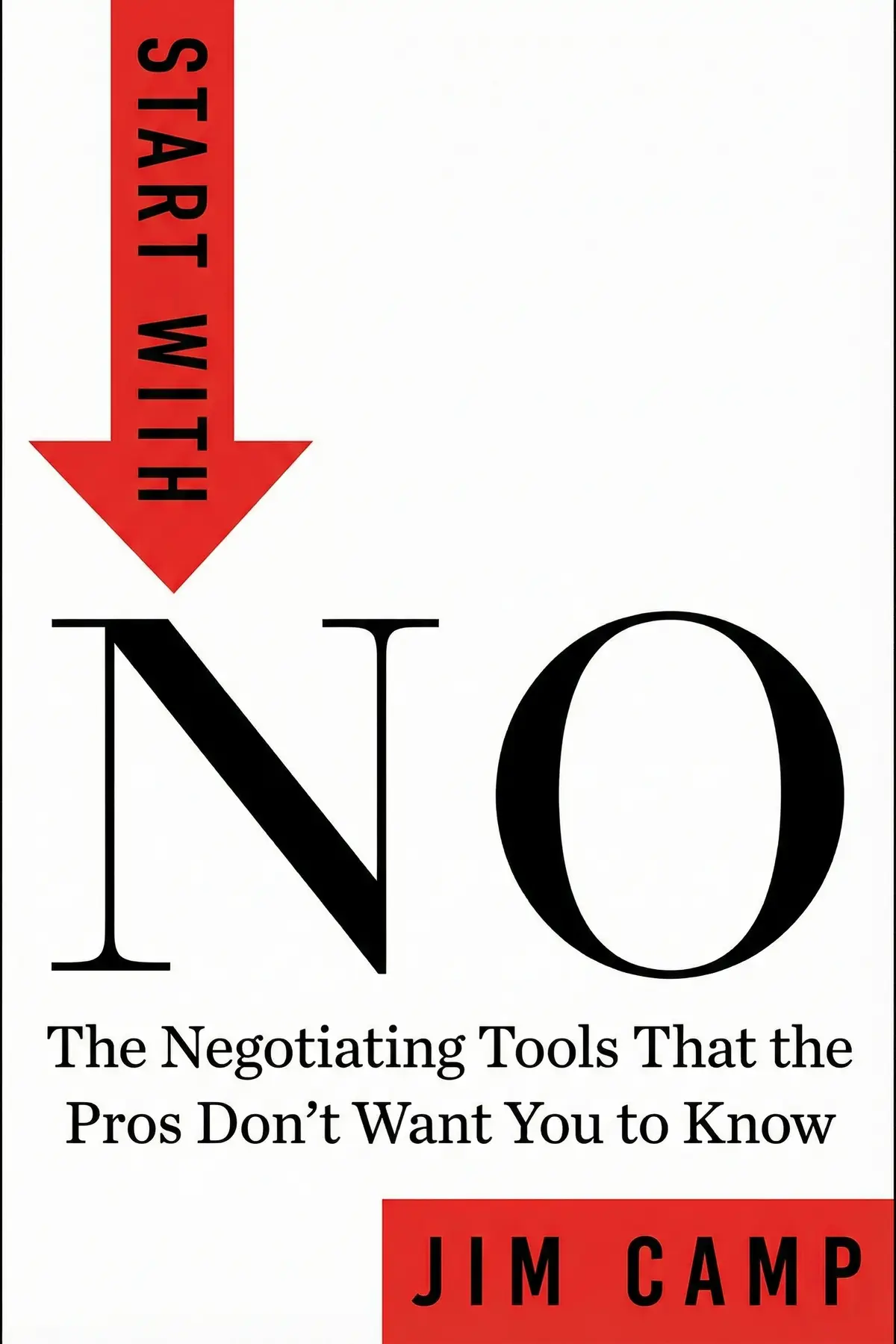
Table of Content
1. Introduction
59 sec
If you walk into a salary talk or a client meeting hoping for a yes, you have already handed the other side a lever. In Start with No, negotiation coach Jim Camp argues that the familiar goal of a win-win deal is often a trap. Skilled opponents use it to pull concessions out of people who are anxious to agree. His alternative sounds backward at first: go in ready to hear no, and even invite it.
Camp’s central claim is that control in a negotiation belongs to the side that needs the deal least. Everything else in his method protects that position. A no clears away false hope. Open questions get the other side talking. A calm manner keeps them at the table. A daily habit of reviewing your own performance makes the whole approach stick.
By the end, you will know what to stop showing, what to ask and how to train yourself so the next hard conversation feels steadier than the last.
2. Stop showing them how much you need it
2 min 01 sec
The person who wants the deal most often walks away with the worst terms. Camp explains what the other side is watching for, and why the strongest move can be the one you never have to make.
3. Welcome a clear no over a vague maybe
1 min 58 sec
An early yes feels like progress, and a maybe feels like hope. Camp argues both can leave you weaker, while the answer most people dread is where honest bargaining actually starts.
4. Ask questions that start with what and how
2 min 04 sec
Two questions can seek the same information and get completely different results. One makes people defensive and vague; the other gets them explaining. The difference sits in the very first word you choose.
5. Calm the room without giving any ground
2 min 00 sec
Being warm in a tough negotiation sounds like a fast way to get pushed around. Camp argues the opposite, and his method depends less on what you say than on your posture, pace and voice.
6. Train like a fighter pilot, one day at a time
1 min 59 sec
A nervous recruit becomes a sharp, decisive pilot within a single year. Camp borrows the system behind that change and argues it can turn negotiating from a stressful guessing game into a skill you can measure.
7. Conclusion
1 min 12 sec
Camp’s method changes where your strength comes from. Most people try to win a negotiation by being likable and eager to agree. Camp locates strength somewhere else: in not needing the deal, so that a no costs you nothing and the other side’s real reasons become visible. Open questions, a calm voice and a steady daily review are all ways of protecting that position when the pressure rises.
What changes for you is concrete. Before your next salary talk, supplier call or client pitch, know what you will do if it fails, so wanting never turns into needing. When you hear no, ask what is behind it before you rush to fix anything. Rebuild your yes-or-no questions so they begin with what or how, and let the silence after them do some work. Afterward, take a couple of minutes to note where you stayed calm and where you started to chase.
The lion in Camp’s picture does not chase everything it sees. It picks its moments, walks away from a poor chance and keeps its strength for the next one. The negotiator who can do the same is the one the other side has to take seriously.
About this book
What is this book about?
Most people go into a negotiation hoping for a friendly yes and a deal that leaves both sides happy. Jim Camp argues that this win-win mindset is often a trap. It makes you eager, and eagerness shows. Skilled opponents read that need and use it to pull out concessions you later regret. Camp's alternative starts with the word most people fear. He treats a clear no as an honest decision that brings the real issues into view, while an early yes or a vague maybe hides them. Around that idea he builds a set of habits. Stop needing the deal so you can walk away. Ask questions that begin with what, how or why instead of ones that only allow yes or no. Keep the atmosphere calm through your posture, pace and tone. Keep a daily record of your own performance, the way fighter pilots are trained. The result is a practical method for anyone who negotiates salaries, contracts, sales or everyday disagreements and wants to stay steady, ask better questions and stop giving ground just to be liked.
Book Information
Who it's for
Giving ground to please
Professionals who give ground in salary talks or contract talks just to keep the other side happy.
Founders and sales reps
Founders and salespeople who rush to close and regret the terms later.
Wanting calmer high-stakes talks
Anyone who wants calmer, more honest conversations when something important is at stake.
About the Author
Jim Camp
Jim Camp was a negotiation expert who coached people through thousands of negotiations and worked with more than 150 companies, with his methods applied across a range of industries. He founded the Camp Negotiation Institute, lectured at leading graduate business schools and spoke at major conferences. Start with No sets out the approach he taught.
Ratings & Reviews
Ratings at a glance
What people think
Listeners find this negotiation book both compelling and easy to digest, providing excellent tips for pre-meeting preparation. They value its straightforward methodology and its utility as a consistently helpful resource, and one listener mentions how it forces you to view bargaining through a new lens. The work is praised for its uncomplicated concepts and overall value, though perspectives regarding its factual accuracy are varied.
Top reviews
Audrey
Picked this up after hitting a wall in my sales career, and it completely flipped my perspective. While everyone else is pushing for a 'win-win,' Camp suggests that's actually the fastest way to lose your shirt. I loved the emphasis on letting the other person feel in control by giving them the right to say 'no' immediately. It takes the pressure off both parties and allows for a real conversation rather than a scripted dance. To be fair, some of the military anecdotes feel a bit dated and macho, but the core logic is undeniable. If you are tired of feeling desperate during a deal, this is your manual. It’s not just a book; it’s a mindset shift that keeps you from being cornered. I found it much more practical than the academic stuff you usually find in business school.
Show morePichaya
After hearing about 'Start with No' for years, I finally dove in, and I regret waiting so long. The concept of the 'adversary' might sound aggressive, but the book is actually about deep respect and clear communication. You stop being a needy negotiator and start being a professional who respects the other person's boundaries. It's about finding the truth of the situation rather than forcing a fake 'win-win' that leaves everyone unhappy. Not gonna lie, I was skeptical of the anti-compromise stance at first, but it makes total sense when you see it in action. My only gripe is the constant football analogies which didn't always land for me. Aside from that, it's a stellar guide for anyone in a high-stakes environment.
Show moreConnor
Negotiation isn't just for boardrooms, and this book proves it by focusing on the human element of every interaction. I love how it forces you to think about negotiation in a completely different way—one where you don't have to be a shark or a pushover. The simple idea that 'no' is the start of the negotiation, not the end, is incredibly liberating. It takes away the fear of rejection and replaces it with a process for discovery. I've already applied some of the 'mission and purpose' concepts to my personal life with great success. Honestly, the book is incredibly effective because it’s so simple to grasp. It's one of those rare business books that actually has a soul.
Show moreSatit
I've been looking for a negotiation book that actually feels applicable to real-world stress, and this is it. Unlike the dry, theoretical texts from economists, Camp gives you a playbook for when things get messy. He understands that we are emotional creatures, and his system is designed to keep those emotions in check. The focus on identifying the other party's 'pain' is a total game-changer for my sales process. It’s a quick and informative read that doesn't waste time on academic fluff. I appreciated the no-nonsense approach and the clear, actionable steps for preparing for any meeting. Even with the slightly repetitive nature of the business examples, the core message is too important to ignore. It’s a must-read.
Show morePruet
Ever wonder why common negotiation tactics always leave you feeling like you compromised too much? Camp's central thesis is that the standard Harvard 'Getting to Yes' model is fundamentally flawed because it forces unnecessary concessions. Frankly, his alternative approach—focusing on the adversary’s 'pain'—is far more effective in the real world. By identifying what truly bothers the other side, you can tailor your proposal to solve their specific issues without giving away the farm. I did find the writing style a bit repetitive at times, and the author definitely has a high opinion of himself. Still, the underlying techniques are solid and easy to implement right away. It’s a no-nonsense guide that actually delivers value for the money.
Show moreCameron
This book is a refreshing departure from the usual fluffy self-help business guides. The author argues that desperation is the biggest killer of any deal, and he provides a structured system to maintain emotional control throughout the process. I particularly appreciated the advice on being honest with yourself and your goals rather than trying to 'scheme' your way to a win. Look, the anecdotes about corporate giants can feel a bit exaggerated, and I suspect some are smoothed over for dramatic effect. However, the psychological insight that people feel safer when they can say 'no' is pure gold. It makes the whole negotiation process feel less like a battle and more like a collaborative discovery. This is a very quick read with a lasting impact.
Show moreMingkwan
The chapter regarding 'neediness' changed how I approach my clients entirely. Camp explains that appearing too eager to close a deal actually sends people running in the opposite direction. By being prepared to walk away, you ironically gain the upper hand. It’s a counterintuitive strategy that works because it respects the psychological need for autonomy. I think the book is highly engaging and easy to read, even if the 'no-nonsense' persona gets a bit thick in some sections. I would have liked to see more scientific backing for some of his claims, as most of it is just based on his personal experience. Regardless, the tips on preparing for a meeting are worth the price of admission alone. It’s a solid addition to any professional’s library.
Show moreNatnicha
Gotta say, the logic here is surprisingly sound for a book that positions itself against the grain. I used to think that being a 'nice guy' meant always aiming for a middle ground, but that’s just a recipe for mediocrity. Camp teaches you how to present the best possible case for your interests while still solving the other person's problems. It’s about intelligent decision-making, not just making a fast buck off a quick impulse. Some of the military-style terminology is a bit over-the-top, and I could have done without the 'adversary' label for every single person you talk to. But if you can look past the jargon, the advice on staying focused on your mission is excellent. This is a guide I’ll probably revisit every year.
Show moreWaree
To be fair, I found several of the techniques here very useful, but the delivery was hard to stomach. The author’s style is very much 'my way or the highway,' and he spends a lot of time gloating about his past successes. Many of the anecdotes feel like they were invented to perfectly fit his points, which makes the advice feel less grounded in reality. Also, the constant bashing of the Harvard negotiation school felt forced and often misrepresented what those authors actually wrote. That being said, the focus on honesty and ethics in negotiation was a nice surprise. If you can filter out the repetitive stories and the author's abrasive voice, there is a lot of practical value to be found here. Just be prepared for some heavy-handed self-promotion.
Show moreRin
Wait, so everything we've learned about cooperation is a lie? That’s basically what Jim Camp tries to sell you here, but I found his tone incredibly grating. The book reads like a typical self-help manual filled with hyperbole and personal stories that feel way too convenient to be true. Most of the examples involve a generic manufacturing company, and they are repeated so often I felt like I was reading the same chapter twice. He spends half the time bashing other experts, which felt a bit disingenuous since he often ends up recommending the same basic principles of leverage. Truth is, there are much better books like Simon Sinek’s work if you want a different mindset, or more technical manuals if you want to learn the mechanics of a contract.
Show moreQuestions about this book
What is the main idea of Start with No by Jim Camp?
Camp argues that chasing a win-win yes makes negotiators eager and easy to exploit. Control belongs to the side that needs the deal least. He recommends going in ready to walk away, inviting a clear no so the real issues surface, asking open questions, keeping the atmosphere calm and reviewing your own performance every day.
Why does Jim Camp say no is better than yes in a negotiation?
In Camp’s view, an early yes excites you, narrows your judgment and invites the other side to add new demands. A maybe creates confusion and guessing. A no is a real decision. It forces both sides to look at the reasons behind it, stops empty assurances working and often brings out information that leads to fairer terms.
What kind of questions does Start with No recommend?
Camp separates questions that begin with a verb, such as can you or is this, from questions that begin with what, how, when, where, why or who. Verb-led questions only allow yes, no or maybe and can feel like pressure. Interrogative-led questions get the other person explaining, which reveals their interests and worries and gives the listener more control.
How can I apply Start with No in my next negotiation?
Decide beforehand what you will do if the deal fails, so you want the outcome without needing it. Make it clear that no is an acceptable answer, and ask what lies behind any refusal. Turn yes-or-no questions into what or how questions. Keep your voice low and your pace slow. Afterward, write down where you stayed calm and where you started to push.
Readers also enjoyed









AUDIO SUMMARY AVAILABLE
Listen to Start with No in 15 minutes
Get the key ideas from Start with No by Jim Camp, plus 5,000+ more nonfiction titles.
- 5,000+ titles
- Listen as much as you want
- 7-day free trial
- Cancel anytime









