

14 min 04 sec
Available in: English
Spy the Lie: Former CIA Officers Teach You How to Detect Deception
Shows how to get closer to the truth when someone may be lying: set aside your own biases, ask short neutral questions, and watch for clusters of signals in the seconds after each one.
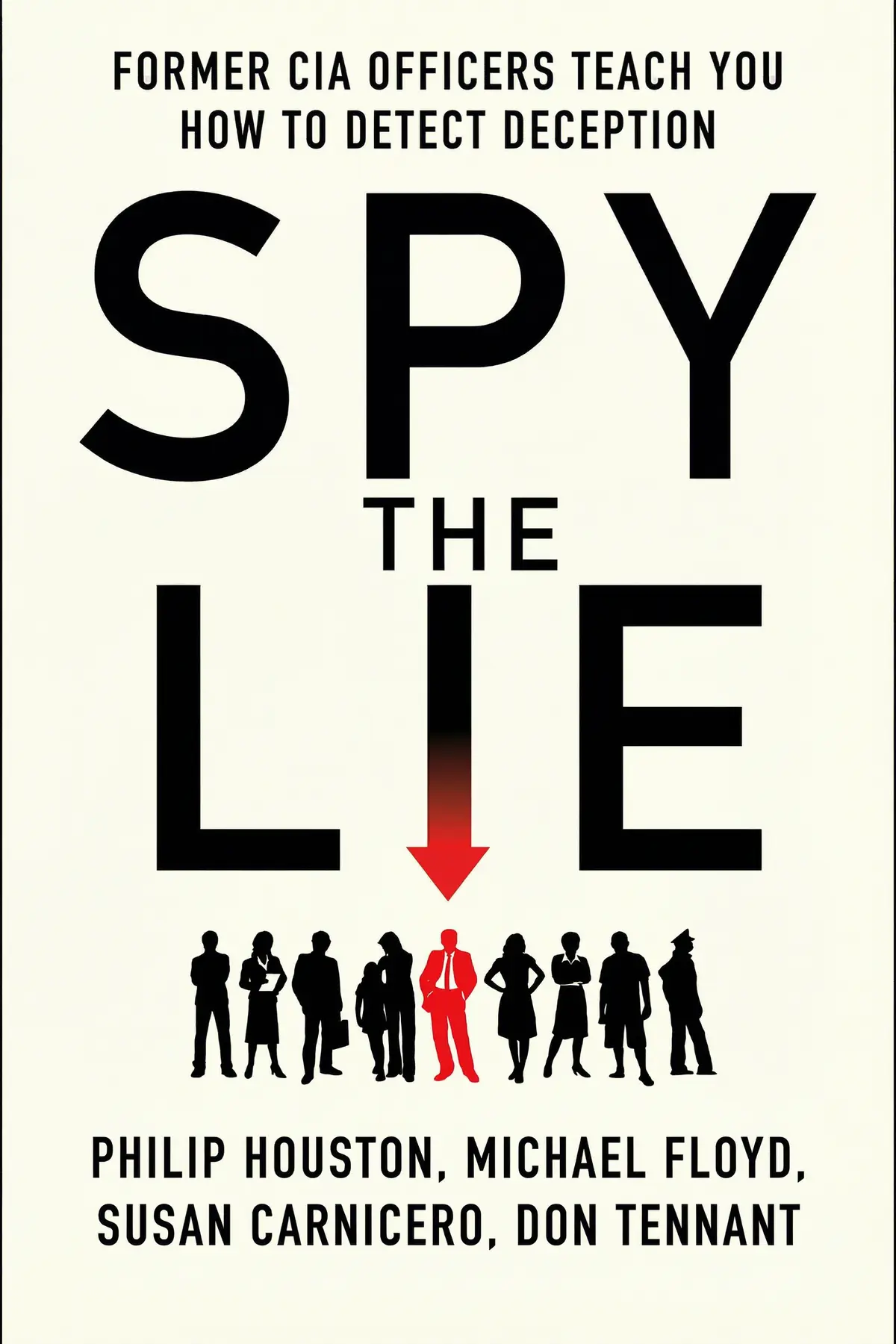
Table of Content
1. Introduction
1 min 05 sec
Someone who looks away while answering you may be lying, or may just be shy, distracted or badly brought up, and the glance alone cannot tell you which. That is the uncomfortable starting point of Spy the Lie, in which former CIA officers Philip Houston, Michael Floyd and Susan Carnicero, writing with journalist Don Tennant, explain the method Houston built for counterterrorism and criminal cases.
The authors say that nobody becomes a human lie detector. Anyone can still get much closer to the truth by working like an interviewer: clearing away their own biases and the liar’s honest-looking act, asking short and neutral questions, and watching for clusters of signals in the first seconds after each one. We all lie ten to twenty times a day, they note, and still do badly at catching others. If you hire, manage, audit, negotiate or raise children, what follows is a working kit: the three forms a lie takes, the physical signals worth noticing, and the questions that pull a prepared story apart.
2. Stop reading guilt into a single glance
1 min 35 sec
The fidgeting, eye-avoiding liar is the picture most of us carry. The authors argue that this familiar image is one of the main reasons ordinary people miss so many of the lies told to them.
3. Spot the bias that picks who you believe
1 min 44 sec
A whole community once trusted a thirteen-year-old’s story over a cult leader’s denials. The way that case finally unraveled shows how our expectations about people can decide a question long before any evidence does.
4. Three ways a lie hides inside an answer
1 min 46 sec
The oath sworn by witnesses in court has three parts, and each one matches a different way people deceive. Learning to hear which promise is being broken changes what you listen for in every answer.
5. Set aside every answer that merely sounds honest
1 min 35 sec
A quick, direct, spontaneous reply feels like proof of innocence. The authors give it no weight at all, and their reasoning comes with a simple move for disarming people who argue their reputation instead of the facts.
6. Read the body in the first five seconds
1 min 49 sec
Itchy noses, shifting feet and a swivel chair in a CIA interview room all point to the same stress response. The trick is knowing which signs matter, and exactly when to look for them.
7. Ask short, calm questions and hear every word
1 min 38 sec
In one imagined exchange, a suspect under pressure uses two ordinary words that tell his questioner far more than he means to. Hearing slips like that depends on how the question was built and how it was asked.
8. Stay friendly and pull the story off its script
1 min 45 sec
Pouncing on a contradiction feels satisfying and usually backfires. The authors explain why repeating your question helps the liar, and which simple follow-ups make a rehearsed story start to come apart.
9. Conclusion
1 min 07 sec
Spy the Lie does not promise a machine in your head that flashes red when someone deceives you. It offers something more modest and more useful: a way of running a conversation so that the truth gets more chances to appear. Most of the method is subtraction. Remove your own lean toward the people you like. Remove the honest-sounding padding and the single gesture you were about to over-read. What remains is small enough to examine closely.
The next time an answer matters, at work or at home, try the method once. Ask one short question in a level voice, then stay quiet and watch the next five seconds for two or more signs together. When the reply praises the speaker’s character, agree with it and return to what actually happened. And when you sense a lie, resist the urge to pounce or to repeat yourself. Ask what else, and let the story drift off its script.
A liar can rehearse his story. He cannot rehearse the question he never expected.
About this book
What is this book about?
Most of us lie several times a day, yet we are poor at noticing when others lie to us. Single gestures mislead us, our biases decide whom we trust before anyone speaks, and practiced liars know how to look honest. For anyone whose work or family life depends on accurate information, that gap is costly. Former CIA officers Philip Houston, Michael Floyd and Susan Carnicero, writing with journalist Don Tennant, set out the deception detection method Houston developed for counterterrorism and criminal investigations, adapted for everyday use. They explain why communication is so hard to read, how bias shaped one false accusation, and how lies fall into three types: omission, commission and influence. They describe the physical stress signals that matter, why only clusters of clues count, and why the first five seconds after a question are the window to watch. The second half is a questioning method. Readers learn to ask precise, calm questions, to listen to the literal words of an answer, to avoid confrontation and repetition, and to break a liar's rehearsed story with follow-ups and bait questions. The authors don't promise to turn anyone into a human lie detector. What they offer is a disciplined way to separate truth from lies more often.
Book Information
Who it's for
Managers, recruiters and auditors
Managers, recruiters and auditors who need straight answers from people with something to hide.
Lawyers, investigators, business owners
Lawyers, investigators and business owners questioning staff, clients or suppliers.
Parents and teachers
Parents and teachers who want calmer, more effective ways to get the real story.
About the Author
Philip Houston
Philip Houston spent 25 years at the CIA and developed a deception detection method used in counterterrorism and criminal investigations. Michael Floyd served as a CIA and NSA officer and has conducted more than 8,000 interviews and interrogations worldwide. Susan Carnicero spent two decades at the CIA interviewing, interrogating and giving polygraph examinations. Don Tennant, a former NSA analyst, became editor in chief of Computerworld and won national journalism awards.
Ratings & Reviews
Ratings at a glance

What people think
Listeners find this book to be a fast-moving and captivating listen that offers excellent broad insights and practical advice for daily life. The narrative is expertly written, and listeners appreciate the way it simplifies intricate ideas for instant real-world use. They value its method for spotting dishonesty, noting how it aids in recognizing deceptive conduct, and view it as an essential tool for both private and work interactions.
Top reviews
Woramet
Picked this up hoping for some real-world application in my HR role, and it definitely delivered more than the standard body language fluff. The authors emphasize the 'cluster rule,' which prevents you from jumping to conclusions over a single nervous tick or a simple itch. To be fair, some stories feel a bit dated, but the logic behind the 'punishment question' is fascinating to see in action. I found the writing style very accessible, making it feel less like a dry manual and more like a conversation with seasoned professionals. It has changed the way I observe people during high-stakes meetings without making me feel like a paranoid investigator. If you want something that moves beyond the cliché idea that 'crossed arms mean they’re closed off,' this is a solid choice.
Show moreHannah
Wow, this actually made complex behavioral psychology feel simple enough for anyone to apply in their everyday life. The authors do a great job of explaining how the autonomic nervous system triggers things like throat-clearing or hiding the mouth during a lie. Not gonna lie, I started watching my coworkers more closely after reading the section on grooming gestures, and it’s startling how many clusters you see once you know what to look for. The prose is clean and direct, avoiding the overly academic jargon that usually ruins books like this. It’s rare to find a non-fiction book that is both educational and genuinely entertaining from start to finish. I’d recommend it to anyone who wants to improve their personal relationships by understanding what’s really being said.
Show moreAim
The chapter on the 'behavioral pause' completely changed how I think about silence during a conversation. The example of asking someone what they did seven years ago versus asking if they robbed a gas station is a brilliant way to illustrate how our brains process truth versus fiction. Frankly, this book is full of these 'lightbulb moments' that make you realize how much you’ve been missing in your daily interactions. I love how it breaks down 'hand-to-face activity' not just as nervousness, but as a physiological reaction to the blood rushing away from the extremities. It’s well-crafted, fast-paced, and provides immediate value if you’re willing to pay attention to the details. This is definitely the best book on the subject I’ve come across so far.
Show moreLiam
As someone who conducts interviews regularly, I was looking for a way to cut through the rehearsed answers people usually bring to the table. This book provides a clear framework for identifying deceptive behaviors by focusing on verbal cues like repeating the question or using 'perception qualifiers.' I appreciate that the authors don't claim this is an absolute science; they admit it’s about increasing your odds rather than reading minds. The chapter on 'anchor-point movement' was particularly enlightening, as I had never considered how a person’s feet or buttocks could signal their internal anxiety level. My only minor gripe is that it can feel a bit repetitive towards the middle, but the practical value outweighs the occasional fluff. It’s a tool I’ll keep in my professional belt for a long time.
Show moreEye
This book is a refreshing departure from the usual body language manuals that are often as reliable as a coin toss. Instead of focusing on subjective 'tells,' Philip Houston and his team provide a structured system based on clusters of deceptive indicators. I think it’s important to note that they frequently remind the reader to ignore 'truthful behavior' to manage bias, which is a key step most amateurs miss. In my experience, the techniques for identifying 'exclusion qualifiers' like 'basically' or 'mostly' are where the real value lies. It does require practice to keep all these variables in mind during a real-time conversation, but the logic holds up well under scrutiny. It’s a professional-grade resource that remains very accessible to the average person.
Show morePot
After hearing so much about the CIA's interrogation techniques, I expected something much more aggressive and perhaps even unethical. Instead, I found a thoughtful approach to detecting deception that emphasizes remaining non-confrontational while digging for the truth. As a parent, I found the 'denial problems' section particularly relatable when dealing with my teenagers’ creative excuses for why they were home late. Look, it’s not about being a 'drone parent' as some critics say, but about understanding the psychology of why a person avoids a direct answer. I appreciated the advice on keeping questions short and simple to ensure the stimulus is clear for the person being interviewed. It’s a fascinating look at the subtle ways we all try to dress up the truth when we’re feeling the heat.
Show moreLucia
Not what I expected at first, but in a good way. I’m a student who often feels guilty for even thinking someone might be lying to me, but this book gave me a more objective way to evaluate people. It focuses on identifying specific 'non-answer statements' like 'that’s a good question' which buy the liar time to think. To be fair, I don’t think I could use the full system without having the book right in front of me, but the general principles are easy to remember. The writing style is engaging and doesn't feel like a lecture, which I really appreciated. It’s a helpful guide for anyone who wants to be a bit more discerning without becoming cynical or overly aggressive in their interactions with others.
Show moreSin
Ever wonder if your 'gut feeling' about a liar actually has a basis in reality? 'Spy the Lie' tries to answer that, though I gotta say, it probably could have been summarized in a lengthy pamphlet rather than a full-length book. While the tips on identifying 'non-answer statements' and 'inappropriate politeness' are useful, the authors stretch the material thin with quite a few repetitive examples. Some of the case studies involving 'weirdos' and foot fetishes felt unnecessary and didn't add much to the actual methodology. It’s an easy read that you can finish in a couple of hours, but don’t expect to walk away as a master human polygraph. It’s decent for a quick brush-up on social cues, but it isn't the life-changing manual the title suggests.
Show moreNit
Look, the information presented here is technically sound, but it’s important to realize that most of these techniques are already in the public domain. The authors try to 'sex up' the narrative with mentions of secret locations and field officers, yet the actual methods—like identifying verbal/nonverbal disconnects—are fairly standard. I found the section on 'invoking religion' to be one of the more interesting parts, as it’s a behavior I’ve seen many times without realizing its significance. However, the book suffers from a lack of truly credible, high-stakes scenarios that show the system working in the field. A lot of the success stories seem to involve people who were already doing a terrible job of hiding their guilt. It’s a good introductory text, but seasoned readers of psychology might find it a bit basic.
Show moreSkylar
Why do people think being in the CIA automatically makes for a groundbreaking book? Frankly, most of these 'secrets' are just common sense observations wrapped in a thin layer of agency branding and self-importance. One anecdote about an agent realizing a man is Muslim because he’s praying was genuinely embarrassing to read in a professional text. They also spend a strange amount of time talking about using these high-pressure tactics on their own children just to check on homework assignments. It feels less like sophisticated intelligence and more like 'drone parenting' mixed with basic psychological tricks you could find on any blog. I was hoping for deep insights, but instead, I got a sanitized collection of stories that didn't really prove the techniques work better than a lucky guess.
Show moreQuestions about this book
What is the main idea of Spy the Lie?
Former CIA officers Philip Houston, Michael Floyd and Susan Carnicero argue that communication is too complex to catch every lie, but deception can still be detected. The method is to ignore single gestures and honest-sounding statements, ask precise and neutral questions, and watch for clusters of two or more clues within about five seconds of each question. Calm, non-confrontational follow-ups then disrupt the liar’s prepared story.
What are the three types of lies in Spy the Lie?
The authors map lies onto the courtroom oath. Lies of omission leave out parts of the whole truth, often signaled by qualifiers such as mostly or basically, or by dodging the question. Lies of commission add false or excessive detail and sudden politeness to look credible. Lies of influence, the most powerful, avoid the facts and argue the speaker’s good character and reputation instead.
Does looking away mean someone is lying?
Not on its own, according to the authors. Breaking eye contact can come from deception, but also from bad manners, low confidence or limited social skill, and the behavior alone cannot tell you which. They advise looking for a cluster of two or more clues, such as an evasive reply plus closed eyes and shifting feet, appearing within five seconds of the question.
How should you respond when you think someone is lying?
The authors advise staying friendly instead of confronting the person, because you need their cooperation to reach the truth. Avoid asking the same question again, since repeating a lie makes it easier to tell. Ask follow-ups that let them revise their story, such as what else, and when someone appeals to their reputation, agree with it and steer back to the actual question.
Who should read Spy the Lie?
It suits anyone whose work depends on accurate information, such as managers, recruiters, lawyers, accountants and business owners, as well as parents and teachers. The techniques come from interviews and interrogations in counterterrorism and criminal cases but are presented for everyday use: phrasing a clear question, timing your observation and handling evasive answers without starting a fight.
Readers also enjoyed





AUDIO SUMMARY AVAILABLE
Listen to Spy the Lie in 15 minutes
Get the key ideas from Spy the Lie by Philip Houston, plus 5,000+ more nonfiction titles.
- 5,000+ titles
- Listen as much as you want
- 7-day free trial
- Cancel anytime









