

14 min 14 sec
Available in: English
Spin Sucks: Communication and Reputation Management in the Digital Age
Shows how to win attention and trust online without spin: give content one clear purpose, earn search rankings honestly, answer critics in public and fix problems in private, and put customers ahead of short-term profit.
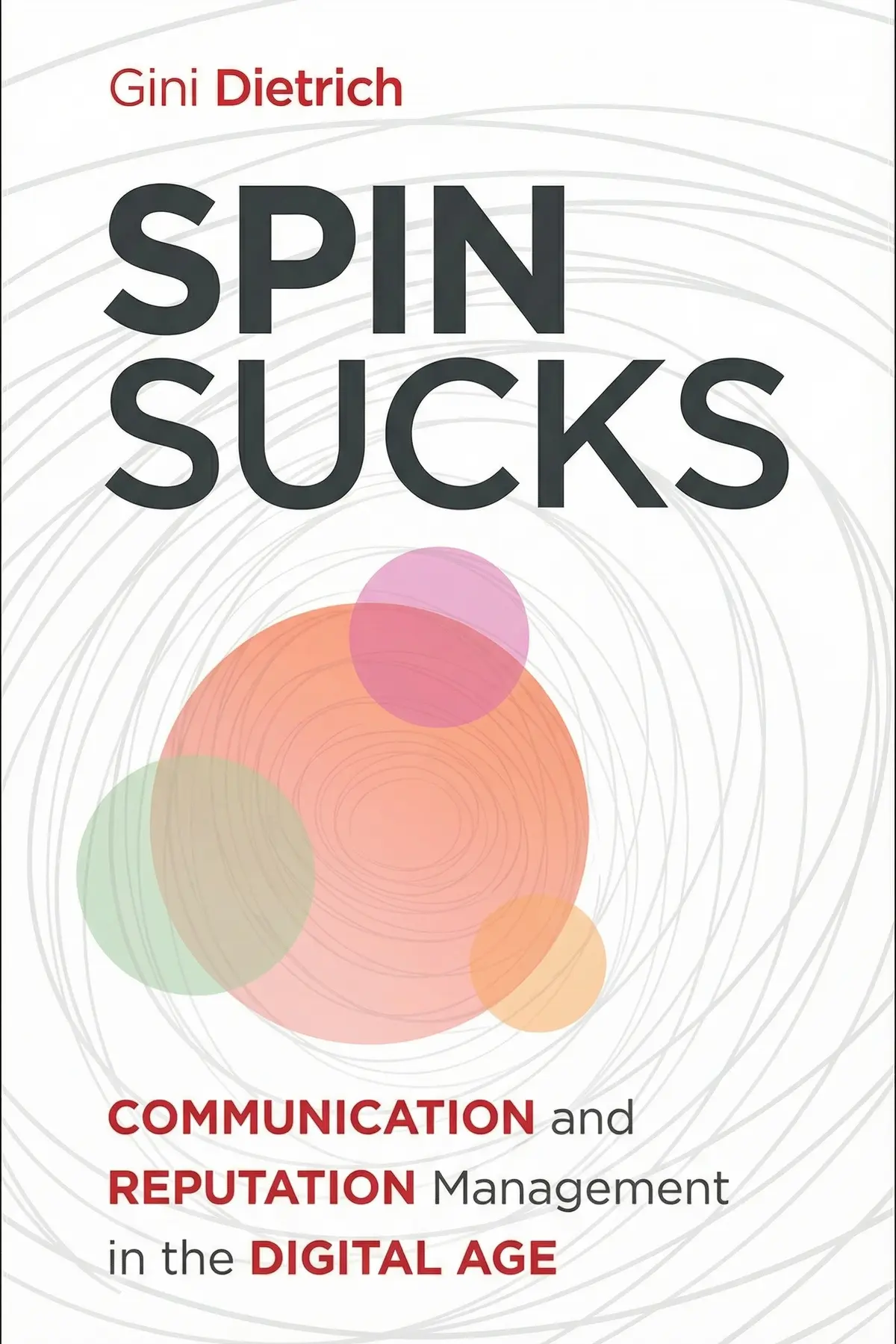
Table of Content
1. Introduction
1 min 01 sec
Most companies trying to be noticed online reach for the same old levers: a provocative image, some spin, a louder claim. In Spin Sucks, Gini Dietrich, founder of the agency Arment Dietrich, argues that those tricks may earn a glance but rarely a customer, because a product nobody finds useful gets dropped as fast as it was clicked. With millions of blog posts appearing every day, the only way to stand out is to offer something people cannot find anywhere else, and then earn their trust.
That is the idea the whole book defends: in a crowded digital world, reputation comes from honesty and real value, not from spin. The cases run from a Chicago taxi driver on Twitter to a retirement home’s furious customer and a cookie brand that tweeted during a stadium blackout. Along the way come working methods for headlines, search rankings, angry critics and the people who copy your work.
2. Give your content one clear purpose
1 min 29 sec
A taxi driver with a Twitter account grew his business by a fifth in a single year. His tweets were small, but one decision about what they were for made all the difference.
3. Let customers tell the stories that sell
1 min 30 sec
An email company filled its website with stories that barely mention its product, and people trusted it more. A recipe site found the same thing with dinner table memories.
4. Win search rankings that survive algorithm changes
1 min 19 sec
Some search specialists treat Google as a partner, others as an enemy to outwit. One camp can lose a website overnight without caring, and that tells you which one a real business should follow.
5. Doing good beats fooling the press
1 min 37 sec
One man fooled reporters at Reuters, MSNBC and the New York Times for weeks, and nobody checked a word. Dietrich tells his story for a reason that has nothing to do with copying him.
6. Keep your social media honest and consistent
1 min 30 sec
A restaurant chain fired an employee over a single posted receipt, and the internet found a reason to doubt its fairness. What came next turned a small dispute into a flood of anger.
7. Turn an angry critic into a loyal fan
1 min 45 sec
A resident’s hair came out blue, and her daughter was furious on Facebook. In the end, the same daughter was praising the company. The difference came down to four steps and one phone call.
8. Make stolen content point back to you
1 min 19 sec
Someone has copied your best article onto their own site without credit. Dietrich offers ways to fight back, and two of them make the thief work in your favor.
9. Win attention with customer focus and good timing
1 min 36 sec
A retailer’s profits dropped sharply after its founder left, and the cause was one word repeated in meetings. Meanwhile a cookie brand needed just four minutes and a dark stadium to win the night.
10. Conclusion
1 min 08 sec
Dietrich’s book is, in the end, an argument that shortcuts cost more than they save. The black hat loses a site, the media manipulator never builds anything real, and a brand that looks inconsistent, like Applebee’s, turns one awkward receipt into hundreds of thousands of angry comments. Honesty is slower, yet it adds up: a taxi driver who simply helped people grew his business by a fifth, and a furious daughter became a loyal fan after one ten-minute call.
The habits that follow are modest. Give your content a one-line purpose and hold every headline to it. When a complaint appears, decide whether it is fair and who sent it, then answer in public and fix it in private. Put links to your own work inside everything you publish, so even stolen copies lead readers home. And listen to which word your team hears most from you.
None of this needs a big budget. It needs the patience to be the most useful, most honest voice in a very noisy room, and the readiness to speak quickly when the lights go out.
About this book
What is this book about?
Every day the web fills with millions of new blog posts, and any company trying to be noticed is tempted by the old tricks: a provocative image, a clever bit of spin, a story that is not quite true. Gini Dietrich argues that these shortcuts may win a glance but rarely a loyal customer, and they can damage a reputation fast. Her alternative rests on honesty and usefulness. She shows how a single clear content vision turned a Chicago taxi driver's Twitter account into a growing business, why letting customers tell their own stories builds trust, and why patient, high-quality work beats the keyword stuffers in search results. She gives a four-step method for turning an angry critic into a fan, practical defenses against people who steal your content, and a warning from Applebee's about canned replies. Readers get a working playbook for communication and reputation online, from writing the headline to answering the complaint, built on one idea: do good, say so plainly, and treat every customer as a person.
Book Information
Who it's for
Founders and business owners
Founders and small business owners whose posts and campaigns disappear in a crowded feed.
Marketing and communications staff
Marketing and communication staff who handle social media, search and customer complaints.
Managers handling public criticism
Managers who want a clear, honest method for answering public criticism without making it worse.
About the Author
Gini Dietrich
Gini Dietrich founded Arment Dietrich, an agency that specializes in digital marketing and communication, and created Spin Sucks Pro, which offers advice and training to public relations and marketing professionals. She is an award-winning blogger, and her client work has included companies such as Abbott and Sprint, giving her a close view of how brands build and lose trust online.
Ratings & Reviews
Ratings at a glance
What people think
Listeners find the material practical, with one listener noting it is chock full of useful information. The guide earns positive marks for its readability, with multiple listeners describing it as a must-read. However, the writing style draws mixed reactions from listeners.
Top reviews
Katya
Ever wonder why some brands thrive online while others just seem to scream into the void of social media? Dietrich provides the answer by highlighting the importance of high-quality content and genuine customer service over old-school manipulation. I particularly loved the case studies, like the Applebee’s example, which serve as a stark warning about what happens when you lose control of the conversation. Truth is, this isn't just for PR pros; it's for any business owner who wants to build a sustainable brand. The book is chock full of useful information that you can implement immediately to improve your professional compass. I felt like I was getting a masterclass from a seasoned expert who truly cares about the ethics of communication. Highly recommend for the insights into whisper campaigns alone!
Show morePloy
After hearing Gini Dietrich speak on a podcast, I finally grabbed a copy of her book to better understand the evolving field of digital PR. As a business owner, I often struggle with how to explain the value of communication efforts to my board, but this text provided the perfect vocabulary. The connection between content creation and the bottom line is explained with such clarity that it makes the ROI of PR undeniable. It’s a readable, engaging guide that shifts the focus from 'spin' to authentic storytelling and customer listening. I especially appreciated the hands-on approach to crisis communication and how to handle anonymous attackers online. This is the kind of book you keep on your desk to reference whenever a PR fire breaks out.
Show morePhichai
Finally got around to reading this after following the Spin Sucks blog for years and it definitely lived up to the hype for me. This book does an excellent job of connecting the dots between SEO, reputation management, and content marketing in a holistic way. It’s rare to find a business book that actually practices what it preaches so effectively within its own pages. The distinctions between paid, earned, shared, and owned media are finally clear to me after years of hearing them thrown around as buzzwords. Not gonna lie, I wish I had read this at the start of my career because it would have saved me a lot of trial and error. It’s an essential text for anyone who wants to build an ethical and effective communications program.
Show morePreeda
This book is a breath of fresh air for anyone tired of the typical PR smoke and mirrors. Gini Dietrich breaks down the PESO model in a way that actually makes sense for the modern digital landscape. I found the sections on integrating paid, earned, shared, and owned media to be incredibly practical for my daily workflow. To be fair, some of the specific internet references feel a bit dated now, especially regarding SEO tactics. However, the core philosophy of radical honesty and reputation management remains absolutely timeless. It's a must-read if you want to move beyond simple press releases and actually engage with your audience. The writing is punchy and direct, which keeps things moving even when the technical details get a bit dense.
Show moreYuwadee
The chapter on whisper campaigns and anonymous attackers alone makes this book worth the price of admission for any reputation manager. In my experience, most PR books ignore the darker side of the web, but Dietrich tackles it head-on with actionable advice. She emphasizes that being a good social media citizen isn't just about posting; it’s about participating in a two-way conversation with your consumers. There’s a lot of discipline required to stay ethical when the impulse is to become defensive during a crisis. While I agree with other reviewers that the SEO bits are showing their age, the overarching strategy is solid. It’s a centering point for any professional who wants to ensure their compass is still pointing toward integrity.
Show moreYaowares
As someone who isn't a PR pro, I was worried this would be too 'inside baseball' for me to get anything out of it. To my surprise, the principles in Spin Sucks are remarkably universal and helped me understand my own role as a consumer in the digital age. Dietrich writes with a passion that shines through every page, making even the technical parts about hub-and-spoke information wheels easy to grasp. I found the Hertz and Applebee's examples particularly enlightening regarding how brands should—and shouldn't—conduct themselves online. The book advocates for a brand that listens to its customers instead of trying to control them, which is a message more companies need to hear. It’s a practical, no-nonsense guide that cuts through the fluff of traditional marketing.
Show moreNora
Look, if you're still relying on old-school billboards and flashy ads to sell your product, you are going to be left behind in this digital age. Gini Dietrich's book is a wake-up call for anyone who thinks PR is just about making things look pretty through 'spin.' She proves that the best payoff comes from the hard work of genuine content creation and building real relationships with your audience. While the internet-specific advice is a bit dated, the focus on proving a return on investment for communications is more relevant than ever. Most business leaders expect results, and this book gives you the tools to show how integrated media efforts contribute to the bottom line. It’s a solid, versatile resource for any communicator’s library.
Show moreRotjanee
Picked this up because a mentor kept raving about the PESO model as a foundational strategy for digital marketing. While the framework itself is brilliant, I have to say the book tries to cover too much ground in a relatively short page count. Some of the overviews on content marketing and search engine optimization felt very cursory and didn't offer the depth I was hoping for. Frankly, it also seems like it could have used another pass through a professional copyeditor to catch some distracting errors. It’s an okay resource if you’re a junior professional looking for a broad landscape, but seasoned pros might find it a bit basic. There are small nuggets of wisdom hidden throughout, but you have to dig for them.
Show moreMontri
Gotta say, I was expecting a more focused deep-dive into reputation management rather than a general overview of digital marketing. The book provides a decent introduction to how different media channels intersect, but it often feels like it's skimming the surface of complex topics. For someone already working in the industry, much of this will feel like common sense or stuff you've already learned from the Spin Sucks blog. That said, the PESO model is a classic for a reason, and seeing it laid out here is helpful for organizing one’s thoughts. It’s a quick read, though the lack of rigorous editing in certain chapters can be a bit of a distraction. Good for a flight, but not necessarily a definitive textbook.
Show moreArjun
Not what I expected, unfortunately. While the author clearly knows her stuff, the writing style felt disjointed and occasionally repetitive to the point of frustration. I struggled with the outdated references to how the internet works, which made some of the advice feel irrelevant in today’s rapid-fire social climate. It felt like the book was trying to be too many things at once—a guide for CEOs, a manual for interns, and a manifesto for ethics. Because it spreads itself so thin, the impact is diluted and the technical sections on SEO are essentially obsolete now. I’ve seen better, more focused deep dives into reputation management elsewhere that don't feel quite so scattered.
Show moreQuestions about this book
What is the main idea of Spin Sucks by Gini Dietrich?
Dietrich argues that spin, sex appeal and media tricks may grab attention but do not build a lasting reputation online. With so much content competing for notice, companies win by offering real value and earning trust: a clear content vision, customers’ own stories, patient high-quality work for search engines, honest handling of critics and genuine care for the customer experience.
How does Spin Sucks suggest handling negative comments online?
Dietrich gives four steps. Judge whether the complaint is fair and fix any real problem. Check whether the source is a troll or a genuine customer. When many complaints arrive, answer the most influential first without ignoring others. Then reply publicly and solve the issue privately. A retirement home CEO did this with a customer whose mother’s hair turned blue, and she became a big fan.
What is the difference between white hat and black hat SEO in Spin Sucks?
White hat specialists keep up with search algorithm changes and believe the dependable route to good rankings is high-quality content built over time, because search engines want to show users useful results. Black hats treat search engines as an enemy, using keyword-stuffed pages or copied content, and accept being banned because they run many sites. Dietrich recommends the white hat approach.
What should I do if someone steals my content?
Dietrich suggests first letting the thief know you noticed, for example by commenting on the copied post. Request a backlink, and should the site owner decline, send their hosting company a takedown notice under the Digital Millennium Copyright Act. Internal links in every article alert you to copies and earn extra links, and a plug-in such as Yoast tells readers where the post originally appeared.
Who should read Spin Sucks?
It suits business owners, marketers and communication staff who publish online and deal with customers in public. Readers get practical methods for writing content with a clear purpose, improving search rankings honestly, responding to critics and protecting their work, along with cautionary cases such as Applebee’s identical replies and the Men’s Warehouse profit drop.
Readers also enjoyed




AUDIO SUMMARY AVAILABLE
Listen to Spin Sucks in 15 minutes
Get the key ideas from Spin Sucks by Gini Dietrich, plus 5,000+ more nonfiction titles.
- 5,000+ titles
- Listen as much as you want
- 7-day free trial
- Cancel anytime









