

9 min 56 sec
Available in: English
Sonic Boom: How Sound Transforms the Way We Think, Feel and Buy
Shows how the sounds around us shape mood, memory and spending, and how to use them on purpose: in shops and restaurants, in a brand's signature sound, in your own voice and in a calmer home.
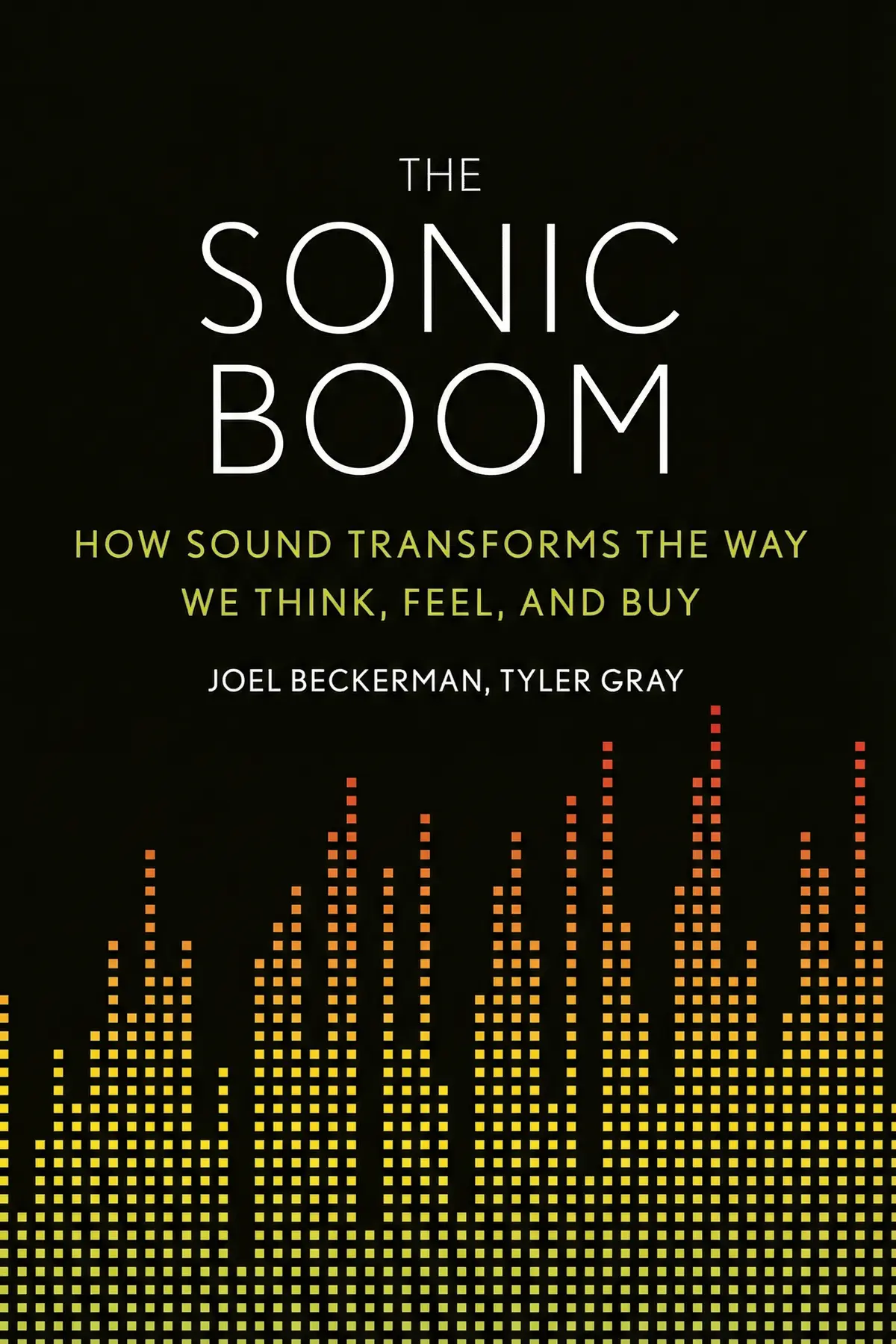
Table of Content
1. Introduction
59 sec
If the noise around you feels like something to block out, Sonic Boom suggests the opposite: it is working on you all the time. Composer Joel Beckerman and editorial director Tyler Gray argue that your brain processes every sound you hear, even the ones you ignore, and links each one to feelings and memories you already carry. When the right sound lands at the right moment and sets off a memory or a strong emotion, they call it a boom moment.
That single fact runs through everything that follows. Because the brain is always listening, sound can be chosen on purpose: to make guests linger, to give a brand a signature, to rally an audience, and to change how others see you and how calm you feel at night. The cases run from a sizzling plate of fajitas to the most-watched broadcast in American television history, and each one ends in something you can try at work or at home.
2. Notice the sounds that are steering your mood
1 min 39 sec
Two low notes can make a whole cinema tense, and a single hiss from a kitchen can make you hungry. The reason has to do with what your brain is doing while you think you are not listening.
3. Slow the music and people stay longer
1 min 27 sec
Diners in one restaurant lingered far longer than diners in another, and nobody asked them to. The difference came from a setting most managers never think about, and it works on your workouts too.
4. Give your brand a sound people remember
1 min 40 sec
A few notes can carry someone back to a childhood holiday, while the crackle of a snack bag can push them away. Learn where the line falls, and why the humblest sounds often win.
5. An anthem that wins an audience back
1 min 44 sec
One broadcaster was losing viewers, and another wanted to top its own record of some 111 million. Both turned to music, and both cases show what a shared sound can do for a group.
6. Make your voice and your home work for you
1 min 28 sec
A gifted business student met many of the largest companies and left without a single offer. What held her back had nothing to do with her grades, and it may be in your voice too.
7. Conclusion
59 sec
Sonic Boom adds up to a simple change in attention. Sound has always been working on us, through a shark theme, a sizzling plate or a rising pitch at the end of a sentence. What Beckerman and Gray add is the idea that this influence can be chosen rather than suffered. The same brain that ties two bass notes to danger will tie a door chime to a favorite shop, a festive anthem to a family, or a steady voice to competence.
That makes the first step a listening one. Spend a day noticing what your workplace, your shop or your home actually sounds like, and which of those sounds help or hurt. Then change one thing. Slow the music where you want people to stay, end your sentences on a level note in your next interview, or put a fan between you and the street at night.
Your brain will keep listening either way. What is still up to you is what it hears.
About this book
What is this book about?
Most people treat sound as background. Joel Beckerman and Tyler Gray argue that it is one of the strongest forces acting on us, because the brain processes every sound it hears and links it to feelings and memories, whether we pay attention or not. When the right sound arrives at the right moment and sets off a memory or a strong emotion, they call it a boom moment. Beckerman, a composer and founder of a sonic branding company, draws on cases from restaurants, film and television. A sizzling plate sells fajitas, slower music keeps diners at the table, a few notes from Disney call up childhood, and new anthems helped Univision win back viewers and NBC set a viewing record. The authors also warn about sonic trash, the sounds that make customers turn away. The book then turns to personal life: how a rising pitch at the end of each sentence can cost a talented student her internship, and how cheap fixes like a fan or a noise machine can bring calm to a loud home. Readers learn to hear what their spaces and voices are saying, and to change it.
Book Information
Who it's for
Business and brand owners
Shop, restaurant and brand owners who want customers to feel something the moment they walk in.
Marketers and team leads
Marketers and team leads looking for a sound that makes a group feel like one.
Job hunters and urbanites
Job seekers and city dwellers who want to sound more credible and sleep in more calm.
About the Author
Joel Beckerman
Joel Beckerman is an award-winning composer and television producer who founded Man Made Music, a company that specializes in sonic branding. He has written original scores for more than fifty television programs and created sonic branding work for Disney, AT&T and Southwest Airlines, collaborating with Morgan Freeman, Moby, John Legend and the composer John Williams. His co-author, Tyler Gray, has worked as editorial director at Edelman New York.
Ratings & Reviews
Ratings at a glance

What people think
Listeners find the book both intriguing and enlightening, with one listener emphasizing its functional day-to-day evaluation. However, the tempo draws conflicting reviews, as several listeners mention that it feels a bit repetitive. The narrative also results in mixed responses from listeners.
Top reviews
Noppadol
Finally got around to reading this and it has completely changed how I perceive my environment. I never realized how much the 'whoosh' of a credit card machine or the specific startup sound of a computer impacted my sense of brand trust. Beckerman has a way of making you listen to the world differently. Not gonna lie, I’m now that person who points out the 'sonic branding' in every grocery store and airport I visit. It’s a fast-paced, engaging look at a hidden world that most of us take for granted every single day. Highly recommended for curious minds who want to understand the invisible cues that shape our modern consumer experience.
Show moreArm
Sound is an invisible force that shapes our lives, and this book highlights that beautifully. From the way a restaurant's playlist affects your appetite to the subtle cues that keep you moving through a theme park, Beckerman reveals the hidden soundtrack of our lives. I found the chapter on how individuals can use sound to improve their own productivity and mood particularly helpful. Frankly, it’s a refreshing take on a subject that doesn't get enough attention in the mainstream. If you want to understand the 'why' behind your emotional reactions to your surroundings, pick this up immediately. It’s a quick read that packs a lot of punch and will leave you listening much more closely.
Show moreMarasri
Ever wonder why certain retail environments make you feel so energized? Beckerman explains how 'sonic branding' works, using examples from places like Disney World to show how sound guides our footsteps and our wallets. I enjoyed the insights into how specific chimes or background hums are engineered to trigger emotional responses. Frankly, the writing is a bit breezy and focuses heavily on the author's own successes, but it definitely makes you more attentive to the acoustics of your surroundings. While it lacks the deep psychological rigor I was craving, it’s an eye-opening read for anyone interested in marketing or human behavior. It’s a solid introduction to how sound influences our daily choices in ways we rarely notice.
Show moreErn
To be fair, the real-world anecdotes about brands like McDonald's and Pepsi are genuinely engaging and offer a peek behind the curtain of corporate marketing. I liked learning about how sound can be layered with smell to influence our hunger or mood. The book is written in a very accessible, conversational style that makes it an easy weekend read. My only real gripe is that it feels a bit light on the details. I wanted more data and fewer stories about the author’s career highlights. Still, it’s a solid 4-star read for the way it heightens your daily awareness. It makes you realize that silence is rarely accidental and noise is almost always a choice.
Show moreKan
After hearing Joel Beckerman on a podcast, I was eager to dive into the full text, but I found the experience a bit mixed. The concept is brilliant—exploring how sound transforms our emotions and buying habits—and the real-world examples of brand chimes are fascinating. However, the book suffers from a serious identity crisis. It’s too superficial for professionals but perhaps a bit too rambling for casual readers. Personally, I found the repetition to be the biggest hurdle, as the same points about Disney and 'sonic fencing' are made multiple times. It’s a decent introductory text, though it lacks the 'how-to' depth I wanted. It’s fine for a plane ride, but don't expect a textbook.
Show moreWaree
As someone who works in creative advertising, I find the premise of 'sonic strategy' absolutely fascinating, yet the execution here is just okay. Beckerman clearly knows his stuff, yet he seems coy about sharing the actual 'why' behind his creative decisions. We hear a lot about the end result—like his work on the Super Bowl score—but very little about the iterative process or the research involved. The truth is, the book leans more toward pop-science than a rigorous academic study. It’s accessible and has some gems, but don’t expect a masterclass in sound design. It’s more of a thematic overview that works best as a conversation starter rather than a professional guide.
Show morePhichai
Not what I expected, though that isn't necessarily a bad thing. While reading, I found myself constantly wishing this was an audiobook or a podcast so I could actually hear the examples Beckerman describes. Describing a 'sonic boom' in text is difficult, and some of the nuances of the music were lost on me. The pacing is a bit uneven, with some chapters feeling like they are just treading water until the next big anecdote. It’s an interesting look at the psychology of sound, but it’s a bit too repetitive to be an essential read for anyone already familiar with marketing basics. A decent library borrow, but maybe not a permanent shelf addition.
Show moreMan
Picked this up hoping for some actionable advice on sonic branding, but I left feeling pretty underwhelmed. The writing is incredibly U.S.-centric and leans heavily on anecdotes rather than providing a structured methodology that a working professional could actually use. It feels like marketing fluff designed to impress potential clients rather than educate the public. To be fair, there are some cool tidbits about how restaurants use sound to turn tables faster, but they are buried under layers of boastful storytelling. It’s not a long read, but it still managed to feel redundant by the halfway mark. I was hoping for something more like a manual and less like a memoir of the author's career.
Show moreCamila
This book felt more like a 200-page business card than an actual exploration of acoustics. I went in expecting a deep dive into the physics or psychology of sound, but instead, I got a series of repetitive stories about how great the author’s agency is. Look, I get that he’s an expert, but the constant self-promotion becomes exhausting after the third chapter. There is very little hard science here to back up the grand claims he makes about 'sonic strategy.' If you’ve heard his interview on Freakonomics, you’ve basically read the entire book already. Save your money and just listen to the podcast episode instead; it’s much more concise.
Show moreMats
The truth is, I found the author’s obsession with constant background stimulation quite disturbing. Beckerman speaks with such enthusiasm about 'musical cattle-prods' and using sound to manipulate people through souvenir shops that it felt a bit Orwellian. There is almost zero respect given to the concept of silence or the right to an un-curated acoustic environment. Beyond the ethical concerns, the writing is repetitive and lacks the scientific backing I expected from a book on this topic. It’s mostly just fluff and anecdotes about the author’s high-profile clients like McDonald's. I’d suggest skipping this one if you value your quiet time or prefer books with more data and less ego.
Show moreQuestions about this book
What is the main idea of Sonic Boom?
Joel Beckerman and Tyler Gray argue that your brain processes every sound around you, even when you are not paying attention, and links it to feelings and memories. A well-timed sound can trigger what they call a boom moment. Because of this, sound can be chosen deliberately to shape how customers feel, how a brand is remembered, how others see you and how calm your own surroundings are.
What is a sonic identity according to Sonic Boom?
A sonic identity is a sound created specifically for a product, so that hearing it brings the brand to mind at once. As an example, the authors cite the opening seven notes from Disney’s song When You Wish Upon a Star, which may bring back memories of childhood visits to Disneyland or of watching Pinocchio. Its opposite is sonic trash, a sound that feels fake, puts customers off or recalls an unwanted memory.
How does music affect how long people stay in a restaurant?
The authors cite researchers Clare Caldwell and Sally A. Hibbert, who found that diners stayed almost 15 minutes longer in a restaurant playing slower music than in one playing faster music. Slower tempo made guests feel relaxed and safe, so they lingered. For workouts the authors recommend the reverse: fast-tempo music instead of podcasts or television, because a quick beat motivates you to push harder.
How can I use the ideas in Sonic Boom in my own life?
Start by noticing your own sounds. The book tells of Sarah, a business school student whose rising pitch at the end of each sentence made employers think she was too young and inexperienced. Be aware of how you speak and move. At home, a low-cost noise machine or a fan can mask street noise, and birdsong or attention to your breathing can ease stress.
Who should read Sonic Boom?
It suits business owners and marketers who want customers to feel something specific, such as the Chili’s diners drawn in by sizzling meat or the Univision viewers won back by a new anthem. It also helps job seekers who want to sound more credible and anyone living in a noisy city who wants practical, inexpensive ways to make home calmer.
Readers also enjoyed





AUDIO SUMMARY AVAILABLE
Listen to Sonic Boom in 15 minutes
Get the key ideas from Sonic Boom by Joel Beckerman, plus 5,000+ more nonfiction titles.
- 5,000+ titles
- Listen as much as you want
- 7-day free trial
- Cancel anytime









