
15 min 41 sec
Available in: English
 ไทย
EnglishไทยSolve for Happy: Engineer Your Path to Joy
By Mo Gawdat
Mo Gawdat treats happiness as an engineering problem: your mood depends on the gap between events and expectations, and you can close it by spotting mental illusions and blind spots and resting on five steady truths.
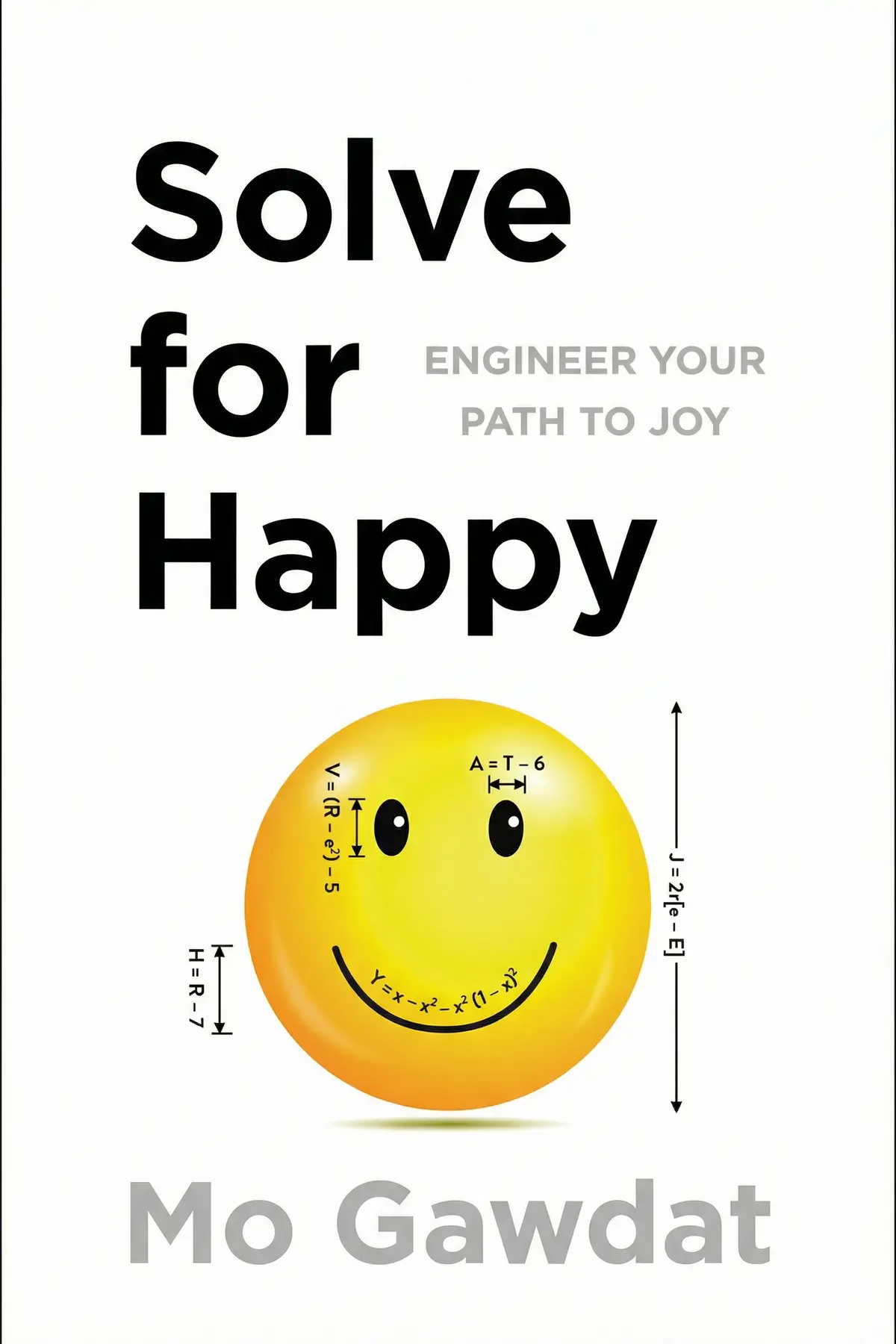
Table of Content
1. Introduction
1 min 00 sec
Plenty of people do everything right, the career, the money, the family, and still feel something is missing. In Solve for Happy, former Google X executive Mo Gawdat argues that happiness was never something to acquire. It is the state we start in, and it fades whenever life falls short of what we expected.
Gawdat had all the outward signs of success and was still unhappy, so he attacked the problem like an engineer. Then, in 2014, his 21-year-old son Ali died during a routine hospital procedure, and the question became urgent. His answer is that happiness comes back when you see life more accurately: when you strip away the illusions and mental blind spots that inflate your expectations, and rest on a few truths that hold even when everything changes. What you get is a one-line equation for checking any bad day, and a set of questions for the thoughts that cause most of your suffering.
2. Read every bad day as a simple equation
1 min 52 sec
Two people can live through the exact same day and come out of it feeling opposite things. An engineer’s formula explains why, and it points to the one number most of us never think to adjust.
3. Stop mistaking the voice in your head for you
1 min 50 sec
A constant stream of commentary runs through your mind from morning to night, and most of us assume it speaks for who we are. Gawdat suggests a simple experiment that reveals someone else is listening.
4. Drop four beliefs that keep raising your expectations
1 min 53 sec
Some of the beliefs that feel most responsible, like staying in control and planning ahead, may be the ones setting you up for disappointment. Gawdat explains why letting them go can make you steadier.
5. Catch the seven ways your brain bends reality
2 min 04 sec
Your mind evolved to keep you alive, and it still runs that old program in meetings, relationships and holidays. Gawdat lists the specific tricks it plays, and one of them may already be shaping your week.
6. Attention matters more than activity, so stay present
2 min 05 sec
Researchers asked people again and again how they felt and what they were doing at that moment. The pattern that emerged suggests a pleasant activity is a weaker source of happiness than most of us assume.
7. Love that asks nothing cannot be disappointed
2 min 04 sec
After losing his son, Gawdat looked for a kind of feeling that no loss or letdown could take away. He found it in an emotion we usually treat as fragile, and in traditions that throw parties for the dead.
8. Let wonder replace your fear of the unknown
1 min 49 sec
Ten dice, ten sixes, odds of one in 60 million. Gawdat uses that roll to make a case about the shape of life itself, and about where a grieving father found comfort without needing certainty.
9. Conclusion
1 min 04 sec
Solve for Happy works like a debugging manual for the mind. Gawdat’s claim is that the system ran fine at the start, as it does in a contented child, and that unhappiness is mostly bad input: illusions that promise certainty and control, and blind spots that show threats where there are none. Correct the input and the default returns. His five truths then give that default a base that does not depend on how things turn out. You can adopt his versions or, as he allows, find your own.
What gives the model weight is that he tested it on the worst day of his life. After losing Ali, he went looking for a way to keep living well.
Start with the equation. When a day goes wrong, separate what happened from what you expected, and see which number you can change. When the voice in your head predicts disaster, hear it as one more forecast from an anxious machine. And bring your attention back to the task in your hands, because that, on Killingsworth’s evidence, is where contentment tends to be waiting.
About this book
What is this book about?
Many people reach the goals they were told would make them happy and still feel restless. Mo Gawdat was one of them: a senior executive at Google X, well paid and loved by his family, and yet unhappy. He spent years treating the problem the way an engineer would, studying ideas from many of the world's religions along the way. When his 21-year-old son Ali died during a routine hospital procedure in 2014, the question stopped being abstract. His answer is an equation. Happiness, he argues, is equal to or greater than the way you perceive events minus what you expected of life. We start out happy, as small children show, and lose that state as expectations climb and perception gets distorted. Gawdat names six grand illusions, from the voice in your head to the belief in control, and seven blind spots, from filtering to exaggeration, that widen the gap. He then offers five ultimate truths that do not collapse when circumstances change: the present moment, constant change, unconditional love, death as part of life and the possibility of design. Readers get a simple test for any bad day and a set of questions for the thoughts behind most suffering.
Book Information
Who it's for
Professionals feeling unfulfilled
Successful professionals who reached their goals and still feel restless or dissatisfied.
Wanting happiness made testable
Analytical thinkers who want happiness explained as a model they can test, not as vague advice.
Grieving, worried or overthinking
People facing loss, worry or constant overthinking who want practical ways to question their own thoughts.
About the Author
Mo Gawdat
Mo Gawdat, born in 1967, is an Egyptian author and former technology executive. He began as a systems engineer at IBM Egypt, worked at NCR and Microsoft, and joined Google in 2007 to build its business in emerging markets. In 2013 he moved to Google X, where he led business strategy and partnerships. He has cofounded more than 20 businesses. Solve for Happy, published in 2017, sets out a model he developed over twelve years of research and tested after losing his son Ali in 2014.

Ratings & Reviews
Ratings at a glance

What people think
Listeners find the work deeply life-changing and thought-provoking, providing a clear structure for discovering joy along with plenty of actionable advice. The writing style is also quite accessible, and listeners particularly value the logical content and mathematical analysis presented. Additionally, the text offers an incredible level of peace, as one listener mentioned it was instrumental in helping them manage anxiety.
Top reviews
Tuck
As a software engineer, the premise of an algorithm for joy immediately grabbed my attention. Mo Gawdat brings a uniquely clinical, yet deeply compassionate perspective to the table by applying his technical background from Google [X] to the human experience. The central equation—happiness equals your perception of reality minus your expectations—is a simple, life-changing tool for anyone prone to overthinking. I found the logical content incredibly grounding during a period of high anxiety. While the author’s personal tragedy regarding his son, Ali, is heartbreaking, it serves as the necessary proof of concept for his theories. Frankly, it’s rare to find a self-help book that feels this structured and actionable without being overly sentimental. It helped me realize that most of my suffering was a result of flawed internal code rather than external circumstances. This is a must-read for anyone who prefers data over fluff.
Show moreManee
Finally got around to this after a particularly stressful month, and the mental shift it provided was almost instantaneous. The way Mo breaks down our 'blind spots' and the 'six illusions' is nothing short of thought-provoking for a modern reader. I particularly appreciated the emphasis on how our default state is actually one of peace, provided we can stop the mental chatter. The writing is incredibly easy to read and understand, which makes the complex psychological concepts feel much more accessible. Truth is, I started using the 'reboot' analogy immediately to manage my daily frustrations at work. This book provides an unbelievable amount of peace for those of us struggling with the noise of the digital age. It’s a beautiful tribute to his son and a gift to the rest of the world.
Show moreAna
This book genuinely changed how I process disappointment. Instead of spiraling into a 'why me' mindset, I now use Mo's method to analyze the gap between my expectations and reality. It’s incredibly logical content that provides immediate results if you're willing to do the mental work. The chapter on the 'truth of now' was especially powerful for me. It’s not just about 'being happy' in a fake way; it’s about finding a state of peace by seeing the world as it truly is. I’ve recommended this to several coworkers who deal with high-stress environments. It feels like a manual for the human brain that we should have been given in school. Truly life-changing stuff if you actually apply the principles.
Show morePenelope
The intersection of cold, hard logic and the messy reality of human emotion is a difficult bridge to build, but Gawdat does a surprisingly decent job. Most self-help titles feel like they were written in a vacuum, but this one feels forged in the fires of real-world experience and unimaginable loss. I loved the mathematical analysis of how our brains process disappointment. It makes the pursuit of happiness feel like a solvable engineering problem rather than some mystical, unreachable state. My only real gripe is that the middle sections on the 'illusions' of time and self felt a bit repetitive at times. To be fair, though, the core message is so strong that I can forgive some of the 'spaghetti code' structure in the writing. It’s a solid 4-star read that offers genuine, actionable advice for anyone feeling stuck in a cycle of negativity.
Show moreDavid
Mo’s vulnerability regarding the loss of his son gives this book a weight that most self-help titles lack. It isn't just theory; it’s a survival guide that he actually used to navigate the worst possible human experience. The way he dissects the 'seven blind spots' like an engineer looking for bugs in a system is utterly fascinating to me. I've found myself quoting the 'Happiness = Perception - Expectations' formula to friends more than once this week. Look, some of the later chapters on the truths of the universe get a bit dense and philosophical, but the practical advice in the first half is worth the price of admission alone. It’s an empowering read that shifts the responsibility for your mood back onto your own internal processing. I felt significantly more equipped to handle life's curveballs after finishing the final page.
Show moreLaddawan
Ever wonder why we aren't born miserable? Gawdat posits that we are actually hardwired for happiness, and that our social conditioning is what introduces the 'bugs' into our system. This perspective was a total game-changer for my anxiety management. The book is easy to read and doesn't get bogged down in too much academic jargon, which I appreciated. I particularly liked the chapter on the 'illusion of knowledge' because it forced me to confront how many of my stressors are based on assumptions rather than facts. It’s a very structured approach that appeals to the analytical mind. Some might find his tone a bit patronizing in certain sections, but I think he’s just trying to be as clear as possible. Overall, it’s a very helpful guide for anyone looking to reframe their perspective on life.
Show moreRin
After hearing Mo on a podcast, I wanted to see if the 'happiness equation' actually held up under scrutiny. It turns out that the formula is a remarkably effective way to deconstruct bad moods. The book is very easy to read and understand, even when he's talking about complex topics like brain chemistry or physics. I loved the emphasis on how our thoughts are often just filters that distort reality. While some of the personal stories felt a bit repetitive, the overall message is incredibly empowering. It’s essentially Stoicism rebranded for the tech age, and that’s exactly what I needed. I didn't agree with every single conclusion he reached in the later chapters, but the practical tools for managing daily stress are top-notch. It’s a solid addition to any self-growth library.
Show morePia
Gotta say, I was skeptical of a tech giant telling me how to be happy, but this book is surprisingly humble and deeply moving. The structure of the '6-7-5' model gives you a clear roadmap to follow, which is great for people who hate vague self-help advice. It’s a very thought-provoking read that challenges you to look at your own biases and blind spots. I found that my anxiety decreased significantly just by practicing the 'brain training' exercises he suggests. The writing is clear and direct, though a bit wordy in the middle sections. Even if you don't buy into the more spiritual elements toward the end, the logic-based approach to emotional regulation is worth studying. It’s a heart-wrenching but ultimately hopeful book that offers a very structured path to finding peace.
Show moreJoshua
In my experience, books that promise a 'solution' to happiness usually overpromise, and this one is a bit of a mixed bag. The engineering approach is definitely a fresh take, and I appreciated the logical breakdown of how our thoughts create our reality. However, the structure felt a bit disjointed, almost like a corporate slide deck that was expanded into a book at the last minute. While I have immense sympathy for his loss, some of the 'logic' in the final chapters regarding intelligent design felt like a massive leap from the earlier scientific tone. It’s thought-provoking, sure, but it starts to feel less like an engineering manual and more like a personal spiritual manifesto by the end. If you can get past the pseudo-scientific ending, there are some decent nuggets of wisdom about managing expectations and staying in the present moment.
Show moreSelin
Not what I expected from a Google executive; the first half is okay, but the second half descends into pseudo-science and logical leaps that I couldn't ignore. While the story of his son is heartbreaking, I felt like the author used it to shield his arguments from actual scrutiny. The 'iPhone in a sandpit' analogy for evolution was particularly weak and felt very out of place in a book that claims to be based on an engineering mindset. Frankly, the tone felt a bit condescending, as if the author is the only one who has ever understood the 'truth' of the universe. There are much better, more grounded books on Stoicism and mindfulness that don't try to shoehorn creationism into the mix at the end. It started strong with the happiness equation but lost me completely by the final third.
Show moreQuestions about this book
What is the happiness equation in Solve for Happy?
Mo Gawdat argues that happiness is equal to or greater than your perception of the events in your life minus your expectations of how life should go. When events meet or beat what you expected, you feel content. When they fall short, you suffer. The practical lesson is that you can often change your mood by examining the expectation, or by checking whether your perception of the event is accurate.
What are the six grand illusions Mo Gawdat describes?
Gawdat names thought, self, knowledge, time, control and fear. Each one distorts how we see reality. We mistake the voice in our head for who we are, build identity on things that change, overrate what we know, live in the past or future, believe we can control events and carry fears we learned long ago. Questioning them, he argues, lowers expectations and brings happiness back.
What are the seven blind spots in Solve for Happy?
They are filtering, assumptions, predictions, memory, labels, emotions and exaggeration. Gawdat traces them to a brain built for survival, which treats every rustle as a predator. He cites a University of Texas study finding that 60 to 70 percent of our thoughts are negative. Recognizing these patterns, he says, lets you question a thought instead of treating it as truth.
How can I apply Solve for Happy in daily life?
Run the equation when you feel let down: ask what you expected and whether the event was truly bad. Notice your harsh thoughts as products of the brain rather than facts. Keep your attention on the task in front of you, since Matt Killingsworth’s study of over 650,000 reports linked presence to greater happiness. And practice love that asks for nothing in return, including toward yourself.
Who should read Solve for Happy?
It suits people who have achieved outward success and still feel unhappy, readers who like problems framed as systems and equations, and anyone working through grief or chronic worry. Gawdat wrote it after years of study and tested his model after losing his son Ali in 2014, so it speaks both to the analytical mind and to people in real pain.
Readers also enjoyed

59 Seconds: Change Your Life in Under a Minute
Richard Wiseman





A Guide to the Good Life: The Ancient Art of Stoic Joy
William B. Irvine


A High-Performing Mind: Strengthen Your Mind and Live Your Best Life
Andrew D. Thompson


Abundance: The Inner Path to Wealth
Deepak Chopra
AUDIO SUMMARY AVAILABLE
Listen to Solve for Happy in 15 minutes
Get the key ideas from Solve for Happy by Mo Gawdat, plus 5,000+ more nonfiction titles.
- 5,000+ titles
- Listen as much as you want
- 7-day free trial
- Cancel anytime









