

14 min 43 sec
Available in: English
Soft Power: The Means to Success in World Politics
Explains how countries win cooperation by being admired, how they waste that appeal through double standards and arrogance, and why combining attraction with force works better than either alone.
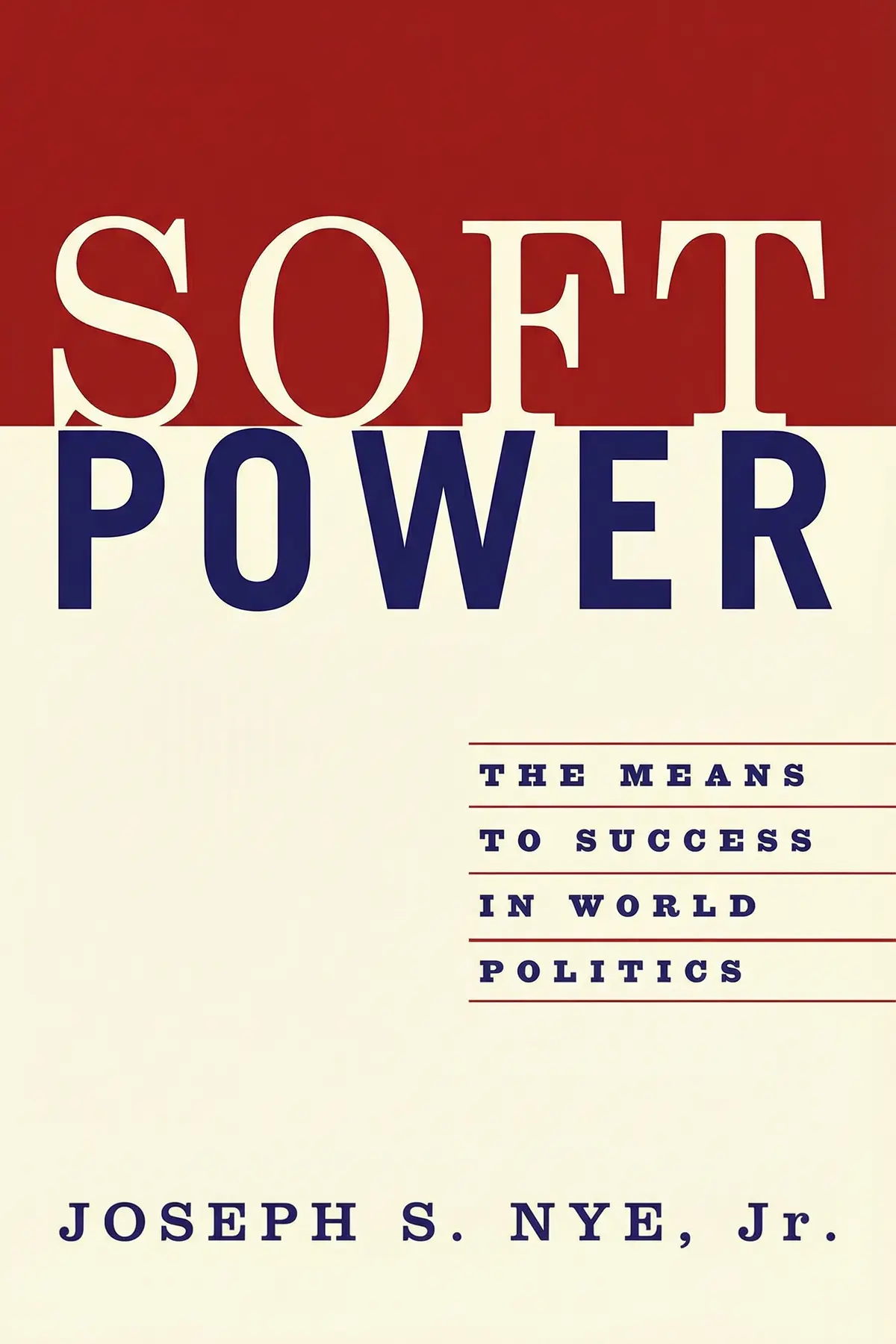
Table of Content
1. Introduction
1 min 03 sec
Force can make people obey, but it rarely makes them eager to help you next time. In Soft Power, political scientist Joseph S. Nye Jr. argues that a country often gets further by attracting others than by threatening or paying them. He calls that pull soft power: shaping what others want through culture, political values and the conduct of foreign policy. Hard power is the carrot and the stick. Soft power works on hearts and minds, and it is far cheaper to keep.
Nye’s case is that attraction is real power, that a nation can waste it through hypocrisy and arrogance, and that lasting success comes from blending force and attraction into what he calls smart power. The evidence runs from the Marshall Plan and Soviet teenagers listening to rock and roll to Norway’s habit of showing up at every peace table. Along the way you get a clear model of why people follow those they admire, and what makes that admiration vanish.
2. Get your way by making others want it
1 min 59 sec
After World War II, the United States spent billions rebuilding Europe. The money mattered, but Nye argues that the way it was spent earned something worth far more than the factories it rebuilt.
3. Let culture carry your values past closed borders
1 min 50 sec
No diplomat could cross the Iron Curtain to argue for Western freedom. Something else got through anyway, and it sometimes said the opposite of what Washington wanted, which turned out to be part of its strength.
4. Avoid double standards to keep your pull strong
2 min 06 sec
A 2002 poll across 43 countries found widespread unease with American influence. Some of that dislike is old and unavoidable. Nye argues that much of the rest was earned, and he names the habit behind it.
5. A small country can outweigh its size
2 min 10 sec
One nation of about 5 million people, with no world language and few cultural exports, punches far above its weight. Meanwhile, much larger powers keep tripping over the same few problems at home.
6. Earn trust when information is everywhere
2 min 05 sec
When information became cheap, a new scarcity appeared in its place. Governments now compete for it with companies, activists and even terrorist groups, and Nye explains the long game that wins it.
7. Blend force and attraction into smart power
2 min 08 sec
America bounced back from unpopularity before, but it had help from a feared rival that no longer exists. Nye lays out what it would take to recover now, and why tone matters as much as policy.
8. Conclusion
1 min 22 sec
Soft Power changes what strength means. Armies and money still count, but Nye shows that being admired can achieve what they cannot: allies who help because they want to, a rival’s teenagers listening to your music, a nation of 5 million treated as a peacemaker. That kind of power is also fragile. Built over decades through generosity like the Marshall Plan and openness like Hollywood’s freedom to criticize its own government, it can drain away in a few years of arrogance and double standards, as it did after Iraq.
Nye saw early that the internet would make this contest harder, turning politics into a competition for credibility among governments, companies, activists and extremists alike. In that world, the most believable story tends to win.
His ideas carry well into ordinary working life. When you want cooperation, check whether your own example is doing any of the persuading. Look for the places where your words and your conduct disagree, because that gap is what others notice first. And put time into the exchanges and conversations that let people see you up close, flaws included, since those who know you well make your best advocates.
Force can win the moment. Attraction decides whether anyone stands with you afterward.
About this book
What is this book about?
Armies, sanctions and money are the obvious tools of world politics. Joseph S. Nye Jr. argues that they leave out a third tool that is cheaper and often longer lasting: the ability to get what you want because others admire your culture, your values and the way you behave. He calls it soft power. Nye traces how this pull has worked and failed. The Marshall Plan built goodwill because the United States rebuilt Europe with partners, not by decree. Rock and roll, Hollywood and the Beatles reached young people behind the Iron Curtain. Then the 2003 Iraq War, launched without a UN mandate, sent global opinion of America sharply down. Along the way he compares the Soviet Union, Europe, Norway, China, India and Japan, and explains why the internet turns politics into a contest for credibility. Readers get a clear model of attraction as power, the habits that destroy it, the public diplomacy that rebuilds it, and Nye's case for smart power, a strategy that blends hard and soft tools.
Book Information
Who it's for
Following world news
Readers of world news who want a clear framework for why some countries win allies and others lose them.
New to soft power
Students of politics and international relations meeting the ideas of soft and smart power.
Wanting influence without pressure
Managers and professionals who want to influence people through example rather than pressure.
About the Author
Joseph S. Nye Jr.
Joseph S. Nye Jr. (1937 to 2025) was an American political scientist who joined the Harvard faculty in 1964 and later served as Dean of the Kennedy School of Government. In government he was an Assistant Secretary of Defense for international security affairs and head of the National Intelligence Council. With Robert Keohane he helped found the neoliberal theory of international relations in Power and Interdependence (1977). He is best known for the idea of soft power and for promoting smart power, the combination of hard and soft power in one strategy.
Ratings & Reviews
Ratings at a glance

What people think
Listeners find the writing engaging and very accessible. They value its impact on political circles, with one listener highlighting it as a vital instrument in geopolitics. The book is praised for its steady tempo; specifically, one review notes its favorable stance on democracy, while another listener appreciates its more composed outlook on Bush2-era foreign policy.
Top reviews
Chee
After hearing Stephen Schwarzman mention this years ago, I finally dove in. Nye’s thesis on attracting others through culture and political ideals rather than just coercion is brilliant. It offers a much-needed calm perspective on international relations that moved past the aggressive stances of the early 2000s. While some say it’s too Jeffersonian or idealistic, the book argues convincingly that 'smart power' is the only sustainable way forward. It’s a masterclass in why a country’s image matters as much as its military. I particularly enjoyed the anecdotes about cultural diplomacy and how cutting those budgets can actually undermine long-term security. Even if you aren't a policy wonk at the Rand Corporation, there is a lot to learn here about persuasion. It really changed how I view global influence and the way we interact with other nations.
Show moreConnor
As someone who is currently prepping for the Foreign Service, this was mandatory reading. Joseph Nye basically coined the term 'Soft Power,' and seeing the original context is eye-opening. The way he blends contemporary events with brief history lessons makes the theory come alive. It’s not just about being 'nice'; it is about the strategic merging of hard and soft influences to create a coalition of nations. I was particularly struck by the mention of the U.N. and the lack of domestic solidarity during the Iraq conflict. Nye doesn't pull his punches when criticizing the lack of a unifying consensus during those years. This book is a masterpiece for anyone trying to understand the intricacies of international relations and how we project our political ideals. Absolutely essential for my career path and graduate studies.
Show moreWoramet
Wow, the implications of favorability data go way beyond just statecraft. Even though Nye is writing about geo-politics, you can see how these principles apply to leadership and personal relationships. It’s about being attractive enough that people want what you want. The book is incredibly fascinating and easy to digest, which I didn’t expect from an academic. It highlights how cutting budgets for cultural exchanges was a critical mistake for the U.S., weakening our ability to communicate relevant themes to the world. For anyone interested in diplomacy or just understanding the world today, this is a must-read. It is a masterpiece that helps us recognize the real purpose behind international interactions. I cannot agree more with the central theme of using 'smart power' to bridge divides between different cultures and political systems.
Show morePacharapol
Picked this up to get a clearer picture of the Bush-era foreign policy shift. Nye explains the difference between hard and soft power with surgical precision, showing how we often mistake military might for the only kind of influence. The book is an excellent, comprehensive review of why our success in the 'war on terror' depended on more than just tanks. I liked the historical context he provided, especially the bits about the Clinton administration's cuts to cultural diplomacy and exchange programs. The pace is steady, and the arguments are well-structured, though I do think the concept is a bit narrow in scope. Other countries use these tools to promote themselves, and it is high time we recognize that 'moving power' is just as vital as threat power. Definitely a solid addition to any IR library.
Show moreRungtip
Ever wonder why 'in your face' diplomacy feels like a relic of the past? Nye’s work suggests that we are entering an era where respect and attraction are the primary currencies. I found his discussion on China particularly relevant today, even though the book was written years ago. It supports my thesis that we are more alike than different and that a little mutual respect goes a long way. The text is accessible, which is a relief because these academic books can sometimes be a slog. He moves through the themes of broadcast capabilities and the internet with a foresight that is impressive. While I think he overestimates the reach of democratic sentiment occasionally, his core message about the 'pull' of a culture is undeniable. Good for those interested in the future of the new diplomacy.
Show moreLincoln
Finally got around to reading Nye's original text after seeing the term used in every news cycle. It is much more nuanced than the talking heads make it out to be. Nye argues that you can't just kill enemies; you have to gather allies, which is a lesson many leaders still haven't learned. The book is an important tool for understanding why certain cultural programs, like sending doctors or teachers abroad, are actually strategic assets for democracy. My only gripe is that it focuses so much on the US. I would have loved to see more historical anecdotes from beyond the 20th century to prove the concept's universality. Still, the lesson that favorability data matters for stable decision-making is something that every leader should take to heart. It is a quick, insightful read for the politically curious.
Show moreEllie
The chapter on the definitions of power was helpful, but the book stayed too abstract for my taste. Frankly, I was looking for something more like a Robert Greene book with concrete examples of individuals or corporations using these principles. Nye focuses almost exclusively on the state level, which makes sense given his background, but it leaves the average reader wanting more personal application. To be fair, his analysis of the Bush Jr. era is illuminating and provides a solid framework for understanding why certain interventions failed. However, the writing can be quite dry and repetitive at times. It’s an informative read for students of geopolitics, but if you want practical life hacks for power dynamics, this isn't it. It feels very much like a product of its specific political era, focusing heavily on the status quo of the time.
Show moreChanpen
Not what I expected given the hype, though Nye is clearly a titan in the field of IR. The core concept of soft power is revolutionary, but the book spends a lot of time rehashing the same few points. Look, I appreciate the calm perspective on the 2000s, but it feels like it’s written for a very specific crowd in D.C. or at a think tank. It’s useful for evaluating how 'pulling' someone along works, but I wanted more on non-state actors and their role in the modern world. The pacing is okay, but it gets bogged down in policy analysis that doesn't always feel relevant to the current day. It’s an interesting publication, just not something I’d call a page-turner. I would recommend it to students, but maybe just skim the middle chapters to get the gist.
Show moreKek
Soft Power is a concept everyone throws around, but few actually read the source material. I’m glad I did, but I’m not sure I’d read it again. It is a great contribution to the field, but it is definitely stuck in the Bush-era headspace. The comparison to Steven Brams’ Theory of Moves in other reviews makes sense—it’s all about the game of influence and how to modify goals to maintain stable relations. I appreciated the sections on how the internet and broadcasting enhance communication strategies, even if those parts feel a little dated now. It’s a solid 3-star read: informative, slightly abstract, and very focused on American political interests. If you want to know where the term came from, this is the place, but don't expect it to change your life unless you’re a diplomat.
Show moreSomrutai
Truth is, I found this to be a bit of a status-quo-preservation manual. While Nye’s definitions are helpful for a college course, the whole thing has a decidedly globalist slant that ignores the downsides of Western cultural hegemony. It feels a bit like a PR manual for the American empire, trying to find a gentler way to exert dominance. I was hoping for a more critical look at how soft power can be used for manipulation rather than just 'attraction.' The writing is fine—easy to read and well-organized—but the perspective is very narrow. It rejects the idea that hard power is the only way, which is good, but then it just replaces it with a different kind of control that feels equally problematic. Not for me, personally. It felt like a long-winded defense of the State Department's budget.
Show moreQuestions about this book
What is soft power according to Joseph Nye?
Soft power is the ability to get what you want through attraction and persuasion instead of force or payment. Nye contrasts it with hard power, the carrot and the stick of military action, sanctions and tough trade policy. Soft power comes from a country’s culture, its political values and the way it conducts foreign policy, and it works when others admire those things and want the same outcomes.
What are examples of soft power in the book?
Nye points to the Marshall Plan, where the United States helped rebuild Europe through agreements with partner governments and earned wide goodwill. He also describes American and British music and films, including rock and roll on Radio Free Europe and the Beatles, reaching young people behind the Iron Curtain. Norway, which keeps offering to mediate international crises, is his example of a small country with outsized appeal.
How does a country lose soft power?
Mainly through hypocrisy and arrogance, Nye argues. When domestic policies such as capital punishment or gun control clash with the values a country preaches, its message rings hollow. The 2003 Iraq War, launched without a UN mandate and with little effort to win international support, caused global opinion of the United States to fall sharply, even among longtime allies.
What is smart power?
Smart power is Nye’s term for a strategy that combines hard and soft power. He warns that relying on military force alone leads to costly results that cannot last, while attraction alone cannot meet every threat. He calls for stronger public diplomacy, more exchanges, friendlier student visa rules and a foreign policy style that avoids needless insults to allies.
How can I apply the ideas in Soft Power to my own work?
The book’s logic transfers well to teams and careers. Influence grows when others admire how you work, so lead by example as well as by instruction. Close the gaps between what you say and what you do, since those gaps destroy trust fastest. And follow Nye’s public diplomacy model: explain your reasons, keep a simple consistent message and invest in long-term relationships.
Readers also enjoyed


A Promised Land
Barack Obama

A River in Darkness: One Man’s Escape from North Korea
Masaji Ishikawa

A Theory of Justice
John Rawls



A Warning
Miles Taylor


AUDIO SUMMARY AVAILABLE
Listen to Soft Power in 15 minutes
Get the key ideas from Soft Power by Joseph S. Nye Jr., plus 5,000+ more nonfiction titles.
- 5,000+ titles
- Listen as much as you want
- 7-day free trial
- Cancel anytime









