


A Short History of Nearly Everything
Bill Bryson
 English
Shows how the human brain is built for connection, from what it does at rest to how it shapes your sense of self. It also explains why social ties can lift happiness and motivation more than money.

1 min 03 sec
If you believe a raise is the surest route to a better life, one finding in Social will unsettle you: volunteering once a week was linked to as much well-being as going from a $20,000 salary to a $75,000 one annually. In this book, UCLA psychologist Matthew D. Lieberman argues that results like this are no accident. Drawing on brain scans from his own lab and on the wider science of the mind, he makes the case that our sociality defines us more than any private inner self.
The throughline is easy to state. Evolution has wired the human brain for connection, from what it does when you rest to how it builds your sense of who you are, so the biggest gains in happiness and performance come from other people. Along the way you will hear why rejection stings, how children learn to guess what others believe, and how a gold star made salespeople give up thousands of dollars. Expect better ways to motivate a team and to spend your own free hours.
1 min 55 sec
Scientists expected the resting brain to go quiet. Instead, one network switched on whenever people stopped working, and what it spends that time on adds up to an expertise most of us never notice we have.
2 min 04 sec
A simple game of virtual catch left volunteers feeling sad or angry. Their brain scans revealed something that changes how seriously anyone should take a cold shoulder at work or at home.
1 min 48 sec
Shown a cartoon of moving shapes, adults saw bullies and flirting. Three-year-olds watching a puppet show got a simple question wrong. Together they reveal a skill you use all day and still misuse under pressure.
2 min 03 sec
A color rule for babies that feels natural to millions turns out to have been reversed a century ago. Lieberman uses it to show where many of your most personal opinions really come from.
1 min 56 sec
A philosopher’s imaginary prison was never built, yet its central trick works in a cafeteria with nothing more than posters. It suggests willpower is less of a solo effort than most of us think.
2 min 00 sec
Salespeople at a software company gave up about $27,000 on average for a small symbol on their business cards. Their choice looks irrational until you see what it says about what people really work for.
1 min 12 sec
Lieberman’s picture overturns a familiar idea of the person as a sealed box of private wants. The brain he describes is social all the way down. It rehearses relationships when idle, treats rejection as injury, reads intentions into moving triangles, absorbs the crowd’s views as its own and behaves better under watching eyes. Food, water and shelter keep us alive. Connection is what lets us thrive.
That has consequences for ordinary choices. When you weigh extra hours for more pay against an evening with friends or a weekly stint as a volunteer, the 2008 numbers suggest the second may do more for you. When a team loses energy, a letter from someone their work helped can matter more than a cash bonus, as Grant’s callers showed. And when someone is left out, even of something as small as a game of catch, take their hurt as real, because their brain does.
The salespeople who gave up $27,000 for a gold star were not being foolish. They were being human, and the wise move is to build work and life around that fact.
Most of us picture the self as a private space of personal tastes and goals, and we chase happiness through income. Matthew D. Lieberman, a UCLA psychologist who studies the brain in social life, argues that both assumptions miss what defines us. Our sociality, he says, is wired in from birth. Drawing on brain scans from his own lab and wider research, Lieberman shows how the brain turns to social thinking whenever it rests. It treats rejection much like physical injury and learns in early childhood to guess what others believe. Even the beliefs that feel most personal often arrive from the crowd, and self-control turns out to serve the group as much as the individual. The practical payoff is a different way to think about well-being and work. Readers see why weekly volunteering can matter as much as a large raise, why salespeople gave up thousands of dollars for a gold star, and how a few letters from grateful students more than doubled a fundraising team's results.
Managers and team leads looking for ways to motivate people beyond pay.
Professionals who chase raises yet feel no happier, and want to know what actually lifts well-being.
Curious readers who want brain science explaining why rejection hurts and where their beliefs come from.
Matthew D. Lieberman teaches psychology at the University of California, Los Angeles, where he directs the Social Cognitive Neuroscience Laboratory. He researches social neuroscience, affective neuroscience and social psychology, and his work has been published in journals including Science and Nature. In 2007 the American Psychological Association gave him its early-career Distinguished Scientific Award.
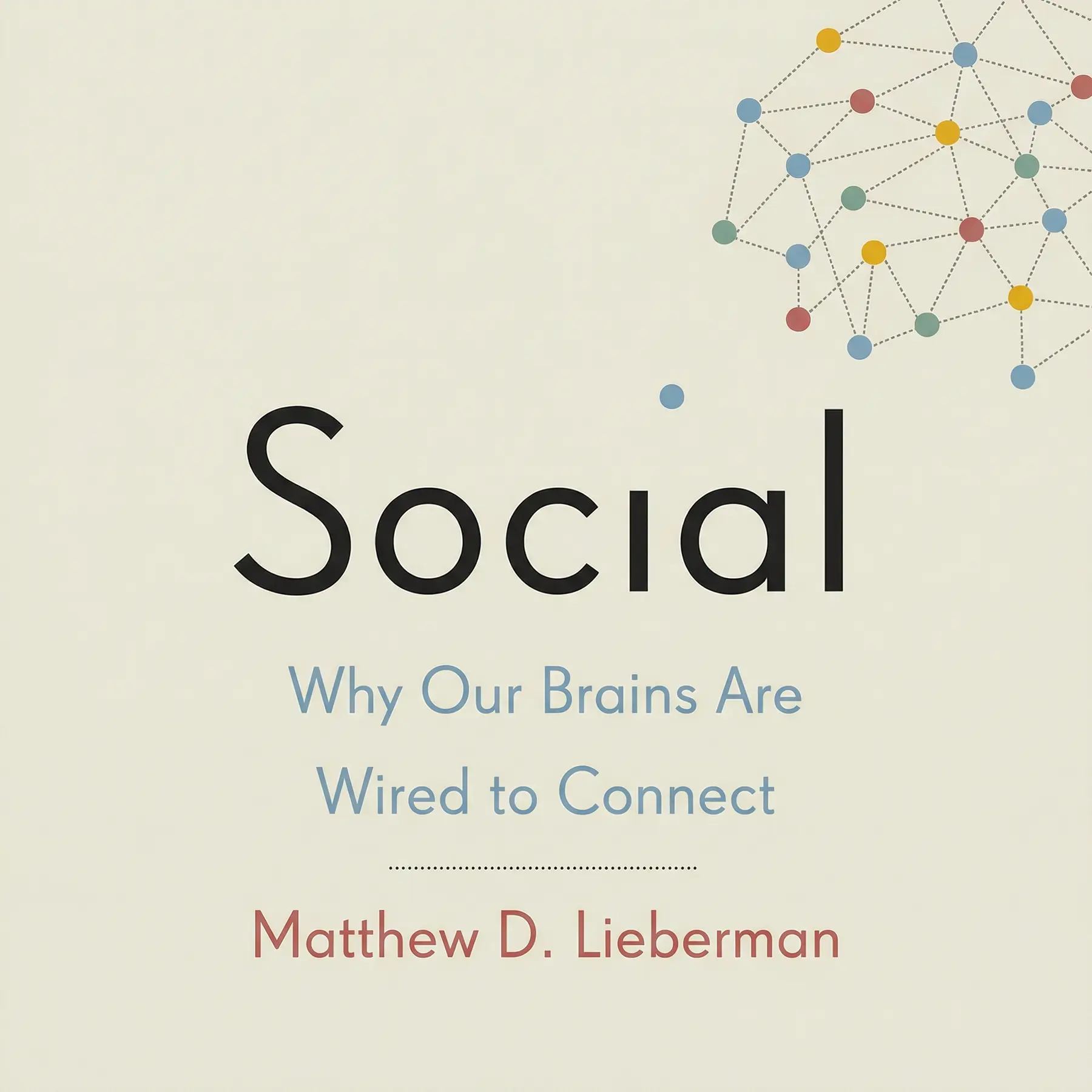
Listeners find the writing style clear and accessible, delivering a deep dive into the biological foundations of our social interactions. Loaded with scientific research, the book invites people to reexamine their relationships and themselves from a different angle. Listeners respect the author’s proficiency and consider the material both compelling and helpful, with one listener remarking that it works well as a handbook for those in leadership roles.
Matthew Lieberman delivers a masterclass in neurobiology without ever feeling like a dry textbook. By framing our social needs not as a luxury but as a fundamental survival requirement, the book shifts your entire perspective on human connection. I was particularly struck by the discussion on the 'default network'—the idea that our brains naturally pivot to social processing the moment we aren't focused on a specific task. To be fair, some of the scientific descriptions get a bit dense, but Lieberman’s engaging prose usually pulls you back in before you get lost. It’s rare to find a book that feels equally relevant to a parent, a manager, and a scientist. If you want to understand why we care so much about what others think, this is the definitive guide.
Show morePicked this up after a recommendation from my supervisor, and it’s easily one of the most useful management resources I’ve encountered recently. Instead of the usual corporate fluff, Lieberman explains the biology of why team dynamics succeed or fail. The insight that social thinking is a separate mental process from analytical thinking is something every leader needs to understand; you can't just treat employees like math problems to be solved. To be honest, I could have done with fewer personal anecdotes about his family, which felt a bit out of place in a scientific text. Regardless, the book is incredibly well-crafted and persuasive. It leaves you with a wealth of conversation starters and a much deeper understanding of your own social instincts.
Show moreWow. It's not often that a book makes me completely re-evaluate my daily interactions, but 'Social' did exactly that. The concept that our brains have a 'default mode' dedicated to social thinking is fascinating. It explains why we're so obsessed with stories, gossip, and social media. Lieberman's writing is fantastic—engaging, funny, and surprisingly accessible for a neuroscientist. Look, some of the experiments are more convincing than others, and he does have a habit of making massive leaps from lab results to life advice. However, the central thesis that our sociality is a superpower is brilliantly argued. I’ve already started recommending this to my friends who work in HR and teaching. It's a meatier read that actually rewards your attention.
Show moreThe chapter on the intersection of mental and physical pain changed my entire outlook on how I treat my own emotional health. Knowing that the brain doesn't see a huge difference between a physical injury and a social rejection is incredibly validating. Matthew Lieberman is an engaging and persuasive writer who manages to make complex neuroscience feel relevant to everyday life. I loved the charts that helped visualize the data; they really helped clarify some of the more technical sections. I’m definitely going to read this again to really soak in the details. It's a great guide for anyone interested in why we are so genetically predisposed toward sociability and how that shapes our entire civilization.
Show moreEver wonder why a breakup hurts as much as a broken arm? This book provides a staggering answer through fMRI data, showing that our brains process social rejection using the same neural pathways as physical pain. Frankly, it’s a game-changer for how we should view empathy and mental health. While Lieberman can be a bit of a 'romantic scientist'—occasionally stretching his data to make sweeping claims about how we should restructure society—the core evidence is undeniably solid. I found the sections on how we're wired to harmonize with our environment particularly enlightening, though as an introvert, I did feel he slightly undervalued the power of solitude. Still, it's a compelling examination of what makes us human.
Show moreAfter hearing many comparisons to Daniel Kahneman, I went into this expecting a similar tone, but Lieberman is much more of a storyteller. He weaves scattered findings into a cohesive narrative about why we are the way we are. The discussion on how we spend so much time reflecting on status and reputation was eye-opening. It isn't just vanity—it's evolution. Personally, I found the final quarter of the book, where he applies these theories to education and organizational structures, to be the most provocative part, even if those ideas seem a bit too grandiose for our current systems to actually adopt. A few mentions of Jonah Lehrer made me raise an eyebrow, but the overall science remains robust and thought-provoking.
Show moreFinally got around to reading this and I'm still processing the sheer volume of insights. Lieberman dives deep into the brain in a way that is memorable without being oversimplified. I was particularly interested in how he explains autism and Asperger's through the lens of social brain regions. While I've read similar books on social psychology, this one feels more grounded in actual neurobiology rather than just behavioral observations. In my experience, most 'science' books for the public are either too dry or too fluffy, but this hits the sweet spot. My only gripe is that he doesn't quite answer the 'why' of our social wiring as deeply as the title suggests—it’s more about the 'how.' Still, it’s an incredibly compelling look at our need for connection.
Show moreAs someone who values their alone time, I found Lieberman’s insistence on our 'helpless' social nature a bit hard to swallow at times. The book argues that our brains are essentially built to conform and connect, which feels slightly reductive when you consider historical revolutionaries or the peace found in isolation. That said, the primary research conducted by Lieberman himself is top-notch. It’s much more credible than the usual secondary-source-heavy books in this genre. I appreciated the charts and diagrams which helped break up the meatier chapters. Truth is, while I didn't agree with every conclusion regarding workplace and education reform, the biological insights into the 'social brain' are worth the price of admission alone.
Show moreLook, I have a degree in psychology, so I’m used to reading about fMRI scans and neural pathways, but I found this book surprisingly dense. There were moments where I felt like I was learning a lot, yet by the end, I struggled to summarize the 'why' behind the title. Lieberman presents a lot of scattered findings, and while he tries to weave them into a grand theory, the logic gaps are hard to ignore. For instance, he suggests our brains are wired for harmony, yet fails to convincingly explain why humans are so prone to conflict and radical dissent. It’s an ambitious project, and the author is clearly brilliant, but it feels like the story he’s trying to tell isn't quite finished yet.
Show moreNot what I expected, and frankly, a bit disappointing. I was looking for practical advice on improving social skills, but this is much more of a high-level scientific treatise. Lieberman is clearly a talented researcher, but as a 'romantic scientist,' he makes some pretty wild stretches from 'this part of the brain lights up' to 'we should change the entire American education system.' It feels a bit unprofessional at times, especially with the constant shout-outs to his family and the inclusion of researchers who have since been discredited for plagiarism. If you want a rigorous, focused study like Kahneman’s work, this isn't it. It strives too much to be profound and ends up feeling a bit disorganized and incomplete.
Show moreLieberman argues that sociality, more than a private inner self, is what defines us. Evolution wired the brain for connection: it turns to social thinking at rest, processes rejection much like physical pain, learns to read other minds in childhood and absorbs the beliefs of the people around it. Because of that wiring, he says, social ties shape happiness and motivation more than money does.
In a 2001 study, Lieberman and a colleague scanned volunteers playing Cyberball, a virtual game of catch in which programmed players stopped passing to them. Participants felt sad or angry, and their scans resembled those from a study of physical pain, both showing more activity in the dorsal anterior cingulate cortex. Lieberman links this to infancy, when staying close to a caregiver meant survival.
Lieberman points to social incentives over financial ones. In Ian Larkin’s study, salespeople gave up about $27,000 on average to win a gold star on their business cards. Adam Grant found that fundraising callers who read letters from scholarship recipients raised pledges by 153 percent. Showing staff who benefits from their work and giving visible recognition can motivate more than a bonus.
It argues that social factors carry surprising weight. A 2008 report found that volunteering at least once a week matched the well-being boost of a pay increase from $20,000 up to $75,000 annually. Lieberman also warns that close contact is declining: in a 2004 repeat of a 1985 survey, most people reported no important conversations in the previous six months.
Bill Bryson


Jeff Hawkins



Steven C. Hayes


Deborah Gruenfeld


AUDIO SUMMARY AVAILABLE
Get the key ideas from Social by Matthew D. Lieberman, plus 5,000+ more nonfiction titles.









