
15 min 27 sec
Available in: English
Smart People Should Build Things: How to Restore Our Culture of Achievement, Build a Path for Entrepreneurs, and Create New Jobs in America
By Andrew Yang
Shows why top graduates drift into banking, consulting and law, why start-ups do more for jobs and innovation, and how to prepare for founding a company or joining one early.
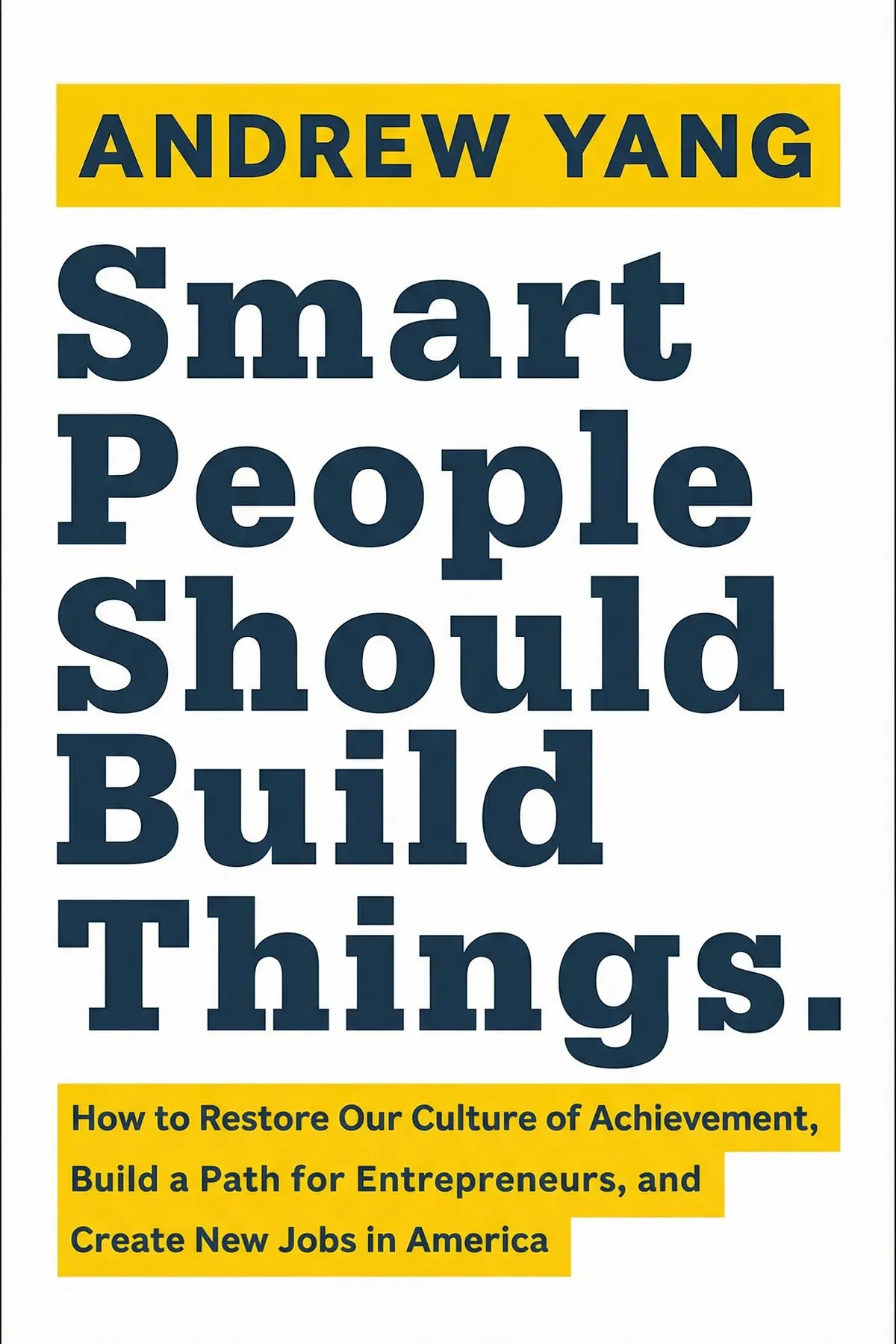
Table of Content
1. Introduction
1 min 00 sec
If you are a strong student or a young professional, your career may already have been chosen for you: a consulting firm, a bank or law school. In Smart People Should Build Things, Andrew Yang, founder of the nonprofit Venture for America, argues that this default wastes talent. Between 1997 and 2005, the entire net gain in American jobs came from new firms rather than big professional ones.
Bright graduates are steered toward professional services by money, prestige, recruiting budgets and each other. Yet the economy depends on people who start and grow young companies, so talented people should build things, and schools should help them.
Yang explains what keeps people on the safe track, what it takes to launch a company or join one early, and how universities could produce more builders. If you are weighing a first job, or a way out of one, both roads will look clearer by the end.
2. Spot the pull behind the predictable career path
1 min 37 sec
Thousands of gifted students at top universities make the same career choice every spring. Yang points mainly to high pay and demanding work, though he adds that the selective hiring process suits these students and that they tend to follow one another.
3. Read the recruiting pitch with clear eyes
1 min 31 sec
One bank has its own room inside a famous university’s career office, and it spends a startling sum on every new hire. That money buys a story, and the story is very convincing.
4. Know the cost of golden handcuffs before you sign
1 min 42 sec
The plan was to stay two years, learn the craft and leave. Yang explains why so many people who make that plan are still in the same job years later, and why small companies may not want them.
5. Where new jobs and new ideas really come from
1 min 43 sec
The share of America’s companies that are young has been shrinking for decades, and one year marked a historic first. Yang argues that the country’s talent is flowing away from the work that grows the economy.
6. Prepare for the long, messy start of a company
1 min 44 sec
A famous mobile game looked like an overnight hit, but its makers had already been through years of struggle and layoffs. Yang explains what to do before you quit, and what to expect after.
7. Use friends and the right city as capital
1 min 34 sec
A spare conference ticket from a friend led to a million-dollar backer and a top tech executive as adviser. Yang shows how people and place can do as much for a young company as money.
8. Join a promising start-up before it gets famous
1 min 34 sec
Almost nobody knows who Google’s seventh employee was, yet that person likely did very well. Yang argues that the best seat in a winning company goes to people who arrived before it looked like a winner.
9. Give students builders to learn from
1 min 44 sec
Bankers and consultants recruit on campus every year, while entrepreneurs rarely get a stage. Yang sets out what universities and public figures could change to make building feel like a real option.
10. Conclusion
1 min 18 sec
What Yang describes is a machine. Pay, prestige, selective applications, campus recruiting rooms and the example of classmates all carry bright graduates the same way. Golden handcuffs then hold them there. None of it is evil, and much of it is comfortable. The cost shows up elsewhere: in a shrinking share of young companies, the firms behind job growth, and in a projected surplus of 176,000 law graduates without enough work by 2020.
The other road needs a nudge more than courage. Yang’s own organization began with a conference pass a friend could not use, and Chobani began with a yogurt factory someone else had closed.
So start sooner than feels comfortable. If you are drawn to a young company, join while it is still unknown, when your role can carry real responsibility. If you want to found one, research the market, set up the web presence and get trusted people excited while you still have a paycheck. Then expect the product to take twice as long as planned. And when a friend offers you a ticket to a room full of builders, take it.
The safe track will always be there. The early seat at something new will not.
About this book
What is this book about?
Every year, a large share of the best students at elite American universities follow the same road into finance, consulting or law school. Andrew Yang, who founded the nonprofit Venture for America, argues that this habit costs the graduates and the country. The firms offer high pay, a familiar selection process and a promise of skills that work anywhere. They also make leaving hard, and they create far fewer jobs and patents than young companies do. Yang backs the economic argument with figures: from 1997 to 2005, all of the net new jobs across America were created by new firms, and small firms produce far more patents per employee than large ones. He then turns practical. He covers the groundwork to lay before quitting a job, the friends and cities that help a company survive, and the case for joining a promising start-up before it becomes famous. The book closes with a plan for universities and public figures: give students builders as role models, recruit entrepreneurs as mentors and teach entrepreneurship by having students run real businesses. The result is a clear picture of the default career and the alternative.
Book Information
Who it's for
Top university students
Students at top universities about to drift into banking, consulting or law school.
Early-career employees wanting out
Young professionals in demanding firms who want out but feel held by their salary.
Future founders, early hires
Would-be founders and early start-up hires deciding how and where to begin.
About the Author
Andrew Yang
Andrew Yang worked as a lawyer and as an executive at early-stage technology companies before founding Venture for America, a nonprofit that places talented graduates in start-ups. The White House named him a Champion of Change for that work. He later ran in the 2020 Democratic presidential primaries on a proposed $1,000 monthly payment for every adult, created the nonprofit Humanity Forward, ran for mayor of New York City in 2021 and founded the Forward Party.
Ratings & Reviews
Ratings at a glance

What people think
Listeners find this book a brisk and captivating experience, especially relevant for college graduates thanks to its intriguing narratives and stimulating ideas. The writing is polished and contains jaw-dropping statistics; one listener even deems it required reading for people eyeing roles in consulting, finance, or law. Furthermore, listeners admire the rigorous level of analysis, with one emphasizing how fostering entrepreneurship can breathe new life into economic growth.
Top reviews
Titiluck
Picked this up after watching Yang on the campaign trail, and I was surprised by how much the message resonated with my own career path. He presents a compelling argument that our most talented graduates are being sucked into a vacuum of professional services that don't actually create much tangible value for the world. The statistics he provides regarding the 'talent funnel' into law and finance are eye-popping and, frankly, a bit depressing. This isn't just a business book; it is a call to action for a generation that wants to do something meaningful rather than just chasing a high-status paycheck. While his focus is primarily on elite university students, the underlying philosophy of building rather than rent-seeking is a lesson every young professional needs to hear. It’s a quick, punchy read that left me feeling incredibly inspired to rethink my own contributions to the economy.
Show moreEleanor
This should be mandatory reading for every college freshman entering the university system today. We are currently wasting an incredible amount of human potential on tasks that don't move the needle for society. Yang’s vision for Venture For America is inspiring, and his analysis of the 'prestige trap' is spot on. I found the statistics about where Ivy League graduates end up to be absolutely staggering. The book is written with a sense of urgency that is infectious. Even if you aren't planning to start a tech company, the way he frames the importance of value creation over rent-seeking is a vital perspective. It’s a fast, engaging, and deeply necessary look at the future of the American workforce. Highly recommended for anyone who wants their work to actually mean something.
Show moreWyatt
As someone who felt immense pressure to head into management consulting after graduation, this book felt like a breath of fresh air. Yang explains why so many smart people end up in these 'safe' roles and how it’s actually harming our national innovation and local communities. The storytelling is engaging and the data is well-thought-through, making it much more than just a typical self-help manifesto. I did find the focus on Ivy League recruiting for Venture For America a bit exclusionary, as if only those students have the capacity to be 'builders.' Despite that elitist undertone, the central message about entrepreneurship reviving economic growth is vital. It’s a fascinating look at how we can redirect human capital toward solving real problems. Definitely worth your time if you're feeling stuck in a cubicle doing work that feels net-neutral to society.
Show moreSamroeng
Finally got around to reading this earlier work from 2014, and it offers a great window into how Yang’s political platform eventually formed. He argues that if we could move just 20% of top grads into startups, the ripple effects for job creation would be massive. The book is packed with jaw-dropping stats about the lopsided nature of our current labor market. It’s a very quick and engaging read, though it's more of a passionate plea than a practical manual on how to actually start a company. If you're looking for a step-by-step guide to entrepreneurship, you might be better off with something like Zero to One. However, for a high-level analysis of why our system is broken and how we can fix the 'brain drain,' this is excellent. It certainly gave me a new way to look at my own career choices.
Show moreNiphon
Ever wonder why our brightest minds end up shuffling papers in Manhattan instead of solving the climate crisis or fixing healthcare? Yang tackles this head-on with a clear and simple thesis that is hard to ignore. He highlights how the education system funnels high-achievers into zero-sum games in finance and law. The book is well-written and features fascinating insights into the mindset of the modern graduate. I appreciated the analytical approach to why startups are struggling to attract the talent they need to thrive. My only gripe is that it ignores the very real possibility of failure; building things is hard and risky, and not everyone has the safety net to try it. Still, the message points in the right direction for our economy. It’s a thought-provoking read for anyone in a quarter-life crisis.
Show moreTan
After hearing so much about the 'Yang Gang,' I wanted to see where it all started. This book is a fascinating look at his earlier philosophy of economic revitalization through entrepreneurship. It’s more of a business memoir than a political manifesto, which I actually preferred. He writes in a very accessible, casual style that makes complex economic ideas easy to digest for the average reader. The storytelling about the early days of VFA is particularly compelling and shows his genuine desire to help others succeed. While he could have spent more time on the challenges of those who aren't from 'elite' backgrounds, the core message is still powerful. It’s a refreshing take on how we can rebuild our cities from the ground up by investing in people. A solid, insightful read.
Show moreRoo
Gotta say, the way Yang describes the soul-crushing nature of professional service firms really hit home for me. He isn't just complaining; he's offering a viable alternative through the builder mindset. The book is well-thought-through and provides a great deal of food for thought regarding national success and economic growth. Personally, I found the chapters on the cultural pressure of 'prestige' to be the most accurate part of the whole book. It’s a quick read, but the implications of what he's saying are massive. My only criticism is that it feels a bit dated now that UBI has become his main focus, but the logic here is still very sound. If you are a twenty-something looking for a new way to view your career, give this a shot. It might just change your trajectory.
Show moreYuki
The core thesis here is undeniably strong, but the execution left me with mixed feelings. On one hand, Yang correctly identifies a massive problem in how we allocate talent in this country. On the other hand, the narrative can feel somewhat condescending toward anyone who didn't attend a top-tier university. He seems to equate 'smart people' exclusively with a very small slice of the population, which feels like a missed opportunity to inspire a broader audience. There is also a lot of self-promotion regarding his non-profit, VFA, which makes the book feel like a long brochure at times. To be fair, his writing style is accessible and the book moves quickly. It’s a good starting point for a conversation about our economy, but it lacks the depth of his later work, The War on Normal People.
Show moreNitaya
Frankly, the title is better than the actual content. Don't get me wrong, the basic message is marvelous: we need to train young people to take risks and become builders. However, the book focuses almost exclusively on success scenarios and treats the entrepreneurial path as if it's the only virtuous choice. It feels a bit repetitive if you've already followed Yang's career or read his later titles. I tended to skim the sections that went over his personal business history, which felt a bit like a resume padding exercise. That said, his data-backed eloquence is impressive, and he makes a convincing case that the current system is inefficient. It’s a decent read for a college student, but seasoned professionals might find it a bit light on substance. It's more of a motivational speech than a deep dive.
Show moreNoppadol
Not what I expected given the promising title. While I agree that the country needs more people building things, this book feels like it was written for a very specific, privileged club. If you didn't go to Harvard or Yale, Yang doesn't seem to think his program or this path is for you. The truth is, the book functions more like a pledge to join his non-profit than a book that provides hands-on advice or lessons learned. There are dozens of better books on entrepreneurship that actually teach you the 'how' rather than just the 'why.' I found the tone a bit too 'cheesy' and self-congratulatory in parts. It’s an interesting read if you’re a fan of Yang’s personality, but as a guide for builders, it falls short of the mark.
Show moreQuestions about this book
What is the main idea of Smart People Should Build Things?
Andrew Yang argues that top graduates of elite American universities flow into consulting, finance and law, while start-ups are what create jobs and innovation. He points to a Kauffman Foundation study which found that every bit of net job growth in the United States between 1997 and 2005 came from new firms. His answer is to encourage talented people to found or join young companies, and to have universities raise more builders.
Why do so many elite graduates go into consulting, banking and law?
Yang points to high pay and challenging work, and to selective application processes that resemble the university admissions students already passed. Peer pressure plays a part too, because uncertain students copy one another. The firms recruit aggressively too: Goldman Sachs has a dedicated room inside the career office at Columbia University and reportedly spends $50,000 on each recruit.
What are golden handcuffs in Andrew Yang's book?
They are the forces that keep people in professional service jobs they would like to leave. Moving to a smaller company usually means a pay cut and changes to lifestyle, and the move feels riskier every year. Small companies also value people who get things done over analytical skill, they need only one finance person, and start-ups tend to hire through their own networks.
How can I apply the advice in Smart People Should Build Things?
Before leaving a job to found a company, research the market, customers and competitors, set up a website and company email, and get trusted people excited about the idea. Plan for the product to need double the time and double the money you budgeted. If you would rather not found a company, Yang suggests joining a promising start-up early, while you can still take on real responsibility.
Who should read Smart People Should Build Things?
It suits students at strong universities choosing a first job, young professionals at banks, consultancies or law firms who are thinking about leaving, and people who want to found or join a start-up. Educators and program leaders will also find Yang’s proposals for role models, alumni mentors and hands-on entrepreneurship teaching useful.
Readers also enjoyed



Alibaba: The House That Jack Ma Built
Duncan Clark


60 Seconds & You’re Hired!
Robin Ryan





7 Powers: The Foundations of Business Strategy
Hamilton Helmer
AUDIO SUMMARY AVAILABLE
Listen to Smart People Should Build Things in 15 minutes
Get the key ideas from Smart People Should Build Things by Andrew Yang, plus 5,000+ more nonfiction titles.
- 5,000+ titles
- Listen as much as you want
- 7-day free trial
- Cancel anytime









