
13 min 11 sec
Available in: English
Smart Brevity: The Power of Saying More with Less
Shows how to write emails, updates, slides and talks that busy people actually read, using a four-part method that puts one clear point and its importance first and leaves the details optional.
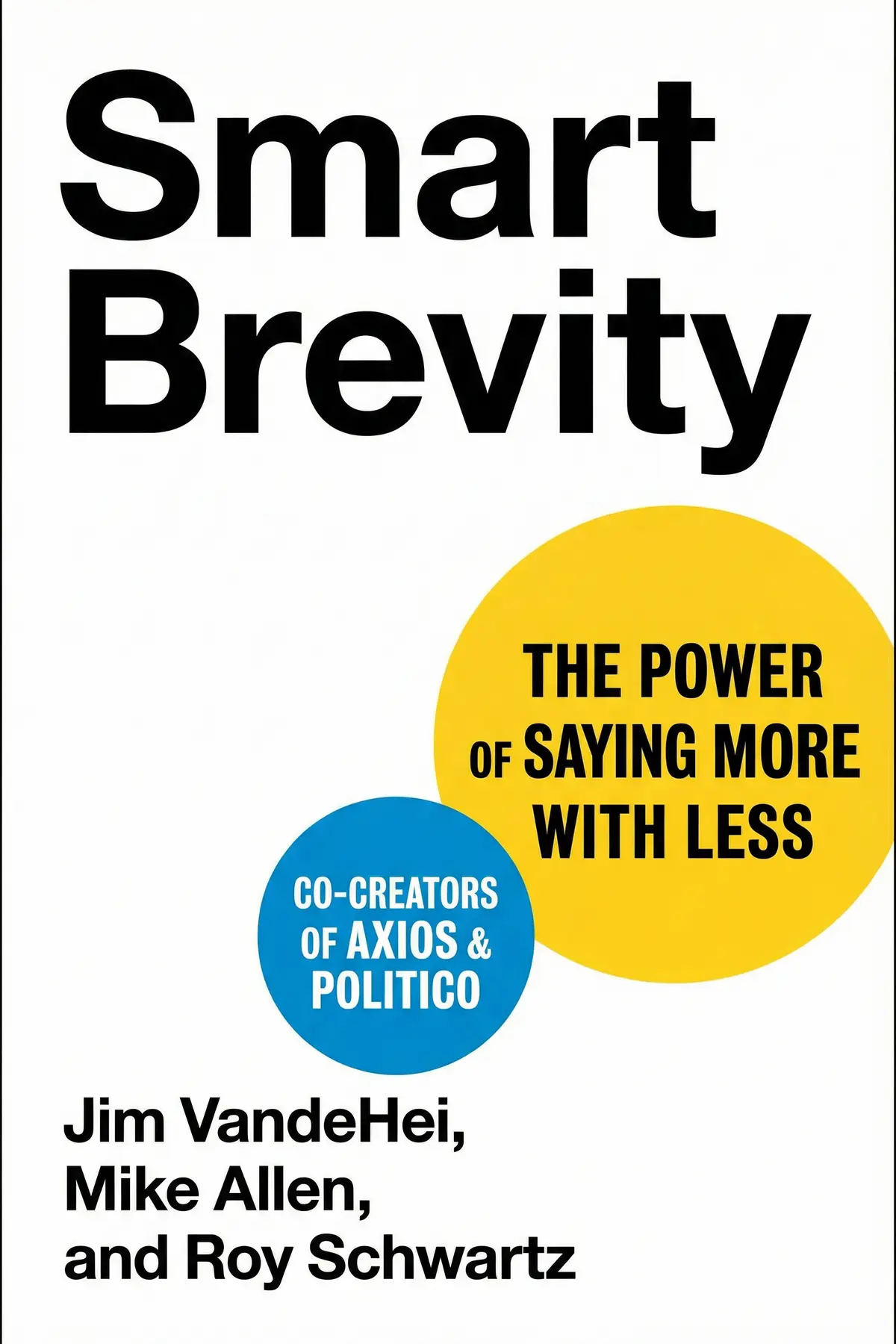
Table of Content
1. Introduction
57 sec
Readers often take in only a few paragraphs of what you send them rather than the whole thing, and the authors of Smart Brevity build a whole method on that fact. Jim VandeHei, Mike Allen and Roy Schwartz, co-founders of the news company Axios, argue that the fix is not to write better long messages but to write radically shorter ones made for distracted minds. People now check phones, scroll feeds and skim in search of quick rewards, they write, yet professional writing still reads as though it belonged to 1980, which leaves billions of words wasted.
Their system has four parts: a tease that wins the first glance, a lede that delivers the main point in one sentence, a short dose of context, and an optional path to more detail. Short must never mean shallow, they insist. Learn the four parts and you can rebuild any email, meeting or slide deck so that the one thing that matters is the thing people remember.
2. Earn attention by saying less
1 min 48 sec
Many writers treat a high word count as proof of hard work, and their readers drift away after a few paragraphs. The authors trace that habit to an unexpected source and offer a simple discipline to replace it.
3. Write a first line nobody skips
1 min 44 sec
Readers decide in seconds whether your email or report deserves their time, often from the subject line alone. A party guest talking about taxes shows what goes wrong, and a few small word choices fix it.
4. Put your one point in sentence one
1 min 30 sec
If a reader takes in only one sentence of your message, which one should it be? The authors answer with a short ride in an elevator and a strict test for every word.
5. Tell readers why it matters, fast
1 min 38 sec
Facts alone rarely persuade a busy reader, and long background sections lose them. The authors use a small labeling trick, which they call axioms, that lets even skimmers see the stakes at once.
6. Give curious readers a door to more
1 min 24 sec
Short messages risk leaving out what experts and the curious need. The authors resolve that tension with a closing section and a few formatting habits that let each reader decide how far to go.
7. Emails and newsletters your team will read
1 min 42 sec
Managers buried in unread messages notice the few colleagues who make their point fast. The authors turn that into concrete rules for emails, team newsletters and social posts, with newsletters given limits down to the word count.
8. Run shorter meetings and give sharper talks
1 min 25 sec
The same discipline that trims an email can cut a meeting to twenty minutes and a slide deck to six slides. The authors show how the written template becomes a spoken one.
9. Conclusion
1 min 03 sec
Smart Brevity is, underneath its rules, a book about respect. Every limit the authors set, the six-word headline, the one-sentence lede, the 20-minute meeting, assumes that a reader’s attention is scarce and should not be wasted. Long prose can still be a pleasure, they grant, but when information has to be understood and remembered, shorter and crisper wins.
The method asks for one hard decision before any writing starts: what single thing must this person remember? Everything else, from the bold Why it matters line to the link at the bottom, exists to deliver that point fast and then let the curious go further.
You can test it on the next message you send. Name the one point and put it in the first sentence. Shrink the subject line until it fits on a phone screen. Read the top of the message aloud and cut whatever bores you. Then stop writing, as the authors urge, even when more words feel safer.
Say the thing that matters, say why it matters, and let people choose whether they want more.
About this book
What is this book about?
Inboxes overflow, phones buzz all day, and readers skim. Yet most professional writing still arrives as long emails and dense reports, as if nothing about attention had changed. The authors, who built the news company Axios, argue that this mismatch wastes billions of words and buries good ideas where nobody finds them. Their answer is smart brevity, a disciplined way of saying more with fewer words without becoming shallow. It rests on four parts: a tease that earns the first glance, a lede that states the main point in one sentence, a short burst of context that explains why it matters, and a Go deeper section for readers who want the full detail. The book then carries the method into daily work: subject lines and email structure, team newsletters with strict word limits, 20-minute meetings, presentations of five to six slides, speeches built on one memorable point, and social posts matched to each platform. Readers get a repeatable template for being understood quickly, and a way to stand out with managers who are drowning in messages.
Book Information
Who it's for
Professionals going unread
Professionals whose emails and reports get skimmed or ignored by busy managers.
Team leaders
Team leads who write weekly updates or run meetings that drag past their purpose.
Students and career starters
Students and early-career workers who want to be known for clear, fast, useful communication.
About the Author
Jim Vandehei
Jim VandeHei, Mike Allen and Roy Schwartz co-founded Axios after earlier helping to build Politico. VandeHei, the CEO, spent over a decade reporting for The Wall Street Journal and The Washington Post and was named 2016 national Editor of the Year. Allen leads Axios's editorial coverage and writes its flagship newsletters, Axios AM and Axios PM, after creating Politico's Playbook. Schwartz, the company's President, launched Axios HQ, a platform for internal team communication, and earlier advised Fortune 500 companies as a partner in Gallup's consulting practice.
Ratings & Reviews
Ratings at a glance
What people think
Listeners find this book highly useful for their professional lives, noting its actionable tips and the way it clarifies complicated notions. Furthermore, they like its ease of reading and how it conveys information, mentioning that it stays focused and aids in producing superior communications. The work's succinctness is celebrated as a significant shift, and listeners admire the caliber of the writing, with one listener specifically mentioning its fun format. Nevertheless, the overall length results in diverse perspectives: some embrace the condensed version while others believe it should be even more compact. Additionally, several listeners note that the content can be repetitive.
Top reviews
Pranee
Finally, a business book that actually practices what it preaches instead of droning on for eight chapters about the same tired case study. I polished this off in about two hours and felt like I had a better handle on my communication style than I’ve had in years of professional writing. The layout is brilliant; it uses bolding, lists, and spacing to make sure you actually retain the information rather than just scanning it. Not gonna lie, I was skeptical about the whole 'Axios HQ' branding at first, but the results speak for themselves. My emails are shorter, my meetings are more focused, and people are actually responding to my memos. It’s not just about being short; it’s about being impactful. It’s an essential tool for anyone working in a fast-paced environment where time is the most valuable currency. Definitely a game-changer for my daily workflow.
Show moreBo
Picked this up after a mentor recommended it, and I’m so glad I did because it completely changed how I think about content creation. The 'Smart Brevity' method is about more than just cutting words; it’s about structuring your thoughts so the most important takeaway is impossible to miss. I particularly appreciated the examples showing 'before and after' versions of emails and articles. It’s fascinating to see how much fluff we include just out of habit or a desire to sound smart. In my experience, most people are actually relieved when you give them less to read. The book itself is a quick accessible format that you can flip through in a single sitting. Some might find the tone a bit self-aggrandizing, but when you’ve built a media empire on these principles, you’ve earned the right to brag a little. Highly recommended for anyone in marketing or management.
Show morePierre
This is exactly what the modern business world needs right now. We are all overwhelmed by information, and the 'Smart Brevity' philosophy is a direct antidote to that exhaustion. The book is remarkably effective at demonstrating its own points, using the very formatting it encourages you to adopt. I loved the focus on the 'one big thing' and the way it encourages you to cut out the 'mush' that clogs up our brains. It’s a very practical guide that provides actionable advice you can use the same day you read it. Personally, I don't mind the references to Axios because they are the ones who pioneered this style and proved it works. If you’re a manager or anyone who has to lead through communication, this book is a mandatory read. It’s short, punchy, and potentially career-changing.
Show moreLucia
Most business books are a chore to get through, but this was a total joy. It gets straight to the point and provides a clear framework for making your messaging more impactful. I’ve struggled for years with being 'the person who writes the long emails,' and this book gave me the permission—and the tools—to stop. The emphasis on 'why it matters' has changed the way I pitch ideas to my team. Instead of burying the lead, I start with the punchline. While some critics say this style is 'cold,' I find it incredibly respectful of people's limited time. The book is a valuable resource that I keep on my nightstand to remind me to keep it simple. If you want to be heard in a world that won't stop talking, buy this book. It's a quick read that delivers a massive punch.
Show moreWei
As a project manager who spends half my life buried in unread Slack threads and bloated Word docs, this was a breath of fresh air. The authors essentially teach you how to treat your audience like people with actual lives, which means getting to the point before they stop caring. I loved the 'Why it Matters' framework because it forces you to justify why you're even taking up space in someone’s brain. Truth is, some of it feels a bit repetitive after the first fifty pages, and I did roll my eyes at the constant Axios self-promotion throughout the chapters. However, the core philosophy is undeniable: we are all drowning in noise. If you want your team to actually read your updates, you need to learn these tricks. It's a quick, punchy read that I’ll likely keep on my desk as a reference for the next time I’m tempted to write a ten-paragraph email.
Show moreFatima
Ever wonder why your emails go ignored while your colleague’s short updates get immediate traction? This book provides the blueprint for that success by focusing on the psychology of the modern reader. The authors argue that since we are constantly bombarded with information, we need to respect people's time by getting the 'bottom line' up front. I’ve started implementing the 'Why it Matters' section in my weekly reports, and the feedback from my director has been overwhelmingly positive. To be fair, the book does get a bit repetitive toward the end as it tries to apply the same three rules to every possible scenario. It could have been shorter, which is a hilarious critique for a book on brevity, but the practical guidance is still worth the price of admission. It’s a solid addition to any professional’s library, especially if you struggle with being long-winded.
Show moreLadawan
After hearing about this from several coworkers, I finally gave it a shot to see if the hype was real. I’ve always been someone who writes long, flowery sentences, so this was a much-needed slap in the face regarding my communication habits. The book is incredibly easy to navigate, featuring a clear presentation of ideas that makes it perfect for busy professionals. I found the specific advice on 'visual hacks' like bolding and bulleting to be the most applicable parts of the text. Gotta say, it’s a bit ironic that a book about brevity repeats itself so often, but I suppose the authors wanted to drill the message into our heads. It’s an entertaining format that keeps you engaged, even if some of the chapters feel like filler. If you want to stop wasting your audience’s time, this is a great place to start.
Show moreAnna
Look, I get the appeal of cutting through the clutter, but there’s a fine line between being concise and being shallow. This book does a great job of explaining how to grab attention, but it fails to address the cost of losing nuance in our daily communication. It’s filled with some genuinely helpful templates and rules for 'smart' writing, yet it often reads like a sales pitch for a specific brand of corporate efficiency. I found the sections on news delivery particularly troubling because the 'just the facts' approach often leaves out the context necessary for real understanding. It’s a valuable professional resource if you want to climb the ladder, but I worry about what happens to language when we all start writing like robots. It's useful for internal memos, sure, but I wouldn't want to live in a world where everything is written this way.
Show moreArjun
The irony is palpable when a book titled 'Smart Brevity' stretches its single, useful thesis across more than two hundred pages. Frankly, this entire concept could have been a three-paragraph blog post or a single, well-organized infographic. While I agree that modern readers have the attention span of a goldfish, I don't think the solution is to turn our language into a series of robotic bullet points. It feels like an instruction manual for a corporate dystopia where nuance goes to die in favor of 'scannability.' The authors spend so much time patting themselves on the back for their Axios success that it starts to feel like a very expensive brochure for their software. I found the constant boldface and forced structure more distracting than helpful. If you’re looking for genuine writing advice that respects the reader’s intelligence, you might want to look elsewhere. This is just a guide on how to sound like a LinkedIn algorithm.
Show moreMason
This felt more like a 200-page infomercial for Axios than a genuine attempt to help people become better writers. The 'Smart Brevity' trademark is plastered everywhere, and the constant references to their proprietary software made me feel like I was paying for the privilege of being marketed to. While the basic advice—write less, use bullets, put the main point first—is sound, it’s also incredibly basic. Do we really need a whole book to tell us that people are busy and don't like walls of text? It feels like they took a decent ten-minute TED Talk and inflated it just to meet a publisher's page count requirement. I was hoping for more deep insights into linguistics or communication theory, but instead, I got a 'how-to' on sounding like a press release. It's a very slick package with very little substance underneath the glossy formatting.
Show moreQuestions about this book
What is the main idea of Smart Brevity?
The authors, who founded Axios, argue that attention is scarce and readers skim, so messages must be radically shorter without becoming shallow. Their method has four parts: a tease that wins the first glance, a one-sentence lede with the main point, a short context section explaining why it matters, and an optional Go deeper section for readers who want detail.
What is a lede in Smart Brevity?
The lede is the first sentence, and it should state the single most useful or unexpected point in as few words as possible. The authors suggest an elevator test: imagine a friend is about to step out and you have seconds to tell them one thing. It should not repeat the headline, and everything after it should support it.
How do you write a Smart Brevity email?
Start with a short, strong subject line; the authors suggest headlines of six words at most so they fit on a phone. Put the key news or question in the first sentence. Add a brief Why it matters line, then supporting facts in short bullets with important figures in bold, plus a simple visual if it helps.
How can Smart Brevity improve meetings and presentations?
For meetings, the authors recommend an agenda and objective set in advance, an on-time start, a stated purpose, focused discussion, and a close with a summary and next steps within about 20 minutes. For presentations, open with a headline idea, give three to five points, keep one message per slide and use five or six slides.
Who should read Smart Brevity?
It suits anyone who writes or speaks at work and feels unheard: employees whose emails get skimmed, managers who send team newsletters or run meetings, and people giving presentations or speeches. The authors also apply it to social media posts, so it is useful for anyone who needs to capture attention quickly and clearly.
Readers also enjoyed







AUDIO SUMMARY AVAILABLE
Listen to Smart Brevity in 15 minutes
Get the key ideas from Smart Brevity by Jim Vandehei, plus 5,000+ more nonfiction titles.
- 5,000+ titles
- Listen as much as you want
- 7-day free trial
- Cancel anytime









