

14 min 45 sec
Available in: English
Sizing People Up: A Veteran FBI Agent’s User Manual for Behavior Prediction
Shows how to judge whom to trust by reading concrete signals instead of gut feeling: what people stand to lose, how they have acted before, how they talk and apologize, and whether fear drives them.
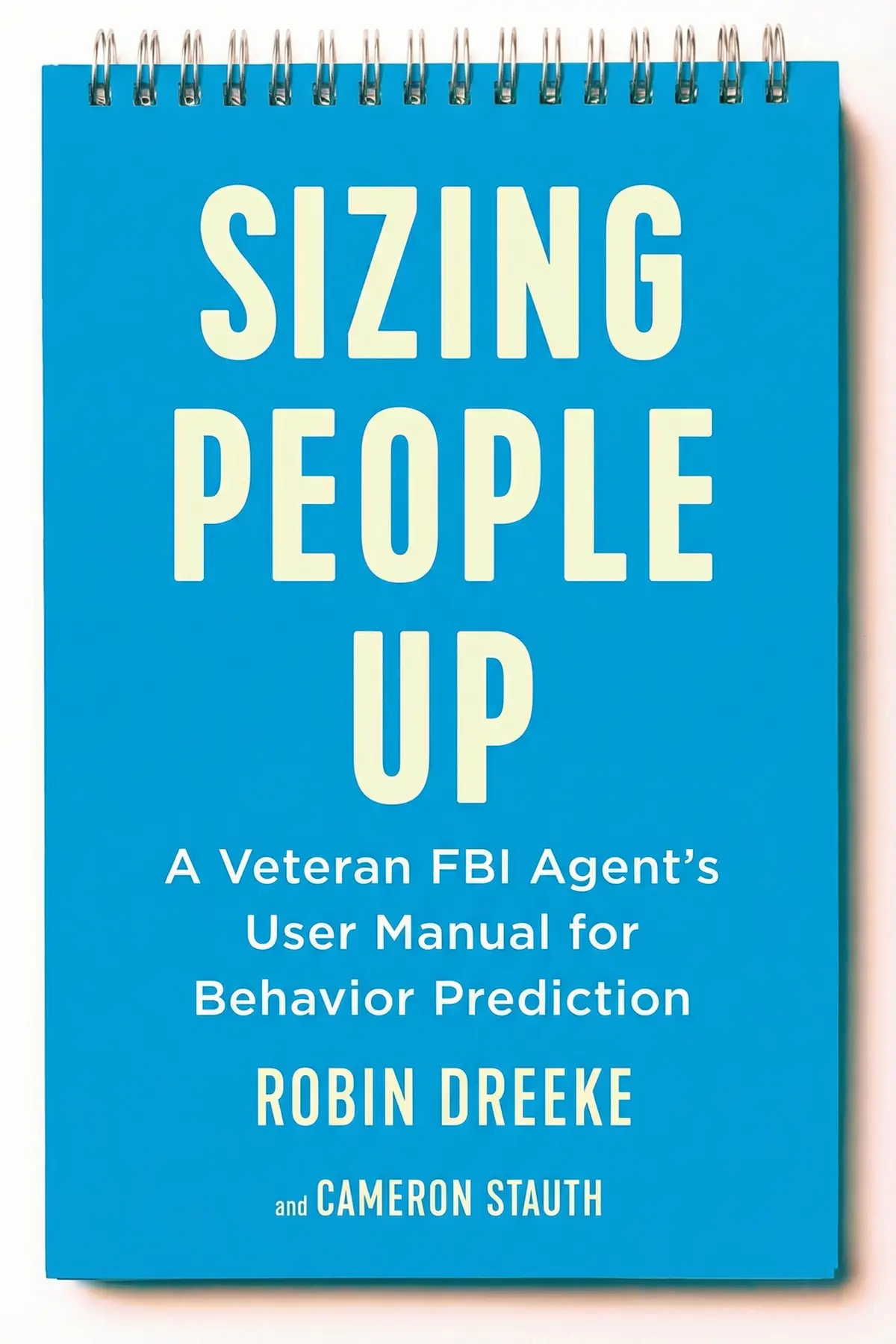
Table of Content
1. Introduction
1 min 00 sec
If you have been let down by a colleague you liked, or helped by someone you never got along with, your instincts about people may be steering you wrong. In Sizing People Up, retired FBI agent Robin Dreeke, writing with Cameron Stauth, argues that gut feeling is a poor guide to who will stand by you, because it mostly tells you whom you like. Dreeke spent more than two decades recruiting human sources and later led the FBI’s Counterintelligence Behavioral Analysis Program.
His case is that predicting behavior comes down to gathering the right information: what a person stands to gain or lose, how they have acted before, how they talk, and what mindset drives them. Each of these can be observed in ordinary conversations. What follows is a short set of signals to check before you hire someone, back a partner or count on a colleague in a crisis, along with a clearer idea of how to become someone others rely on.
2. Predict behavior from what people stand to lose
1 min 46 sec
On September 11, 2001, a young FBI agent watched some colleagues run toward danger while others slipped away. He could not have guessed who would do which, and the day taught him why predicting behavior matters.
3. Spot the allies who win when you win
1 min 42 sec
Some people around you would celebrate your success, and others would barely notice it. Two everyday behaviors separate them, and one decision by your manager may be telling you more than any performance review.
4. Earn trust by giving it first
1 min 46 sec
The best place to look for trustworthy people may be the mirror. Dreeke explains why others copy the signals you send, and which three habits make colleagues more willing to deal fairly with you.
5. Let track records outweigh first impressions
1 min 48 sec
Ask people about their integrity and you may get a lie or a sincere mistake. Patterns are harder to fake, and the most charming one Dreeke describes is also, in his view, the most dangerous.
6. Hear trustworthiness in plain words and clean apologies
1 min 56 sec
Two small words can make a calm discussion turn hostile, and one short phrase can empty an apology of meaning. Dreeke shows what to listen for when someone talks, beyond the content of what they say.
7. Recognize fear-driven minds before they spread panic
1 min 53 sec
Someone can look perfectly confident while running on fear underneath. Dreeke offers a three-part test for spotting that mindset, and it begins with whether a person sees hardship as permanent.
8. Talent alone won't show you who is reliable
1 min 47 sec
Glowing references and polished test assignments can still lead you to the wrong hire. Dreeke explains what competence hides, and which unexpected interview question reveals more about a candidate than their résumé does.
9. Conclusion
1 min 07 sec
Dreeke could not tell, that morning in New York, who would run toward the towers. His book is his answer to that day: a set of signals that can be read ahead of time, in what people stand to lose, in how they treat you when it costs them something, in the words they choose and the apologies they give, and in whether fear or appreciation runs their lives. None of it needs a gut feeling. It needs attention and some patience.
It also starts with you. People mirror the trust they are shown, so the surest way to find reliable allies is to act like one: drop the boasting, hold back judgment, and give a little more than expected. Then watch. Notice who defends you when silence would be easier, who says sorry without a but, and who treats a rainstorm as weather instead of a verdict on themselves. And when you need to know what someone will do next, remember Dreeke’s plainest advice: find out what they want, often just by asking.
Trust works best when you treat it as a forecast, built from evidence you can see.
About this book
What is this book about?
Much of what happens in a career or a family depends on one judgment made over and over: can I count on this person? Most of us make it by instinct, and instinct mostly tells us whom we like. Robin Dreeke, a retired FBI special agent who spent more than two decades recruiting human sources, argues that this is the wrong tool. Writing with Cameron Stauth, Dreeke treats behavior prediction as a matter of gathering the right information. He looks at circumstances, such as how protected someone is from consequences and how long the relationship will last. He looks for people who see your success as their own, for patterns in past behavior like loyalty, gossip and inconsistency, and for clues in language, from absolute words to apologies that end in excuses. He also offers a quick test for emotional instability and advice for interviewing job candidates. Readers get a practical checklist for hiring, choosing partners and relying on colleagues. They also learn how to send the signals that make others trust them in return.
Book Information
Who it's for
Choosing hires and partners
Managers and founders who hire, promote or pick partners and want better signals than a résumé.
Burned by a colleague
Professionals burned by a colleague they liked and unsure whom to rely on.
Wanting to be trusted
Anyone who wants to be seen as more trustworthy at work and at home.
About the Author
Robin Dreeke
Robin Dreeke is a retired FBI special agent, a Marine Corps veteran and a graduate of the US Naval Academy. For more than two decades he recruited and managed human sources, and he later led the FBI's Counterintelligence Behavioral Analysis Program. Since 2010 he has advised executives, entrepreneurs, military teams and law enforcement on trust and communication. Co-author Cameron Stauth is a former magazine editor and columnist whose books, several written with doctors, include The Manhunter and Brain Longevity.
Ratings & Reviews
Ratings at a glance
What people think
Listeners appreciate how this work provides a distinctive viewpoint on human conduct, rooted in the author’s significant background within FBI counterintelligence. Although some listeners believe the high volume of autobiographical stories can sometimes distract from the primary teachings, they find the actionable system for assessing reliability and forecasting behavior via logical analysis highly valuable. Furthermore, listeners find the guide's strategies for establishing career partnerships and uncovering shared advantages in corporate environments helpful. They also highlight the utility of the detailed behavioral indicators shared, as one listener points out that the author’s characterization of trust as "predictability, not morality" offers an especially beneficial change in mindset.
Top reviews
Moo
Wow. This book completely changed how I approach networking and building trust in my industry. Instead of trying to "read" people like a psychic, Dreeke teaches you how to gather information and look for patterns of past behavior. The idea that "actionable trust" is built on competence and commitment rather than just being a "nice person" was a huge eye-opener for me. I’ve read a lot of body language books, but this one goes much deeper into the psychological motivations that drive people to be either loyal or deceitful. The anecdotes about foreign diplomats were absolutely fascinating and helped illustrate how to apply these rules when the stakes are incredibly high. If you want a logical, evidence-based way to navigate human relationships, this is the definitive guide to doing it right.
Show moreVimolwan
Not what I expected, but in the best way possible. I thought this would be a book about "mind games," but it’s actually a very ethical guide on how to be a better leader and partner. Dreeke’s "generosity" approach to trust—where you lead with value and look for win-win scenarios—is a refreshing take in a world that often feels transactional. The behavioral tells he describes are nuanced and go far beyond the typical "crossed arms means they're closed off" clichés you see everywhere else. I especially appreciated the sections on how to spot a master manipulator who uses "smooth talk" to hide their lack of substance. This is a must-read for anyone in a leadership position who needs to build a reliable team. It’s practical, well-researched, and backed by years of real-world experience in the highest levels of government.
Show moreKet
Finally got around to reading this, and I have to say, the concept of "predictability vs. morality" is worth the price of the book alone. Most of us get burned because we assume "good" people will do what they say, but Dreeke argues we should only trust people to act in their own best interests. This rational approach to human behavior takes the emotion out of the equation, which is exactly what I needed for my professional life. The specific tells regarding verbal patterns, like people using "simple language" when they are being honest, were particularly helpful for my daily meetings. It’s true that some of the stories are a bit long-winded, but the underlying framework is solid and easy to apply once you get the hang of it. I’d recommend this to anyone who manages a team or deals with high-level negotiations.
Show moreWaree
As someone who works in sales, I found the strategies for identifying mutual benefit and building quick rapport to be highly effective. Dreeke’s background in the FBI Behavioral Analysis Program gives him a level of credibility that most "business gurus" just don't have. He explains how to look for "verifiable confidence" and distinguish it from the fake bravado that many manipulators use to get ahead. While some reviewers find the anecdotes distracting, I thought they provided necessary context for how these high-stakes techniques work in the field. My only real complaint is that the book can feel a bit repetitive, as if the authors were trying to hit a specific word count. Regardless, I’ve already started using the "rational observation" techniques, and they’ve definitely helped me size up potential clients more accurately.
Show moreSiraporn
Frankly, I wasn't sure if a book by an FBI agent would be applicable to my life, but the insights into emotional maturity and consistency were spot on. Dreeke emphasizes that the most dangerous people aren't necessarily the "evil" ones, but the inconsistent ones who lack a stable sense of self. Learning to spot those subtle signs of desperation or lack of commitment has already saved me from a potentially bad partnership. The writing is clear, and the breakdown of "tells" for both positive and negative behavior is easy to follow, even if some of it feels like common sense. It’s a great manual for anyone who wants to stop relying on "gut feelings" and start using actual data to make decisions about people. It’s not perfect, but it’s a very solid four-star read for the practical value it provides.
Show moreRungtip
Ever wonder how an FBI agent decides who to trust in a room full of foreign spies? This book attempts to answer that, though it struggles with a dry, academic tone that clashes with its thriller-style anecdotes. I appreciated the shift in defining trust not as a moral quality, but as "predictability," which is a much more useful way to look at professional colleagues. Dreeke breaks down his system into six signs of reliability, and while the logic is sound, the delivery feels a bit like a lecture. Some stories are fascinating, particularly the ones involving counterintelligence, but they often drag on long after the point has been made. It’s a decent resource if you can filter out the filler, but it requires some patience to extract the actual nuggets of wisdom. Not ground-breaking, but certainly offers a unique perspective on human behavior.
Show moreRania
The chapter on "Investing in Others' Success" was probably the highlight for me, as it offers a practical way to build alliances in a competitive environment. However, the rest of the book is a bit of a mixed bag of psychology, personal opinions, and "good advice" from a retired agent. It’s one of those books where you find yourself highlighting a few great quotes while skimming through twenty pages of repetitive examples. I liked the idea that we should ignore our own ego to see how others perceive us, as that kind of self-awareness is rare. Still, the writing style is somewhat clunky and feels like it needed a much tighter edit to keep the momentum going. It’s worth a read if you’re interested in behavioral analysis, but don't expect it to completely change how you see the world.
Show moreAiden
Picked this up expecting a tactical guide on reading people, but the execution really missed the mark for me. Dreeke spends so much time talking about his "exciting" career preventing World War III that the actual "how-to" gets buried under a mountain of ego. He presents himself as a purely rational observer, yet the writing is highly opinionated and sometimes emotionally charged, especially when he discusses international relations. The framework for sizing people up relies heavily on the assumption that everyone acts with total consistency, which simply isn't how humans work in the real world. I found the "tells" he provides, like a manager leaving you out of meetings being a bad sign, to be incredibly basic. It’s not a terrible read if you like spy stories, but as a practical manual for life, it’s underwhelming and bloated.
Show moreLillian
After hearing Dreeke on a podcast, I thought this would be a game-changer for my social interactions, but it’s clearly written for corporate ladder climbers. The advice feels very specific to high-stakes business alliances and international diplomacy rather than everyday relationships for a normal person. Most of the "behavioral tells" are things you’d pick up naturally after working in any office for six months, like noticing if someone avoids eye contact or uses passive-aggressive language. There’s a lot of focus on "trust transference" and "mutual benefit" that feels a bit cold and calculating when applied to real life. To be fair, the section on why people gossip was interesting, but not enough to justify the rest of the slog. I really wanted to like this more, but it felt like a missed opportunity to translate FBI skills into something universally useful.
Show moreUbolwan
This book was an absolute chore to get through because it felt like a single magazine article stretched into hundreds of pages. While Dreeke clearly has an impressive background in FBI counterintelligence, the constant personal anecdotes serve more as padding than actual educational material. I was looking for a deep dive into non-verbal communication, but instead, I got vague stories that felt overcomplicated and frankly forgettable. The core advice—to look for consistent behavior and mutual benefit—is basically common sense that most adults have already learned through painful life experience. It’s frustrating when a professional with this much expertise produces something that feels like a repetitive PowerPoint presentation designed for corporate seminars. If you've ever been betrayed by someone, you likely already know these signs better than this manual explains them. Save your time and just look up an interview with the author online instead.
Show moreQuestions about this book
What is Sizing People Up about?
Former FBI agent Robin Dreeke argues that you can predict how people will behave by gathering the right information instead of trusting your gut. He looks at circumstances such as how protected someone is from consequences, whether they see your success as their own, their past patterns, the way they speak and apologize, and whether fear drives their thinking. The book turns those signals into practical checks for work and personal life.
Why does Robin Dreeke say you shouldn't trust your intuition about people?
Dreeke argues that intuition mostly tells you whom you like, not whom you can rely on. Most of us have known someone pleasant who let us down and someone difficult who came through in a crisis. His own wake-up call came on September 11, 2001, when he realized he could not have predicted which fellow agents would run toward the towers and which would hang back.
What is the 3-P personality in Sizing People Up?
It is Dreeke’s shorthand for emotional instability. People with a 3-P personality see hardship as permanent, let one problem become pervasive across their whole life, and take every misfortune personally, as when someone caught in the rain calls themselves stupid for forgetting an umbrella. They tend to turn small problems into disasters, and because fear spreads, Dreeke advises caution before trusting them.
How can I use Sizing People Up in job interviews?
Dreeke warns that résumés, references and even work tasks mislead, because tasks measure competence but not diligence. He suggests asking about the candidate’s life outside work, since people who keep lasting friendships and relationships tend to manage time and commitments well. A guarded answer may be a warning sign. He also pays attention to self-presentation, reading neglected appearance as a sign of unhappiness.
How do I get others to trust me, according to Dreeke?
Dreeke says people mirror the trust they receive, so begin with yourself. Put your ego aside and don’t boast, make people feel validated by steering conversations toward their experiences and challenges instead of their mistakes, and be generous by giving a little more than they expect. People remember when their expectations were exceeded, and they tend to return the favor.
Featured in
Readers also enjoyed









AUDIO SUMMARY AVAILABLE
Listen to Sizing People Up in 15 minutes
Get the key ideas from Sizing People Up by Robin Dreeke, plus 5,000+ more nonfiction titles.
- 5,000+ titles
- Listen as much as you want
- 7-day free trial
- Cancel anytime









