

15 min 40 sec
Available in: English
Shadows at Noon: The South Asian Twentieth Century
Explains how decades of nationalist politics that sorted South Asians by religion led to the 1947 partition, and why that division still shapes the region's politics, trade, rivers, art and food today.
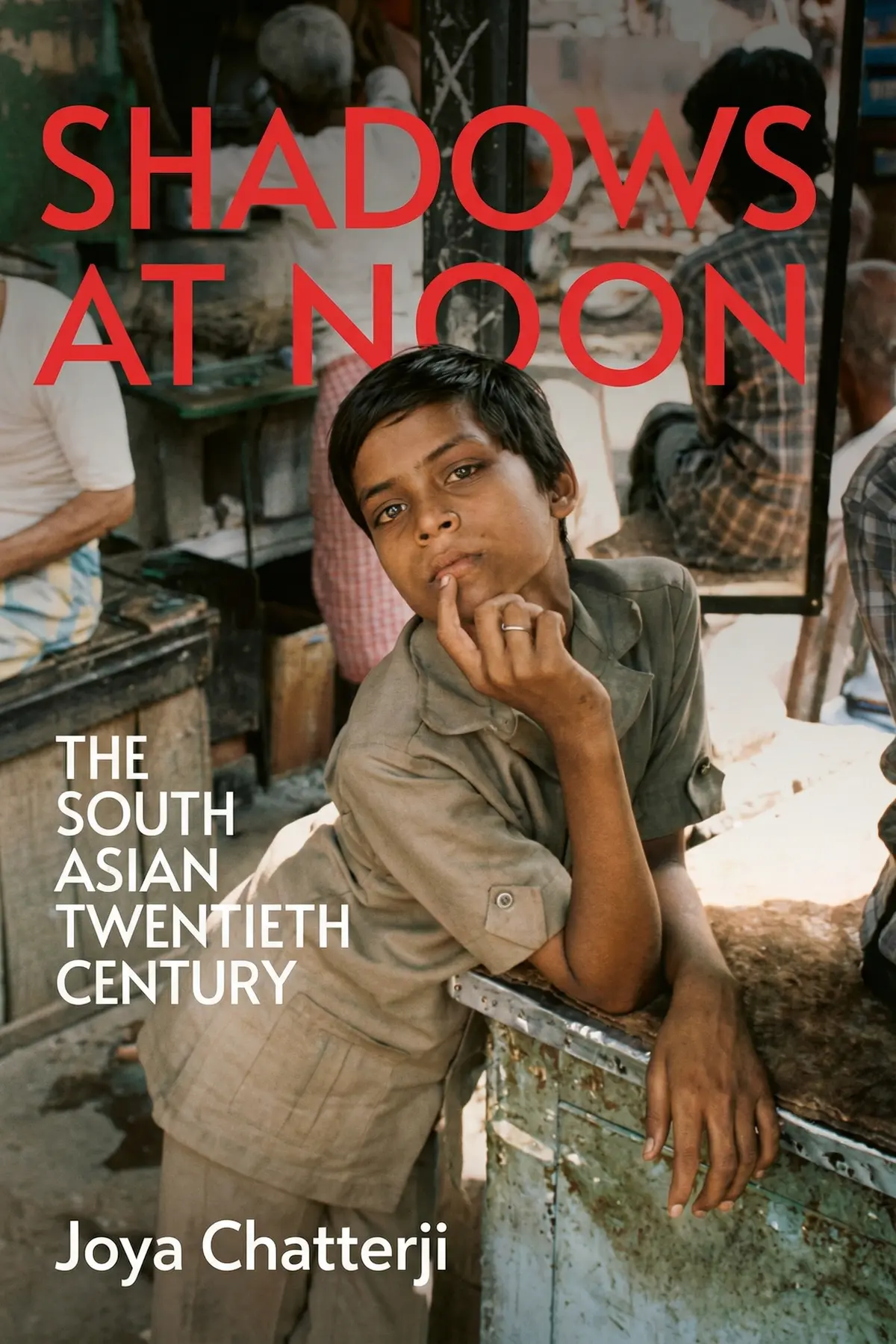
Table of Content
1. Introduction
1 min 09 sec
If South Asia’s frozen borders and river quarrels look like a tangle with no starting point, one detail cuts through it. A truck hauling cement from Delhi to Lahore, about 300 miles apart, will often go through Dubai, covering some 6,000 miles. In Shadows at Noon, Cambridge historian Joya Chatterji explains why such absurdities feel normal. The partition of 1947, when the departing British split the subcontinent into India and Pakistan at a cost of a million dead and ten million uprooted, never really ended. Decades of politics that sorted people by faith prepared it, and afterward it hardened into a permanent condition.
That condition still shapes votes in Karachi, family inheritances, film villains and restaurant menus. Follow Chatterji’s thread from a Pune wrestling ground in 1897 to today’s art galleries, and the region’s twentieth century stops being a list of dates. It becomes one story with a cause you can name, and a lens for any place where a border was drawn through people who once shared a life.
2. Understand the militant roots of Indian nationalism
2 min 13 sec
Long before the famous marches, young men in western India were lifting stone weights and swinging clubs as acts of politics. Their idea of strength set up a rivalry that the whole century would struggle to settle.
3. Learn how Gandhi's unity tactics ended in division
2 min 07 sec
Gandhi wanted Hindus and Muslims standing together against the British, and he chose the strongest glue he could find. Chatterji traces how that same glue later set into two separate camps.
4. Trace three nations down three different roads
2 min 18 sec
The same catastrophe gave birth to a noisy democracy, a country ruled again and again by generals, and a nation born in a second bloodbath. The reasons for those different fates begin in the first few years.
5. Read films and novels as maps of trauma
2 min 20 sec
A beloved national epic ends with a mother killing her son, and a great short story ends with a madman dying between two countries. Chatterji shows what the new nations were telling themselves through such stories.
6. Count partition's cost in trade, rivers and inheritance
2 min 02 sec
Two neighboring cities a few hundred miles apart trade as if an ocean lay between them. The bill for that arrangement arrives every year, and it lands on farmers, shopkeepers and grandchildren as well as governments.
7. See how borders crept into kitchens and imaginations
2 min 17 sec
A dish, a melody, a villain on screen: none of them seem like politics. Chatterji argues they are where the division of 1947 has settled most firmly, and why three generations now struggle to see past it.
8. Conclusion
1 min 14 sec
Chatterji’s century begins with young men oiling their bodies in a Pune gym and ends with a raga claimed by two countries. Between those points runs one argument: South Asia was divided in people’s habits of mind long before it was divided on a map, and the map then made those habits permanent. Part of the tragedy was built from good intentions. Gandhi reached for faith to unite people, and faith became the line along which they separated.
That makes the book useful well beyond the subcontinent. When a leader rallies a crowd with the symbols of one community, ask who is left watching from the edge, as many Muslims watched the Salt March. When you weigh what a border costs, count the detour through Dubai and the frozen inheritance alongside the dead. And when a food, a language or a song is presented as belonging to one nation alone, remember how young that claim may be.
Partition, in Chatterji’s telling, is a condition each new generation inherits, an incompleteness with no end date. The shadows she describes did not shrink when the sun stood highest. They kept stretching.
About this book
What is this book about?
Most accounts treat the partition of India in 1947 as a single, terrible event: new borders, a million dead, ten million uprooted. Joya Chatterji argues that it was neither sudden nor finished. In her telling, it grew out of half a century of politics that taught people across the subcontinent to organize by religion, and it settled afterward into a permanent condition. She traces that arc from the club-swinging wrestlers and bomb-making societies of the 1890s and 1900s, through Gandhi's mass campaigns and Jinnah's demand for Pakistan, to the very different fates of India, Pakistan and Bangladesh. Then she follows the division into films, novels, state television, language, music and even food. Readers get a clear account of how the subcontinent split and a sharp sense of what the split still costs: trade rerouted through Dubai, a shared river managed by rivals, families unable to inherit across borders, and generations who cannot picture the region as one place.
Book Information
Who it's for
Following South Asian news
Readers who follow news about India, Pakistan or Bangladesh and want to understand where today's tensions come from.
History and politics students
Students of history and politics looking for one clear argument linking colonial resistance, partition and modern culture.
South Asian diaspora
Members of the South Asian diaspora curious about the divisions their families carried with them.
About the Author
Joya Chatterji
Joya Chatterji is Professor of South Asian History at Cambridge and a fellow of Trinity College. A specialist in modern South Asian history, she edited the journal Modern Asian Studies for ten years. Her research focuses on partition, migration and nationalism, the themes at the heart of this book, and her earlier works include Bengal Divided and The Spoils of Partition. In 2021 she was elected a fellow of the British Academy.
Ratings & Reviews
Ratings at a glance

What people think
Listeners find this history of the South Asian subcontinent to be a scholarly and exceptionally well-documented account that skillfully integrates major political shifts with the finer details of daily existence. They appreciate the work’s distinctive thematic arrangement, which delves into varied subjects like film and eating habits alongside the intricacies of migration and domesticity. Additionally, listeners value the author’s use of personal stories, with one listener highlighting that the text provides a deep look at the shared traits between India, Pakistan, and Bangladesh. Many also consider the author’s reinterpreted perspective on Partition to be both stimulating and perceptive. They further note that while the text is quite long, its comprehensive nature delivers a necessary and revitalizing alternative to standard historical accounts.
Top reviews
Eleni
Picked this up thinking it would be another dry academic text, but Joya Chatterji’s Shadows at Noon is a sprawling, messy, and utterly brilliant piece of history that breathes life into the dry bones of South Asian scholarship. Most historians stick to the high halls of power, but Chatterji drags us through the streets, into the kitchens, and even into the gymnasiums where young men built 'muscular nationalism' against British rule. The way she dismantles the halo around Gandhi while humanizing the sheer madness of Partition is both brave and necessary. I loved the 'bhadralok' energy of the prose—she writes like a scholar who is also a world-class gossip, jumping from textbook reform to the history of rice consumption without losing the thread. Yes, it’s a massive tome, and yes, it leans heavily toward Bengal, but the depth of research here is staggering. It feels like a lifetime of learning condensed into 800 pages. If you want to understand why India and Pakistan are the way they are today, forget the textbooks and read this.
Show moreThanakorn
As someone who grew up with the standard 'freedom struggle' narrative, this book was a massive reality check. Chatterji doesn't just tell us what happened; she explores how the 'shadows of empire' lengthened long after the British left. The sections on how families were torn apart by borders—unable to inherit property or even visit across the line—brought a human element that is often missing from grand historical narratives. I found the analysis of the Hindu-Muslim divide particularly insightful, especially the idea that Partition was already happening in the imagination long before any lines were drawn on a map. Truth is, the book is quite long and the Bengal-centric focus is obvious, but the insights into everyday life like cinema and household dynamics make it worth the investment. It’s an essential read for anyone trying to look past the 'wonder of democracy' tropes and understand the actual lived experience of South Asians.
Show moreOat
Ever wonder why goods traveling from Delhi to Lahore have to detour through Dubai? Chatterji’s Shadows at Noon explains the sheer absurdity of the post-1947 reality better than anything else I’ve read. This isn't your typical dry history; it’s a vibrant, sometimes gossipy, and deeply analytical look at the commonalities that still bind the subcontinent together despite the borders. I loved the 'revisionist' approach to the 1947 tragedy. She doesn't shy away from blaming the Congress party for their role in the failure of the Cabinet Mission Plan. The inclusion of subaltern voices—snake charmers and sex workers—gives a much-needed bird’s-eye-view alternative. It’s a massive book, but the prose is so enlivened by personal anecdotes and sharp opinions that it never feels like a chore. An absolute triumph of scholarship that managed to make me rethink the historical commonalities between India, Pakistan, and Bangladesh.
Show moreChee
This tome is a masterpiece of South Asian history that feels both epic and intimate at the same time. Chatterji manages to weave together the big political shifts—like the Royal Indian Navy mutiny and the failure of the Lucknow Pact—with the tiny details of everyday life that actually define a nation. I was fascinated by the history of rice and how food habits became politicized during and after the Raj. The way she challenges the 'halo' around Gandhi, portraying him as a befuddled soul rather than a saint, is incredibly refreshing and intellectually honest. It’s a long, brisk read that feels like a conversation with a very smart, very opinionated professor. The photos included throughout are a great touch, adding a layer of visual reality to the trauma of migration and the birth of new nations. Easily the most comprehensive and engaging history of the region I've ever encountered.
Show moreJom
Wow. Just wow. Joya Chatterji has written what I think is the definitive account of the South Asian twentieth century. What sets Shadows at Noon apart is how it refuses to settle for the 'triumphalist' narratives of democracy that we usually get in books like India After Gandhi. Instead, she looks at the scars left by Partition—the 'enduring condition' of division that still affects everything from trade to family inheritance. The way she ties the history of gymnasiums and wrestling to the rise of militant nationalism was a stroke of genius. It’s an erudite, eclectic, and deeply moving book that doesn't just look at the leaders, but at the 'lower orders' and the subalterns who actually lived through these changes. The conversational style makes the heavy subject matter digestible, and the personal touches make it feel alive. An essential read for anyone who wants to understand the soul of the subcontinent.
Show moreLincoln
The chapter on the 'muscular nationalism' of the 1890s changed how I view the independence movement entirely. I always thought of it solely through the lens of non-violence, but Chatterji shows how physical vigor and secret societies in Bengal laid the groundwork for everything that followed. Her writing style is incredibly distinct; it’s erudite yet surprisingly intimate, especially when she weaves in her own family’s experiences. I was particularly struck by the discussion on how language and food were 'rebranded' after 1947 to create distinct national identities that never truly existed before. My only real gripe is the length—it’s a bit of a beast to get through and requires some serious dedication. Also, her critique of Nehru and Gandhi might ruffle some feathers, but it’s backed by such meticulous research that it's hard to ignore. It’s a refreshing update to Guha’s India After Gandhi, offering a much more grounded, subaltern-focused view.
Show moreWararat
Look, there is a lot of good stuff here, but Shadows at Noon desperately needed a more ruthless editor. Chatterji is a fantastic scholar, but her 'bhadralok' tendencies mean she often rambles on subjects that feel tangential to the main thesis. The way she ignores almost everything south of the Deccan while giving 'top billing' to Bengal makes the book feel lopsided in its geographic scope. That said, her take on Manto and the 'madness' of the border was hauntingly beautiful and very well-articulated. I also liked how she contextualized the rise of the Muslim League not just as a religious movement, but as a political reaction to the Congress Party’s own exclusionary rituals. It’s a brilliant mind at work here, even if the structure is a bit erratic. If you have the patience to dig through the 800+ pages, there are gems on every page, but be prepared for a long haul.
Show moreEarn
After hearing so much hype about Chatterji’s 'revisionist' history, I finally dove in. It’s a fascinating read, though clearly written from a very specific Bengali-intellectual perspective. I loved the section on how cinema and music were used to build new myths after Partition, especially the analysis of Mother India and how it reworked trauma into melodrama. The book argues convincingly that colonialism didn't end in 1947 but simply changed form, embedding itself in the bureaucracy and the military of the new states. The transition from political history to a more ethnographic style in the second half was interesting, though it might throw some people off who are looking for a standard chronological account. Gotta say, the depth of research is undeniable, even if I didn't always agree with her dismissive tone toward certain national leaders. It’s a deeply humanizing account that succeeds in making the complex history of the subcontinent feel accessible.
Show moreSatit
Finally finished this after nearly three months of chipping away at it. To be frank, it’s a bit of an endurance test for the average reader. Chatterji is clearly brilliant, and her perspective as a 'card-carrying bhadralok' provides a unique flavor, but the lack of focus on South India and the mofussil was a glaring omission for a book claiming to cover the entire subcontinent. The thematic shift in the second half toward ethnography and personal family history felt a bit jarring compared to the sharp political analysis of the first half. I appreciated the revisionist take on the Congress Party’s role in Partition—it’s a perspective we don't get enough of in mainstream circles. However, the conversational tone occasionally veered into being overly prolix, making it feel longer than it needed to be. It’s a goldmine for trivia about things like Bollywood anti-heroes and the history of taxation, but I wish it had been tighter.
Show moreBam
Not what I expected based on the glowing reviews. While I appreciate the effort that went into such a massive work, I found the tone to be frustratingly elitist. Chatterji constantly reminds the reader of her 'bhadralok' status, and the book feels more like a memoir of a specific class of Calcuttans than a truly comprehensive history of South Asia. Whole regions of India are basically ignored, and the focus on 'food and leisure' often felt like filler in an already bloated book. I was looking for a clear political history, but instead, I got a lot of 'gossip' and personal family anecdotes that didn't always seem relevant to the broader narrative of the twentieth century. It’s well-researched, sure, but the lack of balance and the erratic, conversational structure made it a frustrating experience for me. I struggled to finish it and ultimately felt it was a bit self-indulgent.
Show moreQuestions about this book
What is Shadows at Noon by Joya Chatterji about?
It tells the story of South Asia’s twentieth century around one event, the 1947 partition of India and Pakistan. Chatterji argues that partition was prepared by decades of politics that organized people by religion, from militant Hindu nationalism in the 1890s to Gandhi’s mass campaigns. She then shows how it never ended, shaping the separate paths of India, Pakistan and Bangladesh and leaving marks on film, language, trade, rivers and food.
Why does Chatterji say Gandhi's methods contributed to partition?
Gandhi wanted unity, but he often mobilized people through religion. In the Khilafat movement of 1919 to 1922 he brought religious leaders onto political platforms and urged communities to act on faith. The Salt March of 1930 had an inner circle dominated by upper-caste Hindus, and many Muslims felt Congress was Hindu in style. Jinnah concluded that Muslims needed their own homeland, and the 1946 elections split almost entirely along religious lines.
How does partition still affect South Asia today?
Chatterji points to costs that keep accumulating. India and Pakistan barely trade despite a 1,900-mile border, so goods detour through Dubai and the region loses an estimated forty billion dollars a year. Families cannot inherit property across the border. The Indus River is managed by rivals who distrust each other’s dams. Food, music and film characters now carry national labels, and three generations struggle to imagine the subcontinent as a whole.
Who should read Shadows at Noon?
It suits readers who want to understand the roots of conflict between India and Pakistan, students looking for a single argument that connects colonial resistance, independence and modern culture, and members of the South Asian diaspora interested in the divisions their families inherited. It also offers a lens for any region where a border was drawn through communities that once shared a common life, culture and economy.
Readers also enjoyed
Alexander Hamilton
Ron Chernow

Alexander the Great
Philip Freeman


A History of Iran: Empire of the Mind
Michael Axworthy

A History of the World in 6 Glasses
Tom Standage

A Long Way Gone: Memoirs of a Boy Soldier
Ishmael Beah


AUDIO SUMMARY AVAILABLE
Listen to Shadows at Noon in 15 minutes
Get the key ideas from Shadows at Noon by Joya Chatterji, plus 5,000+ more nonfiction titles.
- 5,000+ titles
- Listen as much as you want
- 7-day free trial
- Cancel anytime









